
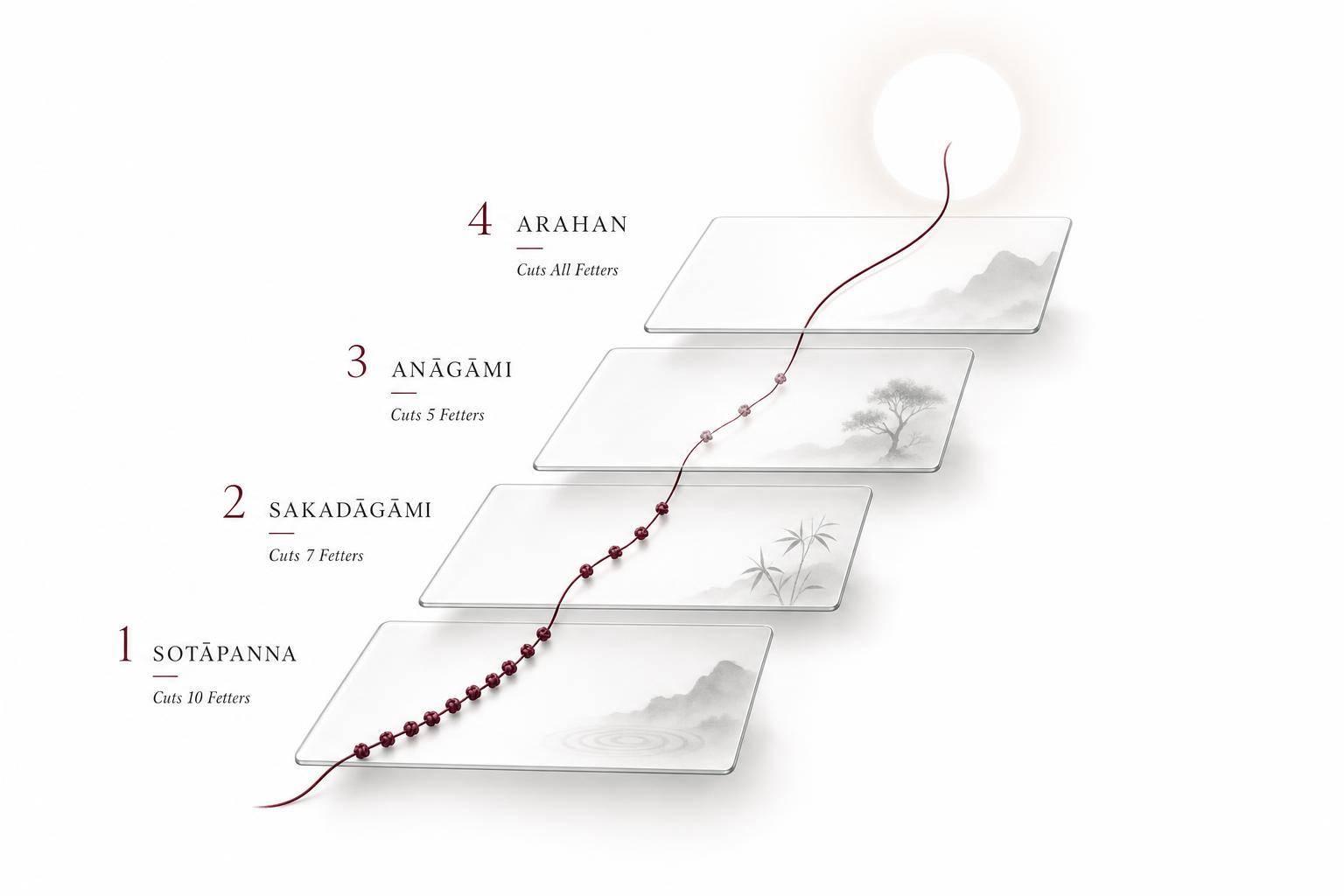
4 Stages of Awakening in Buddhism
Theravada frames awakening as four stages that cut the ten fetters through ethics, mindfulness and reflection.
In Theravada Buddhism, awakening moves through 4 clear stages, and each stage removes more of the 10 fetters that keep suffering going. If you want the short answer, here it is: a stream-enterer cuts the first 3 fetters, a once-returner weakens desire and ill will, a non-returner ends them, and an arahant removes all 10.
That means the path is not framed as belief alone. It is framed by what is dropped, what grows weaker, and what ends. In the article, I would read this as a step-by-step map of how suffering becomes less intense over time.
- Stage 1 - Stream-enterer (Sotāpanna): cuts 3 of 10 fetters
- Stage 2 - Once-returner (Sakadāgāmi): weakens sensual desire and ill will
- Stage 3 - Non-returner (Anāgāmi): ends sensual desire and ill will
- Stage 4 - Arahant: ends all 10 fetters
At a glance: the article says progress rests on ethics, mindfulness, and reflection. It also gives lifetime outcomes often linked to the first two stages: up to 7 more lifetimes for a stream-enterer and up to 1 more human rebirth for a once-returner.
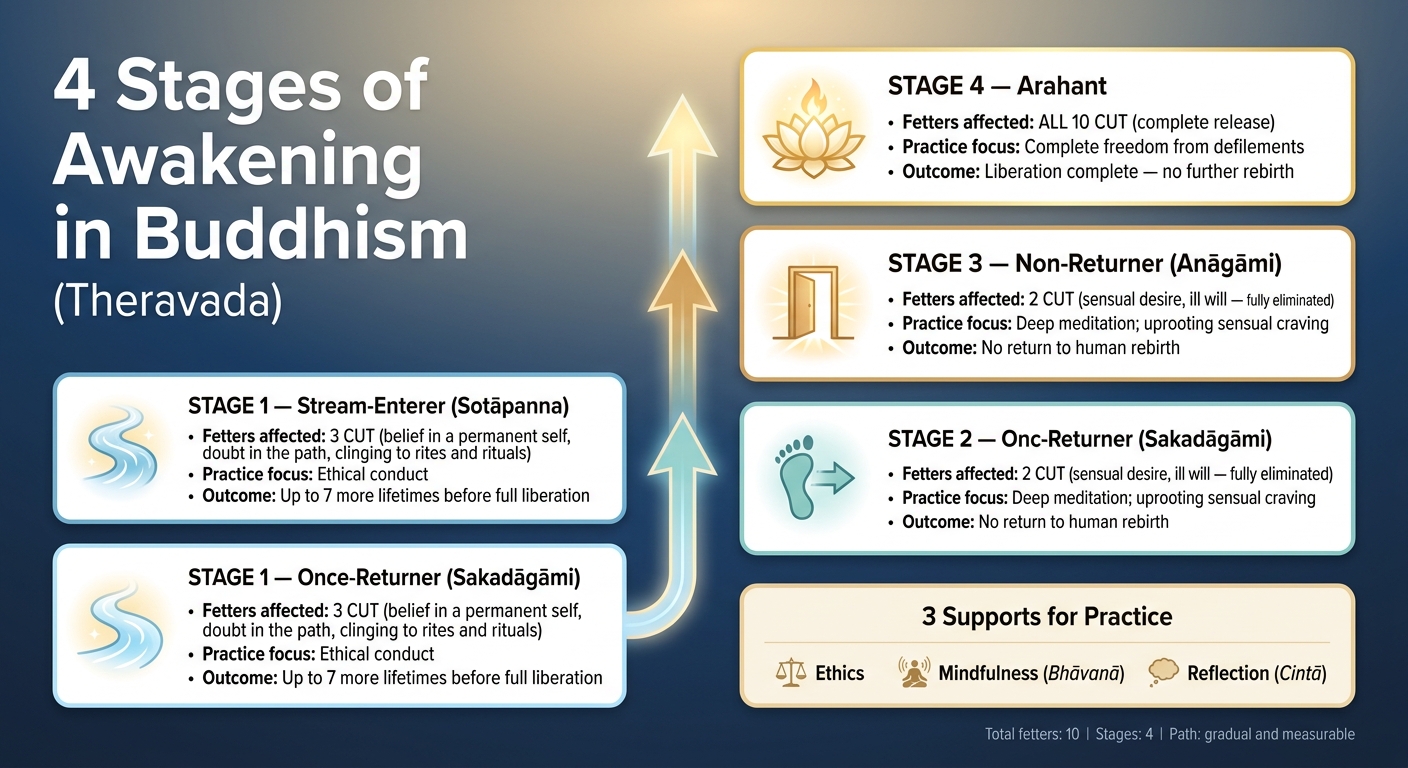
4 Stages of Buddhist Awakening: Fetters Cut & Outcomes
Stream Entry to Arahant: The Buddha's Stages of Awakening | Beyond Claims and Certificates
Quick Comparison
| Stage | Main Change | Fetters Status | Outcome Mentioned |
|---|---|---|---|
| Stream-enterer | First direct entry into the path | First 3 cut | Up to 7 more lifetimes |
| Once-returner | Desire and aversion lose force | 2 weakened | Up to 1 more human rebirth |
| Non-returner | No sensual pull or ill will | 2 cut | No human return |
| Arahant | Complete release | All 10 cut | Liberation complete |
What stands out to me is how simple the structure is: 4 stages, 10 fetters, 3 main supports for practice. That makes the article easy to follow if you want a plain summary of how Theravada lays out awakening.
Stage 1 and Stage 2: Stream-Enterer and Once-Returner
Stream-Enterer (Sotapanna): The First Stage of Awakening
Stream-entry is the first stage of awakening. Once a person reaches this point, the path no longer turns backward. They have entered the stream that leads toward liberation.
A Sotapanna cuts three fetters:
- belief in a permanent self
- doubt in the Buddha's path
- clinging to rites and rituals as purification
A stream-enterer is said to reach full awakening within no more than seven more lifetimes. The next stage doesn't cut additional fetters, but it does weaken the forces that keep rebirth in motion.
Once-Returner (Sakadagami): Sensual Desire and Ill Will Weakened
After the first three fetters fall away, practice continues with the softening of desire and aversion.
A Sakadagami weakens sensual desire and ill will. Craving and aversion still come up, but they have less pull and less heat. This stage is said to allow no more than one more human rebirth before liberation.
| Stage | Pali Name | Fetters Affected | Traditional Outcome |
|---|---|---|---|
| Stream-Enterer | Sotapanna | Belief in a permanent self, doubt, and clinging to rites and rituals - cut | At most seven more lifetimes |
| Once-Returner | Sakadagami | Sensual desire and ill will - significantly weakened | At most one more human rebirth |
Stage 3 and Stage 4: Non-Returner and Arahant
Non-Returner (Anagami): Sensual Desire and Ill Will Fully Cut
At the Non-Returner stage, sensual desire and ill will are cut off completely. What remains are the deepest fetters. From here, the path moves toward full release.
Arahant: Full Liberation
Once sensual desire and ill will are gone, the remaining fetters are cut completely as well. The Arahant is the final stage of awakening. At this point, all ten fetters have fallen away, and liberation is complete.
How the 4 Stages Compare and What They Mean for Practice
The 4 Stages Side by Side
Viewed through the ten fetters, these four stages show a gradual easing of craving and aversion. Based on the fetters outlined above, this summary shows how each stage shapes day-to-day practice.
| Stage | Practice Focus |
|---|---|
| Stream-Enterer (Sotāpanna) | Ethical conduct |
| Once-Returner (Sakadagāmi) | Positive habits; less greed and hatred |
| Non-Returner (Anāgāmi) | Deep meditation; uprooting sensual craving |
| Arahant | Complete freedom from defilements |
How Ethical Living, Mindfulness, and Reflection Support Awakening
That progression rests on three supports: ethics, mindfulness, and reflection.
Ethical conduct helps steady the mind and makes deeper concentration more likely. Meditation (Bhāvanā) supports calm and direct insight through mindful breathing and clear observation of experience. Reflection (Cintā) builds clarity and confidence through logical analysis and honest self-examination.
Sutta 423 delivers one Dhammapada verse each day for quiet reading and reflection.
Conclusion: The 4 Stages as a Clear Path to Liberation
The four stages show liberation as a gradual, disciplined change. In that sense, the path isn’t measured by belief. It’s measured by what drops away. Each stage points to a deeper cutting off of the roots of suffering through the Ten Fetters.
That makes the direction of practice plain. Practice rests on ethics, meditation, and clear self-observation - the steady groundwork that moves the mind toward full liberation.
FAQs
What are the ten fetters?
The provided information does not explain the ten fetters.
Sutta 423 is a mobile app that shares one verse from the Dhammapada each day to support quiet reading and reflection as part of spiritual practice.
How does a once-returner differ from a non-returner?
A once-returner has gone past stream-entry, but will still come back to the human realm at least one more time before full liberation.
A non-returner has gone further. They won’t return to the human world. Instead, they reach final awakening after a rebirth in a higher realm.
Can an ordinary person reach stream-entry?
Yes. The teachings of the Dhammapada are open to everyone, no matter their background or spiritual path.
Spending a little time with these verses each day can deepen your understanding of the four stages of awakening, including stream-entry. The Sutta 423 app helps with that by sharing one Dhammapada verse per day in a simple, distraction-free space for quiet reflection and steady practice.