

What Is the Dhammapada: A Beginner's Guide
A concise guide to the Dhammapada: origins, 423 verses, core teachings on mindfulness, ethics, and practical daily practice.
The Dhammapada is a collection of 423 verses attributed to the Buddha, offering clear and concise teachings on mindfulness, ethics, and spiritual growth. Divided into 26 chapters, it simplifies complex Buddhist philosophy into short, actionable insights, making it approachable for both beginners and seasoned practitioners. Key themes include:
- The Power of the Mind: Our thoughts shape happiness and suffering.
- Ethical Living: Avoid harm, do good, and purify the mind.
- Core Teachings: It reflects the Four Noble Truths and the Eightfold Path.
- Self-Reliance: Spiritual growth is a personal responsibility.
The text has a rich history, originating from oral traditions and preserved in the Pāli Canon of Theravāda Buddhism. It is widely regarded as a practical guide to mindfulness, offering wisdom that remains relevant today. Popular translations, like those by Eknath Easwaran, Acharya Buddharakkhita, Glenn Wallis, and Thanissaro Bhikkhu, make it accessible to modern readers.
Whether you're seeking peace of mind, ethical guidance, or a deeper understanding of Buddhism, the Dhammapada provides timeless advice for navigating life's challenges.
Origins and Structure of the Dhammapada
Historical Background and Compilation
The Dhammapada traces its roots back to an oral tradition that began around the 3rd century B.C.E., though the oldest existing manuscripts date to 1500 C.E.. These verses were originally spoken by the Buddha in response to specific situations within his monastic community. Early followers, called Bhāṇakas (scripture reciters), memorized and passed down these teachings across generations.
Designed for accessibility, the text simplifies complex philosophical ideas into concise and practical verses. Interestingly, over half of its verses can also be found in other parts of the Pāli Canon, showcasing its strong ties to the larger body of Buddhist scripture.
The Dhammapada also exists in parallel versions outside the Pāli tradition. These include the Gāndhārī Dharmapada, the Patna Dharmapada (written in Buddhist Hybrid Sanskrit), and the Udānavarga (available in Sanskrit and Tibetan). These versions share about 330 to 340 verses and 16 chapter headings with the Pāli text. Additionally, in the 4th or 5th century C.E., the monk Buddhaghosa wrote the Dhammapada Aṭṭhakatha, a commentary that includes 305 stories explaining the circumstances behind each verse.
This deep historical context lays the foundation for the text's structured organization, as detailed below.
How the Text Is Organized
The Dhammapada is divided into 26 chapters, each focusing on a specific theme (vaggas). The first chapter, Yamakavagga (The Pairs), introduces the key concept that one’s mind determines experiences of joy or suffering. The final chapter, Brahmanavagga (The Brahmins), highlights the attributes of an enlightened person who has completed the spiritual path.
Translator and abbot Thanissaro Bhikkhu describes the text’s progression as follows:
"The work as a whole... begins with the duality between heedless and heedful ways of living, and ends with the final attainment of total mastery".
Between these chapters, the text covers a range of topics - such as wisdom, anger, craving, and mindfulness - offering varied and practical insights throughout its verses.
Why the Dhammapada Matters in Buddhism
A Practical Guide to Awakening
The Dhammapada is often regarded as one of the most straightforward ways to delve into Buddhist philosophy. Comprised of 423 verses sourced from the Pāli Canon, it serves as a kind of "greatest hits" collection, distilling the Buddha's teachings into concise, memorable wisdom without requiring extensive prior knowledge. Translator and abbot Thanissaro Bhikkhu explains that "the Dhammapada has for centuries been used as an introduction to the Buddhist mindset". This makes it an ideal starting point for beginners who might feel daunted by the sheer breadth of Buddhist texts.
What makes the Dhammapada so impactful is its simplicity and clarity. It presents practical principles that are easy to grasp and apply. For instance, Verse 183 is often seen as a summary of the Buddha's entire teaching: "The non-doing of anything wicked, undertaking of what is good, the purification of one's mind - this is the teaching of the Buddhas."
This straightforward guidance serves as a gateway to deeper practices, especially in the realms of mindfulness and ethical living.
Mindfulness and Ethical Foundations
A core teaching of the Dhammapada is that our minds shape our reality. The very first verse underscores this idea: "Mind precedes thoughts, mind is their chief, their quality is made by mind." It emphasizes that our internal thoughts, rather than external circumstances, are the primary drivers of both happiness and suffering.
The concept of heedfulness (appamada) is central to the text, highlighting the importance of staying vigilant and mindful. It contrasts the wise, who diligently train their minds, with those who remain caught in heedlessness. This wisdom translates into practical advice for daily life - how we communicate, behave, and interact with others.
The Dhammapada also provides an ethical framework for navigating challenges and fostering peace. Verse 5 offers timeless wisdom on addressing conflict: "For not by hatred do hatreds cease at any time in this place, they only cease with non-hatred, this truth is surely eternal." Additionally, the text stresses personal accountability, reminding readers that "purity and impurity come from oneself" and "no one can purify another". This focus on self-reliance encourages individuals to take control of their spiritual growth and apply these teachings in their daily lives.
Key Themes and Important Verses
Core Themes in the Dhammapada
The Dhammapada stands out as a practical guide for cultivating mindfulness and ethical living. At its heart, it introduces foundational Buddhist teachings that pave the way toward liberation. Central to its message are the Four Noble Truths, which outline the nature of suffering, its root cause (craving), the possibility of its cessation, and the path leading to freedom - the Eightfold Path. These teachings offer a clear and actionable framework, particularly helpful for those beginning to explore their own struggles with dissatisfaction and seeking a path to inner peace.
Another recurring theme is the Three Marks of Existence. Verse 277 captures this insight:
"All conditions are impermanent, when one sees this with wisdom, then one grows tired of suffering – this is the path to purity."
The verses further elaborate on the transient and unsatisfactory nature of conditioned phenomena (dukkha) and the absence of a permanent self (anatta). Contemplating these truths - impermanence, suffering, and the lack of a fixed self - helps practitioners release attachments and develop deeper wisdom.
Self-reliance also emerges as a key principle in the text. In Verse 160, the Buddha reminds readers:
"Self is one's own protector; what other protector can there be? With self well-tamed, one gains a protector which is hard to find."
This idea resonates throughout the Dhammapada's 26 chapters, emphasizing that true spiritual progress comes from within and cannot be handed down by external authorities. Bhikkhu Bodhi, a respected scholar, notes that the text addresses four levels of spiritual progress: improving one's current life, ensuring a favorable rebirth, attaining liberation from suffering, and celebrating the enlightenment of those who have achieved ultimate freedom. These profound teachings are woven into verses that guide readers toward a life of mindfulness and wisdom.
Examples of Important Verses
The Dhammapada offers practical advice for navigating daily challenges, often through concise, memorable verses. For instance, Verse 50 encourages self-reflection over fault-finding in others, urging individuals to focus on their own shortcomings as a path to personal growth.
In Verse 222, the text compares controlling anger to the skill of a master driver, highlighting the importance of self-restraint. Similarly, Verse 223 offers actionable advice on dealing with negativity: overcome anger with patience, wickedness with kindness, and falsehood with truth. These verses provide clear strategies for managing emotions and interactions in a constructive way.
Verse 239 uses the metaphor of a silversmith refining silver to illustrate the gradual nature of spiritual growth. It reminds practitioners that self-purification happens slowly, "little by little, from moment to moment." Across its 423 verses, spread over 26 chapters, the Dhammapada delivers timeless wisdom that can be immediately applied to everyday life, offering both practical tools and profound insights.
Applying Dhammapada Teachings to Daily Life
Daily Mindfulness Practice
The teachings of the Dhammapada are meant to be lived, not just read. By reflecting on a single verse each day, you can connect its wisdom to your personal experiences and allow its meaning to unfold in your life. This approach isn't just about understanding the words - it's about feeling their impact and letting them guide your daily journey.
Incorporating regular meditation into your routine can help sharpen your focus and discipline your mind. A well-trained mind, as the Dhammapada reminds us, shapes your experiences and becomes the foundation of either happiness or suffering. Think of your mind as a sacred space that needs care and attention. Through meditation, you practice sense restraint, reducing distractions and fostering clarity. Many beginners find themselves experiencing samvega - a deep awareness of life's fleeting nature - and pasada - a sense of calm and clarity - when they immerse themselves in these teachings.
This inner work naturally aligns with ethical behavior, creating a balanced approach to living.
Living with Virtue and Awareness
While meditation nurtures your inner world, ethical living ensures your actions reflect that inner harmony. Verse 183 of the Dhammapada offers straightforward guidance: avoid evil, do good, and purify your mind. Core precepts - such as refraining from killing, stealing, lying, sexual misconduct, and intoxication - serve as practical tools to help you avoid actions that harm yourself or others. These guidelines act as safeguards, preventing you from "digging up your own root" through harmful deeds.
In moments of conflict, resist the urge to dwell on grievances like "he wronged me" or "she hurt me". Instead, turn your attention inward, focusing on refining your own flaws, much like a silversmith carefully polishes silver. In conversations, choosing silence over irritation can diffuse tension and promote understanding. This ethical way of living is anchored in two essential principles: caring for your own long-term well-being and genuinely considering the happiness of others. The Dhammapada poetically describes virtue as having a "scent" sweeter than any flower or perfume, symbolizing the far-reaching and uplifting effects of living ethically.
The Dhammapada: Teaching of the Buddha (Part 1, 2) by Gil Fronsdal
Beginner-Friendly Translations
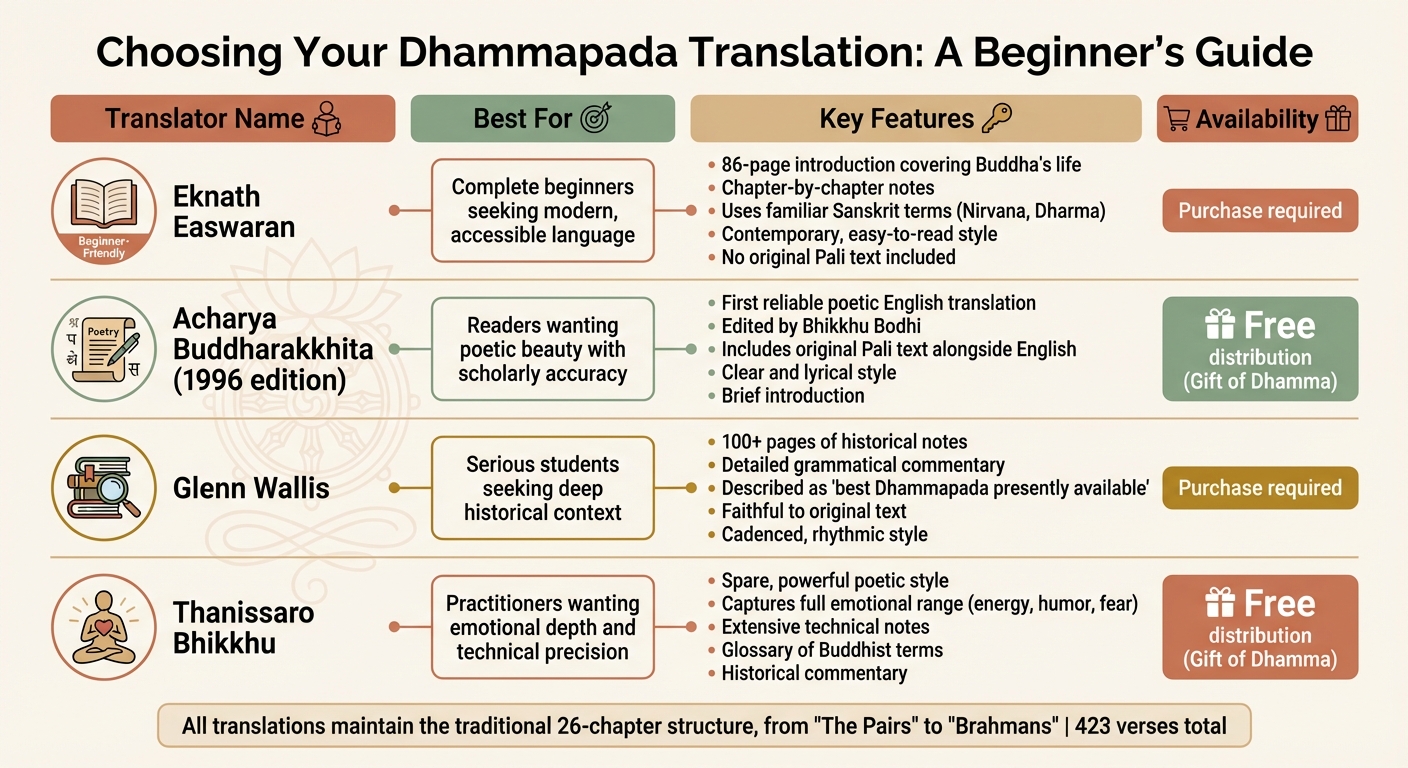
Dhammapada Translation Comparison Guide for Beginners
Overview of Popular Translations
Finding the right translation of the Dhammapada can make your introduction to this timeless text much smoother. One standout option is Eknath Easwaran's translation, praised for its approachable, modern tone. His 2007 edition includes an 86-page introduction that walks readers through the Buddha's life and key teachings. Each of the 26 traditional chapters is accompanied by detailed notes, making it a helpful guide for newcomers. Easwaran also uses familiar Sanskrit terms like Nirvana and Dharma, which can feel more relatable for Western readers.
Another popular choice is Acharya Buddharakkhita's translation, known as the first reliable poetic English rendering of the Dhammapada. Edited in 1996 by Bhikkhu Bodhi, this version strikes a balance between scholarly accuracy and lyrical beauty. It often includes the original Pali text alongside the English, offering a richer reading experience.
For those seeking depth, Glenn Wallis' translation stands out with over 100 pages of historical and grammatical notes. Bhante Shravasti Dhammika described it as "the best Dhammapada presently available", highlighting its faithfulness to the original text.
Finally, Thanissaro Bhikkhu's translation is concise and powerful, capturing the text's emotional range - from energy and astonishment to humor and fear. He explained his approach:
"I've aimed at a spare style flexible enough to express not only its dominant emotions - energy and astonishment - but also its transient emotions, such as humor, delight, and fear".
This version includes extensive notes, a glossary of technical terms, and, best of all, is distributed for free as a gift of Dhamma.
Translation Comparison Table
Here's a quick comparison of these translations to help you decide which might suit your needs best:
| Translator | Readability | Annotations/Notes | Key Features |
|---|---|---|---|
| Eknath Easwaran | Very High (Contemporary) | High (86-page introduction; chapter notes) | Uses Sanskrit terms; excludes original Pali text |
| Acharya Buddharakkhita | High (Clear/Poetic) | Moderate (Brief introduction) | Often includes original Pali; 1996 edition recommended |
| Glenn Wallis | High (Cadenced) | Very High (100+ pages of notes) | Detailed historical and grammatical commentary |
| Thanissaro Bhikkhu | Moderate/High (Spare/Poetic) | High (Technical/Historical) | Free distribution; glossary of technical terms |
All these translations retain the traditional 26-chapter structure, starting with "The Pairs" and concluding with "Brahmans". Notably, both Buddharakkhita and Thanissaro Bhikkhu's versions are freely available through Buddhist organizations as gifts of Dhamma.
Conclusion
The Dhammapada provides a straightforward guide for living with mindfulness and integrity. Its 423 verses condense the Buddha's teachings into practical wisdom that anyone can incorporate into their daily life, regardless of their background or spiritual path. This enduring guidance offers tools for navigating everyday challenges and making thoughtful choices.
One of its most enduring teachings is the idea that hatred cannot end through more hatred - it ends through understanding and compassion. This principle is as relevant today as it was centuries ago, offering solutions for personal disputes, workplace struggles, and even larger societal issues.
Start simply - perhaps by reflecting on a single verse each morning. Pay attention to how your thoughts and actions influence your peace of mind. The text reminds us that “purity and impurity come from oneself, for no one can purify another.” This underscores that personal growth is a responsibility only you can fulfill.
No matter which translation you choose, the core message of the Dhammapada remains the same: it’s a guide to mindfulness and self-discipline. It’s not just a book to read - it’s a companion for life, offering insight and support as you navigate daily challenges. By engaging with its teachings regularly, you join generations of practitioners who’ve found clarity, inner strength, and purpose through these verses, making the Dhammapada a timeless resource for mindful and ethical living.
FAQs
Do I need to be Buddhist to read the Dhammapada?
No, you don’t need to be Buddhist to read the Dhammapada. This timeless collection of teachings is open to everyone, offering practical advice and insights that can inspire personal growth and mindfulness in daily life.
Which Dhammapada translation is best for beginners?
For those starting out, The Dhammapada: A Translation by Thanissaro Bhikkhu is an excellent choice. Its straightforward and easy-to-understand style makes it perfect for beginners exploring Buddhist teachings.
How can I use one verse a day in daily life?
Incorporate a verse from the Dhammapada into your daily routine by setting aside time each morning or evening to reflect on it. Choose a verse that speaks to you personally, recite it slowly and with intention, and think about how its wisdom connects to your own life. Let its message guide your mindset and actions throughout the day, serving as a reminder to approach situations with mindfulness and compassion. Over time, this practice can help deepen your understanding and nurture your spiritual journey.