
What Prajna Means in Buddhism
Explains prajna (Buddhist wisdom) and how study, reflection, and meditation cultivate insight to reduce craving and harmful reactions.
Prajna means Buddhist wisdom: seeing clearly so you cling less and cause less suffering. I’d start with a simple practice: pause for 10–60 seconds before reacting, and notice what’s driving your urge.
Prajna grows through study, reflection, and meditation, supported by ethics and concentration - the 3 Buddhist trainings. It means seeing that experiences change, depend on conditions, and don’t form a fixed self. Emptiness doesn’t mean nothing exists.
My takeaway: <u>test understanding through your actions</u>. A daily Dhammapada verse can prompt reflection, but the point isn’t collecting quotes. It’s responding with less craving, more compassion, and honest speech - not treating a moment of clarity as proof of awakening.
On the Meaning of Prajna - Roshi Pat Enkyo O’Hara
Why Wisdom Matters for Awakening
When prajna moves from study to direct seeing, its purpose becomes clear: to end the habits that sustain suffering. It shows how craving, clinging, and aversion keep that cycle going.
The Three Trainings: Ethics, Concentration, and Wisdom
Ethics and concentration support wisdom - the insight that reveals impermanence and weakens craving.
In the Eightfold Path, wisdom takes the form of right view and right resolve. Right view means understanding suffering and its causes. Wisdom, then, is a practical commitment, not just detached analysis.
The Four Noble Truths
The Four Noble Truths give this understanding a clear shape: suffering, its origin in craving, its cessation, and the path to its cessation. Seeing these truths puts wisdom into practice by pointing to freedom from suffering.
Book Learning and Direct Seeing
The next step is moving from understanding teachings to seeing them in your own experience. Study gives prajna direction, but direct seeing turns words into understanding. This means learning through experience - not having a mystical experience - and it can change how you see and respond.
Learning, Reflection, and Meditation
Knowing that feelings change isn't the same as watching them change. Insight deepens through repeated observation. To connect study with practice, spend 10–60 seconds reflecting on how one Dhammapada verse applies to your current actions.
These three modes show how prajna matures.
| Mode of wisdom | Source | Contribution | Limitation |
|---|---|---|---|
| Learning | Reading or hearing teachings | Gives language and guidance | Words alone are not realization |
| Reflection | Carefully considering teachings | Tests understanding | Reasoning can remain abstract |
| Meditative cultivation | Steady attention to present experience | Develops direct understanding of change | Passing observations are not awakening |
This shift shows up in how we understand change, stress, and self.
Impermanence, Suffering, and Non-Self
Impermanence (anicca), suffering (dukkha), and non-self (anattā) show that changing experiences cannot offer lasting security or a fixed self. When we treat those experiences as permanent, controllable, or defining who we are, we create suffering.
Dependent Origination and Emptiness
From here, Buddhism looks at how these experiences arise. Dependent origination describes how experience and suffering arise through conditions, rather than on their own. Emptiness (śūnyatā) means things lack independent existence. It doesn't mean nothing exists or that actions have no effect.
Seeing these conditions clearly weakens grasping and supports awakening. Rather than treating a craving as a command, you can notice what feeds it and choose not to reinforce it.
Developing Prajna in Daily Life
Practicing Prajna in Daily Life
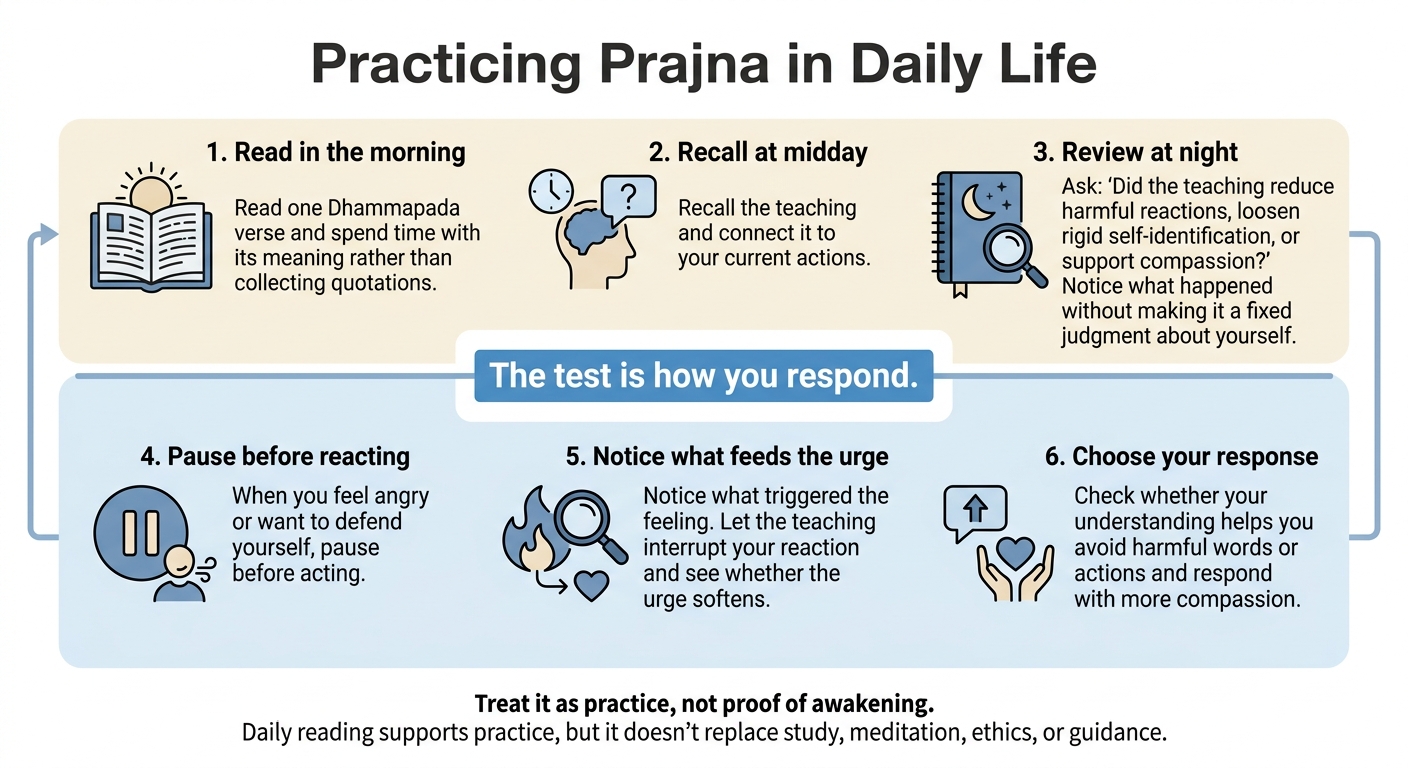
Prajna takes shape in the pause before a reaction turns into speech or action. Try applying one Buddhist teaching to an actual moment: read it, notice your reaction, and check whether it helps you avoid harmful words or actions. The test is how you respond. Prajna weakens craving by changing what you do next, not by giving you more information.
Wisdom is easiest to test when you're under pressure.
Notice Craving Before Reacting
When you feel angry or want to defend yourself, pause before acting. Notice what triggered the feeling, let the teaching interrupt your reaction, and see whether the urge softens. Does your understanding loosen a fixed sense of self and help you respond with more compassion?
Reflect on a Dhammapada Verse
A daily verse can support this practice. Sutta 423 offers one Dhammapada verse a day for reading and reflection, moving through 423 verses and then continuing. Spend time with its meaning rather than just collecting quotations. Read it in the morning, recall it at midday, and review it at night. Look for changes in your speech, actions, or compassion.
Keep that review specific: Did the teaching reduce harmful reactions, loosen rigid self-identification, or support compassion? Notice what happened without making it a fixed judgment about yourself. Treat it as practice, not proof of awakening. Daily reading supports practice, but it doesn't replace study, meditation, ethics, or guidance.
Conclusion: Putting Wisdom Into Practice
Wisdom matters because it changes how you see things and respond to them. Ethics and concentration support this insight, helping you act with patience, truthfulness, and care. This week, practice honest speech: before you speak, ask whether your words are true and whether they cause unnecessary harm.
FAQs
How can I tell if I’m developing prajna?
You develop prajna as your understanding moves from abstract ideas to direct experience. You begin to grasp the Four Noble Truths more deeply and recognize impermanence, suffering, and the absence of a fixed self in your own experience.
Signs include greater resilience, less reactivity to praise or blame, and a willingness to accept correction. Mindful awareness takes the place of automatic reactions, helping you notice and let go of unskillful intentions, such as greed or anger.
Can I develop prajna without meditating?
Meditation is a main tool for developing prajna, or wisdom. Ethical discipline, regular reflection, and mindfulness during daily activities also help wisdom grow. Paying attention to your intentions and reactions can build insight that weakens ignorance.
Small moments of reflection each day can help you build awareness. Still, Buddhist teachings hold that wisdom wanes without the clarity meditation provides.
How does non-self fit with personal responsibility?
In Buddhist teaching, non-self (anatta) does not remove personal responsibility - it clarifies it. Without a fixed, permanent self, you aren’t locked into past mistakes or traits that can never change. Your actions and intentions shape your path.
The Dhammapada stresses that you are responsible for your own liberation. Paying attention to your actions and intentions helps you take ownership of your conduct and move from reacting automatically toward mindful awareness, integrity, and wisdom.