

Virtue in the Dhammapada: Key Themes
Ancient Dhammapada verses show how non-harm, generosity, and right speech build virtue and lead toward liberation.
The Dhammapada, a collection of 423 Buddhist verses, offers timeless guidance on ethical living. Rooted in sila (virtue), it emphasizes avoiding harm, cultivating good actions, and purifying the mind. Key teachings focus on non-harm, generosity, and truthfulness, all tied to the idea that intention shapes outcomes (kamma). The text outlines three levels of ethical practice: daily conduct, moral causality, and the Noble Eightfold Path, leading to liberation (Nibbana). Practical applications include daily reflection and living by the Five Precepts, fostering mindfulness and ethical growth step by step. The teachings remain deeply relevant to modern life, encouraging mindful choices for personal and collective peace.
Core Teachings on Virtue in the Dhammapada
Nonharm and Compassion
The Dhammapada lays its ethical foundation on the understanding that all beings value their lives and fear harm. This forms the basis of ahimsa - the principle of nonharm. The Buddha explains:
"All tremble at violence; all fear death. Putting oneself in the place of another, one should not kill nor cause another to kill."
This teaching encourages empathy as a practical, daily practice rather than a lofty ideal. Before reacting with harsh words or impulsive actions, it urges us to pause and consider the other person's experience. This mindfulness fosters genuine compassion.
The Dhammapada also addresses anger with striking clarity. Holding onto anger, it teaches, is self-destructive - comparable to "grasping a hot coal with the intent of throwing it at someone else. You are the one who gets burned." The antidote lies in non-retaliation. Verse 223 offers a powerful reminder:
"One who conquers anger by non-anger, who conquers evil by good, who conquers the miser by generosity, and the liar by truth: that one I call a brahmin."
This approach prioritizes patience and forgiveness over reactive behavior. By practicing non-retaliation, we create space for generosity and ethical growth, loosening the grip of cravings that often fuel harmful actions.
Generosity and Letting Go
In the Dhammapada, dana (generosity) extends far beyond material giving. It is a practice aimed at countering the destructive force of greed. The text vividly describes greed's consuming nature:
"There is no fire like greed, no illness like hatred, no suffering like the aggregates of existence, no happiness higher than peace." (Verse 202)
Acts of generosity, even when inconvenient, gradually weaken the habit of clinging. A mind attached to possessions or desires, the text warns, is like a sleeping village vulnerable to a sudden flood. Conversely, letting go builds resilience - an "island which no flood can overwhelm".
Renunciation takes this teaching even further. Verse 285 offers a vivid metaphor:
"Cut off your affection in the manner of a man who plucks with his hand an autumn lotus. Cultivate only the path to peace, Nibbana."
This isn't about becoming detached or indifferent but recognizing the impermanence of worldly attachments. By letting go of illusions of permanence, one cultivates peace. Truthfulness, particularly through mindful speech, plays a key role in reinforcing this ethical path.
Truthfulness and Right Speech
The Dhammapada underscores the power of speech as a reflection of the mind. When the mind is clouded, words can cause harm - sometimes immediately, sometimes over time. Verse 2 highlights the connection between thoughts, words, and outcomes:
"If one speaks or acts with a pure mind, happiness follows, like a shadow that never leaves."
Right speech (sammā-vācā) involves avoiding four specific actions: lying, divisive talk, abusive language, and idle chatter. Beyond avoiding harm, the text encourages using speech to foster trust and harmony.
Spiritual growth, the Dhammapada teaches, is not about how much one speaks. Verse 258 makes this clear:
"A man is not spiritually mature merely because he talks a lot. He is said to be spiritually mature who is secure (in himself), friendly, and without fear."
True wisdom lies in the alignment of belief, speech, and action, not in eloquence or verbosity. In this way, the teachings on speech guide us toward integrity and inner peace.
The Dhammapada: Teaching of the Buddha (Part 1, 2) by Gil Fronsdal
Virtue, Kamma, and the Path to Liberation
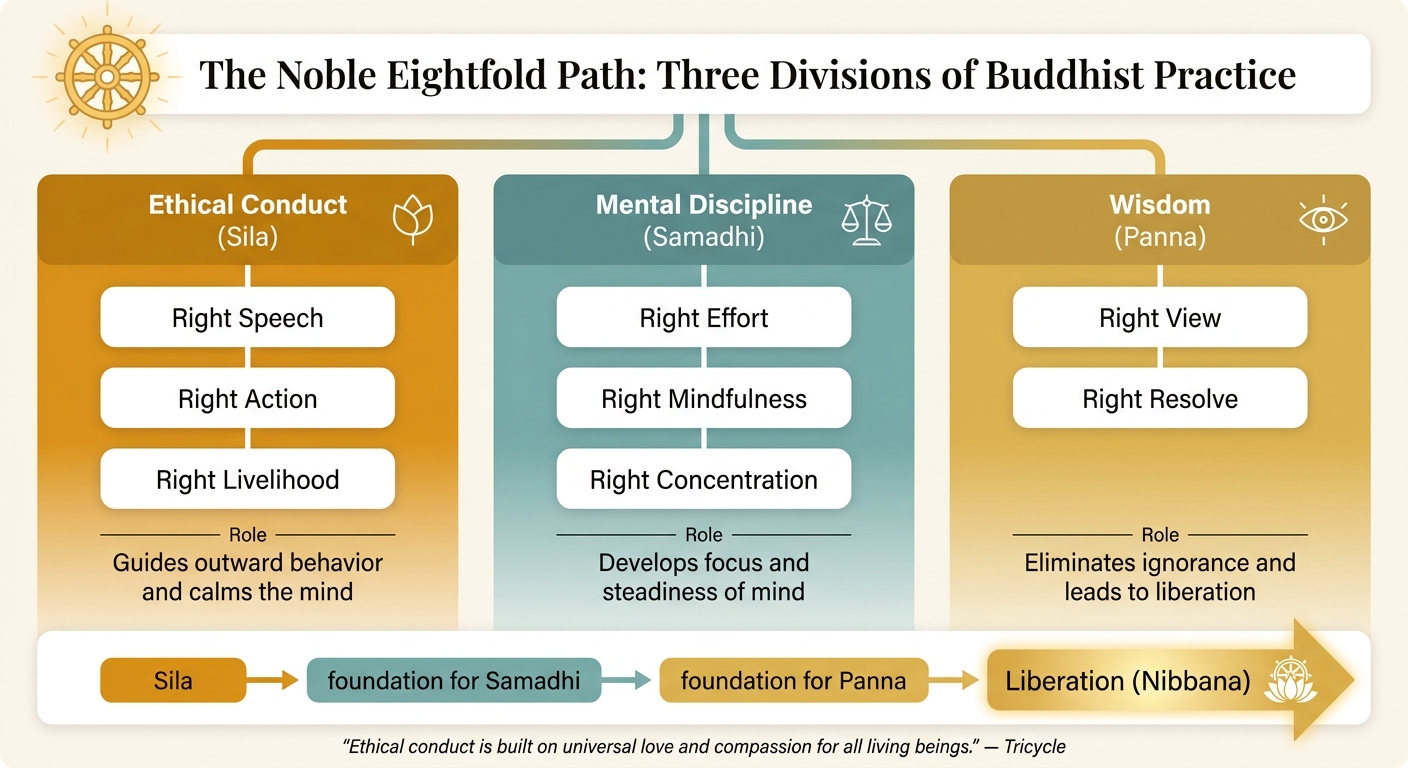
The Noble Eightfold Path: Virtue, Discipline & Wisdom in Buddhism
Virtue and Moral Causality
Every action begins with a thought, and the nature of that thought determines the results that follow.
"Mind precedes all mental states. Mind is their chief; they are all mind-wrought. If with an impure mind a person speaks or acts suffering follows him like the wheel that follows the foot of the ox." - Acharya Buddharakkhita, Translator
The concept of kamma (or karma) highlights that every intentional action plants a seed, which will eventually bring either happiness or suffering. The Dhammapada emphasizes that no one can escape the consequences of their actions.
What matters most is intention. A story from the Dhammapada commentary illustrates this: Thera Cakkhupala, a monk, unintentionally stepped on insects while meditating. Despite this, the Buddha declared him free of evil kamma because he acted without intent to harm. However, his blindness in that life was the result of past-life kamma. In a previous life, as a physician, he had deliberately blinded a patient out of revenge. This story shows that moral outcomes are shaped by intention rather than the act itself.
Virtue on the Noble Eightfold Path
Ethical conduct (sila) forms the bedrock of the Buddhist path. It is the foundation for all higher practices within the Noble Eightfold Path, which is divided into three stages: sila (ethical conduct), samadhi (mental discipline), and panna (wisdom). Without a strong ethical foundation, the other stages cannot fully flourish.
| Division of the Path | Path Factors | Role in Practice |
|---|---|---|
| Ethical Conduct (Sila) | Right Speech, Right Action, Right Livelihood | Guides outward behavior and calms the mind |
| Mental Discipline (Samadhi) | Right Effort, Right Mindfulness, Right Concentration | Develops focus and steadiness of mind |
| Wisdom (Panna) | Right View, Right Resolve | Eliminates ignorance and leads to liberation |
Right Speech, Right Action, and Right Livelihood are not abstract concepts - they are daily practices. They involve speaking truthfully, acting mindfully, and ensuring that one's work does not harm others. As Tricycle notes, "Ethical conduct (sila) is built on the vast conception of universal love and compassion for all living beings, on which the Buddha's teaching is based". This ethical foundation creates the stability needed for deeper spiritual practice.
When ethical conduct is aligned with disciplined practice, the mind becomes prepared for cultivating insight, which is essential for liberation.
From Virtue to Liberation
Moral discipline does more than improve daily life - it lays the groundwork for deeper insight. When the mind is no longer weighed down by harmful impulses, it becomes calm and clear, creating the conditions for wisdom to arise.
Bhikkhu Bodhi explains:
"The path evolves through its three stages, with moral discipline as the foundation for concentration, concentration the foundation for wisdom, and wisdom the direct instrument for reaching liberation."
The Dhammapada teaches that virtue is not achieved all at once but is built gradually, through intentional choices. Each moment of honesty, patience, or generosity strengthens the mind and moves it closer to liberation. Ultimately, liberation is the natural outcome of a life lived with mindfulness and care.
Practical Ways to Apply Virtue in Daily Life
Daily Reflection on Dhammapada Verses
A simple yet meaningful way to bring the teachings of the Dhammapada into your life is by starting each day with a single verse. Let its wisdom guide your actions and decisions throughout the day. This practice makes ancient teachings feel relevant and accessible, even in modern challenges.
"You yourself must strive. The Buddhas only point the way." - The Dhammapada
An app like Sutta 423 can help you engage with these teachings. With 423 verses, it provides a year-long journey of reflection and insight. Pay attention to verses that make you uncomfortable - they often highlight areas where growth is most needed. That discomfort can act as a quiet nudge, pointing to lessons that resonate with your current path.
Applying Virtue in Everyday Situations
Daily reflection is just the beginning. You can take the wisdom of the Dhammapada further by applying it to real-life situations. The Five Precepts offer a clear guide for ethical living:
- Avoid harming living beings
- Refrain from stealing
- Avoid sexual misconduct
- Speak truthfully
- Avoid intoxicants
These principles are more than abstract ideas - they can shape how you interact with the world. Here's how they translate into everyday actions:
| Precept | Accompanying Virtue | Everyday Application |
|---|---|---|
| Abstain from killing | Kindness and compassion | Practice non-violence toward all living beings. |
| Abstain from theft | Generosity | Respect others' belongings and look for ways to give. |
| Abstain from sexual misconduct | Contentment and respect | Build responsible and respectful relationships. |
| Abstain from false speech | Honesty | Avoid gossip or divisive talk; speak truthfully. |
| Abstain from intoxication | Mindfulness | Stay clear-minded and alert in all situations. |
Before speaking - whether at work, online, or in personal conversations - pause and ask yourself: Is what I’m about to say true, kind, necessary, and helpful? This simple habit can prevent harm and encourage more thoughtful, compassionate communication.
Building Virtue Step by Step
Virtue isn’t about instant transformation; it’s a gradual process. The Dhammapada teaches that ethical growth is like filling a pot with water - drop by drop, small, consistent actions add up over time.
One way to nurture this growth is by setting aside a few moments each evening for self-reflection. Think about your intentions and actions during the day. Where did you act with kindness or restraint? Where could you improve? This isn’t about self-judgment but about gentle self-awareness. By recognizing your own desire for peace and avoiding harm, you become your own guide.
"The self is the master of the self. Who else could be the master? With a well-trained self, one gains a master hard to find." - The Dhammapada, Verse 160
Each small choice - a moment of patience, a kind word, or a decision to pause instead of reacting - strengthens your ethical foundation. These moments, though small, build a resilient mind and bring you closer to the liberation described in the Dhammapada.
Conclusion: The Lasting Relevance of Virtue
The timeless wisdom of the Dhammapada continues to resonate with modern life, even after 2,500 years. Its insights into human challenges - like restlessness, craving, and anger - still feel strikingly relevant today. More than just diagnosing these struggles, it offers practical steps for cultivating qualities like honesty, patience, and care in everyday life.
What makes these teachings stand out is their foundation in cause and effect. Virtue, as described in the Dhammapada, isn’t about blindly following rules or appeasing some external authority. Instead, it’s about training the mind to reduce suffering - for yourself and those around you. Modern psychology echoes this idea: mindful awareness has the power to reshape how we think, feel, and act. The Dhammapada understood this truth long before it became a topic of contemporary study, reminding us that these lessons can guide our daily decisions.
"Awareness is the path to the deathless. Negligence is the path to death. The aware do not die. The negligent are as if already dead." - The Buddha, Dhammapada Verse 21
At the heart of these teachings lies appamada, or heedfulness, which the Buddha himself emphasized as the highest virtue. In fact, it was the theme of his final words before his passing. Every virtue - whether it’s non-harm, truthfulness, or generosity - grows from the mindful awareness of our thoughts and actions.
The path forward is simple yet profound: one verse, one day, one small decision at a time. Resources like Sutta 423 make this practice accessible by offering a daily Dhammapada verse, guiding readers through all 423 verses over the course of a year. The final verse, Verse 423, describes the perfected one who has reached the end of the path. But that journey begins right now - with the very next choice you make.
FAQs
How does intention affect karma?
Intention lies at the heart of karma. Actions - whether through body, speech, or mind - are shaped by the intent behind them. The nature of this intent determines whether the consequences will be positive or negative. Living ethically involves nurturing intentions that lead to actions bringing about constructive and positive results.
How can I practice Right Speech in daily life?
Practicing Right Speech, as described in the Dhammapada, means communicating with intention and care. This involves steering clear of lying, using harsh or hurtful language, spreading gossip, or engaging in speech that harms others. Instead, aim to:
- Speak honestly and with kindness.
- Avoid words that create conflict or pain.
- Use your speech to encourage understanding and compassion.
By following these guidelines, your words can embody the Buddha's teachings on ethical living and virtuous behavior.
Do the Five Precepts apply to laypeople?
The Five Precepts absolutely apply to laypeople. They act as the core ethical principles for Buddhist lay practitioners, encouraging moral behavior and helping individuals move forward on their journey toward enlightenment.