

2 Truths Doctrine: Study Guide
Explore the Two Truths across Buddhist schools with practical meditation exercises, Dhammapada reading, and a 5-step study path.
I approach the two truths as two ways of understanding the same experience - not two separate worlds. I start with everyday life, then look at how things depend on conditions and change. Try observing a feeling for 10–60 seconds without acting on it.
In this guide, I connect that approach with:
- Three Buddhist schools: Madhyamaka focuses on emptiness, Yogācāra on the absence of a subject-object split, and Theravāda on mental and physical processes.
- Meditation: I use calm, concentration, and observation to notice change without treating non-self as a reason to ignore ethics.
- Dhammapada reading: I begin with a verse’s plain guidance and keep later philosophical readings separate.
- Daily practice: I learn the terms, study each school, observe craving, apply one verse, and review my actions.
My starting rule: <u>emptiness does not mean nothing matters</u>. Study should help me reduce harm - not replace action.
The Buddhist Doctrine of Two Truths: Abhidharma and Nagarjuna
The Two Truths in Buddhist Schools
Buddhist schools use the language of two truths in different ways. The table below shows the main contrasts.
| Feature | Madhyamaka | Yogācāra | Theravāda |
|---|---|---|---|
| Conventional truth | Everyday distinctions and how causes work | Experience as it appears through cognition, including subjects and objects | Ordinary talk about persons and things |
| Ultimate truth | Emptiness: the lack of intrinsic existence | The absence of subject-object duality in dependent experience | Mental and physical processes |
| Analytical framework | Dependent arising and examination of intrinsic existence | The three natures: imagined, dependent, and perfected | Analysis of experience into its component processes |
| Practical purpose | Loosen attachment to fixed views | Recognize and loosen mistaken constructions of experience | Understand experience without assuming a permanent self |
Ultimate truth does not mean the same thing across these schools. Each interprets the same experience differently. Before comparing a text’s claims, it helps to know which school it belongs to.
Madhyamaka: Emptiness and Dependent Arising
Madhyamaka links emptiness with dependent arising. Things work through causes and conditions, but they lack intrinsic existence: they do not exist independently. This view challenges our tendency to treat things as fixed and separate from what they depend on.
Yogācāra: Cognition and the Three Natures
Yogācāra explains experience through three natures. The imagined nature falsely divides experience into subject and object. The dependent nature is experience shaped by conditions. The perfected nature is the absence of that subject-object split.
Theravāda: Persons and Mental-Physical Processes
In Theravāda, ordinary talk about persons remains useful at the conventional level. Analysis, however, focuses on mental and physical processes. The school can therefore use everyday language without assuming a permanent self. These differences shape how meditation and insight work in practice.
The Two Truths in Meditation
Meditation brings your attention to breath, sensations, feelings, thoughts, and intentions. Conventional language helps you name what’s happening. Closer observation helps you see the conditions behind it and how it changes. Insight into emptiness or non-self does not erase ethical choice. It is neither nihilism nor emotional detachment.
Calm, Concentration, and Insight
Calm, concentration, and insight work together to help you see what changes and which conditions support it.
A Short Exercise in Observing Change
During a pause in activity, spend 10 to 60 seconds observing a feeling, your breath, bodily sensations, thoughts, and the intention to act. Notice the conditions that support what you observe. Then watch for change without trying to force it. This exercise trains observation; it does not prove realization.
The same pause can prevent reactive speech: If someone speaks harshly, stay silent to avoid escalation.
Reading the Dhammapada Through the Two Truths
After observing change in meditation, use the same lens to read Dhammapada verses. Start with the verse’s plain meaning. Then note later philosophical readings separately, treating them as interpretations rather than the verse’s direct message.
Ethical Guidance and Insight in Each Verse
Begin with what the verse asks you to do: What should you cultivate, avoid, or notice?
Verse 1 links mind, speech, action, and consequences; a two-truths reading can explore their dependence on conditions.
Verses 129–130 ground compassion in shared vulnerability to harm and death; an interpretive reading can connect this vulnerability with impermanence.
Verse 21 stresses heedfulness; a two-truths reading can examine mindful action without assuming a fixed self.
This approach connects doctrine with daily reading and action while keeping the verse’s guidance separate from your interpretation.
A Daily Verse Reading Routine
Read one verse slowly two or three times. Name its central theme in one or two words, then write a brief paraphrase. Record your interpretation separately. Choose one specific situation you’ll face that day and take one concrete action that follows the verse’s guidance.
During a 2–3 minute evening review, note what you did, what you noticed, and whether your action reduced harm. Ask yourself: Are you treating something changing as permanent or clinging to a fixed self?
For a daily prompt, Sutta 423 offers one Dhammapada verse each day for quiet reading and reflection.
A Beginner’s Study Path
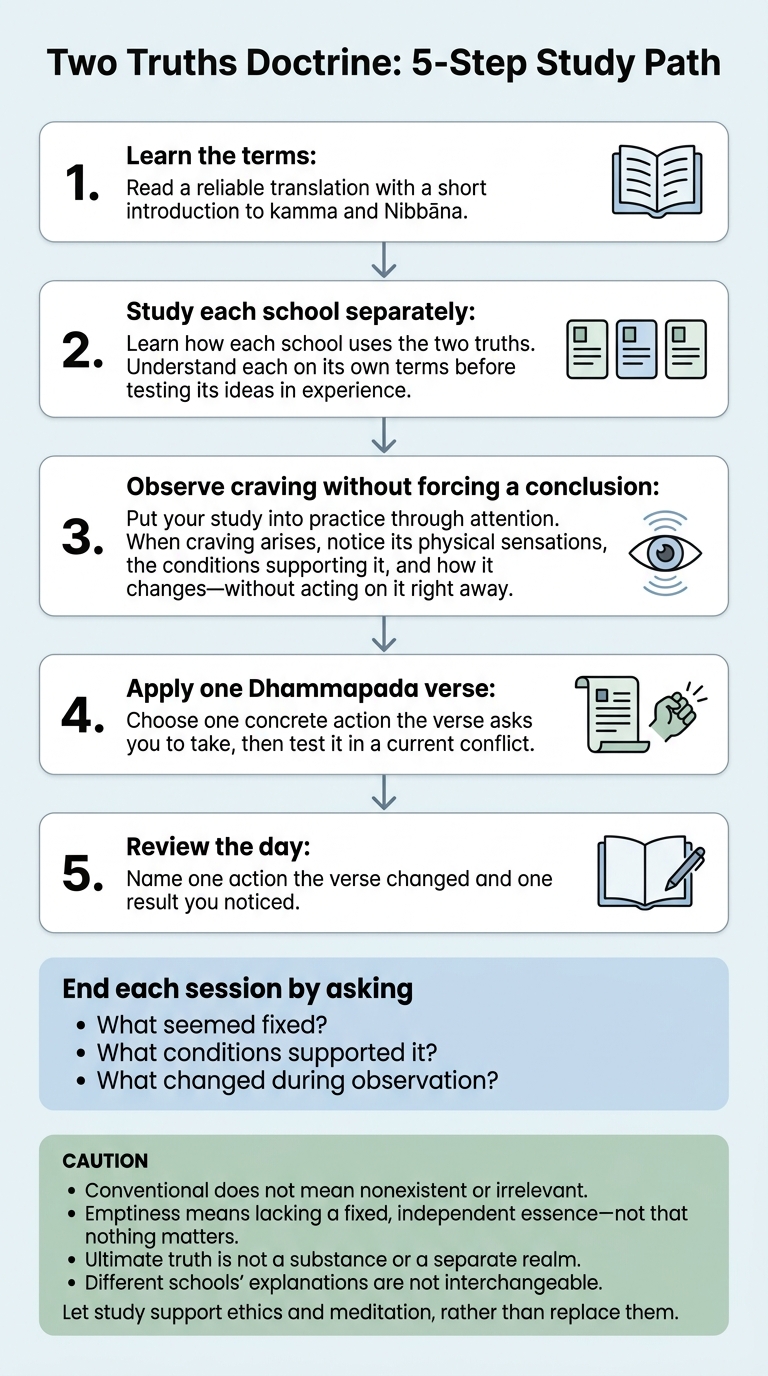
Two Truths Doctrine: 5-Step Study Path
Move from doctrine to direct observation through study, practice, and daily reflection.
5 Steps for Study and Reflection
- Learn the terms: Read a reliable translation with a short introduction to kamma and Nibbāna.
- Study each school separately: Learn how each school uses the two truths. Understand each on its own terms before testing its ideas in experience.
- Observe craving without forcing a conclusion: Put your study into practice through attention. When craving arises, notice its physical sensations, the conditions supporting it, and how it changes - without acting on it right away.
- Apply one Dhammapada verse: Choose one concrete action the verse asks you to take, then test it in a current conflict.
- Review the day: Name one action the verse changed and one result you noticed.
End each session by asking: What seemed fixed? What conditions supported it? What changed during observation?
Common Misunderstandings to Avoid
Conventional does not mean nonexistent or irrelevant. Emptiness means lacking a fixed, independent essence - not that nothing matters.
Ultimate truth is not a substance or a separate realm. Different schools’ explanations are not interchangeable.
Let study support ethics and meditation, rather than replace them.
FAQs
If there’s no permanent self, who is responsible for actions?
In Buddhist teaching, no permanent self doesn’t mean actions have no source or consequences. Instead of a fixed soul, existence is a changing process shaped by interdependent causes and conditions.
Your past and present actions shape what you experience, which means you can influence future outcomes. Since mind precedes actions, you remain responsible for your purity and growth. Paying attention to your mental states helps you replace impulsive reactions with skillful, intentional actions [4].
How can I distinguish insight from emotional detachment?
Approach your experience with curiosity instead of trying to avoid it. Emotional detachment often means pushing feelings away or numbing yourself to them. Insight, by contrast, means noticing emotions without judgment as they appear, change, and fade.
When an emotion comes up, pause and label it pleasant, unpleasant, or neutral. Notice it with kindness rather than judging it or trying to shut it down. This helps you process the experience without feeling overwhelmed or holding on to it.
Which Buddhist school should I study first?
You don’t have to choose a school of Buddhism before you start reading. The Dhammapada, a core text in Theravāda Buddhism, is open to readers of any background or spiritual path. You don’t need advanced preparation.
Reading one verse a day can help you build mindfulness and reflect on ethical choices. The Sutta 423 app delivers a daily Dhammapada verse, helping you bring these teachings into your life over a full year.