
Twelve Links in Time: Key Debate Map
Compare four readings of the twelve links by time frame and what suffering they explain: three-life, cyclical, psychological, moment-to-moment.
I compare 4 readings of the 12 links by asking: What time frame does each use, and what suffering does it explain? My starting rule: <u>keep a link’s definition separate from its placement in time</u>.
- Three-lifetime: Maps past causes, present results and causes, and future rebirth. This grouping comes from commentaries such as the Visuddhimagga.
- Cyclical: Focuses on recurring conditions for suffering, drawing on early discourses rather than a fixed timeline.
- Psychological: Examines habits and self-making within a life or episode. Identity-based meanings of birth and becoming need to be labeled as readings, not canonical definitions.
- Moment-to-moment: Examines conditions within a single instant of consciousness through Abhidhamma and technical analyses.
Quick Comparison
| Reading | Time frame | Main focus |
|---|---|---|
| Three-lifetime | Three lives | Karma and rebirth |
| Cyclical | Recurring cycles | Repeated suffering |
| Psychological | One life or episode | Habits and identity |
| Moment-to-moment | One instant | Immediate suffering |
I use SN 12.2 to check definitions, then ask what each reading explains - and what it leaves unresolved. These are different emphases, not four sealed systems.
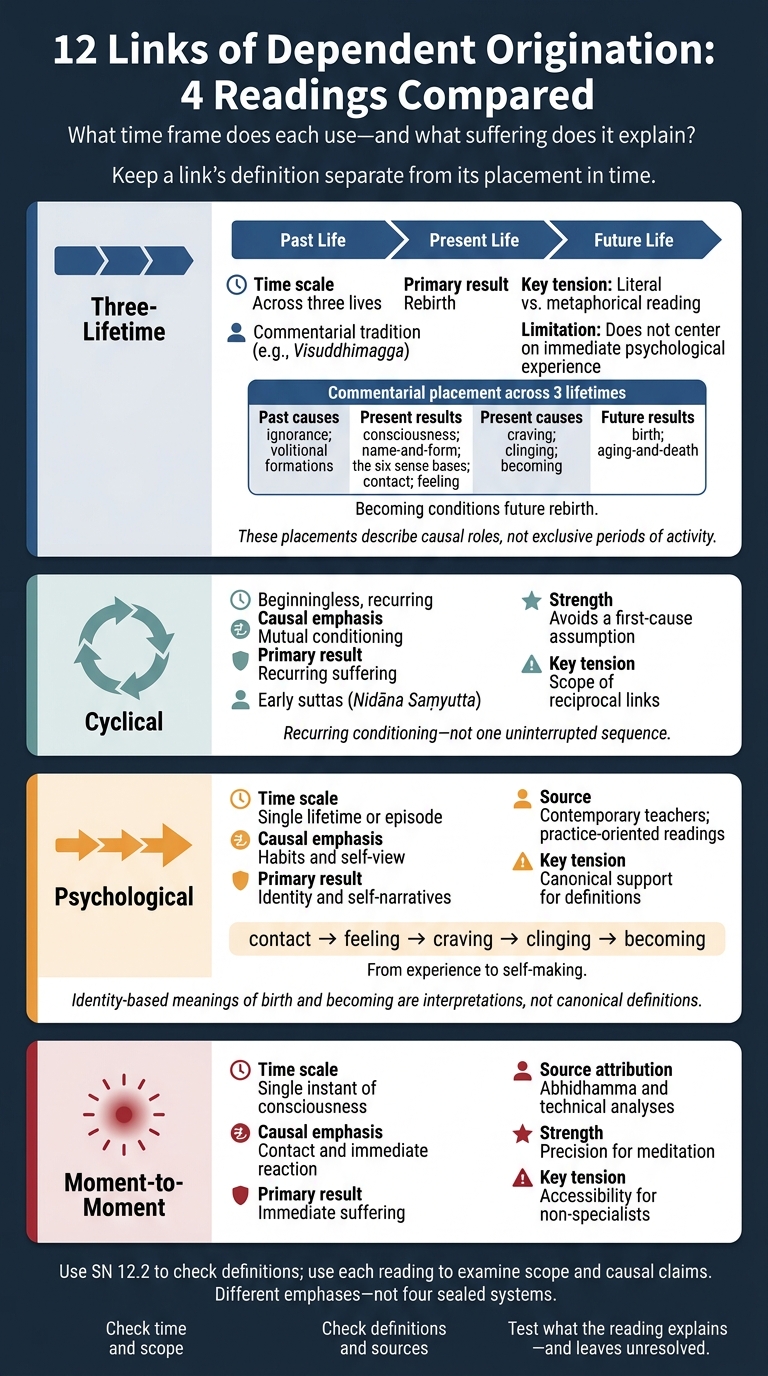
12 Links of Dependent Origination: 4 Readings Compared
Decoding the Buddha's Most Puzzling Teaching
Checklist: Causes and Results Across 3 Lifetimes
Keep definitions separate from time placement. SN 12.2 defines the links; the Visuddhimagga is a key source for organizing them across three lifetimes. Label this a commentarial reading.
Past Causes: Ignorance and Formations
Mark ignorance and volitional formations as past causes. Here, “past” means a prior life.
Use the checklist below to distinguish each link’s definition from its causal role.
| Link | Canonical wording (SN 12.2) | Commentarial placement | Meaning of “past” |
|---|---|---|---|
| Ignorance | Check its definition separately from its place in the sequence. | Past cause | Ignorance in a prior life |
| Volitional formations | Check the definition before treating “formations” as karmic activity. | Past cause | Karmic conditioning from a prior life |
Present Results and Causes: Consciousness Through Becoming
- [ ] Present results: consciousness, name-and-form, the six sense bases, contact, feeling.
- [ ] Present causes: craving, clinging, becoming.
Becoming counts as a cause because it conditions future rebirth.
| Feature | Rebirth-oriented reading |
|---|---|
| Time frame | Past, present, and future lives |
| Becoming | A process that supports renewed existence |
| Primary result | Rebirth, followed by aging and death |
| Limitation | Does not center on immediate psychological experience |
Future Results: Birth and Aging-and-Death
Mark birth and aging-and-death as future results. In this reading, present karmic activity conditions a later existence.
Check whether “birth” refers to rebirth or to identity arising in experience. These time assignments explain causal roles; they don’t prove that a link acts only within its assigned period.
Checklist: Cyclical and Psychological Readings
These readings approach the same links from different angles, separating recurrence, time scale, and identity formation. The focus shifts from mapping rebirth to examining how suffering repeats in lived experience.
Cyclical Reading: How Suffering Repeats
A cyclical reading draws on early discourses in the Nidāna Saṃyutta to explain how suffering repeats, rather than assigning links to periods of time. Check whether the account describes recurring conditioning - not one uninterrupted sequence.
Psychological Reading: From Feeling to Identity
Within a single episode, trace contact → feeling → craving → clinging → becoming as a shift from experience to self-making. When becoming and birth describe habits and identity, treat those meanings as interpretations, not canonical definitions.
Comparison Table: 4 Readings of Time
These categories reflect different emphases, not fixed systems. Compare their scope, sources, and main causal claims below.
| Reading | Time Scale | Causal Emphasis | Primary Result | Source Attribution | Strength | Key Tension |
|---|---|---|---|---|---|---|
| Three-Lifetime | Across three lives | Karmic continuity | Rebirth | Commentarial tradition (e.g., Visuddhimagga) | Continuity across lives | Literal vs. metaphorical reading |
| Cyclical | Beginningless, recurring | Mutual conditioning | Recurring suffering | Early suttas (Nidāna Saṃyutta) | Avoids a first-cause assumption | Scope of reciprocal links |
| Psychological | Single lifetime or episode | Habits and self-view | Identity and self-narratives | Contemporary teachers; practice-oriented readings | Directly useful in practice | Canonical support for definitions |
| Moment-to-Moment | Single instant of consciousness | Contact and immediate reaction | Immediate suffering | Abhidhamma and technical analyses | Precision for meditation | Accessibility for non-specialists |
Conclusion: A Checklist for Classifying Each Reading
With the main readings mapped out, use this checklist to classify any new account by its time frame, sources, and causal claims.
- [ ] Check time and scope: Does it cover three lives, one life, or a single moment? Does it stress a linear sequence or recurring conditioning? Does it explain rebirth, immediate experience, or both?
- [ ] Check definitions and sources: How does the account use birth and becoming? Does it draw on early suttas or later commentarial sources? Keep the text’s wording separate from the model used to organize it.
- [ ] Test the reading’s scope: Identify what it explains well and what it leaves unresolved.
FAQs
Can the four readings work together?
Yes. The four readings of the twelve links can complement one another. For example, the three-life model of rebirth and the moment-to-moment psychological perspective offer different ways to approach meditation and understand conditionality. Together, they can help you see where to interrupt the causal chain of suffering.
The Sutta 423 app offers one Dhammapada verse each day for quiet reflection, helping you maintain a steady practice.
Does breaking one link end the cycle?
Yes. The links depend on one another; they aren’t fixed. Interrupting the chain of conditions can end the cycle of suffering. You can break that chain between sensory contact and feeling, or between feeling and craving. Practicing mindfulness and replacing ignorance with wisdom can stop the conditions that keep the cycle going.
How can I spot these links in daily life?
Pay attention to your reactions as events unfold. Notice how sensory contact brings pleasure, pain, or indifference - and how those feelings can lead to craving or aversion. Pause with the physical sensation before a story forms in your mind or a familiar reaction takes over. That pause can help interrupt the chain of suffering.
Reflecting on Sutta 423 each day can help build the mindfulness needed to spot these patterns.