
Suffering and Compassion in Buddhism
Explores how understanding dukkha leads to karuna, using the Eightfold Path and daily Dhammapada practice to build lasting compassion.
Buddhism highlights a profound connection between suffering (dukkha) and compassion (karuna). Suffering is seen as a universal experience, while compassion arises as a natural response to this shared human condition. By understanding suffering's causes - such as impermanence and harmful emotions like greed or anger - we can cultivate compassion to ease both personal and collective pain. The Buddha's teachings emphasize that protecting oneself from harmful thoughts also protects others, and vice versa.
Key Takeaways:
- Suffering (dukkha): Includes physical pain, impermanence, and the dissatisfaction tied to life's fleeting nature.
- Compassion (karuna): The active wish to alleviate suffering, rooted in empathy and mindfulness.
- Practical Steps: The Noble Eightfold Path guides actions, thoughts, and intentions to reduce suffering and grow compassion.
- Daily Practice: Reflecting on teachings like Dhammapada verses can help integrate compassion into daily life.
This balance between understanding suffering and practicing compassion is essential for personal growth and fostering a more harmonious world.
Softening Suffering with Compassion | Ajahn Canda | 6 December 2024
Understanding Dukkha: The Nature of Suffering in Buddhism
The Three Forms of Dukkha in Buddhist Philosophy
The Meaning of Dukkha
Dukkha, a central term in Buddhism, is often translated as suffering, but it also encompasses feelings of stress, unease, and frustration. The Buddha emphasized that grasping the nature of dukkha and finding its cessation is at the heart of his teachings.
Originally, dukkha described a broken axle on an oxcart, symbolizing life as a "bumpy ride" rather than a smooth journey. This metaphor doesn’t suggest life is constant misery but instead underscores its intrinsic imperfections. Walpola Rahula, in What Buddha Taught, clarifies this perspective:
Buddhism is neither pessimistic nor optimistic. If anything at all, it is realistic, for it takes a realistic view of life and of the world.
What sets dukkha apart from our usual concept of suffering is its inclusion of not just physical pain or grief but also the subtle discomfort tied to pleasurable experiences due to their fleeting nature. As contemporary teacher Joseph Goldstein puts it:
Whatever has the nature to arise will also pass away.
This acknowledgment of impermanence reveals an underlying instability in life.
The 3 Forms of Suffering
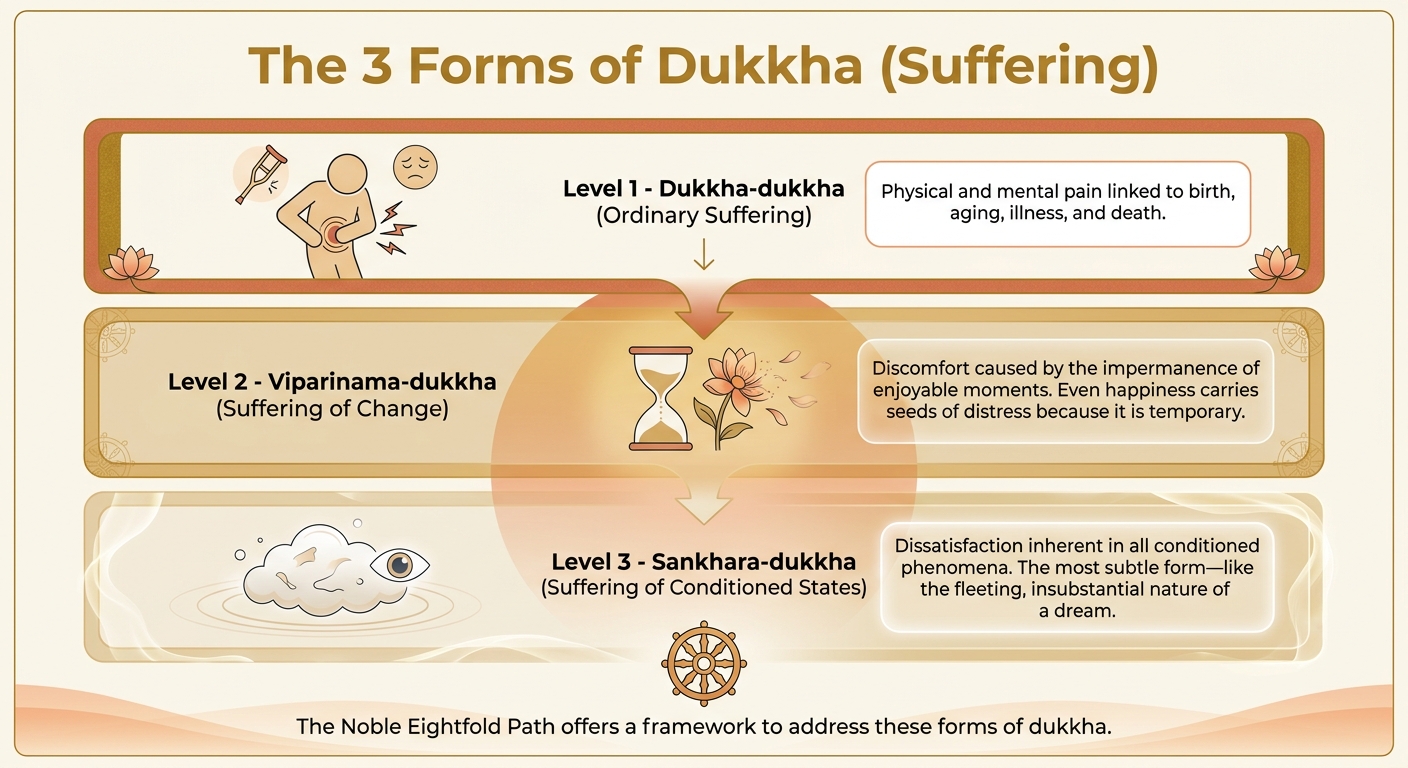
To deepen our understanding of dukkha, Buddhist philosophy identifies three distinct forms, each progressively more subtle.
- Dukkha-dukkha (Ordinary Suffering): This is the straightforward physical and mental pain linked to birth, aging, illness, and death .
- Viparinama-dukkha (Suffering of Change): This type stems from the discomfort caused by the impermanence of enjoyable moments . Even the happiest experiences carry the seeds of distress because they are temporary.
- Sankhara-dukkha (Suffering of Conditioned States): The most nuanced form, this refers to the dissatisfaction inherent in all conditioned phenomena . It’s often compared to the fleeting, insubstantial nature of a dream.
The Noble Eightfold Path offers a framework to address these forms of dukkha. By understanding these layers of suffering, practitioners can cultivate the compassion and wisdom central to Buddhist practice.
Compassion (Karuna) as a Core Buddhist Virtue
Defining Karuna
Karuna, often translated as "compassion", represents the deep desire to alleviate suffering. Ancient texts describe it as a heartfelt response - a "trembling of the heart" when witnessing pain. But this isn't a passive emotion. Instead, it pushes practitioners toward actively addressing and easing distress.
Buddhaghosa, in his work The Path of Purification, provides a vivid explanation of compassion's role:
Its function is to find others' suffering unbearable. It manifests as compassionate nonviolence. Its proximate cause is seeing helplessness in those overwhelmed by suffering.
In Buddhist teachings, karuna is one of the four brahma-viharas (often referred to as "divine abidings"), alongside loving-kindness (metta), sympathetic joy (mudita), and equanimity (upekkha). What sets karuna apart from metta is its emphasis: while metta focuses on wishing happiness for others, karuna is centered on the desire to free beings from pain.
In Mahayana Buddhism, compassion is considered equally important as wisdom (prajna). Together, they are likened to the two wings of a bird - both essential for spiritual growth. However, there’s a crucial distinction to be made: true karuna must not be confused with its "near enemy", which is personal distress or worldly grief. When genuine compassion is practiced, it reduces cruelty. But when it falters, it can lead to sorrow or despair. As the 14th Dalai Lama wisely notes:
Compassion enables us to look at suffering in all its tortuous varieties without succumbing to despair.
This understanding of karuna provides a foundation for integrating it into daily life.
Practicing Compassion in Daily Life
To embody true karuna, mindfulness serves as the starting point. As Thich Nhat Hanh succinctly puts it, "Compassion is a verb". It demands action, not just an emotional response. Begin by cultivating awareness - observe your thoughts and reflect on the shared longing for happiness that connects all beings. Recognizing this shared vulnerability fosters a deeper commitment to extend compassion universally.
Shantideva, in The Way of the Bodhisattva, beautifully expresses this idea:
Since I and other beings both, in wanting happiness, are equal and alike, what difference is there to distinguish us, that I should strive to have my bliss alone?
This perspective encourages compassion not just for those in visible pain but for all beings, including those who may act harmfully. The 14th Dalai Lama emphasizes that compassion doesn't assign blame. Instead, it recognizes that both the one suffering and the one causing harm are influenced by karma and are equally deserving of compassion.
When faced with suffering in your daily life, try to focus on the vision of freedom from pain rather than fixating on the suffering itself. This approach helps maintain a positive outlook and prevents emotional exhaustion or burnout.
How Suffering and Compassion Connect in the Noble Eightfold Path
The Noble Eightfold Path provides a practical way to transform suffering (dukkha) into compassion (karuna). Bhikkhu Bodhi highlights the importance of balancing two key qualities on this path: "renunciation and compassion." Renunciation focuses on addressing one’s personal suffering, while compassion directs attention to the suffering of others.
Guided by the Four Noble Truths, the path encourages practitioners to develop a deeper understanding of suffering. This wisdom transforms basic sympathy into a more enduring, spiritual compassion.
Right Understanding and Right Intention
Right Understanding uncovers the roots of suffering - craving and ignorance - helping practitioners see the interconnectedness of all beings. This awareness naturally fosters a sense of shared humanity and compassion.
Building on this, Right Intention promotes three essential qualities: renunciation, loving-kindness, and non-injury. Letting go of personal cravings creates space for a mind filled with "boundless sympathy." Wisdom and compassion are deeply interconnected; neither can thrive without the other.
Before acting - whether through speech, thoughts, or deeds - it’s helpful to pause and ask whether the action might cause harm to yourself or others. Harmful actions should be avoided, while those that bring benefit are worth cultivating.
Right Action and Right Livelihood
Inner changes in understanding and intention naturally influence outward behavior, shaping how compassion is expressed in daily life.
Right Action and Right Livelihood bring compassionate intentions into ethical practices. These steps emphasize moral discipline, creating harmony for individuals and society. Right Action involves refraining from harmful acts like taking life, stealing, or deceiving others. Right Livelihood encourages choosing work that avoids causing suffering, steering clear of trades involving weapons, poisons, or intoxicants.
These practices echo the Buddha’s principle of mutual protection. By maintaining discipline in your own actions, you not only protect yourself from greed and hatred but also reduce the harm these tendencies might cause to others.
Choosing a livelihood free from harm and reflecting on whether your work supports well-being over suffering are key. Mindfulness helps break harmful habits and reduces the spread of greed, hostility, and deceit in the world. This creates the conditions for genuine compassion to grow.
Each aspect of the Eightfold Path weaves wisdom and compassion together, reinforcing every step of the journey.
Using Dhammapada Verses for Compassionate Living
Daily Wisdom Through Dhammapada Verses
Incorporating daily reflections on Dhammapada verses can profoundly shape how we live with compassion. By focusing on just one verse each day, we can shift from reactive behaviors to more thoughtful, compassionate actions. As Buddhist teacher Bodhipaksa points out:
Without mindful observation of the mind, it's impossible for us to choose to act skillfully rather than unskillfuly.
Without this awareness, our actions often go unexamined, leaving us stuck in habitual patterns.
A helpful tool for this practice is the Sutta 423 app (https://sutta423.com), which delivers a single Dhammapada verse daily. With its complete collection of 423 verses, the app provides a full year of guidance for reflection and mindfulness. This consistent engagement fosters a mindset rooted in compassion, insight, and contentment, gradually making these qualities second nature. Over time, daily reflection strengthens the mind, making it more resilient to negativity.
Through this practice, certain verses stand out, offering profound insights into the connection between suffering and compassion.
Key Dhammapada Verses on Suffering and Compassion
The Dhammapada contains powerful verses that illuminate the relationship between suffering and compassion.
Verse 129 teaches the importance of empathy:
All tremble at violence; all fear death. Putting oneself in the place of another, one should not kill nor cause another to kill.
This verse invites us to imagine ourselves in another’s position, helping to dissolve impulses toward harmful actions or words.
Verse 5 highlights a universal truth:
Hatred is never appeased by hatred in this world. By non-hatred alone is hatred appeased. This is a law eternal.
In moments of conflict, this teaching encourages us to replace anger with love, breaking destructive cycles of retaliation and fostering peace.
Verse 239 offers a reminder about the gradual nature of personal growth:
One by one, little by little, moment by moment, a wise man should remove his own impurities, as a smith removes his dross from silver.
This verse emphasizes patience and self-compassion, reminding us that meaningful change happens step by step rather than all at once.
Conclusion
These teachings bring together insights on suffering and compassion, rooted in the mindfulness practices discussed throughout this guide. By understanding how suffering and compassion are interconnected, we gain a practical way to approach life with greater awareness. When we nurture mindfulness and self-reflection, we naturally reduce the tendencies toward harm, greed, and anger that can otherwise dominate our actions.
This approach encourages us to explore the wisdom that shapes compassionate thoughts. Compassion, after all, is more than just a comforting emotion. As noted, it is "shaped by wisdom", urging us to examine the root of pain rather than reacting out of fear or attachment. A simple yet profound question - Does this action harm myself or others? - can guide us toward ethical choices and a more meaningful life.
The teachings also highlight that suffering often arises from an excessive focus on the self. Compassion helps break down these barriers by reminding us that all beings share the same experiences of birth, aging, and illness. As Nyanaponika Thera wisely pointed out:
By winning to spiritual health, we shall diminish at least by one the sources of infection in the world.
Recognizing our shared vulnerabilities naturally leads us to meditation as a way to foster deeper compassion. Meditation becomes more than a personal practice; it transforms into an act of kindness that benefits others. A calm, focused mind not only alleviates personal burdens but also strengthens our ability to support those around us. The journey, however, requires patience. As the Dhammapada reminds us: "One by one, little by little, moment by moment, a wise man should remove his own impurities, as a smith removes his dross from silver". True change unfolds gradually through consistent effort.
These timeless teachings provide practical wisdom for anyone striving to live with more mindfulness and kindness. By reflecting deeply and acting with intention, we can turn understanding into genuine compassion.
FAQs
How is compassion different from feeling sad for someone?
In Buddhism, compassion is seen as a virtue deeply intertwined with wisdom. It's not just about feeling for someone; it's about actively working to alleviate their suffering. In contrast, simply feeling sad for someone is a passive emotional reaction. It doesn't necessarily involve understanding their pain or taking steps to ease it. Compassion goes further - it blends empathy with a genuine desire to help, creating a state that is both meaningful and purposeful.
How can I practice compassion without burning out?
Buddhist teachings emphasize the importance of blending compassion with self-awareness and the practice of letting go. It's crucial to recognize your personal limits, prioritize self-care, and concentrate on what you can realistically manage. The concept of renunciation - releasing excessive desires and attachments - plays a key role in maintaining compassion over the long haul. By adopting this mindset, you can avoid feelings of frustration or burnout, ensuring you stay compassionate while also taking care of your own well-being.
How do I use a daily Dhammapada verse for real-life choices?
Reflecting on a daily Dhammapada verse can provide meaningful guidance for your mindset and actions. Take a few moments to read a verse, consider its deeper meaning, and think about how it applies to your daily choices. For instance, a verse on overcoming craving might encourage you to make mindful, compassionate decisions. With consistent practice, this reflection can deepen your ethical awareness, helping you align your behavior with Buddhist teachings and nurturing a sense of inner peace and thoughtful, compassionate living.