
SN 12.2: Line-by-Line Reading of Dependent Origination
SN 12.2 explained: Pali definitions of the 12 links, how ending conditions stop suffering, and simple practice to notice feeling and craving.
SN 12.2 explains suffering through 12 links - and shows how suffering ends when its supporting conditions end. I read each link alongside the sutta’s definition, rather than relying on everyday meanings.
In this reading, I follow:
- Arising: from ignorance through feeling, craving, and clinging to birth, aging, and death.
- Definitions: what the Pali terms mean in this sutta.
- Cessation: the ending of conditions for suffering, not the destruction of a self.
For practice, I start with <u>feeling and what follows</u>: Is it pleasant, unpleasant, or neutral? Does craving follow? This gives you a place to observe the teaching without assuming every feeling must lead to clinging.
SN 12.2: The 12 Links of Dependent Origination
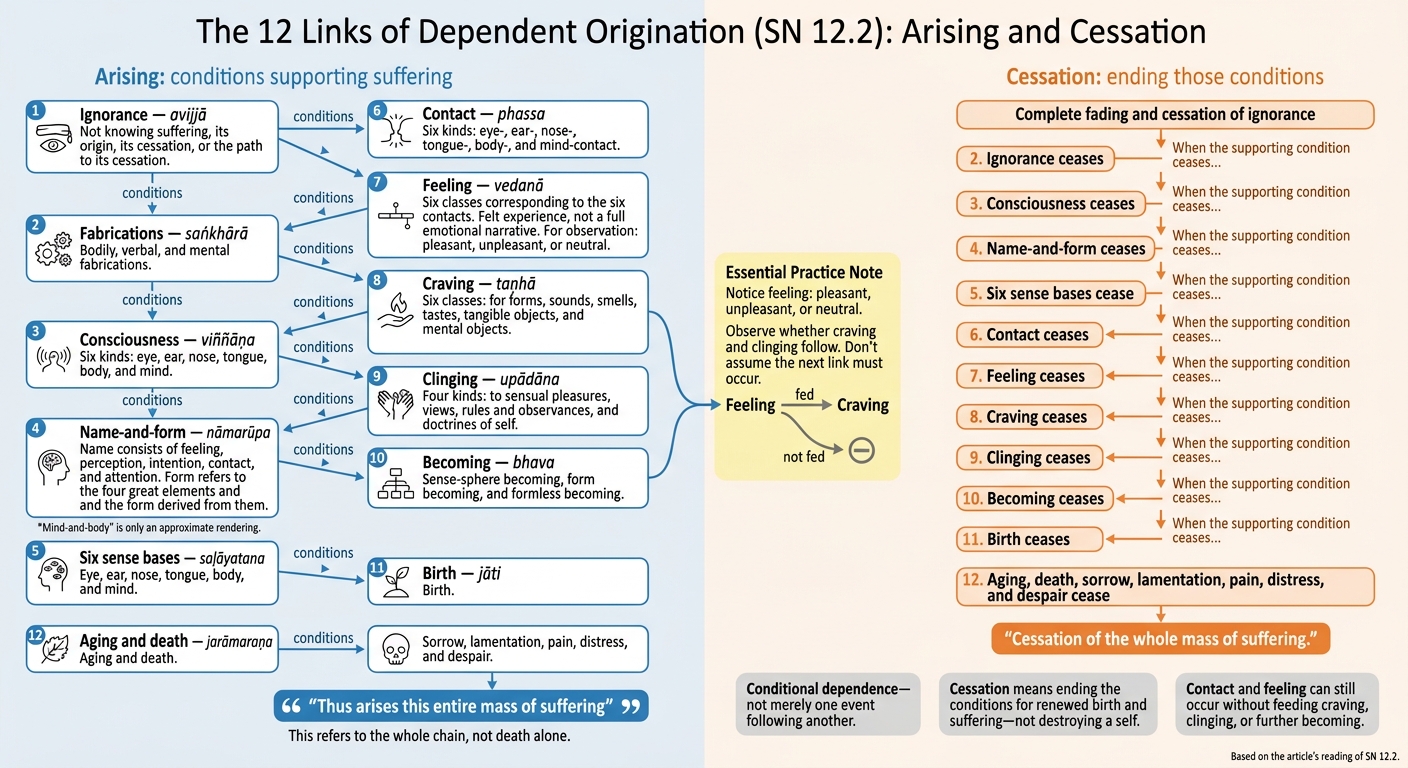
How Suffering Arises: Ignorance to Feeling
Ignorance Conditions Fabrications and Consciousness
Avijjāpaccayā saṅkhārā - with ignorance as condition, fabrications. In SN 12.2, ignorance means not knowing suffering, its origin, its cessation, or the path to its cessation. Saṅkhārā refers to bodily, verbal, and mental fabrications that condition consciousness.
Saṅkhārapaccayā viññāṇaṃ - with fabrications as condition, consciousness. The sutta names six kinds of consciousness: eye, ear, nose, tongue, body, and mind. This clause describes direct dependence, not just one event following another.
The chain then moves from consciousness to the mental and material factors that support the sense bases.
Consciousness Conditions Name-and-Form and the Sense Bases
Viññāṇapaccayā nāmarūpaṃ - with consciousness as condition, name-and-form. Nāma consists of feeling, perception, intention, contact, and attention. Rūpa refers to the four great elements and the form derived from them.
“Mind-and-body” is only an approximate rendering.
With name-and-form in place, the six sense bases arise.
Nāmarūpapaccayā saḷāyatanaṃ - with name-and-form as condition, the six sense bases. These are the eye, ear, nose, tongue, body, and mind.
Sense Bases Condition Contact and Feeling
Saḷāyatanapaccayā phasso - with the six sense bases as condition, contact. SN 12.2 lists six kinds of contact: eye-, ear-, nose-, tongue-, body-, and mind-contact.
Phassapaccayā vedanā - with contact as condition, feeling. SN 12.2 groups feeling into six classes, each corresponding to one of these contacts. Here, vedanā means felt experience, not a full emotional narrative.
From feeling, the sutta moves to craving and the rest of the chain.
Venerable Candā: Sutta Discussion Group "Analysis of Dependent Origination Pt1 (SN 12:2)" 21.06.24
How Suffering Arises: Craving to Aging and Death
From feeling, the chain moves into craving, clinging, and renewed becoming.
Feeling Conditions Craving; Craving Conditions Clinging
Vedanāpaccayā taṇhā - with feeling as condition, craving.
Taṇhā includes six classes of craving: for forms, sounds, smells, tastes, tangible objects, and mental objects.
Taṇhāpaccayā upādānaṃ - with craving as condition, clinging.
Upādāna includes four kinds of clinging: to sensual pleasures, views, rules and observances, and doctrines of self.
Clinging Conditions Becoming; Becoming Conditions Birth
Upādānapaccayā bhavo - with clinging as condition, becoming.
Bhava includes sense-sphere becoming, form becoming, and formless becoming.
Bhavapaccayā jāti - with becoming as condition, birth.
Jāti means birth.
Birth Conditions Aging, Death, and Distress
Jātipaccayā jarāmaraṇaṃ - with birth as condition, aging and death.
The chain also includes sorrow, lamentation, pain, distress, and despair. The closing line, evametassa kevalassa dukkhakkhandhassa samudayo hoti, means:
“Thus arises this entire mass of suffering”
This refers to the whole chain, not death alone.
The next section follows the same chain through cessation, clause by clause.
How Suffering Ceases: Ending Its Conditions
Reading Each Cessation Clause
Avijjāya tveva asesavirāganirodhā opens with the complete fading and cessation of ignorance. When ignorance ends, the conditions that depend on it also end.
With ignorance gone, fabrications cease; with fabrications gone, consciousness ceases; with consciousness gone, name-and-form ceases; with name-and-form gone, the six sense bases cease; with the six sense bases gone, contact ceases; with contact gone, feeling ceases; with feeling gone, craving ceases; with craving gone, clinging ceases; with clinging gone, becoming ceases; with becoming gone, birth ceases; with birth gone, aging, death, sorrow, lamentation, pain, distress, and despair cease.
The closing line names the cessation of the whole mass of suffering. This reversal helps us read cessation as the ending of conditions, rather than as annihilation.
Why Cessation Is Not Annihilation
Cessation means ending the conditions for renewed birth and suffering - not destroying a self. The passage describes how those conditions end, not how experience itself ends.
Contact and feeling can still occur without feeding craving, clinging, or further becoming. When reading the feeling-to-craving clause, separate a feeling occurring from craving being fed. The chain describes how each link ceases when the condition supporting it ends.
Conclusion: Reading the 12 Links Clearly
Read Each Clause With Its Definition
Reread each conditional phrase alongside its definition. Vedanā means pleasant, unpleasant, or neutral feeling.
Don’t add an enduring self. Read cessation and arising together, then watch how each link follows from the one before it.
Notice Feeling and What Follows
Once the terms are clear, apply the same reading to your own experience. Pause when you notice a feeling. Identify it as pleasant, unpleasant, or neutral, then observe whether craving and clinging follow. Don’t assume the next link must occur.
Keep each link tied to its definition as you read the sutta.
FAQs
Do the 12 links unfold within one lifetime or across lifetimes?
The twelve links of dependent origination work on both levels [1][2]. They can unfold in a single instant of consciousness, showing how psychological processes play out in the present moment. They can also span past, present, and future lives, illustrating the process of rebirth [1][2].
Both perspectives are valid tools for meditation, helping practitioners see where they can interrupt the cycle of suffering [1][2].
How can I notice craving before it becomes clinging?
Practice mindfulness in the gap between what you sense and how you react. Craving is the subtle yearning that follows a feeling. Clinging is the stronger, grasping attachment that follows craving.
Notice desire, aversion, physical tension, or an urge to act - whether that means checking your phone or reacting to criticism. Pause and observe these sensations as they come and go instead of acting on them. This pause helps keep the cycle from hardening into reactivity.
If ignorance ends, why do feeling and contact continue?
Contact and feeling are part of how the senses and mind work. Ending ignorance stops the cycle of suffering, but it doesn’t mean every physical or mental process disappears right away.
Instead, these processes stop triggering the habitual craving and attachment that lead to future suffering. When wisdom replaces ignorance, contact and feeling can occur without the mistaken belief in a permanent self.