
Self and Suffering in Dhammapada: 5 Views
Five Dhammapada perspectives—clinging, ego, craving, fear, release—map how self-view fuels suffering and how to practice letting go.
I can’t stop every painful change, but I can notice when “this hurts” becomes “this defines me.” My starting point: pause, notice one feeling, and let it change without calling it me or mine.
I use five Dhammapada views to examine that habit:
- Clinging: Where am I treating my body, feelings, or thoughts as a fixed self?
- Ego: Am I protecting my well-being - or just my image?
- Craving: When does “I enjoy this” turn into “I need this”?
- Fear: Where does sensible care turn into demanding certainty?
- Release: Can I care without holding on so tightly?
<u>Letting go doesn’t mean giving up boundaries or ignoring pain.</u> I can begin with one verse, one everyday situation, and one pause before acting.
The Craving Cycle: From Trigger to Dissatisfaction
Attachment, Ego, And Suffering | Dharma Talk
Understanding Self-View and Dukkha
Dukkha means suffering, stress, or unsatisfactoriness. It includes birth, aging, illness, loss, and frustration. Verse 278 describes all conditioned things as unsatisfactory. Pain is not proof of poor practice.
Verse 279 points toward freedom through non-identification. You can use I and mine in everyday conversation without believing in a fixed self.
Buddhist teaching uses the five aggregates - form, feeling, perception, formations, and consciousness - to name these patterns and show what we mistake for self.
The three cravings - pleasure, becoming, and non-becoming - help explain how verse 216 connects wanting with suffering. During quiet reflection, notice whether you're seeking pleasure, insisting on a particular identity, or wishing an experience away. Notice that pull without judging yourself.
The five views below show how this grasping at a self plays out in daily life, starting with clinging.
1. Clinging to the Five Aggregates as “Me” and “Mine”
Building on the five aggregates - body, feeling, perception, formations, and consciousness - this view explains how we form a sense of self. We turn these experiences into “me” and “mine” when we treat them as permanent or under our control.
Self-view leads to clinging, and clinging leads to suffering. Once an experience becomes “mine,” changes in it can feel like a personal threat. Verse 212 connects attachment with sorrow and fear.
Teaching: Distress grows when we demand that change stay pleasant, vanish, or remain under control.
Self-observation: Pause quietly and notice one sensation, emotion, or thought. Watch how it changes. Notice any urge to hold on to it, push it away, or use it to define who you are.
Reflection prompt: What am I grasping: the experience, its pleasantness, or the identity I attach to it?
2. Ego and Protecting a Fixed Identity
Clinging to a fixed sense of self can make us quick to defend the image we want others to see.
Verse 81 compares the wise person to a rock unmoved by wind: praise and blame do not shake their steadiness. Either can trigger the urge to defend ourselves when we treat it as a judgment of who we are. The problem is not praise or blame itself, but turning it into a verdict on our identity.
Steadiness does not mean accepting mistreatment. Healthy boundaries protect well-being; ego-driven reactions protect reputation or status. Before responding, ask whether you're addressing harmful behavior or protecting your image.
Teaching: You can respond firmly without making praise or blame the measure of your worth.
Self-observation: When your identity feels threatened, pause before answering. Notice any tension or heat in your body. Label the feeling as unpleasant, and check whether your mind is steady or reactive. Then respond to the issue, not your image.
Reflection prompt: What needs protection right now: my well-being, a boundary, or my image?
3. Craving and the Demand for Satisfaction
If ego protects identity, craving tries to feed it.
Self-view turns I am into I need, I must have, or I must avoid. Verses 334–335 picture craving as a creeper, a monkey, and rain-fed birana grass. Each image points to how craving keeps the self busy with what it wants, wants to become, or rejects.
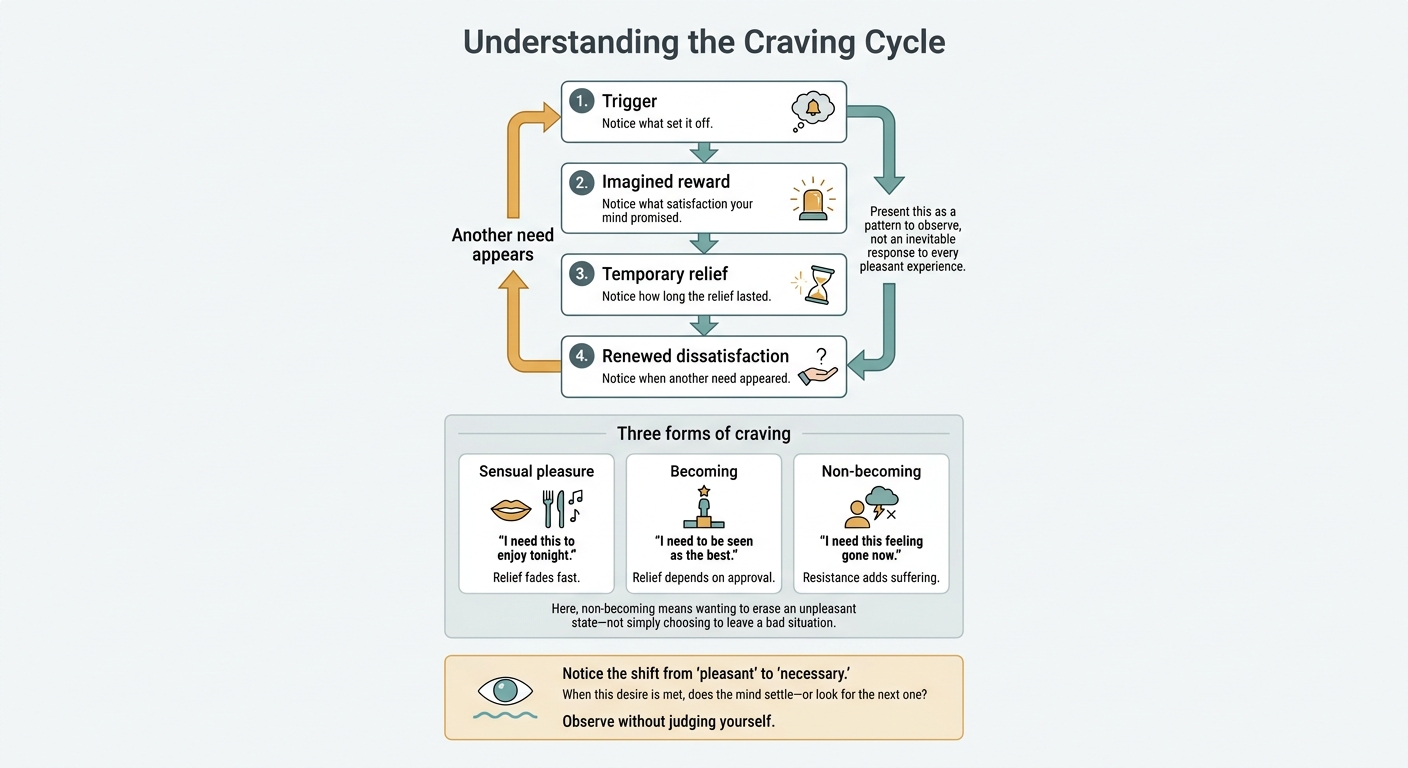
Buddhist teaching names three cravings: sensual pleasure, becoming, and non-becoming. Here, non-becoming means wanting to erase an unpleasant state - not simply choosing to leave a bad situation.
- Sensual pleasure: “I need this to enjoy tonight.” Relief fades fast.
- Becoming: “I need to be seen as the best.” Relief depends on approval.
- Non-becoming: “I need this feeling gone now.” Resistance adds suffering.
Without judging yourself, follow one recurring desire through trigger → imagined reward → temporary relief → renewed dissatisfaction. Notice what set it off, what satisfaction your mind promised, how long the relief lasted, and when another need appeared.
Teaching: Enjoyment becomes suffering when the mind starts depending on it to feel okay.
Self-observation: Notice the shift from ‘pleasant’ to ‘necessary.’
Reflection prompt: When this desire is met, does the mind settle - or look for the next one?
When craving keeps asking for more, fear is close behind.
4. Fear of Losing What We Hold Onto
When attachment makes something feel like part of who we are, losing it feels personal. Verses 212 and 216 link attachment and craving to grief and fear. What craving wants to keep, fear tries to protect.
Practical care asks what needs attention. Clinging demands certainty about people, roles, possessions, and outcomes. In each case, self-view turns ordinary change into a threat.
Attachment-based protection Clear awareness of change Demanding that a partner never change. Cherishing the person deeply today while accepting that all unions eventually end. Tying self-worth to a title or role. Doing the work well while knowing roles are temporary. Feeling diminished when a possession is damaged or lost. Caring for and using items effectively without the illusion that they can be kept forever. Fixating on a specific result as the only source of happiness. Setting intentions, then staying steady regardless of the result.
Release is not indifference. It doesn't mean neglecting responsibility or dismissing ordinary protective fear. You can take sensible precautions without demanding certainty.
Teaching: Care for what matters without asking it to remain unchanged.
Self-observation: Name one loss you fear. Notice where useful care turns into a demand for certainty.
Reflection prompt: What can I protect or care for today - and what is beyond my control?
5. Finding Release Through Non-Clinging
Fear narrows experience. Non-clinging makes room for it again.
Verse 221 points to letting go of anger, pride, and attachment to mind and body before suffering takes hold. This doesn’t mean erasing feelings - or your personality. It means not mistaking feelings for who you are. Seeing them as part of a fixed self tightens your grip; this verse points toward letting that grip soften.
Verse 282 links meditation with wisdom. A settled mind can notice a feeling without making it an identity. There’s no need to force it away.
Teaching: Allow a feeling to change without treating it as “me” or “mine.”
Self-observation: When a strong feeling comes up, pause quietly. Notice sensations in your body and the thoughts around them without judging yourself.
Reflection prompt: Can I let this feeling change without making it “me”?
A Daily Practice of Quiet Reflection
Keep the five views active in daily life with a short verse check-in. Read one Dhammapada verse two or three times, then name its key quality in one or two words. Write a brief paraphrase under “My paraphrase” so it stays separate from the verse. Try putting that insight into practice in an ordinary moment from your day.
Choose one everyday situation and one concrete action to try. When the situation comes up, notice whether clinging, ego, craving, or fear is tightening your self-view. Name the pattern, then pause before acting.
There’s no need to track streaks or feel guilty about missed days. Return when you’re ready. If a daily structure helps, try a verse-delivery practice. One optional source, Sutta 423, delivers one Dhammapada verse each morning. Its 423-verse cycle lasts more than a year and continues afterward.
Conclusion: Notice Grasping and Practice Release
When we treat changing experiences as “me” or “mine,” we feed clinging, ego, craving, and fear. Non-clinging isn’t indifference. It means caring without demanding permanence or a fixed identity. The practice is to notice when we grasp, then let that grip loosen.
Ask yourself:
Can I let this experience change without making it mine?
Notice one sensation, thought, or sound as it comes and goes. Watch for the urge to hold it in place, and practice letting it change - that’s release.
FAQs
If there’s no fixed self, who is responsible for my actions?
The Dhammapada teaches that there is no fixed, permanent self or soul. Yet it still stresses personal responsibility. Verses 1 and 165 explain that suffering and happiness aren’t punishments or rewards handed down from outside. They arise from our mental states, intentions, and actions.
You’re responsible for your choices. And because those choices shape your experience, you can change your path.
How can I tell non-clinging from emotional avoidance?
The difference comes down to how you engage and what you intend. Non-clinging means staying mindfully present and cherishing experiences and relationships without trying to possess them or desperately needing them to last. It supports inner freedom and compassion.
Emotional avoidance, by contrast, means pulling away to numb your feelings or sidestep emotional involvement, often with indifference. Non-clinging keeps you engaged in the present moment; avoidance distances you from it.
Can I pursue goals without feeding craving?
Yes. The difference is how you relate to the outcome. Craving ties your self-worth to a specific result, often bringing stress, fear of failure, and a feeling that something is missing. Healthy goals give you something meaningful to work toward while helping you stay balanced and present.
Practice letting go of the need to control results without neglecting your responsibilities or boundaries. This helps you act with care instead of reacting on impulse.