

Right Livelihood and Spiritual Growth: Guide
Practice Right Livelihood at work: assess and reduce harm, align earnings with values, and build short daily ethical habits.
I can make work part of spiritual practice by earning honestly, reducing harm, and choosing one change to test for seven days. That might mean correcting a misleading claim, setting a boundary, or reviewing how I spend money - not quitting before I can cover my bills.
Right livelihood is the fifth factor of Buddhism’s Noble Eightfold Path. I put it into practice by checking both what my work does and how I do it:
- Check for harm: Review my tasks, motives, and workplace practices, then address problems within my control.
- Plan changes: If harm remains central to my job, prepare a move that accounts for income, health coverage, debt, and dependents.
- Use money with care: Meet my responsibilities, cut waste, and give within my means.
- Practice throughout the day: Speak honestly, respect boundaries, pause before reacting, and make room for rest.
- Keep practice brief: Spend one to five minutes setting an intention or reflecting on a verse, then review my actions after work.
My aim is <u>better conduct, not a perfect job</u>. Small daily habits support growth - but they don’t replace action when work causes harm.
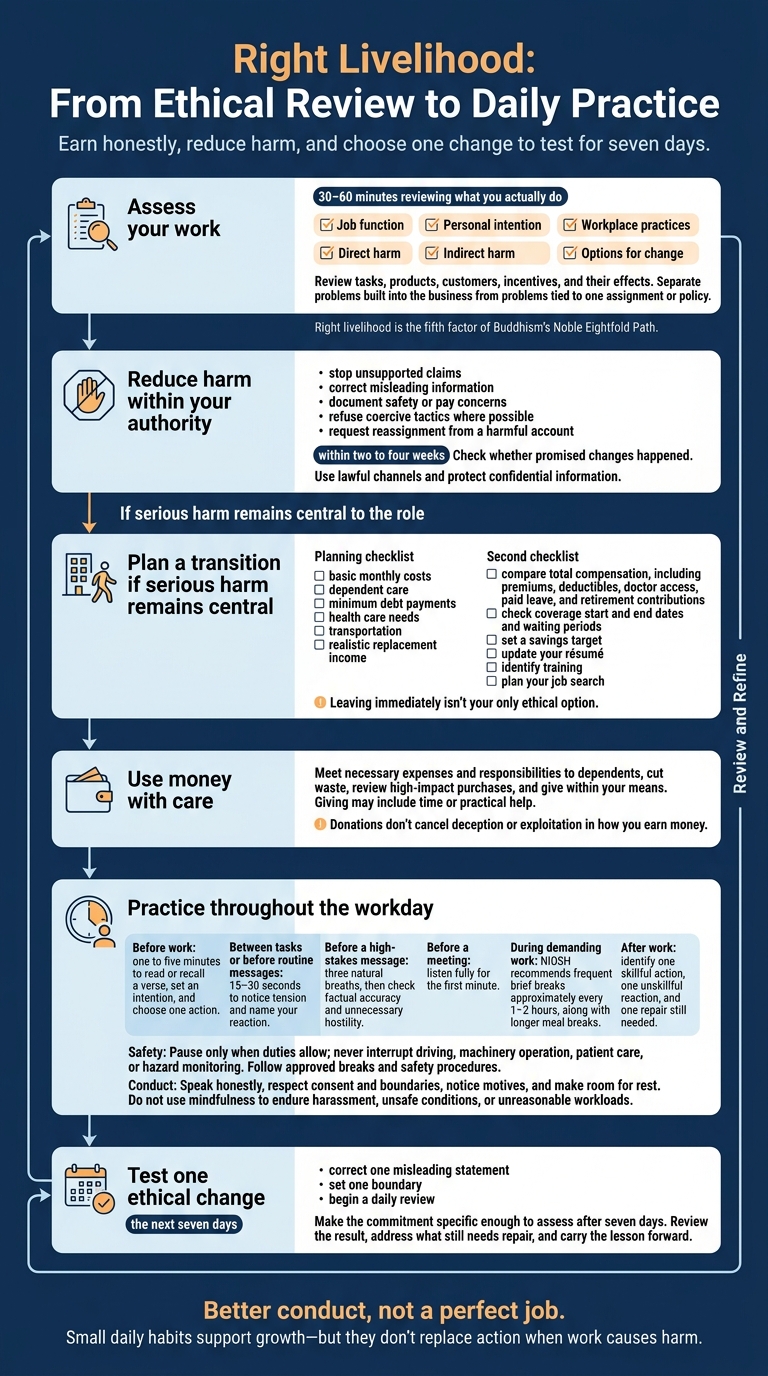
Right Livelihood: From Ethical Review to Daily Practice
Assess Your Work and Plan Changes
Check for Harm and Dishonesty
Seeing clearly is part of practice - not separate from it. The Vaṇijjā Sutta (AN 5.177) advises lay followers to avoid trade in weapons, living beings, meat, intoxicants, and poisons. Long-standing readings connect “living beings” with slavery and trafficking, and “meat” with trade tied to slaughter. Start with that list, then examine any modern role for cheating, coercion, exploitation, unsafe products, and other harm.
Spend 30–60 minutes reviewing what you actually do: your tasks, products, customers, incentives, and their effects. Separate problems built into the business from those tied to a single assignment or policy. Be honest about your motives. Service and financial need can sit alongside greed, status seeking, fear, or competition. Good intentions don’t erase harm.
Use this checklist to name the problem before acting.
| Factor | Question to examine |
|---|---|
| Job function | What does the work produce, sell, operate, or enable that needs to change? |
| Personal intention | Which motives need attention: greed, status seeking, fear, or competition? |
| Workplace practices | Which sales claims, prices, pay practices, contracts, reports, or communications need correction? |
| Direct harm | What injury, addiction, deception, exploitation, or danger can I stop or reduce? |
| Indirect harm | What harm connected to suppliers, contractors, investors, customers, or downstream users needs investigation? |
| Options for change | Can I change a task, client, assignment, process, or policy - or do I need another employer? |
Reduce Harm Before Changing Jobs
If the work still causes harm, move from identifying the problem to fixing it. Start with specific, lawful changes within your authority. Stop unsupported claims, correct misleading information, document safety or pay concerns, refuse coercive tactics where possible, or request reassignment from a harmful account. Keep records without improperly sharing confidential information. Bring concerns to your manager, HR, compliance, union, or regulator.
Business owners should review advertising, fees, sales pressure, product safety, data collection, supplier conditions, waste, pay, scheduling, leave, workplace safety, and treatment of customers with limited alternatives. Set a follow-up date within two to four weeks to check whether promised changes happened.
If serious harm remains central to the role, build a transition plan. Calculate basic monthly costs, dependent care, minimum debt payments, health care needs, transportation, and realistic replacement income. Compare total compensation - not just salary - including premiums, deductibles, doctor access, paid leave, and retirement contributions. Before resigning, check when coverage begins and ends, including any waiting period, COBRA, Marketplace coverage, or a spouse’s plan. Set a savings target, update your résumé, identify needed training, and plan your job search. Leaving immediately isn’t your only ethical option.
Use Money in Line With Your Values
Financial stability is part of the moral context. List necessary expenses and support for dependents, then separate them from discretionary spending. Review recurring purchases and major expenses for waste, deceptive providers, unsafe labor conditions, exploitative financing, or conflicts with your core commitments. Focus on basic needs and decisions with the greatest effects rather than investigating every purchase. Business owners can choose suppliers with safer labor practices and pay invoices promptly.
Give within your means. When money is limited, that can include time or practical help. Donations don’t cancel deception or exploitation in how you earn money. Don’t take on new debt or neglect dependents to appear charitable.
As your external choices become clearer, apply the same discipline to how you speak, decide, and act at work, including your speech, effort, mindfulness, and concentration throughout the workday.
Practicing Buddhist Right Livelihood: Surprisingly Beneficial
Practice the Eightfold Path at Work
Once you’re clear about the work itself, put the path into practice through how you speak, decide, and respond - moment by moment.
Speak Honestly and Act Respectfully
Right speech goes beyond avoiding lies. It also means avoiding false, divisive, harsh, and idle speech. Be clear about uncertainty when making promises, report numbers accurately, and focus feedback on behavior, not character. Before sending a message, ask whether it’s true, needed, timely, and respectful - and whether it spreads gossip or causes harm.
Respectful action means honoring consent, boundaries, property, and confidentiality. Ask before recording meetings or using someone’s work. Access sensitive records only when you have a legitimate need to know. People must be able to say no without retaliation; otherwise, a request becomes pressure. If confidentiality conflicts with safety or a duty to report serious misconduct, turn to workplace policies, HR, an ethics officer, a union representative, or legal counsel for guidance.
Apply Right View and Right Intention
Right view recognizes how craving, aversion, and confusion shape choices and outcomes. In Buddhist terms, it also includes suffering, its causes, its end, and the path. Before a difficult decision, name your emotion, separate facts from assumptions, identify your motive, and ask who bears the risk.
Right intention guides that choice toward renunciation, goodwill, and non-harming. In practice, that means loosening your attachment to status and winning, refusing to turn disagreement into a personal battle, and considering how your choices affect people with less power or less information.
Train Effort, Mindfulness, and Concentration
Right effort means preventing and abandoning unskillful states, then cultivating and maintaining skillful ones - not simply working harder. Notice irritation, craving, or distraction early. Pause, let go of the urge to retaliate, and treat people fairly even under pressure. These moments bring spiritual growth into the workday. Rest, delegation, and asking for help also support this training.
Mindfulness includes awareness of the body, feelings, mind, and mental qualities. Before sending a high-stakes message, take three natural breaths. Notice tension, name the emotion, and check your words for factual accuracy and unnecessary hostility. Brief attention practice can help you listen, but it isn’t full right concentration. Don’t use mindfulness to endure harassment, unsafe conditions, or unreasonable workloads. Use it to set boundaries, seek support, or take formal action.
Make Daily Practice Part of Your Workday
Start With an Intention and a Verse
Once your work is clearer, bring practice into small moments throughout the day. Take one to five minutes before work to read or recall a verse, set an intention, and choose one action that puts it into practice. Tie this habit to arriving at your desk, sitting in a parked car before a shift, signing in at home, or opening your business. These everyday cues can turn ordinary tasks into practice.
Sutta 423 delivers one Dhammapada verse each day for quiet reflection. It begins with the Dhammapada’s 423 verses, providing a daily verse for more than a year. Let the verse guide your actions, not replace good conduct.
Pause Before Messages and Between Tasks
Brief pauses can help you stay connected to your intention. Take 15–30 seconds between tasks or before routine messages to notice tension and name your reaction before acting. Before a meeting, silence unrelated notifications and commit to listening fully for the first minute.
Pause only when your duties allow. Never interrupt driving, machinery operation, patient care, or hazard monitoring. Shift workers should follow approved break times and safety procedures.
Review Your Day and Make Time to Rest
After work, take a moment to identify one skillful action, one unskillful reaction, and one repair still needed. Treat mistakes as chances to correct your actions - not judgments about your character. Check whether spending pressures, after-hours availability, and your stopping time support your values. If you work remotely, mark the end of the workday by closing your laptop or leaving your workspace.
Rest is part of practice. NIOSH recommends frequent brief breaks approximately every 1–2 hours during demanding work, along with longer meal breaks. Managers should make those breaks possible. Persistent exhaustion may point to excessive hours, understaffing, or a health concern - not failed mindfulness. Track one adjustment to carry into tomorrow.
Conclusion: Choose One Ethical Change
Right Livelihood takes practice: earn honestly, reduce harm, and stay attentive at work.
You don’t need to be perfect or resign immediately to make progress. Work within your financial and family responsibilities.
Start today by choosing one commitment for the next seven days: correct one misleading statement, set one boundary, or begin a daily review. Make your commitment specific enough to assess after seven days. Then review the result, address what still needs repair, and carry the lesson forward.
FAQs
How do I assess harm in an indirect role?
Assess whether your contributions align with Right Action and Right Livelihood. Look at whether your work supports harmful outcomes, such as violence or the promotion of harmful substances.
Use mindfulness to notice your intentions and how your daily choices affect others. Consider whether your tasks support harmony or create division. Draw on the Dhammapada’s teachings to guide your actions with compassion, non-harm, and ethical integrity.
What if raising ethical concerns risks my job?
If speaking up about ethical concerns feels risky, use mindfulness and heedfulness to stay true to your values. The Dhammapada stresses responsibility for your actions and growth through steady personal effort. Before you act, pause to notice your impulses and check that your choices match your values.
Daily reflection with the Sutta 423 app can help you build resilience, calm, wisdom, compassion, and non-attachment when situations get difficult.
How can I measure spiritual growth at work?
Pay attention to how you handle daily challenges and whether your actions match your intentions. Can you pause before reacting in anger, choose your response with care, and stay grounded under pressure?
Each evening, review your actions, words, and thoughts. Recognize both moments of kindness and times you fell short, then use them to guide tomorrow’s practice. Reflecting on a daily Dhammapada verse with Sutta 423 can help build this awareness. Growth means acting with integrity, reducing harm, and keeping inner peace.