
How Laypeople Can Practice Monastic Simplicity
Monastic simplicity—use contentment, mindfulness, and fewer desires with daily habits to reduce stress and focus on what matters.
Monastic simplicity isn’t just for monks - it’s a practical way for anyone to reduce stress, find balance, and focus on what matters most. It’s about living with mindfulness, contentment, and fewer desires. Here’s how you can bring these principles into your daily life:
- Contentment: Shift your mindset from wanting more to appreciating what you already have. For example, pause before replacing items and ask, “Does this still serve me?”
- Mindfulness: Make conscious choices by being fully aware of your actions and their purpose. This applies to spending, eating, or even how you plan your day.
- Fewness of Wishes: Simplify your wants by recognizing the hidden costs of excess. Try a 30-day spending freeze to identify what you truly need.
Small steps like decluttering for 15 minutes a day, limiting distractions, and reflecting on your habits can make a big difference. Simplicity doesn’t mean deprivation - it’s about creating space for meaningful growth and inner peace.
A Buddhist Guide to Living Simply | Ajahn Amaro
Core Principles of Monastic Simplicity
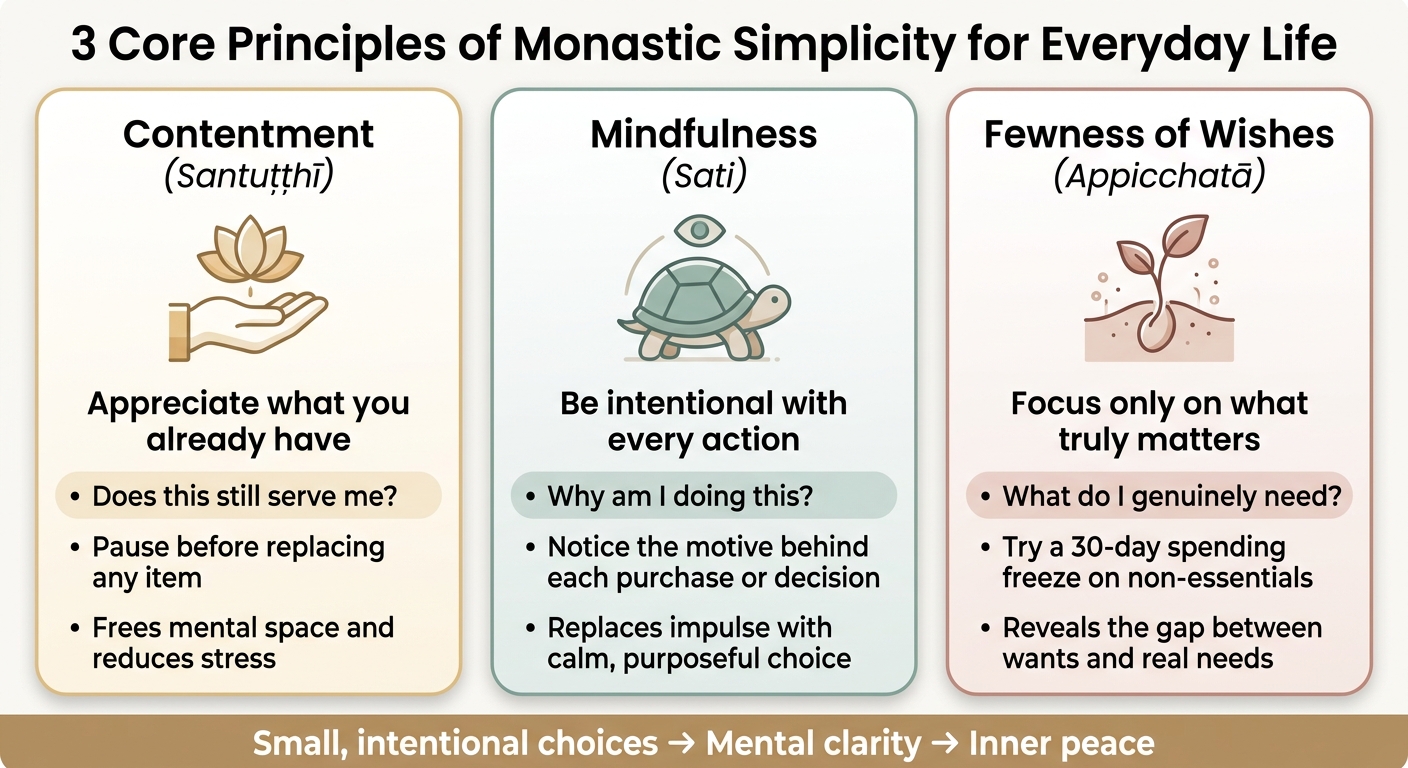
3 Core Principles of Monastic Simplicity for Everyday Life
At the heart of monastic simplicity are three guiding values: contentment, mindfulness, and fewness of wishes. These principles aren't just for monks - they offer practical ways for anyone to simplify their daily lives, from small tasks to major decisions.
Contentment: Finding "Enough" in What You Have
Contentment, known as Santuṭṭhī in Pali, is about shifting your mindset from “I need more” to “I have enough.” It’s not about giving up - it’s about choosing to appreciate what’s already in front of you. When you embrace this value, you free up mental space for what truly matters.
Kim Allen, a Dharma teacher and author, explains that constantly chasing "more" creates stress and can lead to unwise decisions. A simple way to practice this is by pausing before replacing an item. Ask yourself, “Does this still serve its purpose?”
Mindfulness: Making Conscious Choices
Mindfulness (Sati) goes hand in hand with contentment. It’s not just about meditation; it’s about being fully aware of your motives before taking action. Whether you’re buying something, planning your day, or sitting down for a meal, mindfulness helps you act with intention rather than impulse.
The Dhammapada offers a vivid metaphor for mindfulness: a turtle pulling its limbs into its shell to avoid danger. In the context of simplicity, mindfulness helps you identify what truly simplifies your life versus what might just be a fleeting urge to let go. It’s about making choices that bring calm, not chaos.
Fewness of Wishes: Letting Go of Excess
Fewness of wishes, or Appicchatā, encourages you to rethink your desires. This isn’t about depriving yourself - it’s about recognizing the hidden costs of every possession, whether in time, energy, or attention.
The Buddha highlighted the power of this principle:
Bhikkhus, I do not see even a single thing that so causes unarisen wholesome qualities to arise and arisen unwholesome qualities to decline as fewness of desires.
One practical way to explore this idea is by committing to a 30-day spending freeze. During this time, limit purchases to essentials. At the end of the month, reflect: What did you genuinely miss? What turned out to be unnecessary? This exercise often reveals just how wide the gap is between wants and needs.
The Monk Manual describes this process as gardening - clearing away the clutter so the most important things can thrive.
These three principles - contentment, mindfulness, and fewness of wishes - offer timeless wisdom that can be applied to modern life. They provide a solid foundation for simplifying everything from your schedule to your spending habits.
| Principle | Core Idea | Simple Daily Practice |
|---|---|---|
| Contentment | Appreciate what you already have | Pause before replacing: “Does this still serve me?” |
| Mindfulness | Be intentional with every action | Notice the “why” behind each purchase or decision |
| Fewness of Wishes | Focus on what truly matters | Try a 30-day spending freeze for essential needs |
How to Bring Monastic Simplicity Into Daily Life
Simplifying Your Daily Schedule
Streamlining your daily routine begins with cutting out the excess. Monastic simplicity thrives on removing distractions, not adding more to your plate.
Start with how you consume information. Instead of letting news, social media, or podcasts run constantly in the background, set specific times to engage with them. Even a small adjustment like this can create moments of quiet in your day. Try a "phone fast" until noon to preserve the clearest, most focused hours for yourself.
Another simple habit is spending just 15 minutes a day decluttering a small area - like a desk drawer, a shelf, or a corner of a room. Keeping the task brief makes it manageable and helps you build consistency over time.
"What appears to be a form of stark privation under the surface becomes a form of tending, a gardening to make room for the most important seeds of the coming season." - Monk Manual
These small but intentional steps toward decluttering set the stage for more mindful habits in other areas of life.
Mindful Spending and Owning Less
Once your schedule feels less chaotic, it's time to examine your financial habits. Take a look at last month's bank statement and identify purchases that didn’t bring lasting satisfaction. How often do we buy things to ease stress or feel better, only to realize they didn’t help? Jerome Chandler captures this perfectly:
"The peace you have been buying cannot be found until you stop buying it."
This week, cancel one subscription you rarely use. Instead of spending that saved money on something else, consider giving it away. Practicing generosity - known as dāna - is a powerful way to shift your focus from acquiring to letting go.
Balancing Simplicity with Work and Family
Simplifying your life doesn’t mean convincing your family or workplace to change - it starts with setting your own boundaries. For instance, say no to just one social commitment a week. That small act of protecting your time can make a big difference.
At work, simplicity might mean closing unnecessary browser tabs, eating a basic lunch, or stepping away from your desk without headphones. At home, it could be carving out 10 quiet minutes before everyone else wakes up. These aren’t major overhauls - they’re small, deliberate choices that build up over time.
Using Daily Reflections to Stay Grounded
Daily reflections can help you stay connected to these values. The Sutta 423 app offers a simple way to incorporate this into your routine. It delivers one verse from the Dhammapada each day - just one. The app emphasizes ease: "A few minutes is enough... No streaks. No pressure. Just the teachings, day by day."
With 423 verses cycling throughout the year, this practice provides a fresh perspective daily without requiring much time or effort. For those juggling busy lives, such a low-pressure approach can be a practical way to stay grounded in monastic ideals.
Common Challenges and How to Handle Them
Does Simple Living Mean Giving Up Comfort?
Simple living isn't about denying yourself comfort - it's about understanding when comfort turns into attachment. The Buddha's teaching on the Middle Way encourages avoiding extremes: neither overindulgence nor unnecessary self-denial.
Thanissaro Bhikkhu explains renunciation as a wise trade-off:
"An intelligent sacrifice is any in which you gain a greater happiness by letting go of a lesser one, in the same way you'd give up a bag of candy if offered a pound of gold in exchange."
Every possession comes with hidden costs - whether it's time, energy, or attention. That said, a modern lifestyle can still include essentials like food, shelter, clothing, medicine, transportation, and communication without guilt.
If giving something up permanently feels overwhelming, consider a temporary step back. Observing the eight precepts on a weekend or a lunar holiday can help you explore simplicity without a long-term commitment. This practice involves pausing from entertainment and small luxuries, offering a way to align your daily mindful habits with a deeper sense of simplicity.
Of course, simplicity isn't just about internal adjustments. External pressures can also challenge your commitment.
Handling Social Pressure to Spend and Consume
Consumer culture is relentless. From birthdays to holidays, coworker lunches, and group outings, there’s always a reason to spend. Even when subtle, the pressure to buy and consume is hard to ignore.
The Buddha spoke about avoiding social circles that encourage overindulgence. The Maha-mangala Sutta highlights this wisdom:
"Not to associate with the foolish, but to associate with the wise; and to honor those who are worthy of honor - this is the greatest blessing."
One way to counteract this pressure is by redefining what success means to you. The Sigalovada Sutta suggests focusing on qualities like generosity, kind speech, helpfulness, and fairness. These values don’t require spending money and can shift your perspective on what makes life fulfilling.
Before making a purchase influenced by social expectations, take a moment to reflect: will this ease your stress, or will it add to it?
Practicing Simplicity When Family Members Do Not Share Your Values
Living simply at home can be especially tricky when others in your household don’t share your perspective. Trying to impose simplicity on others often leads to tension rather than harmony.
Early Buddhist teachings acknowledge this challenge. Ven. Mahā Kaccāna offers practical advice:
"Please, right there as you are a householder, devote yourself to the message of the Awakened Ones and to the proper-time, one-meal-a-day, sleeping-alone holy life."
The focus here is on personal restraint rather than trying to control others. Small, individual practices - like waking up early, eating simply, or stepping away from screens - can be quietly maintained without disrupting the household. This approach lets you honor your values while preserving peace at home.
Benefits and Limits of Monastic Simplicity for Laypeople
What Simple Living Can Do for You
Simplifying your life clears the way for a deeper understanding of yourself. When you cut down on distractions - whether it's excess possessions, overwhelming obligations, or constant noise - mental clarity tends to follow. It's like clearing a foggy windshield; suddenly, you can see what’s really going on inside.
Bhikkhu Khantipalo explains how restraint can spark a ripple effect that ultimately leads to freedom. Simplicity has a way of reducing regrets, increasing contentment, and naturally encouraging generosity. After all, when you need less, sharing becomes second nature.
However, while simplicity offers mental clarity and ethical rewards, it's important to recognize that applying these principles in everyday life differs greatly from the way monastics live.
How Lay Simplicity Differs from Monastic Life
Monastics live under strict Vinaya rules. They eat just one meal a day, avoid handling money, and rely on the support of lay donors within their community. Soṇa Koṭikaṇṇa, in the Pali Canon, put it plainly:
"According to the Dhamma... it's not easy living at home to practice the holy life totally perfect, totally pure, like a polished shell."
For laypeople, the situation is entirely different. Daily life involves earning a living, raising families, and managing social responsibilities. Simplicity for lay practitioners doesn’t mean renouncing everything; it’s about tailoring a simpler lifestyle that works alongside these everyday commitments.
The challenge lies in ensuring that this approach to simplicity stays aligned with Buddhist principles.
Checking That Your Simplicity Aligns with Buddhist Values
While simplicity can bring personal benefits, it’s equally important to ensure it addresses the root causes of suffering, as taught in Buddhism. Ask yourself: Does your simplicity truly free your mind, or is it just a way to avoid difficult situations? Genuine renunciation feels steady and calming. If your approach feels forced or leaves you uneasy, it might be time to reassess.
A good way to check is by observing whether your simplicity reduces greed, hatred, and delusion in your daily life. The Buddha’s teachings aren’t about chasing a minimalist lifestyle; they’re about liberating the mind.
It’s also worth noting that Buddhist simplicity for laypeople doesn’t mean embracing poverty. A traditional guideline divides wealth into four parts: one for personal needs and charity, two for maintaining livelihood and business, and one for emergencies. Simplicity in this sense means using your resources thoughtfully, not stripping them away entirely.
Conclusion: Taking Small Steps Toward a Simpler Life
Monastic simplicity isn’t about reaching a final destination - it’s about moving in a purposeful direction. You don’t have to quit your job, sell your home, or live in a monastery to embrace this mindset. Instead, the journey is shaped by small, intentional choices.
As Xion Feng, Feng Shui Master and Buddhist Author, wisely says:
"Perfection is never the goal; genuine effort is. We encourage you to begin with small, deliberate steps."
Simple changes - like waking up 10 minutes earlier, spending a few moments decluttering, or pausing to reflect before a difficult conversation - can lead to meaningful, lasting transformation.
These small, mindful actions tie directly to the practices explored earlier. For instance, reading a single verse from the Dhammapada each day can be a grounding ritual. The Sutta 423 app offers one verse daily, allowing you to reflect quietly and work through all 423 verses over the course of a year.
FAQs
How do I start practicing simplicity without changing my whole life?
You can start embracing simplicity by taking small, deliberate steps. Begin by reducing distractions - cut back on time spent scrolling through social media or consuming excessive news. Create moments of quiet in your day to recharge. Another step is to declutter your surroundings - dedicate just 15 minutes a day to tidying up and organizing your space.
Set clear boundaries by learning to say no to obligations that don’t resonate with your priorities or values. Finally, try practicing contentment with less. For one month, avoid buying anything non-essential and take time to reflect on how this shift impacts your mindset and habits. Small changes like these can make a big difference.
How can I handle social pressure to spend more?
To navigate the pressure to spend, embrace simplicity and detachment. Take time to reflect on what truly matters to you, helping you stay rooted in your values. Practicing mindfulness can make you more aware of social influences and help you manage them effectively. Set clear boundaries by politely saying no to expenses that don't align with your priorities. Redirect your attention toward non-material sources of happiness, such as meditation or connecting with others, to ensure your actions reflect a life centered on simplicity and inner contentment.
How do I practice simplicity if my family isn’t on board?
Start by taking small, intentional steps toward simplifying your life. Begin with actions like decluttering your space, embracing moderation in your habits, and setting aside time for quiet reflection or meditation. These changes can gradually create a sense of balance.
When it comes to your family, approach the topic with care. Share your intentions calmly and give them time to understand your perspective. Remember, living a simpler life is a personal choice - it doesn’t have to depend on anyone else's approval. You can pursue this path while maintaining peaceful and loving relationships.