
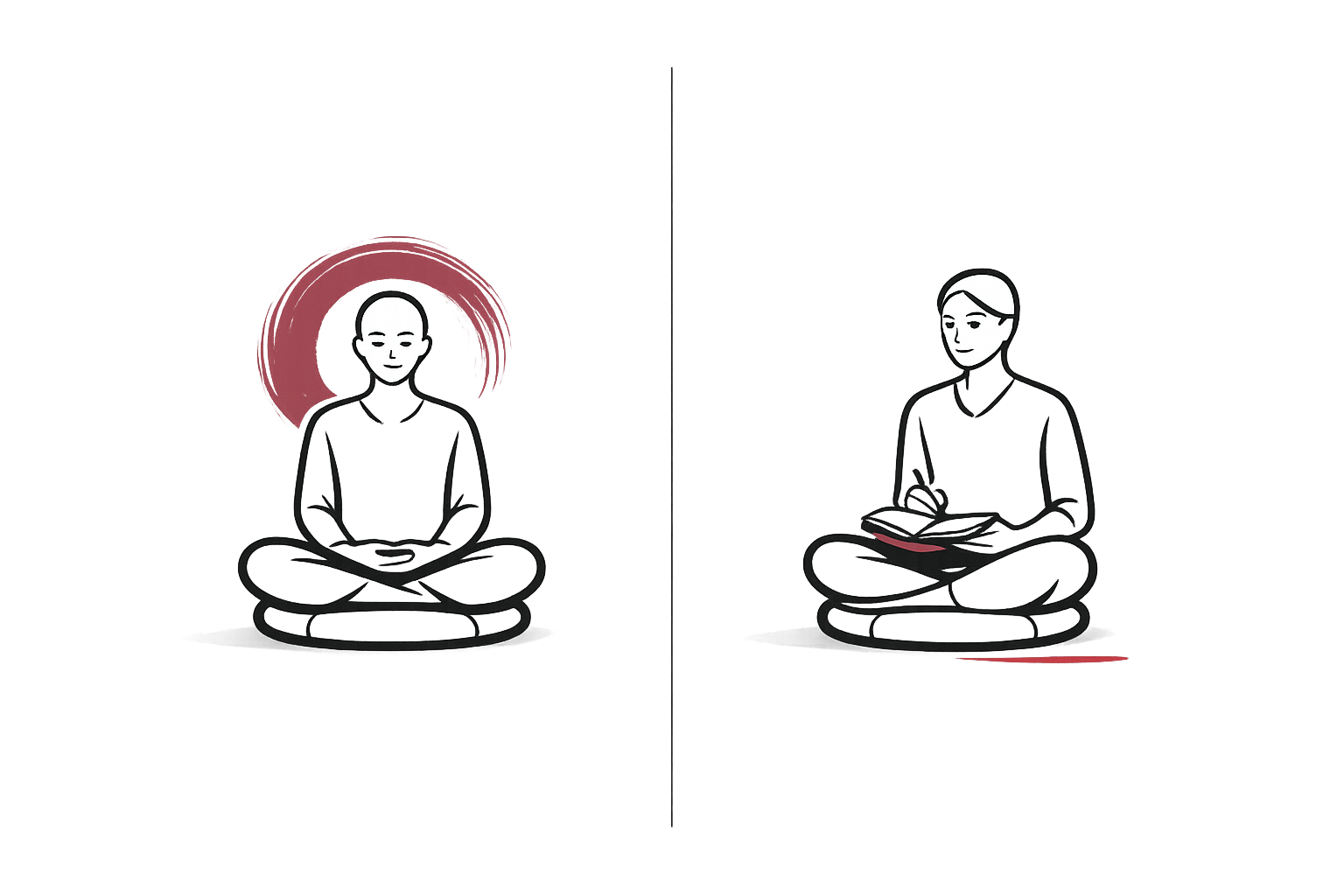
Meditation vs Reflection: Key Differences Explained
Explore meditation vs reflection in Buddhism: calming present-moment awareness vs analytical contemplation for insight and ethical clarity.
Meditation and reflection are two distinct practices in Buddhism, each serving a unique purpose. Meditation focuses on calming and centering the mind, helping you stay present and develop mental clarity. Reflection, on the other hand, involves analyzing experiences and teachings to gain deeper understanding and personal insight. Both practices work together to enhance mindfulness and self-awareness.
Quick Overview:
- Meditation: Centers on stillness and present-moment awareness. Techniques like mindfulness of breathing (Anapanasati) help calm the mind and prepare it for deeper focus.
- Reflection: Involves logical analysis and contemplation of past experiences or teachings to develop wisdom and conviction.
Key Differences:
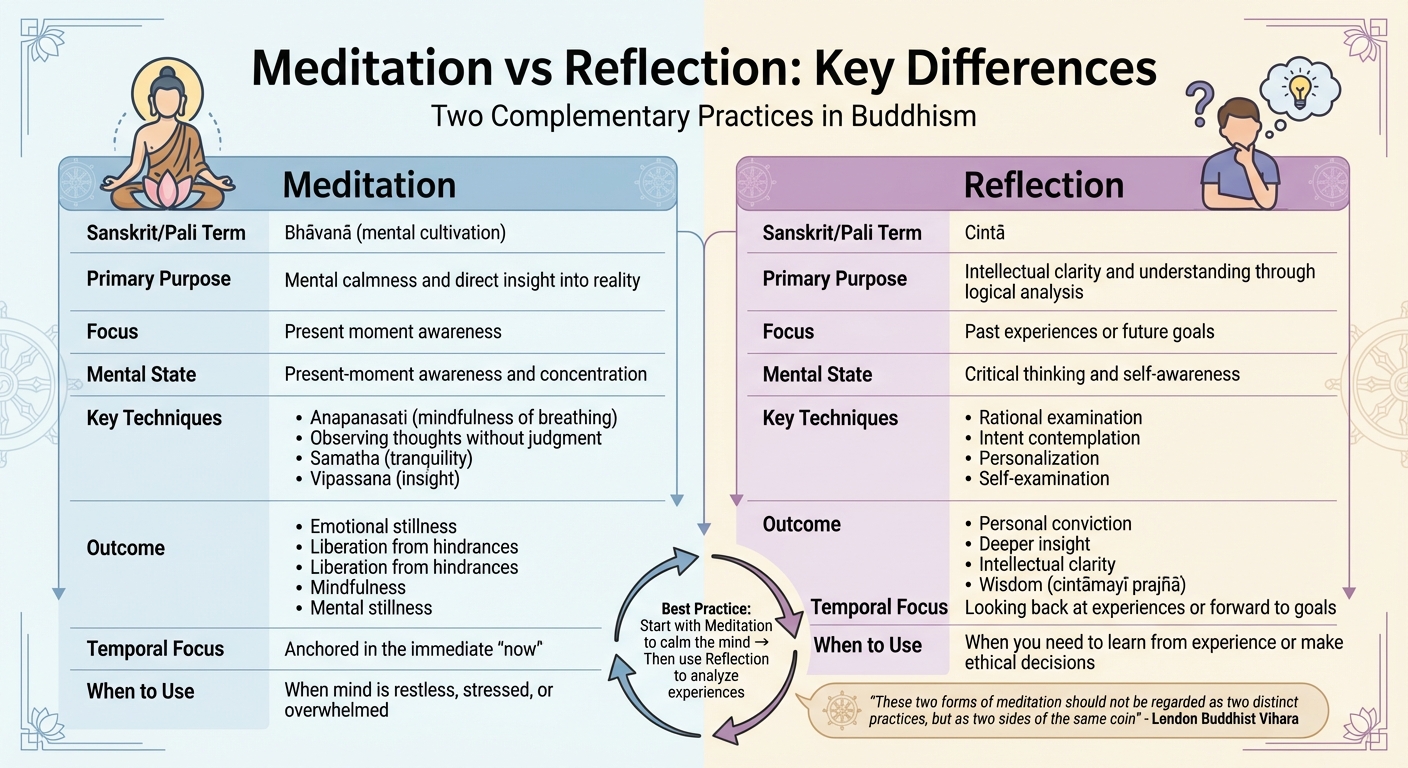
| Aspect | Meditation | Reflection |
|---|---|---|
| Purpose | Mental calmness and direct insight | Intellectual clarity and understanding |
| Focus | Present moment | Past experiences or future goals |
| Technique | Mindful breathing, observing thoughts | Logical analysis, self-examination |
| Outcome | Emotional stillness, mindfulness | Personal conviction, deeper insight |
To integrate both into daily life, start with meditation to calm your thoughts, then use reflection to analyze experiences and decisions. Together, they create a balanced approach to mindfulness and personal growth.
Meditation vs Reflection in Buddhism: Key Differences and Techniques
What’s The Difference Between Meditation and Thinking?
What is Meditation in Buddhist Teachings?
In Buddhism, meditation is referred to as bhāvanā, meaning "mental cultivation." It serves as a way to purify the mind and develop the wisdom needed to perceive reality as it truly is. The Buddha described meditation as "the direct path for the purification of beings, for the overcoming of sorrow & lamentation, for the disappearance of pain & distress, for the attainment of the right method, & for the realization of Unbinding".
Meditation works on two interconnected levels. First, there's samatha (tranquility meditation), which calms and focuses the mind by concentrating on a single object, creating a sense of mental stillness. Then, there's vipassana (insight meditation), which uses that calm focus to explore the deeper truths about existence - impermanence, suffering, and the lack of a fixed self. Think of samatha as clearing the mind's clutter, while vipassana dives into understanding life's fundamental nature. Together, these practices form the foundation for effective meditation techniques.
Meditation Techniques
One of the most basic and widely practiced methods is anapanasati, or mindfulness of breathing. The Anapanasati Sutta provides a framework of 16 stages, grouped into four progressive steps. To start, you sit with your legs crossed, keeping your back straight, and focus your attention on the sensation of the breath at the nostrils or upper lip. The practice begins with observing whether the breath is long or short and gradually expands to include awareness of bodily sensations as you breathe.
When your mind inevitably wanders, you simply acknowledge the distraction without self-criticism and gently bring your focus back to the breath. This process helps quiet the "monkey mind", the constant chatter of thoughts. These techniques are essential for achieving clarity and mental discipline, paving the way for deeper spiritual exploration.
Purpose of Meditation
The ultimate goal of mastering these meditation techniques is to prepare the mind for profound spiritual growth. Meditation lays the groundwork for concentration, emotional resilience, and the ability to observe your thoughts without attachment. As the Dhammapada states, "Mind is the forerunner of all states. Everything we experience in life is through our mind". By focusing attention on the breath, practitioners nurture the seven factors of awakening: mindfulness, investigation of qualities, energy, joy, tranquility, concentration, and equanimity.
The benefits of meditation extend beyond formal practice. By carrying mindfulness into everyday activities - whether eating, walking, or working - you turn meditation into a way of life rather than a separate practice. This integration transforms how you engage with the world, fostering continuous awareness and presence.
What is Reflection in Buddhist Teachings?
In Buddhism, reflection is a practice that goes hand in hand with meditation, but it serves a different purpose. While meditation focuses on cultivating awareness in the present moment, reflection - called cintā in Sanskrit - centers on examining teachings and personal experiences. It’s a process of using logic and reasoning to internalize the Dhamma (the Buddha's teachings) and develop a deeper, more personal conviction in them.
Reflection acts as a bridge between learning Buddhist principles and applying them in meditation. A key aspect of this practice involves contemplating sacred verses, such as those in the Dhammapada. Bhikkhu Bodhi describes this revered text as:
"for the intellectually overburdened its clear and direct teachings inspire humility and reflection; for the earnest seeker it is a perennial source of inspiration and practical instruction".
The process isn’t just about reading these verses - it’s about diving into their meaning and figuring out how their wisdom applies to your daily life. Another essential aspect of reflection is self-examination, where you regularly analyze your thoughts, speech, and actions to identify and address impurities. Below, we’ll explore the methods of reflection and its role in cultivating wisdom.
Reflection Methods
Buddhist reflection relies on three main approaches to deepen understanding: rational examination, intent contemplation, and personalization.
- Rational examination involves using logic to evaluate and verify the teachings instead of accepting them at face value.
- Intent contemplation digs beyond the surface meaning of words to uncover their deeper purpose.
- Personalization is about reflecting on what you’ve learned until it becomes an integral part of your beliefs and actions.
For example, when dealing with emotions like anger, reflection encourages observing it objectively - acknowledging it as "there is anger" - to reduce its power over you. This detached examination allows for a deeper understanding of the three characteristics of existence: anicca (impermanence), dukkha (unsatisfactoriness), and anatta (the absence of a permanent self).
Purpose of Reflection
Through reflection, practitioners cultivate what is known as cintāmayī prajñā - wisdom born from contemplation. Vasubandhu, a prominent Buddhist scholar, described this type of wisdom as:
"The wisdom arisen from reflection is a certitude born of rational examination".
This practice helps temporarily quiet disturbing emotions and offers a way to analyze past experiences in alignment with Buddhist principles. It’s not just about intellectual understanding - it’s about transforming that understanding into conviction.
Scott Tusa, a Buddhist meditation teacher, emphasizes the importance of this process:
"this internal churning, fueled by logical reasoning and critical thinking, is a vital stage in the growth of our understanding and practice".
Ultimately, the conviction developed through reflection lays the groundwork for deeper meditation. It enhances the clarity meditation provides and deepens one’s engagement with the teachings. As the Buddha himself said:
"whoever earnestly practices the teachings found in the Dhammapada will taste the bliss of emancipation".
Key Differences Between Meditation and Reflection
Meditation and reflection are both integral to Buddhist practice, but they serve different purposes and follow unique approaches. Knowing these distinctions can help shape your practice.
Purpose and Outcomes
The goals of meditation and reflection set them apart. Meditation, particularly in forms like Shamatha (calm abiding) and Vipashana (insight), centers on calming the mind and fostering awareness of the present moment. As Scott Tusa, a Buddhist meditation teacher, puts it:
"Insight meditation is where the learnings and reflections from the first two wheels truly come alive. It's a direct, transformative experience in meditation".
This transformative experience aims to free the mind from obstacles like sensual cravings and negative emotions. Reflection, on the other hand, focuses on developing intellectual clarity and conviction by analyzing teachings logically. It encourages moving beyond mere acceptance of doctrines, helping practitioners build a deeper understanding they can genuinely embrace.
These differences in purpose lead to distinct outcomes and methods, as summarized below:
| Feature | Meditation | Reflection |
|---|---|---|
| Primary Purpose | Achieve calm and direct insight into reality | Deepen understanding through logical analysis |
| Mental State | Present-moment awareness and concentration | Critical thinking and self-awareness |
| Outcome | Liberation from hindrances and mental stillness | Intellectual clarity and conviction in teachings |
| Temporal Focus | Anchored in the immediate "now" | Looking back at experiences or forward to goals |
These contrasting purposes shape the techniques used in each practice.
Techniques and Processes
Though both practices enhance mindfulness, their methods are quite different. Meditation often involves techniques like mindfulness of breathing (Anapanasati), which helps quiet the mind in a serene environment. This process includes steps such as "calming the mind" and "experiencing rapture" as mental stillness develops.
Reflection, however, leans on structured analysis to evaluate and internalize teachings. A practical example is the ERA model (Experience, Reflection, Action), which integrates reflection into daily routines through planned check-ins. This structured, analytical approach contrasts with meditation's emphasis on observing thoughts and sensations without judgment or analysis.
How to Use Meditation and Reflection in Daily Life
Meditation and reflection can seamlessly fit into your daily routine. Meditation helps bring mindfulness to even the simplest tasks, while reflection allows you to better understand your experiences. Together, they promote clarity and a deeper sense of ethical awareness. Let’s explore how meditation can ease stress and how reflection sharpens ethical decision-making.
Using Meditation for Stress Reduction
You can start meditating with everyday activities - washing your hands, tidying up, or preparing your space. When stress or negative emotions like anger surface, shift your focus to something positive, such as cultivating a sense of friendliness (metta).
If your thoughts wander, gently acknowledge their unhelpfulness and guide your attention back. On days when formal meditation feels difficult, engage in simple, grounding tasks like organizing your belongings or reading. These activities can help settle a restless mind and prepare you for deeper focus.
Consider the example of the novice Tissa at Cittalapabbata. He balanced physical labor, memorizing sacred texts like the Samyutta Nikaya, and practicing fire-device meditation (tejokasina). Through consistent effort, he achieved the state of an arahant - a person who has mastered the art of choosing which thoughts to nurture and which to release.
While meditation calms the mind, reflection plays a key role in refining your ethical decisions.
Using Reflection for Ethical Decision-Making
Reflection is about observing your mind and its patterns to gain insight into reality. During quiet moments, take time to examine your intentions and attitudes, exploring how desires can lead to dissatisfaction. As the Dhammapada teaches, "Mind is the forerunner of all states", highlighting how our mental habits influence our ethical choices.
Everyday tasks - like cleaning, driving, or enjoying a cup of tea - can become moments of reflection when you pause to notice your physical sensations and mental states. Reflection also reinforces ethical living by encouraging commitments to avoid harm, theft, sexual misconduct, intoxicants, and unkind speech.
When to Choose Meditation Over Reflection
The choice between meditation and reflection often depends on your mental state and what you want to achieve. A simple guideline is this: if your mind feels restless or overwhelmed, start with meditation. As explained by the London Buddhist Vihara:
"True contemplation is hard to achieve unless the mind is calm and clear. Hence, the practice of samatha [meditation] is an essential aid to vipassana [reflection]".
Think of your mind like a pond. When the water is choppy, you can't see the bottom clearly. Meditation helps calm those ripples, allowing clarity to surface. On the other hand, reflection dives deeper to address the underlying causes of mental unrest, helping prevent those disturbances from returning.
Meditation is especially helpful during moments of high stress, emotional upheaval, or when you're dealing with a "monkey mind" - where thoughts jump erratically from one worry to another. In such situations, logical thinking becomes nearly impossible. A short 10-minute walking or sitting meditation can help settle the chaos, allowing you to observe emotions more objectively. For instance, recognizing "there is anger" instead of "I am angry" can reduce the emotion's intensity.
Reflection, on the other hand, is better suited for times when you need to learn from an experience, make ethical decisions, or evaluate your actions. It requires a calm and focused mind to uncover the "why" behind your emotions, assess your skills, or create actionable plans for the future [20,22]. However, attempting reflection with an unsettled mind can backfire, leading to repetitive thought loops or harsh self-criticism [20,21].
The best approach? Combine both practices. Start with meditation to calm and focus your mind, then move into reflection to explore insights about your patterns and beliefs. This sequence ensures that your analysis comes from a place of clarity rather than anxiety or overthinking.
Conclusion
Meditation and reflection work hand in hand to create a well-rounded approach to mindfulness and personal growth. Meditation helps quiet the mind through techniques like focusing on the breath, while reflection applies thoughtful analysis to deepen understanding of Buddhist teachings. As Buddhist meditation teacher Scott Tusa puts it:
"Reflection enhances our understanding and brings a richer experience to our meditation".
The Buddhist concept of the Three Wheels highlights this connection: learning the Dharma, reflecting on it, and meditating to internalize it. Each step supports the next, and skipping one can weaken the entire process. Meditation transforms intellectual knowledge into direct experience, emphasizing the importance of balancing these practices.
The London Buddhist Vihara beautifully sums up their relationship:
"These two forms of meditation [Samatha and Vipassana] should not be regarded as two distinct practices, but as two sides of the same coin".
Start with meditation to calm your thoughts, then use reflection to examine your patterns and beliefs. Meditation provides stillness, while reflection deepens understanding. Together, they strengthen your journey along the Buddhist path, offering a way toward meaningful transformation and awakening.
FAQs
How do I know if I’m reflecting or just overthinking?
You can distinguish between the two by focusing on your mindset and intentions. Reflection involves deliberate and thoughtful consideration, meant to help you learn from past experiences or lessons. On the other hand, overthinking tends to be a cycle of repetitive and unhelpful thoughts, often fueled by stress or fear. Think about it this way: Are your thoughts helping you gain clarity, or are they just going in circles? If it feels like the latter, you’re probably overthinking.
Can I practice reflection without meditation first?
Reflection doesn't require meditation. It's about thoughtfully examining past experiences or lessons to gain deeper understanding. While meditation helps with staying present, reflection focuses on analyzing and learning from what has already happened, making it a standalone way to build self-awareness.
How long should I meditate before I start reflecting?
Meditation can be a powerful way to prepare your mind for reflection. Taking just a few minutes to meditate helps you achieve a sense of calm and focus. By fostering concentration and tranquility, meditation creates the mental clarity needed for deeper and more effective self-reflection.