

Karunā and Empathy: A Buddhist Perspective
Empathy opens the heart; karunā turns that feeling into sustained, ethical action to relieve suffering.
Karunā (compassion) and empathy are key concepts in Buddhist practice, but they serve different purposes. Empathy is the ability to deeply feel and understand another's emotions, while karunā transforms that understanding into actions that alleviate suffering. Together, they form a pathway for ethical living and meaningful engagement with the world.
- Empathy: Emotional awareness of others' pain; the starting point for connection.
- Karunā: Compassionate action aimed at reducing suffering, grounded in empathy.
- Meditation Practices: Both are cultivated through mindfulness and practices like "sameness of self and others."
- Ethical Impact: Empathy builds awareness, while karunā drives tangible actions like non-harming and community support.
In Buddhist teachings, empathy without action risks emotional fatigue, while karunā without empathy can feel detached. Together, they bridge emotional understanding with ethical action, inspiring practices that address suffering at all levels.
1. Karunā (Compassion)
Definitional Scope and Intent
Karunā is the heartfelt desire for others to be free from suffering. Unlike maitrī, which focuses on fostering happiness, karunā emphasizes the alleviation of pain. This difference is key because it shapes how one approaches suffering - not by fixating on the pain itself, but by envisioning liberation from it.
The Visuddhimagga sheds light on this intent: "Compassion (karuna) is characterized as promoting the aspect of allaying suffering. Its function resides in not bearing others' suffering." This compassionate mindset extends to all beings ensnared in saṃsāra - even those who seem content but remain trapped by ignorance and karma, as well as those who inflict harm. Bhikkhu Analayo highlights this perspective, stating, "The cultivation of compassion itself... finds its expression in the wish for the other to be free from dukkha. In this way, the mind takes the vision of freedom from affliction as its object."
This deep commitment to easing suffering forms the bedrock of Buddhist ethical practices.
Role in Non-Harming (Ahimsa)
Living out karunā naturally leads to the practice of non-harming, or ahimsa. Karunā dissolves the illusion of separation between self and others. Through the practice of "interchangeability of self and other" (parātmaparivartana), harming another becomes unthinkable - it’s akin to harming oneself. Shantideva captures this beautifully in the Bodhisattvacaryavatara: "Since I and other beings both, in wanting happiness, are equal and alike, what difference is there to distinguish us, that I should strive to have my bliss alone?"
This understanding, grounded in śūnyatā (emptiness), breaks down the usual divisions of good versus bad or like versus dislike, which often fuel harmful actions. Historically, this compassion has inspired acts of kindness, such as freeing animals, building infrastructure, and supporting social welfare programs. Its reach extends to all beings, from humans to "helpless beasts and even insects".
Practice Methods in Meditation
As one of the Four Immeasurable Attitudes (catvāri apramāṇāni), karunā is cultivated alongside friendliness, sympathetic joy, and equanimity. True compassion doesn’t involve being consumed by another's pain; instead, it focuses on fostering a vision of relief, avoiding emotional burnout.
The 14th Dalai Lama explains this balance: "Compassion enables us to look at suffering in all its tortuous varieties without succumbing to despair." Meditation on karunā involves seeing the shared desire for happiness and freedom from pain among all beings. This practice, often referred to as "sameness of yourself and others", helps practitioners develop compassion by recognizing the helplessness of those overwhelmed by suffering.
Through meditation, this internal cultivation translates into ethical action.
Outcomes for Ethical Conduct
In Mahāyāna Buddhism, mahākaruṇā (great compassion) and prajñā (wisdom) are inseparable, ensuring that compassion is both enduring and effective. The Bodhisattva Vow illustrates this dedication: "As long as there is one unhappy person in the world, my happiness is incomplete".
This commitment to non-harming fosters well-being on both personal and collective levels. The Buddha encouraged this ethos, saying: "Bhikkhus, wander forth for the welfare and happiness of the manyfolk, for the compassionate assistance of the world". This guidance transforms inner compassion into outward action, promoting harmony with interconnected natural systems and engaging in efforts to reduce suffering within communities.
2. Empathy
Definitional Scope and Intent
Building on the concept of karunā, empathy can be seen as the emotional starting point. At its core, empathy is the ability to share in someone else's feelings, experiencing their emotions as if they were your own. Fleet Maull, PhD, a Buddhist teacher and author, explains:
I like to define [empathy] as the capacity to feel with accuracy what another is feeling, by directly sharing similar feelings.
This idea of "empathic resonance" goes deeper than merely observing someone’s pain - it’s about internally reflecting their emotional state. In Buddhist philosophy, empathy is closely tied to the Four Immeasurable Attitudes. For example, muditā (sympathetic joy) involves sharing in another’s happiness, while empathy in the context of suffering sets the stage for karunā, the compassionate response aimed at easing that suffering. However, if empathy doesn't transition into compassionate action, it can lead to "empathic distress", where being overwhelmed by another's pain causes withdrawal instead of engagement.
Role in Non-Harming (Ahimsa)
Empathy is crucial in overcoming the "bystander effect", where people ignore suffering to maintain personal comfort. The Socialist Therapist poses a powerful question:
What if we practiced a sense of empathy for all those who suffer around us? Because [the city] is so enormous we have to block out much to go on with our daily lives. But what if we didn't turn away so much?.
By choosing not to look away from suffering - whether it’s homelessness, poverty, or community struggles - empathy challenges judgmental attitudes and encourages ethical, engaged responses. This shift from passive observation to active participation creates a pathway for ethical conduct. Cultivating empathy in this way not only builds awareness but also lays the groundwork for meditation practices that transform emotional pain into compassionate action.
Practice Methods in Meditation
Buddhist meditation offers tools to address the challenge of empathic distress, which can trigger a fight-flight-freeze response that pushes people away from suffering. Instead of retreating, practitioners are taught to see this distress as a signal to open the heart and move toward compassion. Fleet Maull highlights this perspective:
Compassion is the willingness to be with suffering - our own and that of others - without blame or fear-based reactions.
Rather than rushing to fix discomfort, meditation encourages individuals to bear witness and "suffer with" those in pain. This practice, often referred to as "radical acceptance", allows empathy to evolve into compassion without becoming overwhelming. By bridging the emotional understanding of empathy with the ethical commitment of karunā, this approach reinforces the interconnectedness central to Buddhist teachings.
How Compassion Became Empathy in Buddhist Meditation
Comparing Karunā and Empathy
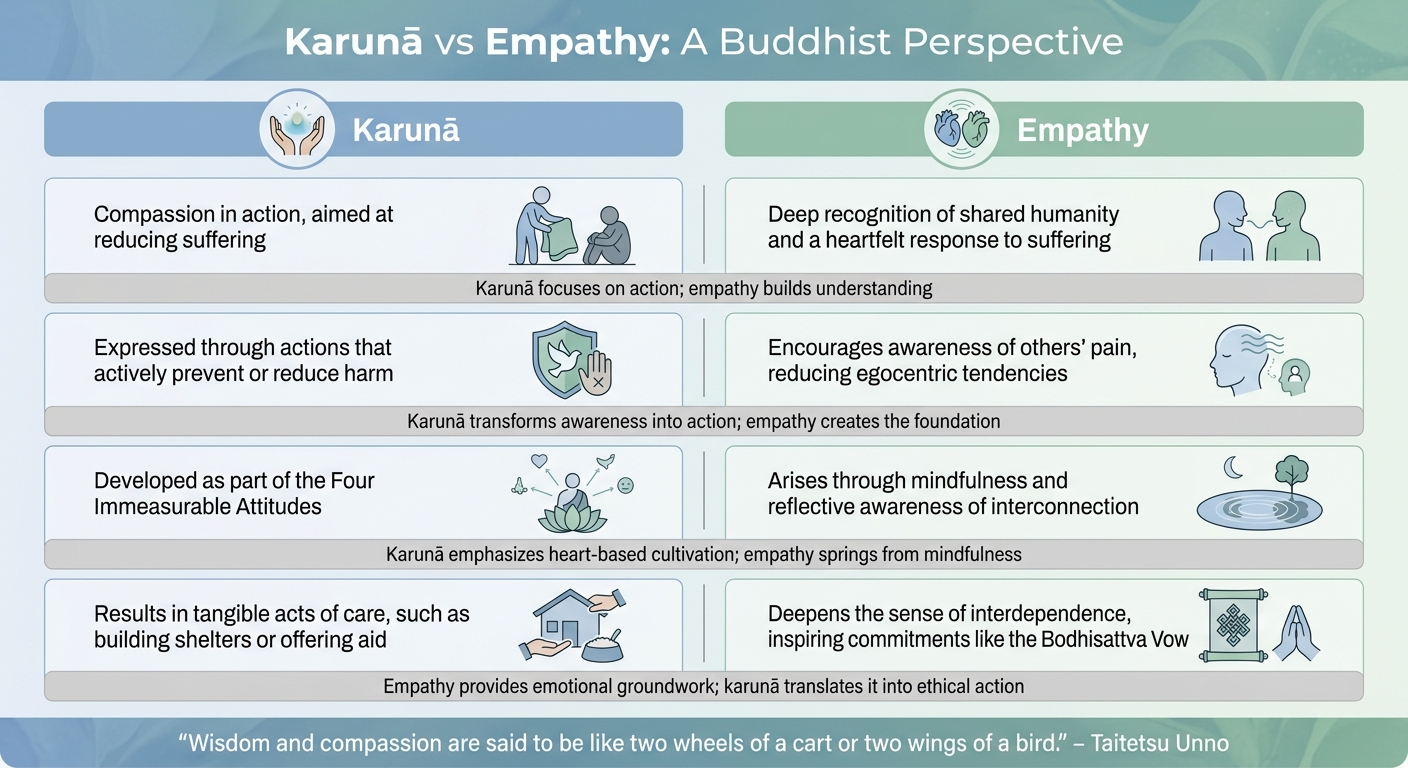
Karunā vs Empathy: Key Differences in Buddhist Practice
In Buddhist philosophy, karunā and empathy are closely connected, yet they serve distinct roles that complement each other in shaping ethical behavior. Empathy is the inner awareness of shared suffering and the interconnectedness of all beings. Karunā, on the other hand, channels that awareness into deliberate, compassionate actions aimed at relieving pain.
Here’s a breakdown of their unique yet interconnected features:
| Criterion | Karunā | Empathy | Key Difference/Implication |
|---|---|---|---|
| Definitional Scope and Intent | Compassion in action, aimed at reducing suffering. | Deep recognition of shared humanity and a heartfelt response to suffering. | Karunā focuses on action; empathy builds understanding. |
| Role in Non-Harming (Ahimsa) | Expressed through actions that actively prevent or reduce harm. | Encourages awareness of others’ pain, reducing egocentric tendencies. | Karunā transforms awareness into action; empathy creates the foundation for non-harming. |
| Meditative Practice Methods | Developed as part of the Four Immeasurable Attitudes. | Arises through mindfulness and reflective awareness of interconnection. | Karunā emphasizes heart-based cultivation; empathy springs from mindfulness practices. |
| Outcomes for Ethical Conduct | Results in tangible acts of care, such as building shelters or offering aid. | Deepens the sense of interdependence, inspiring commitments like the Bodhisattva Vow. | Empathy provides the emotional groundwork; karunā translates it into ethical action. |
Together, empathy and karunā create a foundation for ethical practice, as illustrated by scholar Taitetsu Unno:
"Wisdom and compassion are said to be like two wheels of a cart or two wings of a bird."
This metaphor highlights how essential both elements are - neither can function fully without the other. Empathy breaks down the barriers between self and others by revealing shared interdependence, while karunā transforms this understanding into meaningful acts of care. Historically, such compassionate action has been evident in initiatives like planting orchards, digging wells, founding orphanages, and teaching sustainable farming.
By combining the emotional insight of empathy with the active compassion of karunā, practitioners go beyond passive reflection. This fusion embodies the spirit of the Bodhisattva Vow:
"As long as there is one unhappy person in the world, my happiness is incomplete."
Strengths and Limitations
Both karunā (compassion) and empathy hold important places in Buddhist practice, but they bring different strengths and challenges to the table. By examining how they function in practical, neurological, and ethical contexts, we can better understand how to use them together to ease suffering effectively.
| Aspect | Karunā (Compassion) | Empathy |
|---|---|---|
| Strengths | Promotes taking action to reduce suffering; engages brain areas tied to positive emotions and nurturing behaviors; avoids burnout and remains sustainable | Deepens understanding of others' pain; counters the instinct to avoid suffering; highlights the interconnectedness of all beings |
| Limitations | Risks becoming superficial or procedural if not grounded in empathetic awareness | Can stay passive without leading to action; may cause "empathetic distress", resulting in emotional fatigue |
| Practical Application | Essential for ethical actions, helping practitioners respond to suffering without feeling overwhelmed | Offers the first step in recognizing suffering, paving the way for deeper karunā to develop |
Scientific research backs up these differences, particularly in how the brain reacts to compassion versus empathy. Dr. Richard J. Davidson's work at the University of Wisconsin–Madison, using fMRI imaging, highlights a key distinction: empathy activates brain regions tied to personal pain, while compassion engages areas associated with positive emotions and caregiving behaviors. This explains why empathy alone can lead to "empathetic distress", leaving individuals emotionally drained, whereas compassion fosters a more sustainable and proactive response.
Author David Michie captures this contrast perfectly:
"The ability of someone to emote is quite different from their ability to take compassionate action. Emoting may very well be an obstacle!"
Conclusion
Throughout our exploration of empathy and karunā in Buddhist philosophy, it’s clear these principles aren’t opposing forces - they are deeply interconnected. Empathy acts as the starting point, training us to notice suffering and resist the urge to turn away. As The Socialist Therapist puts it:
Most of us want to turn away from suffering. I can instinctively do it at times... But because it is so enormous we have to block out much to go on with our daily lives.
This natural tendency to avoid discomfort often fuels the bystander effect. However, when we consciously acknowledge suffering, we create the foundation for karunā - the active wish to alleviate that suffering. Together, empathy and karunā form a pathway to meaningful ethical action.
Without empathy, compassion risks becoming superficial. Without karunā, empathy alone can lead to emotional exhaustion. The challenge lies in transforming our recognition of shared pain into committed, compassionate action. This requires us to face suffering head-on, quiet our inner critic, and move beyond judgment to embrace our shared humanity. Over time, the daily practice of not turning away builds the emotional resilience needed for true compassion.
To bridge understanding and action, tools like the Sutta 423 app can be invaluable. By offering one verse from the Dhammapada each day, it provides a year-long guide to help translate these teachings into everyday life, turning abstract ideas into lived experiences.
FAQs
How do I turn empathy into karunā in daily life?
To turn empathy into karunā (compassion), the key lies in shifting from simply feeling to actively doing, guided by kindness and a sense of responsibility. This means being mindful of the suffering of others, fostering a sincere desire to assist, and taking steady, meaningful actions to ease their pain. In Buddhist teachings, compassion is seen as more than just an emotion - it's a deliberate and ongoing effort to support others, even when their suffering cannot be entirely eliminated.
How can I avoid empathic distress or burnout?
To avoid empathic distress or burnout, work on nurturing compassion (karunā). Compassion differs from empathy in that it emphasizes providing care and kindness without becoming consumed by someone else’s pain. This approach helps you respond with genuine support while preserving your emotional well-being.
What meditation helps cultivate karunā and non-harming?
Meditation on loving-kindness, also known as metta, is a meaningful practice that nurtures both karunā (compassion) and the commitment to non-harming. By focusing on cultivating feelings of goodwill and empathy, this meditation aligns closely with key principles in Buddhist teachings, encouraging kindness toward oneself and others.