

Ignorance Link Problems in Early Buddhist Thought
Examines whether ignorance is first in time or explanation, how it’s conditioned, and how responsibility and practice allow change.
Ignorance starts the 12-link account of suffering, but it is not an uncaused beginning. I read its position as a starting point for explanation - not proof that it came first in time.
I focus on three questions:
- Sequence: Does “first” describe time, the cycle of rebirth, or the order of explanation?
- Conditions: What keeps ignorance going? Early texts describe some mutual dependence without making every link reciprocal.
- Responsibility: If misunderstanding shapes our choices, how can we change? Intention still matters, and not all suffering comes from past karma.
The practical point is <u>conditioned does not mean fixed</u>. I can pause before responding and work to change my habits. That supports training and choice without settling every question about rebirth or how later commentaries fit the early texts.
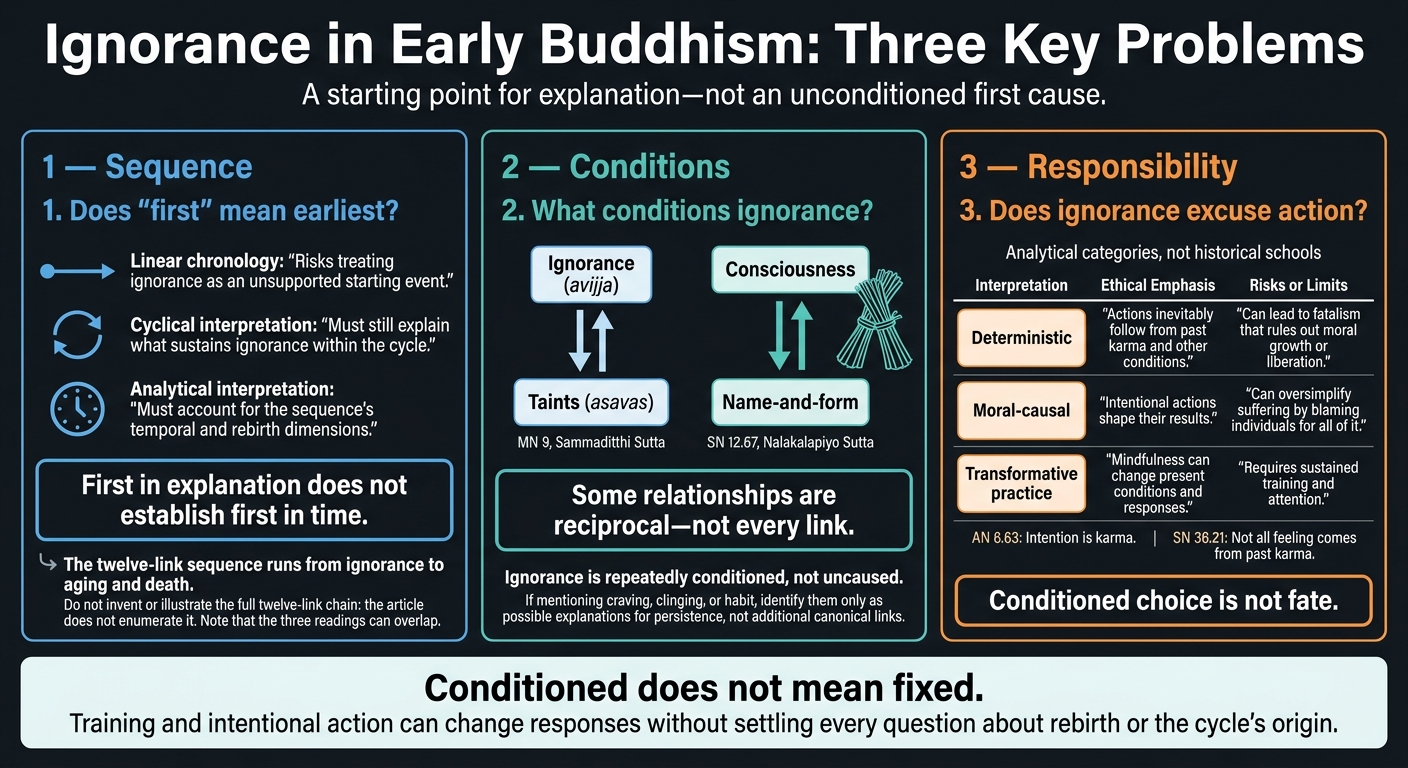
Ignorance in Early Buddhism: Three Key Problems
Bhante Gunaratana: Dependent Origination - What is Ignorance?, Class 5
The Sequence Problem: Does First Mean Earliest?
The key issue is what “first” means: earliest in time or first in explanation.
The twelve-link sequence runs from ignorance to aging and death. The question isn’t whether the links follow one another, but whether their order describes time or explains how suffering works. A conditional relationship alone doesn’t establish a single timeline. Read literally, the sequence can make ignorance look like an unsupported first cause.
Commentarial Answers: Rebirth and Explanatory Order
Commentarial explanations often separate temporal order from explanatory order. They treat ignorance as the starting point for analyzing how suffering continues - not as an absolute beginning.
Three Readings of the Sequence
| Reading | Difficulty with “First” |
|---|---|
| Linear chronology | Risks treating ignorance as an unsupported starting event. |
| Cyclical interpretation | Must still explain what sustains ignorance within the cycle. |
| Analytical interpretation | Must account for the sequence’s temporal and rebirth dimensions. |
These readings can overlap: “first” may mean earliest in time, first in presentation, or first in analysis. This leaves a further question: does ignorance itself have conditions?
The Mutual-Conditioning Problem: What Conditions Ignorance?
The formula begins with ignorance, but that doesn’t mean ignorance is unconditioned. The challenge is to explain what conditions it without making every link in the chain mutually dependent. Early Buddhist texts allow some reciprocal conditioning without claiming an absolute starting point.
Reciprocal Conditions in the Early Discourses
MN 9, the Sammaditthi Sutta, explicitly describes a reciprocal relationship between ignorance (avijja) and the taints (asavas): with the arising of the taints, ignorance arises, and with the arising of ignorance, the taints arise.
SN 12.67, the Nalakalapiyo Sutta, uses the analogy of two sheaves of reeds leaning against each other to describe the mutual dependence of consciousness and name-and-form. The point here is methodological: conditionality can be mutual, but that does not make every link reciprocal.
Commentarial Answers: Recurring Conditions
Commentaries maintain this balance by treating ignorance as repeatedly conditioned, not uncaused, while placing it first in the explanation. On this reading, ignorance persists within a continuing process; it isn’t an unconditioned first cause.
Craving, clinging, or habit may help explain how ignorance persists. But these explanations do not add a new link to the canonical formula. They treat ignorance as a starting point for analysis, not a first cause.
The Moral Agency Problem: Does Ignorance Excuse Action?
The harder issue is ethical: if conditions shape ignorance, how can people remain responsible for their actions? Conditioned choice is not fate. Ignorance can explain harmful action without excusing it.
Intention and Non-Karmic Causes
AN 6.63 identifies intention as karma. This keeps the focus on intentional action, even when prior conditions shape it.
SN 36.21 rejects the claim that all feeling comes from past karma. The body and a person’s surroundings also play a part. Responsibility, then, does not mean blaming people for everything they suffer.
3 Views of Responsibility
These texts suggest three ways to understand responsibility. They are analytical categories, not historical schools.
| Interpretation | Ethical Emphasis | Risks or Limits |
|---|---|---|
| Deterministic | Actions inevitably follow from past karma and other conditions. | Can lead to fatalism that rules out moral growth or liberation. |
| Moral-causal | Intentional actions shape their results. | Can oversimplify suffering by blaming individuals for all of it. |
| Transformative practice | Mindfulness can change present conditions and responses. | Requires sustained training and attention. |
Conclusion: A Starting Point, Not a First Cause
Ignorance is a starting point for explanation, not an unconditioned first cause. The focus is on how suffering continues and how it ends. Commentaries explain this by placing ignorance within recurring conditions.
These readings address sequence, mutual conditioning, and moral agency, but leave some questions open. They retain a role for intentional action and training without settling how closely later explanations match the early discourses or how conditioned action works.
A Hypothetical Example: Changing a Response
The same logic applies in practice.
In a threatening situation, separate the event from your interpretation, pause, and choose a different response. It is a practical use of conditionality, not an answer to the cycle’s origin.
FAQs
How can I recognize ignorance in everyday choices?
Start by being honest with yourself: admitting confusion is a step toward clarity. Ignorance often means misunderstanding reality and what causes suffering. That misunderstanding can feed habitual reactions driven by greed, anger, or confusion.
Practice mindfulness by watching your thoughts, speech, and actions. Look for patterns behind your impulses, and notice how sensory contact turns into an emotional reaction. Daily reflection with the Sutta 423 app can help you build this awareness over time.
Can mutually conditioned ignorance be fully overcome?
Yes. Ignorance keeps the cycle of suffering going, but it isn’t permanent. Buddhist teachings describe it as a lack of clear understanding of reality and the Four Noble Truths. Since ignorance arises from conditions, it can also cease.
Developing wisdom, practicing ethical conduct, and maintaining mindfulness can weaken ignorance and eventually eliminate it. Replacing ignorance with clear insight ends the interdependent conditions that sustain suffering.
How do commentators reconcile conditioned choices with responsibility?
Commentators distinguish rigid determinism from dependent origination, which describes a changing process. Past conditions influence the present, but they don’t make the outcome inevitable. Mindful effort and ethical intention can change what happens next.
Seeing the links as a network rather than a fixed sequence helps show where change is possible. Inherited conditions aren’t your fault, but the choices you make now shape future results.