

How to Practice Mindful Observation with Dhammapada Verses
Use one Dhammapada verse, breath anchors, and four-frame observation to build short, daily mindfulness practices for clarity and calm.
Mindful observation is about paying attention to your thoughts, emotions, and surroundings without reacting or judging. The Dhammapada, a collection of 423 verses from Buddhist teachings, offers concise guidance for practicing mindfulness. You don’t need to be an expert or spend hours meditating - just start with a single verse that resonates with your current mood or situation.
Here’s how you can use the Dhammapada to build mindfulness:
- Pick a Verse: Choose one that aligns with your feelings, like frustration or restlessness.
- Create a Quiet Space: Sit in a calm spot, free from distractions.
- Anchor with Breath: Start with a few deep breaths to steady your mind.
- Reflect on the Verse: Hold it in your thoughts without overanalyzing.
- Observe Through Four Frames: Notice physical sensations, feelings, thoughts, and truths the verse reveals.
For daily practice, apps like Sutta 423 deliver a verse each day, helping you maintain a simple, consistent routine. Over time, these small moments of mindfulness can bring clarity and calm into your daily life.
Learn this simple mindfulness meditation... | Buddhism In English
Choosing a Dhammapada Verse for Reflection
The Dhammapada contains 423 verses divided into 26 themes, covering topics like heedfulness, craving, anger, joy, clarity, and freedom. While this diversity is a strength, it can feel overwhelming, especially for beginners. The good news? You don’t need to tackle the entire text at once. Often, a single verse that speaks to your current state is all you need to begin.
How to Pick a Verse
Choose a verse that connects with what you’re feeling in the moment. If you’re grappling with frustration, look for a verse on anger. Feeling restless? Seek one that addresses craving or an unsettled mind. This approach keeps your practice relevant and grounded in your present experience.
Focus on verses that are concise and easy to understand. These teachings were originally oral and designed to be impactful and memorable. As Just-Buddha.org explains:
"The verses were originally oral teachings, meant to be memorized and repeated. They needed to be short enough to stick in the mind and sharp enough to cut through confusion on contact."
Take your time exploring a few verses. If one stirs a subtle sense of discomfort, it might be reflecting something within you that’s worth examining. Once you’ve selected a verse, resist the urge to overanalyze it. Instead, embrace its simplicity. As Sutta 423 reminds us: "A small portion. Enough to hold. Enough to return to."
Using Daily Verse Delivery to Stay Focused
To make your practice even easier, the Sutta 423 app delivers a single Dhammapada verse to you daily - automatically, at midnight local time. This app cycles through all 423 verses over the course of a year and continues to repeat them, all without any paywalls or added pressure. By offering a simple, consistent way to engage with the teachings, it provides an effortless way to build a habit of mindful reflection.
Setting Up Your Space and Mindset
To practice mindful observation, all you really need is a quiet, consistent space. The key is to limit distractions and commit to showing up regularly.
Creating a Quiet, Comfortable Space
Pick a single, familiar spot - maybe a cozy chair or a peaceful corner - and make it your go-to place. Using the same space consistently helps create a sense of routine. Aim to sit undisturbed for a few moments, keeping phone notifications and background noise at bay. Sit in a posture that feels both stable and alert.
Before diving into a verse, take a few deep breaths. This simple act helps calm your mind and sets a steady foundation, making it easier for the verse to resonate with you as a focus for meditation.
Setting an Intention Before You Begin
Once you feel settled, read the verse aloud. Let its rhythm and flow linger in your mind. After reading, pause and hold the verse gently in your thoughts - don’t overanalyze it. Instead, notice any emotions, memories, or resistance that may arise naturally.
As Thalira Wisdom advises:
"Use a verse as a meditation object. After settling the mind with breath awareness, bring a verse to mind and hold it gently. Let it work on you rather than analysing it intellectually."
It’s normal for your mind to wander during this process - it’s just what minds do. When it happens, avoid criticizing yourself. Instead, take guidance from the Dhammapada:
"The mind is restless, hard to guard, hard to control. The wise one straightens it as a fletcher straightens an arrow." - The Buddha
Each time you notice your attention drifting, gently bring it back to the verse. This act of steady redirection is at the heart of mindful observation. By creating this thoughtful setup, you’ll be ready to engage deeply with the verses in the steps to come.
How to Practice Mindful Observation with a Verse
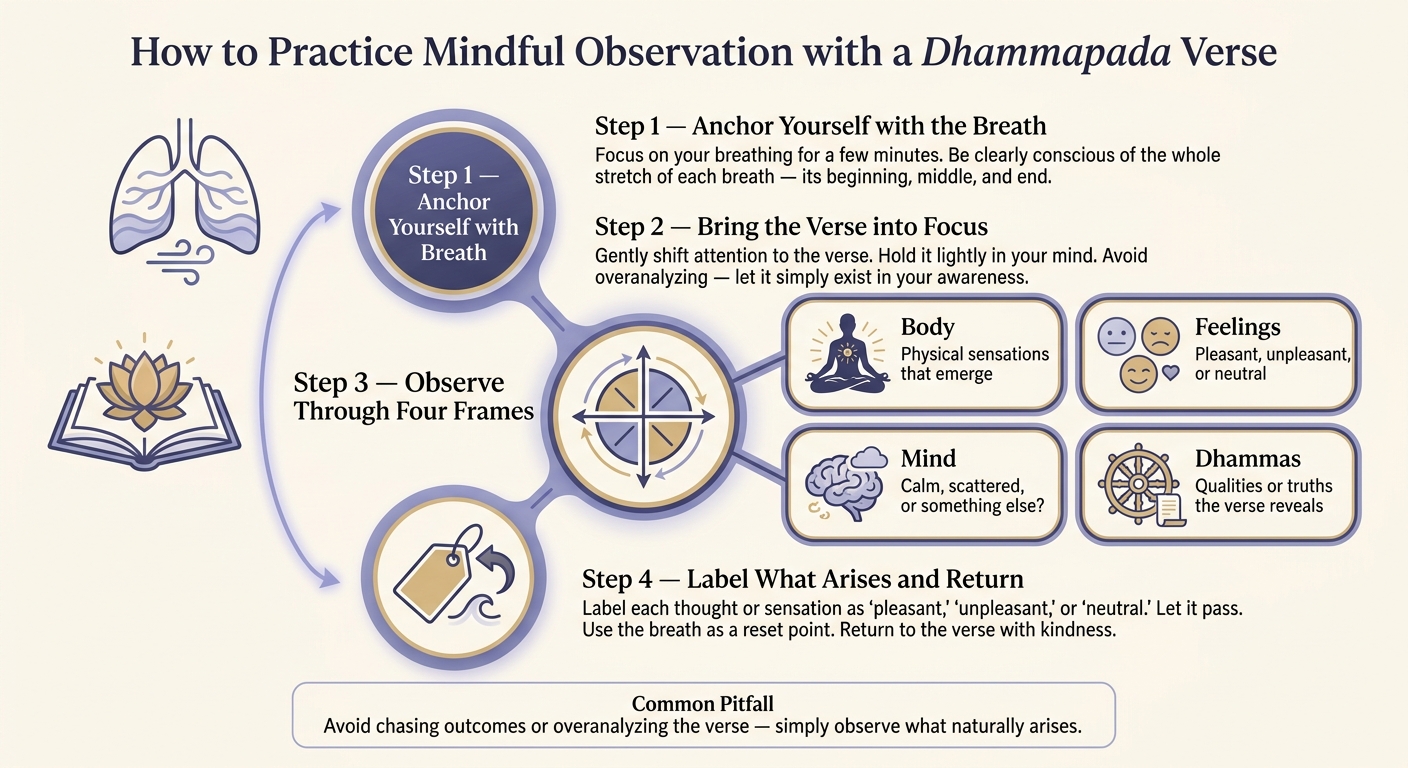
How to Practice Mindful Observation with Dhammapada Verses
Now that your space is ready and your intention is set, it’s time to dive into the practice itself. This is where mindful observation truly takes shape.
Step-by-Step Practice Instructions
- Anchor Yourself with the Breath Start by focusing on your breathing for a few minutes. As described in the Maha-satipatthana Sutta, aim to be “clearly conscious of the whole stretch” of each breath - its beginning, middle, and end. This grounding step helps quiet mental chatter and creates a steady base for your practice.
- Bring the Verse into Focus Once your breath feels steady, gently shift your attention to the verse. Hold it lightly in your mind, almost as if it were a delicate object. Avoid overanalyzing or trying to decode its meaning. Instead, let the verse simply exist in your awareness and notice what naturally arises.
-
Notice Through Four Frames
As you sit with the verse, observe your experience through these four perspectives:
- Body: Pay attention to any physical sensations that emerge.
- Feelings: Note whether your experience feels pleasant, unpleasant, or neutral.
- Mind: Observe the state of your thoughts - are they calm, scattered, or something else?
- Dhammas: Reflect on the qualities or truths the verse brings to light.
- Label What Arises and Return When a thought, emotion, or sensation surfaces, give it a simple label like “pleasant,” “unpleasant,” or “neutral.” Then, let it pass without clinging. If your mind starts to wander, gently guide your focus back to the verse using your breath as a reset point. Remember to approach this with kindness and without judgment.
Common Pitfalls to Avoid
One of the most common challenges is expecting a specific result - whether it’s calm, clarity, or peace - as a sign that the practice is “working.” However, as the Maha-satipatthana Sutta reminds us:
"The bhikkhu keeps his mind steadfastly on the dhamma with diligence, comprehension and mindfulness, thus keeping away covetousness and distress".
Chasing outcomes can become a distraction. Similarly, overanalyzing the verse can pull you away from observing how thoughts and sensations naturally arise and fade.
If you feel frustrated during the process, view that frustration as part of the practice. As Thanissaro Bhikkhu explains:
"Right mindfulness... remembers to abandon unskillful dhammas and to develop skillful ones in their place, and it brings these directives to bear on whatever is happening in the mind in the present moment".
Even challenges provide valuable insights, offering opportunities to deepen your mindfulness and refine your practice.
Bringing Mindful Observation into Daily Life
The true challenge of mindfulness isn't what happens during meditation - it’s how you handle the daily grind. Whether you're stuck in traffic, rushing through a meal, or juggling work deadlines, mindfulness can transform these moments into opportunities for presence and clarity.
Practicing Mindfulness During Everyday Tasks
The Dhammapada was originally shared as an oral teaching - short, impactful, and easy to remember. This makes it perfect for weaving into your daily life. Start your day by choosing one verse as your mental guide.
For instance, while cooking or driving, reflect on Verses 3–5, which highlight the distractions caused by constant mental chatter. This inner dialogue can pull you away from the present moment into a spiral of imagined scenarios. Simply noticing when your mind wanders is a key part of mindfulness.
"Mind is the forerunner of all actions. All deeds are led by mind, created by mind." - The Buddha, Dhammapada
If work feels overwhelming, turn to the wisdom of Verse 1: "life is the creation of the mind". Take a moment to pause and question whether your thoughts are making the situation more difficult than it actually is.
The Maha-satipatthana Sutta reminds us to practice awareness in every posture - sitting, standing, walking, or lying down - and even during routine activities like eating and drinking. You don’t need a special setting or ritual; every moment is an opportunity to be mindful.
These small, intentional pauses can create a foundation for a more mindful daily routine.
Building a Consistent Daily Routine
Once you begin adding mindful moments into your day, creating a regular practice becomes much easier.
What matters most is consistency, not duration. A few minutes of focused attention every day can be more impactful than occasional long sessions.
Try this simple approach: read, pause, observe, and return. Begin your morning by reading a verse and sitting quietly with it for a few minutes. Then, during natural pauses in your day - like waiting for coffee, walking to your car, or taking a break - bring that verse back to mind. This low-pressure method emphasizes the quality of your attention over the need for perfection.
"A few minutes is enough. A quiet daily reading from the Dhammapada. No streaks. No pressure. Just the teachings, day by day." - Sutta 423
To make this even easier, consider using the Sutta 423 app. It delivers one concise verse each day, helping you maintain a simple, focused practice without overcomplicating things.
These repeated moments of mindfulness strengthen inner calm over time. By steadily integrating these reflections, you’ll deepen your connection to the teachings and experience their transformative wisdom in your everyday life.
Conclusion: Cultivating Peace Through Mindful Observation
Practicing mindful observation with the Dhammapada doesn’t demand hours of study or a special meditation space. What it does require is showing up consistently, one verse at a time - because the state of your mind directly shapes the quality of your life. As the text reminds us, "You yourself must strive. The Buddhas only point the way". In other words, no external force can do the inner work for you; transformation comes through your own steady effort.
This idea forms the basis for a simple and accessible daily practice. Start your day by reading a single verse, reflect on it quietly, and revisit its meaning throughout the day. Tools like the Sutta 423 app (sutta423.com) are designed to support this approach. The app provides one verse per day, free of charge, with no pressure to maintain a streak. With 423 verses, it offers a year-long journey through the Dhammapada and beyond.
Over time, this small, consistent effort can lead to profound inner peace. Begin with just one verse. Be consistent. The peace you seek isn’t an endpoint - it grows gradually, in the moments you choose to engage with mindfulness each day.
FAQs
How long should I sit with one verse?
Spend time with each verse, allowing its meaning to sink in and encourage thoughtful reflection. While there's no set time frame, sitting quietly for a few minutes can help you process, notice your reactions, and let the message take root. Each verse stands on its own and can be revisited as often as needed to gain a deeper understanding through focused contemplation.
What if a verse brings up strong emotions?
If a verse from the Dhammapada evokes strong emotions, try approaching it with a sense of gentle awareness. Instead of judging or pushing the emotion away, allow it to be there. Simply acknowledge its presence while staying mindful. Pay attention to any physical sensations, thoughts, or feelings that come up, and approach them with curiosity and kindness. This practice helps create a safe space to process emotions without letting them become overpowering. Reflecting on these verses daily can also build emotional resilience and deepen mindfulness over time.
Do I need to understand the verse to use it?
Dhammapada verses are perfect for mindfulness practice because they’re short, stand-alone, and easy to approach - even if you're unfamiliar with them. You don’t need to fully understand every word or concept to benefit. Simply read a verse, take a moment to reflect, and pay attention to how it speaks to you. This simple act can add depth to your mindfulness journey without requiring complete comprehension.