
How Silent Observation Deepens Insight
Brief daily silent observation calms emotional reactivity, boosts self-awareness, and sharpens focus and relationships.
Silent observation is a simple practice where you observe your thoughts and emotions without judgment or interference. Instead of reacting or suppressing, you step back and notice them as they are. This approach, rooted in ancient Buddhist teachings and supported by modern neuroscience, helps calm emotional reactions, increase self-awareness, and improve focus.
Key Takeaways:
- What It Is: Silent observation means watching your inner experiences - thoughts, emotions, and physical sensations - without trying to control them.
- Why It Works: Studies show that naming emotions reduces activity in the brain's emotional center (amygdala) and activates rational areas (prefrontal cortex).
- How to Start: Dedicate 2–3 minutes daily. Observe your thoughts like leaves floating on a stream. Use moments like waiting in line to practice.
- Benefits: Reduces mental clutter, improves emotional clarity, and strengthens relationships by fostering thoughtful responses.
Even a few minutes of silent observation each day can create a calmer, clearer mind without requiring major lifestyle changes. Tools like the free Sutta 423 app can support this habit by offering daily reflective verses to guide your practice.
Mental Distractions and Their Effects
Types of Mental Distractions
Our minds tend to follow certain patterns when it comes to distractions. One common form is conceptual proliferation, where your thoughts drift into abstract ideas about identity or existence. This can lead to what Buddhist texts describe as a "wilderness of views" - a mental maze that pulls you away from direct experiences. Instead of clarity, this type of thinking often creates confusion and unresolved mental loops.
Another frequent culprit is inner noise, which shows up as constant mental chatter. Researchers have identified five main types of intrusive thoughts: planning, worrying, remembering, judging, and fantasizing. These thoughts can quickly spiral into complex narratives that drain your focus. For instance, a simple intention to call your mom might snowball into worries about her feelings, guilt about not visiting, and a cascade of related concerns.
Then there’s emotional turbulence, which affects both your mind and body. Negative emotional states tied to desire, anger, or confusion often come with physical sensations - like a tight chest when you're angry or a fluttering stomach when you're anxious. These sensations are signals from your amygdala, the brain’s emotional alarm system, which can override the more rational prefrontal cortex. This often leads to compulsive reactions, where you respond impulsively rather than pausing to observe the situation.
Understanding these patterns is the first step toward breaking free from them through greater self-awareness.
Awareness as the First Step
The journey to overcoming mental distractions begins with simply acknowledging them. When you recognize these patterns, you create space for observation rather than reaction. As Bhante Gunaratana wisely puts it:
"If you want to change something, the first thing you have to do is see it the way it is".
This act of recognition, often referred to as metacognitive awareness by neuroscientists, shifts your perspective. Instead of being caught inside a thought, you become the observer of it. This mental distance weakens the thought’s grip on you.
Without such awareness, distractions operate on autopilot. They take root in your unconscious mind, and by the time you notice them, you’re already entangled. Trying to fight these distractions only feeds them, much like swatting at flies makes them swarm even more. But when you simply recognize them without resistance, they lose their power and fade on their own, no longer fueled by emotional reactions like fear or frustration.
Silent Observation: A Method for Inner Clarity
The Principles of Silent Observation
Silent observation involves watching your thoughts, emotions, and behaviors unfold without trying to control or judge them - like viewing a movie of your inner world without stepping into the scene.
This practice has its roots in the Satipatthana Sutta, an ancient text that guides practitioners to focus on four specific areas: the body, feelings, the mind, and mental qualities, all while avoiding external distractions.
The key is to cultivate non-reactivity. Instead of suppressing emotions or forcing positivity, you simply observe them as they are. The Satipatthana Sutta describes this state as being "independent" and "unsustained by anything in the world". By stepping back, you create space for your thoughts to lose their grip on you.
This neutrality isn’t passive - it’s a deliberate practice that lays the groundwork for a deeper understanding of yourself.
How Silent Observation Creates Deeper Understanding
Research from Harvard suggests that just 8 minutes of daily silent observation can increase gray matter density in the brain’s introspective regions, activating the prefrontal cortex while calming the amygdala. This neurological shift helps the mind settle, creating a sense of clarity.
Consistent practice also reveals what Buddhist teachings call "samudaya", the processes that generate thoughts and emotions. Instead of just noticing surface-level feelings, you start to uncover recurring patterns that influence your reactions - patterns that often go unnoticed in the rush of daily life.
Author Mukkul Maheshwari captures the essence of this practice beautifully:
"Quiet observation is not absence from the moment; it is depth within it. It is the discipline of noticing, the courage to pause, and the grace to understand without interrupting".
This stillness isn’t about withdrawal - it’s about gaining clarity. By observing without interference, you unlock insights into your inner world, offering a clearer path forward in both thought and action. These revelations make silent observation a powerful tool for everyday life.
How to Practice Silent Observation
Setting Up a Quiet Space
You don’t need a dedicated space to practice silent observation. Everyday moments - like waiting in line for coffee, standing at the grocery store, or sitting quietly before work - are great opportunities to step back and observe your mind without judgment. These small, transitional moments in your day can serve as mini-retreats from the constant noise of life, giving you a chance to simply notice what’s happening internally.
Pair these moments with reflective readings to deepen your practice and enhance your self-awareness.
Using Daily Verses for Practice
Daily reflective readings can help anchor your silent observation practice. The Sutta 423 app (https://sutta423.com) is a handy tool for this. It offers one verse from the Dhammapada every day - there are 423 verses in total, providing over a year’s worth of teachings. The app is free and encourages a single quiet reading each day, giving you a simple entry point for reflection.
Here’s how it works: read the verse in the morning, let it settle in your mind, and carry its teaching with you throughout your day. The app also features an "Echo" system, where a verse you read on Day 1 reappears on Day 8, reinforcing the lesson through repetition. There’s no pressure to stick to a streak - the app is designed to be "guilt-free", so you can return to the verses whenever you’re ready.
Incorporating these structured practices can help you create mindful pauses during your daily routine.
Basic Steps for Silent Observation
Start small - just 2–3 minutes at a time. Find a quiet spot, sit comfortably, and imagine your thoughts as leaves drifting by on a stream. Observe them without getting attached or trying to change them. If a strong emotion arises, take a moment to notice where you feel it in your body. Is there tightness in your chest? A flutter in your stomach? Recognizing the physical sensations tied to emotions can help you understand your stress signals more clearly.
You can also try the Daily Pause Method: set 3–5 random reminders on your phone throughout the day. When an alert goes off, take 30 seconds to observe your current thoughts and feelings without judgment or interference. Author Sarah Thompson describes it beautifully:
"Think of silent observation as watching a movie of your inner experience. You're not the director trying to change the plot - you're just the audience, noticing what unfolds".
Even short, consistent pauses like these can make a difference. Over time, they help rewire your brain, making it easier to recognize and manage your emotions.
The Quiet Observer: Guided Meditation to Calm an Overactive Mind | Daily Meditation
Benefits of Silent Observation
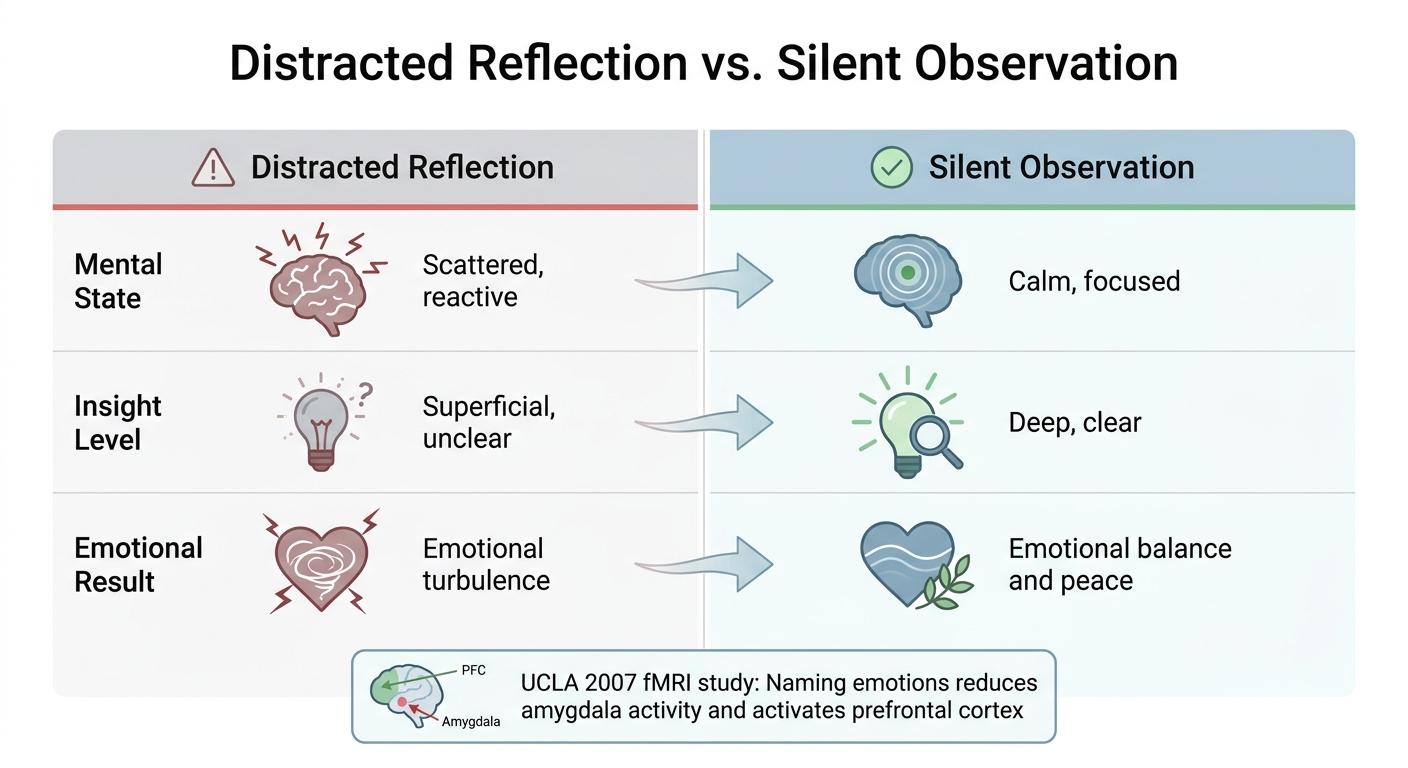
Distracted Reflection vs Silent Observation: Mental States and Emotional Outcomes
Distracted Reflection vs. Silent Observation
Silent observation engages the prefrontal cortex while calming the amygdala, creating a state of focus and clarity. In contrast, distracted reflection keeps your mind scattered, allowing thoughts to spiral unchecked, often amplifying emotional distress.
Here's a quick comparison of the two:
| Approach | Mental State | Insight Level | Emotional Result |
|---|---|---|---|
| Distracted Reflection | Scattered, reactive | Superficial, unclear | Emotional turbulence |
| Silent Observation | Calm, focused | Deep, clear | Emotional balance and peace |
A study led by neuroscientist Matthew Lieberman at UCLA in 2007 used fMRI scans to demonstrate the power of "affect labeling" - the simple act of naming an emotion. This process significantly reduces amygdala activity, shifting the brain from reactive, emotional responses to intentional reflection.
Silent observation also sharpens emotional granularity, which is the ability to differentiate between closely related feelings, like frustration and disappointment. This skill plays a key role in managing emotions effectively. By fostering this internal clarity, silent observation not only enhances personal insight but also strengthens your ability to connect meaningfully with others.
How Silent Observation Improves Relationships
A quieter mind and heightened self-awareness naturally improve your interactions with others. Silent observation helps you tune into subtle nonverbal cues, such as a slight change in tone, a fleeting hesitation, or body language that doesn’t match someone’s words. As Mukkul Maheshwari beautifully states:
"Quiet observation is also a form of love".
This practice creates a pause between stimulus and response. For example, during a heated discussion, instead of reacting immediately, you can take a moment to observe your emotions and respond thoughtfully. Over time, this mindfulness allows you to sense the emotional undercurrents in a room, helping you address potential conflicts before they escalate. The result? A deeper capacity for empathy and stronger, more meaningful connections. It’s not just about hearing words - it’s about understanding the feelings behind them.
Conclusion
Silent observation stands out as a powerful remedy to the constant mental chatter that often consumes us. This practice helps break free from reactive cycles that sap energy and cloud judgment. By stepping into the role of a neutral observer of your thoughts and emotions, you create a valuable pause between stimulus and response. This pause not only calms the amygdala but also engages the prefrontal cortex, turning emotional chaos into moments of clarity.
The best part? Silent observation doesn’t demand dramatic lifestyle changes or hours of meditation. Even dedicating just 8 minutes a day can lead to measurable changes, like increasing gray matter density in areas of the brain linked to self-awareness and introspection. You can also weave this practice into everyday moments - take 30 seconds while waiting in line or during a coffee break to simply observe your mental state. These small, consistent efforts fit seamlessly into your routine, making the habit easy to maintain.
Tools like the Sutta 423 app can support this journey. Each morning, the app delivers a single verse from the Dhammapada, encouraging you to reflect deeply rather than rush through wisdom. Its "echo" feature brings verses back after a week, reinforcing insights naturally. There’s no pressure - no streaks or nagging notifications - just a quiet space to return to when you're ready. The app is free, with optional support tiers starting at $1.99.
As Mukkul Maheshwari beautifully puts it:
"Quiet observation is not absence from the moment; it is depth within it. It is the discipline of noticing, the courage to pause, and the grace to understand without interrupting".
Start small, stay consistent, and let this practice bring clarity to your inner world and strengthen your connections with others.
FAQs
Am I supposed to stop my thoughts?
No, you’re not supposed to stop your thoughts altogether. Instead, just watch them as they come and go - without judging or reacting to them. Let them flow naturally. This approach can quiet mental chatter and offer a clearer understanding of your thoughts and emotions.
What if my emotions feel too intense to observe?
If emotions start to feel overpowering, try to meet them with patience and kindness. Simply observing them in silence can help you become a neutral witness - recognizing what you feel without judgment or the urge to push those feelings away. When emotions become intense, grounding yourself can make a difference. Focus on your breath or tune into physical sensations, like the feel of your feet on the ground or the texture of an object in your hand. With time, this gentle approach helps you process emotions more fully, offering clarity and understanding without falling into patterns of avoidance or self-criticism.
How do I stay consistent with silent observation each day?
To build consistency, set up a daily routine for quiet observation. Pick a peaceful time - morning or evening often works best - and find a space free from distractions. Begin with just a few minutes and slowly extend the duration as you get more comfortable. Think of it like reflecting on a daily verse from the Dhammapada using the Sutta 423 app. The key is to stay non-judgmental, simply observing your thoughts without trying to alter them. Over time, this practice can help deepen your understanding and awareness.