

How the Four Noble Truths Address Suffering
How the Four Noble Truths identify suffering, reveal craving as its root, point to cessation, and guide practice via the Eightfold Path.
The Four Noble Truths, taught by the Buddha over 2,500 years ago, provide a practical framework for understanding and addressing suffering. Here’s a quick breakdown:
- Suffering Exists (Dukkha): Life involves pain, change, and dissatisfaction.
- Suffering Has a Cause (Samudaya): Craving and attachment fuel suffering.
- Suffering Can End (Nirodha): Letting go of craving leads to peace.
- There’s a Path to End Suffering (Magga): The Noble Eightfold Path offers a clear way forward.
The teachings apply to everyday challenges - like stress, loss, or unmet expectations - and encourage a shift in perspective. Instead of avoiding pain, they invite us to understand its roots and respond wisely. By recognizing suffering, identifying its cause, and following a practical path of mindfulness, ethical conduct, and wisdom, anyone can work toward lasting inner peace.
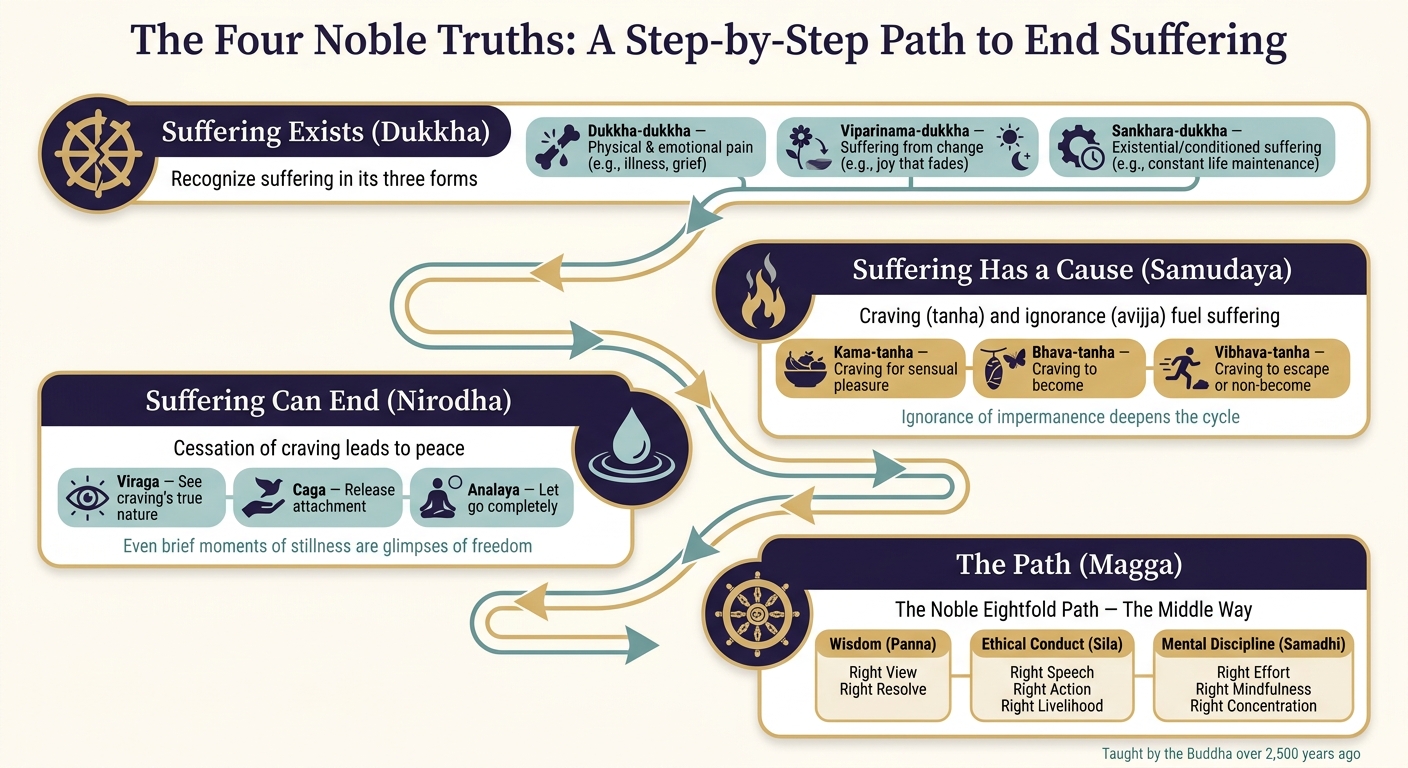
The Four Noble Truths: A Step-by-Step Path to End Suffering
The First Noble Truth: Recognizing Suffering
What Is Suffering?
The Pali term dukkha paints a vivid picture of life's challenges, originally symbolized by a broken cart axle - a reminder of life's impermanence. The First Noble Truth identifies three layers of suffering. The most recognizable, Dukkha-dukkha, refers to the physical and emotional pain we all encounter, like illness, injury, or grief. Then there's Viparinama-dukkha, a subtler form of suffering tied to change - the unease felt even in joyful moments, knowing they won't last. Think of that bittersweet feeling on the last day of a vacation. Finally, Sankhara-dukkha represents a deeper, existential discomfort stemming from the ever-changing conditions of existence, including the constant effort required to sustain life.
| Form of Dukkha | Description | Modern Example |
|---|---|---|
| Dukkha-dukkha | Physical/mental pain | Chronic illness, losing a job, or physical injury |
| Viparinama-dukkha | Suffering from change | Feeling anxious during a vacation, knowing it will end |
| Sankhara-dukkha | Conditioned or existential suffering | The unease of constant maintenance - eating, working, etc. |
The Buddha’s words encapsulate this understanding:
"Birth is stressful, aging is stressful, death is stressful; sorrow, lamentation, pain, distress, & despair are stressful; association with the unbeloved is stressful, separation from the loved is stressful, not getting what is wanted is stressful."
This layered perspective helps explain why simply avoiding suffering won't resolve it.
Why You Need to Understand Suffering Fully
Grasping the nature of suffering is essential for reshaping how we respond to it. Most people instinctively try to escape discomfort, but the First Noble Truth calls for deeper understanding rather than quick fixes.
Ajahn Sumedho emphasizes this point:
"One should understand dukkha, not just try to get rid of it."
This mindset shift is crucial. When we rush to suppress pain, we miss the opportunity to learn from it. Thanissaro Bhikkhu likens pain to a "watering hole" where unconscious habits surface. By observing suffering instead of avoiding it, we can uncover the patterns driving our reactions.
Tulku Thondup Rinpoche adds:
"Buddhism first asks us not only to see the momentary and suffering character of the world, but also to have tolerance in accepting suffering as natural and not negative. Only then will we be able to work toward the solution."
How to Spot Suffering in Everyday Life
Recognizing suffering is the gateway to understanding the Four Noble Truths. A simple yet profound method for identifying suffering is the "two arrows" reflection. The first arrow represents unavoidable pain, like a tough diagnosis, a breakup, or losing a job. The second arrow, however, is optional - it’s the added suffering we create through resistance, self-criticism, or anger. Learning to let go of that second arrow can transform how we experience hardship. A small but powerful shift in language - from "I am suffering" to "there is suffering" - can help frame pain as a universal condition rather than a personal shortcoming.
Practices like daily reflection can deepen this awareness. For instance, the Sutta 423 app offers a verse from the Dhammapada each day, encouraging users to pause and sit with the teachings instead of rushing past them. Over time, this habit can help you notice suffering as it arises and prevent it from escalating into deeper distress.
The Second Noble Truth: The Causes of Suffering
What Causes Suffering?
Once we recognize suffering, the next step is to uncover its cause. If the First Noble Truth identifies the problem, the Second Noble Truth digs deeper to explain it. According to the Buddha, the root of suffering lies in tanhā - a Pali term meaning "thirst." This craving has a magnetic quality, pulling the mind from one experience to another. It manifests in three distinct forms.
Craving for sensuality (kama-tanha) is the desire for pleasurable experiences like food, entertainment, or comfort. Thanissaro Bhikkhu explains that this craving is "aimed less at sensual pleasures themselves, and more at the mind's fascination with thinking about and planning them". Craving for becoming (bhava-tanha) refers to the longing to adopt a specific identity or role, while craving for non-becoming (vibhava-tanha) reflects the urge to escape an unpleasant situation or shed an unwanted identity.
The Buddha captured this dynamic in a vivid metaphor:
"If this sticky craving overcomes you in the world, your sorrows grow like wild grass after rain." - Dhammapada 335–336
Craving doesn’t stop at wanting - it escalates into clinging (upādāna), often compared to a fire feeding on fuel. This cycle is fueled by a deeper misunderstanding of impermanence.
How Ignorance Feeds Craving
Craving doesn’t exist in isolation. It thrives on avijjā - ignorance - which clouds our understanding of reality. This ignorance blinds us to the impermanence of all things and the absence of a fixed, unchanging "self." Scholar John M. Koller puts it this way:
"The craving for separate and permanent selfhood is the origin of all forms of suffering... ignorance constructs a false reality of separate and permanent selves and things."
When we cling to the illusion of a solid, enduring "me", we intensify the cycle of craving. We then invest energy in defending and maintaining this identity. Thanissaro Bhikkhu, Abbot of Metta Forest Monastery, notes, "The attempt to maintain full being for one's sense of 'me' is a stressful effort doomed to failure, in that all of the components of that 'me' are inconstant, stressful, and thus not worthy of identifying as 'me' or 'mine'". This creates a feedback loop where ignorance and craving feed off each other.
How to Identify Craving in Your Own Life
Recognizing the roots of craving is key to spotting how it shows up in your daily life. A practical way to do this is by observing how your mind builds a "self" around each desire. For instance, when you want a promotion, a compliment, or a specific outcome, notice how you mentally take on roles like a producer, a consumer, or even a commentator. This mental construction is a clear indication of craving at work.
A five-step method can help in addressing this:
- Origination – Notice when the craving begins.
- Passing – Observe how it fades over time.
- Allure – Identify what makes it appealing.
- Drawbacks – Reflect on the discomfort it brings.
- Escape – Recognize the moments when detachment arises.
Ajahn Sumedho, a respected Theravada monk, reminds us, "The more we contemplate and investigate grasping, the more the insight arises, 'Desire should be let go of'". A simple practice, like reflecting nightly on moments of frustration or longing and tracing them back to specific cravings, can make this process more concrete and impactful.
The Third Noble Truth: The End of Suffering
What Does the Cessation of Suffering Mean?
If craving is identified as the root of suffering in the Second Noble Truth, the Third Noble Truth offers a hopeful solution: this craving can be eliminated. In Buddhist teachings, the term for this is nirodha, which translates to "cessation." The Buddha explained it in SN 56.11:
"And this, monks, is the noble truth of the cessation of dukkha: the remainderless fading & cessation, renunciation, relinquishment, release, & letting go of that very craving."
This isn't about repressing desires or forcing them away. Instead, it's about cultivating awareness that naturally dissolves craving, freeing us from its grip. Think of it like a fire: when the fuel is removed, the flames die out. Similarly, when the causes of craving are clearly understood and released, they fade away.
Chögyam Trungpa described this state beautifully:
"The truth of cessation is a personal discovery... It is like experiencing instantaneous good health: you have no cold, no flu, no aches, and no pains in your body."
This cessation brings a sense of clarity and calm - a state free from the constant cycle of wanting and dissatisfaction. It may not be permanent at first, but even brief moments of this peace can be deeply revealing.
Recognizing Moments of Peace
You don't need to achieve full awakening to experience glimpses of cessation. Ajahn Buddhadasa explained it simply:
"The cooler the mind, the more Nibbana in that moment."
Consider moments in your life when you weren’t chasing after anything - when you weren’t scrolling through your phone for distraction, replaying a frustrating memory, or planning how to achieve something. That fleeting stillness, when your mind wasn’t grasping or resisting, is a small taste of the peace described in the Third Noble Truth.
These moments might seem ordinary, but they’re powerful evidence that freedom from craving is possible. Pay attention to these experiences in your daily life. For example, notice when irritation softens after a disagreement, or when you feel content without needing anything to change. These are valuable signs that craving can diminish, even in small ways.
Steps Toward Realizing Cessation
Fully realizing cessation involves actively observing and letting go of craving through three mental actions: virāga (seeing craving’s true nature), cāga (releasing attachment), and anālaya (letting go completely).
- Virāga: Instead of suppressing a craving, observe it closely and recognize its drawbacks. When you see its temporary and unsatisfying nature, its grip naturally weakens.
- Cāga: Release your attachment to specific outcomes, identities, or experiences. This doesn’t mean indifference - it’s about freeing yourself from possessiveness.
- Anālaya: Let go entirely, without clinging to what the craving once provided or fearing its absence.
A practical way to start is by noticing stress in your life and asking yourself: What’s fueling this? Is it a desire for something to happen a certain way? Or a need for things to be different? Instead of reacting to the stress, focus on identifying and understanding the craving beneath it. This process is where the real transformation begins.
The MN 64 sutta captures the essence of this journey:
"This is peace, this is exquisite - the stilling of all fabrications, the relinquishment of all acquisitions, the ending of craving, dispassion, cessation, Unbinding."
The Fourth Noble Truth: The Noble Eightfold Path
What Is the Noble Eightfold Path?
The Fourth Noble Truth presents a clear route to ending suffering, known as the Noble Eightfold Path. This practical guide, described by the Buddha, consists of eight interconnected elements that, when practiced together, lead to liberation from suffering. It’s also called the Middle Way because it avoids two extremes: indulgence in sensual pleasures and harsh self-denial.
The path is divided into three areas of training:
| Training | Path Factors |
|---|---|
| Wisdom (Paññā) | Right View, Right Resolve |
| Ethical Conduct (Sīla) | Right Speech, Right Action, Right Livelihood |
| Mental Discipline (Samādhi) | Right Effort, Right Mindfulness, Right Concentration |
These factors are not meant to be followed one at a time but are cultivated together. They guide ethical decisions, mental focus, and the growth of wisdom in daily life.
Right View serves as the foundation for the entire path. Thanissaro Bhikkhu explains its importance:
"Right view is what leads the way in performing all the duties connected with the noble truths: comprehending suffering, abandoning its origination, realizing its cessation, and developing the path."
It ties understanding suffering to the practical steps that lead to its end.
Putting the Path Into Practice Today
The Eightfold Path isn’t just theoretical - it’s meant to be lived in everyday life.
Right Speech encourages avoiding lies, harsh language, gossip, or speech that causes division. For instance, this could mean pausing before sending an angry email or refraining from sharing harmful rumors. When there’s nothing constructive to say, the tradition advises practicing noble silence.
Right Action involves refraining from harm, whether through violence, stealing, or other harmful behaviors. Similarly, Right Livelihood guides you to choose a career that doesn’t cause harm, such as avoiding work related to weapons or harmful substances.
For Right Mindfulness, Ven. Walpola Rahula Thero highlights four areas of focus: the body, feelings, the mind, and mental qualities. You can start small - use everyday moments, like sipping your coffee or waiting in line, to observe your thoughts and sensations without judgment.
Right Effort is about actively preventing negative mental states like anger or greed while nurturing positive ones. For example, gently redirecting your mind when it drifts toward unhelpful patterns is part of the practice. Over time, this effort weakens the cravings that cause suffering.
Why Consistent Practice Matters
The path only works when you commit to walking it. Bhikkhu Bodhi emphasizes this point:
"The path translates the Dhamma from a collection of abstract formulas into a continually unfolding disclosure of truth."
Progress comes through deliberate and repeated effort. Ethical behavior creates a stable base for mental focus, which in turn sharpens the clarity needed to let go of cravings. Each part of the path supports the others, forming a cycle of growth and understanding.
To maintain momentum, regular reflection on the Buddha’s teachings can help. For example, the Sutta 423 app shares a verse from the Dhammapada daily. These brief moments of reflection can act as a steady reminder of the path, helping to build the consistency needed for meaningful change.
Conclusion: Living the Four Noble Truths
How the Four Noble Truths Work Together
The Four Noble Truths aren't just a set of disconnected ideas - they're an interconnected framework that works as a whole. Thanissaro Bhikkhu, Abbot of Metta Forest Monastery, explains it well:
"These four truths are best understood, not as beliefs, but as categories of experience."
Think of them as a progression: first, recognizing suffering; then, understanding its cause; next, realizing that it can end; and finally, following the path that leads to that end. Each truth builds on the one before it, and in practice, they reinforce each other. Every moment of mindfulness on this path deepens your understanding of these truths, creating a foundation for meaningful, everyday actions.
Small Steps Toward Lasting Change
Once you see how the truths fit together, you can start making small, intentional changes in your daily life. H.E. Tsem Rinpoche offers this advice:
"Take one step at a time. Work on one delusion at a time. It is an inner war... but it is a battle worth fighting because it will bring you peace of mind."
Even simple actions, like noticing moments of irritation or unkind words, can be a starting point for practice. Tools like the Sutta 423 app, which provides daily verses from the Dhammapada, can serve as a gentle reminder to stay connected to the teachings.
Finding Your Way to Inner Peace
For over 2,500 years, the Four Noble Truths have guided people toward understanding and easing suffering. Chögyam Trungpa, a Tibetan Buddhist meditation master, described the realization of cessation in relatable terms:
"The truth of cessation is a personal discovery. It is not mystical... It is like experiencing instantaneous good health."
This journey toward inner peace is grounded in the ongoing practice of the Eightfold Path. Facing your experiences honestly and taking deliberate action makes this clarity and peace accessible to anyone willing to walk the path.
The Four Noble Truths in Buddhism: Understanding and Overcoming Suffering
FAQs
Is all suffering caused by craving?
According to the Four Noble Truths, the root of suffering lies in craving - whether it's a desire for sensual pleasures, a longing for existence, or even a wish for non-existence. While physical pain or external events are inevitable, mental suffering is deeply tied to our attachments and cravings. Recognizing and addressing these causes is key to alleviating suffering. For daily inspiration, Sutta 423 provides a verse from the Dhammapada each day, offering guidance on this path.
What does it mean for suffering to end in daily life?
Letting go of craving, attachment, and resistance is key to easing suffering in everyday life. These tendencies often transform simple pain into deeper unhappiness. Instead, it helps to observe life as it unfolds, without holding on to fleeting things or measuring yourself against others. By embracing mindfulness and simplicity, you can nurture a sense of inner calm that stays steady through life's highs and lows. Reflecting on daily verses from the Dhammapada can be a helpful guide in this practice.
How do I start the Eightfold Path without becoming overwhelmed?
To integrate the Eightfold Path into your life without feeling daunted, think of it as a comprehensive practice rather than a rigid step-by-step process. Begin with small, manageable changes in your daily routine. For instance, take a moment to pause before responding in conversations, aim for clarity in your speech, concentrate on completing one task at a time, and recognize when to ease off if your efforts start to feel overwhelming. You might also find guidance in Sutta 423, which provides daily verses from the Dhammapada to inspire mindfulness and reflection.