

The Five Precepts In The Dhammapada
The Dhammapada presents the Five Precepts as voluntary ethical training that fosters mindfulness, mental clarity, and compassionate conduct.
The Five Precepts in Buddhism - refraining from killing, stealing, sexual misconduct, false speech, and intoxicants - are personal commitments to ethical living, not imposed rules. They guide individuals toward mindfulness, inner peace, and spiritual growth. Rooted in the ancient text Dhammapada, these principles emphasize how ethical actions impact both mental clarity and relationships. The text links morality to meditation and wisdom, showing how these precepts align with the Noble Eightfold Path. Each precept addresses harmful tendencies like greed, ill will, and delusion, fostering a balanced, mindful life. The Dhammapada offers practical verses to integrate these teachings into daily life.
The Dhammapada: 246-247 - He Who Does Not Observe The Five Precepts
The Ethical Framework of the Dhammapada
The Dhammapada weaves ethics deeply into its teachings, making moral conduct (sila) the cornerstone. It emphasizes that meditation and insight cannot thrive without a solid ethical foundation. As Bhikkhu Bodhi explains, sila serves as "the beginning of higher states". This ethical grounding is essential for fostering deeper meditation and wisdom.
The text’s opening verses encapsulate this principle by highlighting the power of the mind:
"If one acts or speaks with an evil mind, suffering follows just as the wheel follows the foot of the draft-ox; if one acts or speaks with a pure mind, happiness follows like a shadow that never departs."
Here, ethical behavior is more than a set of rules - it’s a method for shaping the mind and cultivating inner peace.
Why Moral Conduct Matters in Buddhism
In Buddhism, spiritual growth follows a clear sequence: morality supports concentration, which leads to wisdom. A mind burdened by guilt or harmful actions struggles to settle into meditation. Bhikkhu Khantipalo captures this idea well:
"Meditation trains the mind away from unwholesome states but how could this be done if body and speech were uncontrolled?"
By abstaining from actions like stealing, lying, or harming others, one weakens the mental tendencies tied to greed, hatred, and delusion. As Ven. Ananda succinctly put it: "The benefit and advantage of moral virtues is the absence of remorse". A clear conscience creates the mental calm necessary for deeper focus and insight. This progression - from ethical conduct to mental clarity - underlines the Dhammapada’s emphasis on mindful living.
How the Five Precepts Align with the Noble Eightfold Path
The Five Precepts align seamlessly with the ethical aspects of the Noble Eightfold Path: Right Speech, Right Action, and Right Livelihood. Together, these factors form the sila group, which lays the groundwork for developing concentration and wisdom.
| Precept | Noble Eightfold Path Factor | Spiritual Function |
|---|---|---|
| Refrain from Killing | Right Action | Cultivates compassion and harmlessness |
| Refrain from Stealing | Right Action / Right Livelihood | Encourages contentment (santutthi) |
| Refrain from Sexual Misconduct | Right Action | Builds trust and emotional safety |
| Refrain from False Speech | Right Speech | Fosters truthfulness and mental clarity |
| Refrain from Intoxicants | Right Mindfulness / Right Effort | Prevents heedlessness and safeguards the other precepts |
These precepts function as sikkhapada, or training steps. A lapse is not seen as a "sin" but rather as a deviation from one’s chosen path. This approach promotes self-awareness and accountability, echoing the Dhammapada’s central message: the mind is the root of both suffering and liberation. With this ethical framework in place, the next step is to explore how daily reflection brings these teachings to life.
How the Dhammapada Reflects Each of the Five Precepts
The Dhammapada, while not explicitly listing the Five Precepts, offers a rich tapestry of teachings that align with these ethical guidelines. Its verses on compassion, honesty, restraint, and mindfulness form a moral foundation that resonates with the precepts. Here's how each precept is reflected in the text:
Refraining from Taking Life
The Dhammapada emphasizes non-violence through empathy and self-awareness:
"All beings tremble before danger, all fear death. When a man considers this, he does not kill or cause to kill." - Dhammapada 129
This verse encourages a deep connection with the shared fear of harm among all living beings. Similarly, Dhammapada 405 highlights that true greatness lies in choosing a path of non-harm. These teachings inspire modern practices like mindful eating and showing kindness to all creatures.
Refraining from Taking What Is Not Given
The text connects acts of taking what is not freely offered to inner states of greed and dissatisfaction. Verses 246–247 caution that such actions "undermine the roots" of one’s life. To counter this, the Dhammapada promotes santutthi, or contentment, urging individuals to cultivate an honest and respectful relationship with what they rightfully possess.
Refraining from Sexual Misconduct
Although the Dhammapada doesn’t directly address sexual misconduct in a specific verse, it warns of the disruptions caused by unchecked desire. By highlighting the dangers of sensual craving, the text encourages a mindful and balanced approach to relationships and desires.
Refraining from False Speech
The Dhammapada strongly condemns dishonesty and its far-reaching consequences:
"For a liar who has violated the one law (of truthfulness) who holds in scorn the hereafter, there is no evil that he cannot do." - Dhammapada 176
It also addresses the harm caused by harsh words, gossip, and insinuation, emphasizing the importance of clear and truthful communication:
"Speak the truth; do not yield to anger; give, even if it is but a little, to him who begs; by these three means one may go to the presence of the gods." - Dhammapada 224
By committing to truthfulness, one naturally avoids influences that cloud the mind, a concept tied to the fifth precept.
Refraining from Intoxicants
The Dhammapada underscores the value of appamāda - heedfulness - which intoxicants directly undermine. Verse 247 warns against indulging in "distilled, fermented drinks", as such actions weaken one’s foundation in this world. Since intoxication diminishes self-control, it often leads to further unwholesome behavior. In this way, the fifth precept serves as a protective measure, supporting the integrity of all other precepts.
These verses illuminate how the Dhammapada’s teachings can guide individuals in integrating the Five Precepts into their daily lives through mindful and intentional practices.
How the Five Precepts Connect and Reinforce Each Other
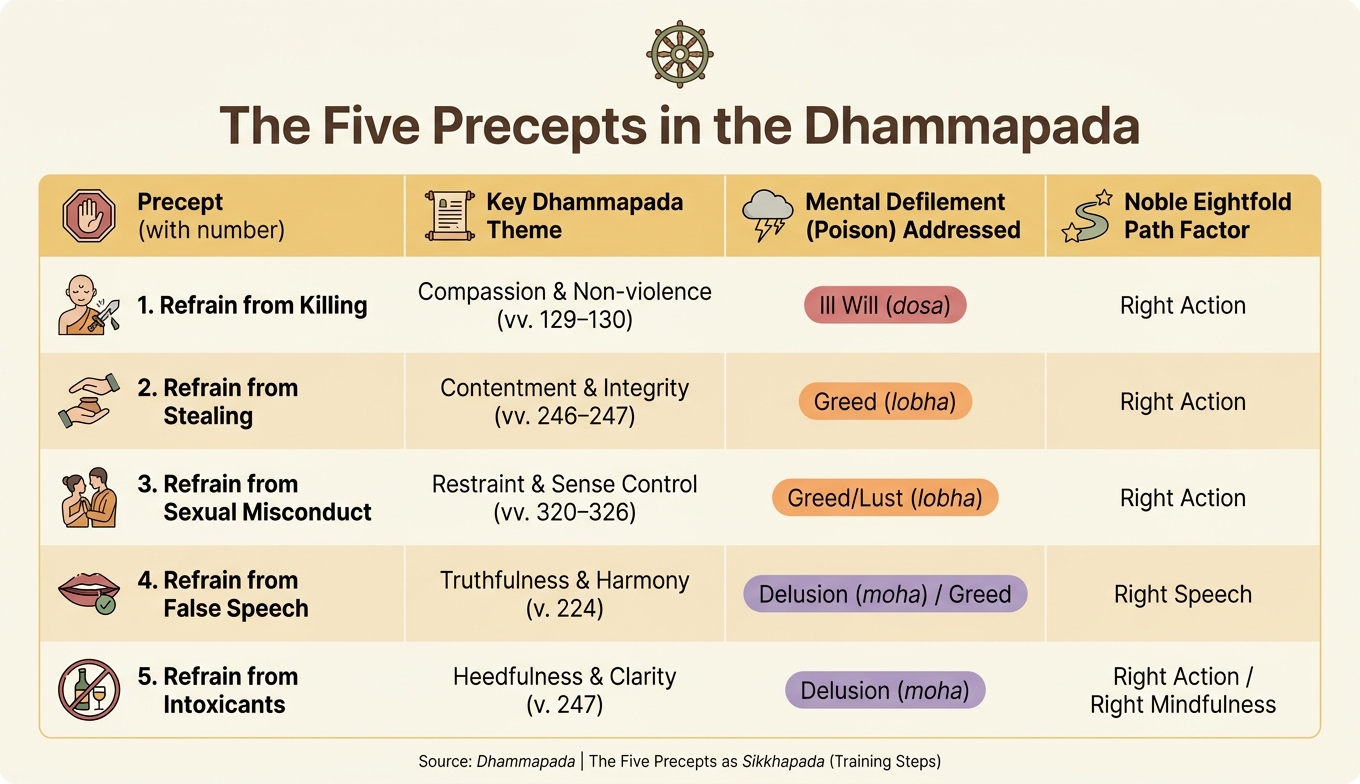
The Five Precepts: Dhammapada Themes, Mental Poisons & Eightfold Path
The Five Precepts aren’t just standalone guidelines - they work together as a unified framework. If one precept is compromised, it often weakens the others. On the flip side, strengthening your commitment to one can naturally support adherence to the rest. This interconnectedness not only bolsters ethical behavior but also enhances mindfulness as a whole.
Take the fifth precept, for instance: abstaining from intoxicants. This precept safeguards the other four by maintaining clarity and self-control. Intoxicants impair judgment, lower inhibitions, and encourage carelessness, all of which can lead to breaking other precepts. As the North Market Dhammapada Glossary puts it, "Intoxication makes it easy to break the other four precepts".
Beyond the immediate effects of intoxication, the precepts collectively address deeper mental defilements known as the three poisons: greed (lobha), ill will (dosa), and delusion (moha). Each precept targets one or more of these poisons. For example:
- Refraining from killing counters ill will.
- Avoiding theft and sexual misconduct curbs greed.
- Abstaining from intoxicants helps preserve clarity and protects against delusion.
Delusion, in particular, plays a central role in violating any precept. By tackling these core defilements, the precepts act as a cohesive system that reinforces ethical discipline.
The Dhammapada frequently warns of the consequences of neglecting these principles:
"Whoever destroys living beings, speaks false words, who in the world takes that which is not given to him, or goes too with another's wife, or takes distilled, fermented drinks - whatever man indulges thus extirpates the roots of himself even here in this very world." - Dhammapada 246–247
The phrase "extirpates the roots" serves as a powerful reminder: breaking any precept erodes the foundation of mindful living.
The Five Precepts and Dhammapada Themes: A Comparison Table
Here’s a breakdown of how each precept aligns with Dhammapada themes, addresses specific mental poisons, and connects to the Noble Eightfold Path:
| Precept | Key Dhammapada Theme | Defilement (Poison) Addressed | Noble Eightfold Path Factor |
|---|---|---|---|
| 1. Refrain from Killing | Compassion & Non-violence (vv. 129–130) | Ill Will (dosa) | Right Action |
| 2. Refrain from Stealing | Contentment & Integrity (vv. 246–247) | Greed (lobha) | Right Action |
| 3. Refrain from Sexual Misconduct | Restraint & Sense Control (vv. 320–326) | Greed/Lust (lobha) | Right Action |
| 4. Refrain from False Speech | Truthfulness & Harmony (v. 224) | Delusion (moha) / Greed | Right Speech |
| 5. Refrain from Intoxicants | Heedfulness & Clarity (v. 247) | Delusion (moha) | Right Action / Right Mindfulness |
Together, the Five Precepts address harmful impulses across actions, speech, and thoughts, guiding practitioners toward a more balanced and compassionate way of life.
Putting the Five Precepts into Practice with the Dhammapada
Understanding the Five Precepts is one thing; weaving them into the fabric of daily life is another. The Dhammapada serves as a bridge between these two - offering not rigid rules, but practical guidance to keep ethical intentions alive, even when life’s demands threaten to sideline them.
Daily Reflection on the Precepts
A simple yet powerful way to engage with the precepts is to recite them each morning. This practice, known as sikkhāpada, is a voluntary training rule. But the real transformation happens in how you live these precepts throughout the day.
Bhikkhu Sīlācāra captures this beautifully:
"To 'take the precepts'... means to remind oneself afresh of what the world's pressure of business and pleasure is so apt to make man forget."
This daily recitation acts as a steadying compass, helping you navigate the day with mindfulness. Over time, it shifts the precepts from abstract ideals into second nature.
This habit naturally aligns with structured guidance, such as the teachings in Sutta 423.
How Sutta 423 Supports Ethical Practice

The Dhammapada's 423 verses are perfectly suited for daily reflection. Reading just one verse each morning sets a focused intention for the day. Sutta 423 embodies this idea by offering a single verse for quiet contemplation each day, cycling through the entire collection over a year and beyond.
This practice directly addresses pamāda - heedlessness - which often causes people to stray from their ethical commitments. By focusing on just one verse, the teachings become manageable and memorable. When these verses touch on a specific precept, they reinforce the morning recitation, grounding your intentions in something tangible.
A Daily Reflection Table for the Five Precepts
The table below pairs each precept with a Dhammapada verse and a practical focus for reflection:
| Precept | Dhammapada Verse | Daily Reflection Focus |
|---|---|---|
| 1. Refrain from Killing | Dhp 246: "Whoever destroys living beings..." | Fostering compassion and safeguarding all sentient life |
| 2. Refrain from Stealing | Dhp 246: "...takes that which is not given..." | Practicing generosity and avoiding any form of exploitation |
| 3. Refrain from Sexual Misconduct | Dhp 246: "...goes too with another's wife..." | Respecting commitments and honoring boundaries |
| 4. Refrain from False Speech | Dhp 246: "...speaks false words..." | Speaking with honesty and kindness to nurture trust |
| 5. Refrain from Intoxicants | Dhp 247: "...takes distilled, fermented drinks..." | Preserving mental clarity to support mindfulness |
This table transforms the precepts into actionable daily steps, guided by mindfulness. For instance, the commitment to “not killing” can evolve into actively cultivating compassion for all living beings as your understanding grows. The Dhammapada provides support for this deepening practice, offering wisdom at every stage of the journey.
Conclusion: The Five Precepts as a Guide for Mindful Living Today
The Five Precepts go far beyond their origins in monastic traditions. They are voluntary commitments that anyone can adopt to minimize harm and enhance mental clarity. Their enduring relevance lies in their adaptability - they're seen as training steps, not rigid rules. If one is broken, it isn't about failure but an opportunity to pause, reflect, and recommit.
The ethical framework of the precepts is further enriched by the teachings of the Dhammapada. Bhikkhu Bodhi describes this text as a "scriptural spiritual friend" that meets individuals where they are, helping them navigate moral and personal challenges. Its 423 verses don't preach; instead, they illuminate a path forward.
For example, refraining from harsh words naturally transitions into speaking with honesty and kindness. Similarly, refraining from taking what isn't freely given creates space for acts of genuine generosity. This gradual transformation - from restraint to positive action - is where true ethical growth takes root.
Studies indicate that these principles can help buffer stress and alleviate symptoms of depression, regardless of one's religious background. The Pali term for virtue, sīla, translates to "cool" or "natural", symbolizing a return to a calm, untroubled state of mind. In this sense, the precepts are more than ethical guidelines - they offer a pathway to inner steadiness.
"If one acts or speaks with a pure mind, happiness follows like a shadow that never departs." - Dhammapada
This blend of ancient wisdom and contemporary insight highlights the lasting value of the Five Precepts in fostering mindfulness. Guided by the Dhammapada and its teachings, these precepts provide practical clarity for daily life. Start with one and weave it into your routine. Let the Dhammapada guide you - one verse, one step at a time.
FAQs
Are the Five Precepts rules or personal commitments?
The Five Precepts are personal promises that individuals choose to follow voluntarily - they're not rigid rules or commandments. These commitments guide people to avoid actions such as harming living beings, stealing, or lying. By embracing these principles, individuals work toward developing moral character, lessening harm in the world, and cultivating a sense of inner calm. They represent a commitment to personal integrity and the care for others' well-being.
How do the precepts support meditation and wisdom?
The Five Precepts serve as a cornerstone for developing meditation and wisdom, much like the sturdy legs of a tripod. By guiding individuals to avoid unskillful actions, they help reduce feelings of guilt and mental unrest. This, in turn, nurtures a calm and concentrated mind. Such ethical discipline fosters a sense of security and mental clarity, paving the way for deeper meditation and profound insight. Sutta 423 complements this practice by providing daily verses from the Dhammapada for meaningful reflection.
What should I do if I break a precept?
If you break a precept, try not to get stuck in feelings of guilt or regret. These emotions can unsettle your mind and don't help in the long run. Remember, precepts are voluntary guidelines meant to aid personal growth - not strict rules with punishments. Instead, take a moment to reflect on what led to the misstep. Was it driven by greed, anger, or maybe just carelessness? Once you understand the cause, focus on making a sincere commitment to act differently and uphold the precept moving forward.