

The Five Aggregates and the No-Self Doctrine
The sense of self arises from five changing processes—recognizing their impermanence reduces attachment and suffering.
The Five Aggregates - form, feeling, perception, mental formations, and consciousness - are key to understanding the Buddhist teaching of no-self (anatta). Instead of seeing a person as a permanent, unchanging self, the Buddha explained that our identity arises from these five constantly changing processes.
Here’s the core idea:
- Impermanence: Each aggregate is in a state of constant change and cannot form a lasting self.
- Interdependence: The aggregates work together but lack any independent essence.
- Practical Insight: Observing the aggregates helps dissolve the illusion of self, reducing suffering and opening the path to liberation.
The no-self doctrine avoids extreme views like eternalism (an unchanging soul) or annihilationism (complete extinction). Instead, it focuses on the dynamic nature of experience. By examining how we cling to the aggregates as "I" or "mine", we start to let go of attachments and reduce stress in everyday life. This teaching is not about abstract philosophy but practical tools for ending suffering.
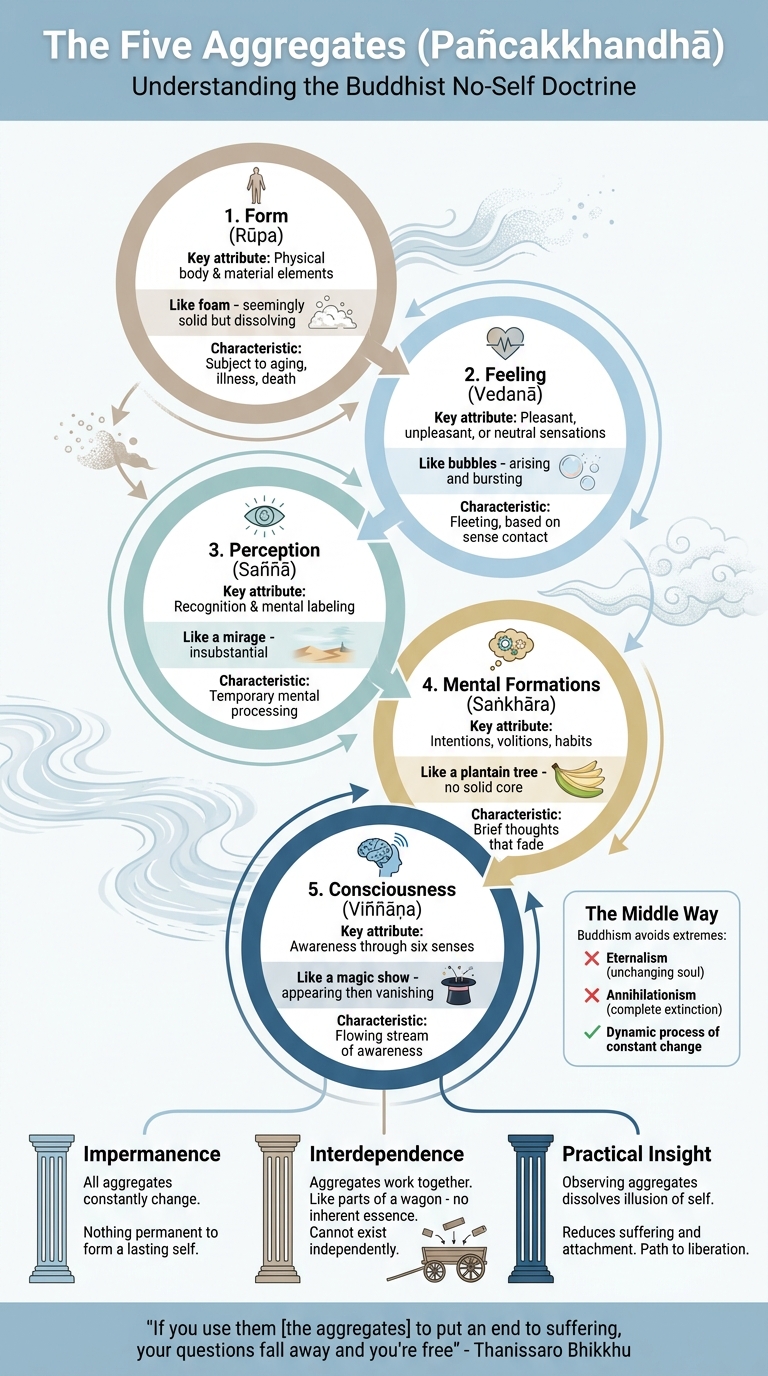
The Five Aggregates in Buddhist Philosophy: Components of No-Self
1. The Five Aggregates
Impermanence
Each of the five aggregates reflects constant change. Take form (rūpa), for example - it’s subject to wear and tear. The body deals with heat, cold, hunger, and thirst, and eventually succumbs to illness, aging, and death. Feeling (vedanā) is equally fleeting since it arises from momentary sense contacts; as soon as those conditions shift, feelings of pleasure, pain, or neutrality change too. Similarly, perception (saññā) acts like a mental labeling process, relying on temporary interactions between past knowledge and new experiences. It’s as insubstantial as a mirage.
Mental formations (saṅkhāra) and consciousness (viññāṇa) also highlight impermanence. Mental formations - our intentions and volitions - shape our thoughts briefly before fading, while consciousness flows like a stream, arising and ceasing based on the six senses and their corresponding objects. The Buddha captured this transient nature with vivid imagery, comparing the aggregates to foam, bubbles, mirages, and magic shows - seemingly solid but dissolving under scrutiny.
Beyond their impermanence, the aggregates reveal an intricate web of interdependence.
Interdependence
The five aggregates don’t function in isolation; they arise together, dependent on conditions. Think of a wagon - it’s just a term for the assembly of wheels, axles, and a chassis. Disassemble it, and there’s no inherent “wagon-ness.” Similarly, the “self” is simply a label for the combined functioning of the aggregates. This becomes clear when you consider control: if the body were truly independent, you could command it to never age or fall ill. But since the body depends on external conditions and natural laws, it cannot exist as an independent entity.
The connection between mental and physical aggregates is constant. Mental states can influence the body, and physical ailments can affect the mind. As N.K.G. Mendis explains, "The mental components arise, exist for a moment and then perish. They arise dependent on conditions; so, here again, according to the ultimate truth, we cannot state that the 'mental components are mine' or 'I am the mental components'". This interdependence further challenges the idea of a permanent self, as no single aggregate can operate or exist on its own.
Practical Application
Recognizing impermanence and interdependence offers practical ways to explore the concept of no-self in everyday life.
One effective approach is the Control Test: examine each aggregate by asking whether you can make it behave exactly as you want. Is this aggregate constant or ever-changing? Does it bring ease or stress? Is it appropriate to think of it as "mine" or "my self"?. This method shifts the focus from abstract questions like “What am I?” to directly observing how the mind constructs a sense of “I” and “mine” in daily experiences.
When difficult emotions arise, try deconstruction: break down experiences like depression or a strong sense of self into the five changing aggregates. This can dissolve the illusion of an unchanging, fixed “self”. Another helpful practice is dis-identification: label unskillful urges (like the impulse to break a precept) as “not-self,” creating mental space to let go of them.
2. The No-Self Doctrine
From Observation to Doctrine
The concept of no-self, or anatta, isn't something you’re expected to blindly believe - it’s a conclusion drawn from observing the Five Aggregates. These aggregates - body, feelings, perceptions, mental formations, and consciousness - are impermanent and inherently stressful, making them unsuitable to be considered a permanent self. Their uncontrollable nature further proves they can’t form a lasting self. The Buddha encapsulated this reasoning in the Anatta-lakkhana Sutta:
"Now, that which is impermanent, unsatisfactory, subject to change, should one regard it as 'mine' or 'my self?'"
This idea of lack of control is key. The Visuddhi Magga elaborates on this with:
"Mere suffering exists, no sufferer is found. The deeds are, but no doer of the deeds is there, Nirvana is, but not the man that enters it. The path is, but no traveller on it is seen"
This reasoning lays the foundation for understanding how Buddhism avoids extreme views about the self.
The Middle Way
The no-self doctrine takes a balanced approach between two extremes. Eternalism suggests that an eternal soul exists beyond death, while Annihilationism (or Materialism) claims that a temporary self is destroyed at death. Buddhism offers a third perspective: everything is part of a psychophysical process that is constantly changing, with no enduring entity at its core.
In everyday language, we use terms like "I" or "person" for convenience. But in the ultimate sense, only ever-changing phenomena exist.
Strategic Application
The practical side of the no-self doctrine is just as important as the theory. Instead of pondering abstract questions like "What am I?", the focus shifts to understanding how we build a sense of "I" and "mine" around fleeting experiences. Tools like the Not-Self Questionnaire help examine each aggregate’s instability, stress, and lack of true ownership. This approach moves away from philosophical debates and toward direct observation.
The Buddha likened a "healthy sense of self" to a raft used to cross a river. You rely on it to develop skillful qualities and progress along the path, but once you reach the other shore - Nirvana - you let it go. This perspective doesn’t dismiss moral responsibility. On the contrary, it emphasizes accountability through the law of kamma, urging the replacement of harmful tendencies like greed and hatred with wholesome qualities.
No Self, Selflessness (Anatta/Anatman) & the Five Aggregates
Strengths and Limitations
This section takes a closer look at the practical benefits and challenges of the Five Aggregates framework and its connection to the no-self doctrine.
The Five Aggregates - form, feeling, perception, mental formations, and consciousness - offer a way to analyze the concept of "self." Instead of relying on abstract ideas, practitioners can observe these components directly to understand the no-self doctrine. As N.K.G. Mendis put it:
"The Buddha showed that the sentient being was made up of these five aggregates only"
This framework also provides a balanced approach, avoiding extremes like eternalism (belief in an unchanging soul) and annihilationism (belief in complete extinction at death).
But the framework isn't without its challenges. A common misunderstanding is to see the aggregates as a rigid definition of identity. Thanissaro Bhikkhu, Abbot of Metta Forest Monastery, highlights this issue:
"If a person is just khandhas, then what gets reborn? ... A large part of the history of Buddhist thought has been the story of ingenious but unsuccessful attempts to settle these questions"
The Buddha sidestepped such metaphysical debates, focusing instead on practical questions about suffering and its resolution.
| Feature | Strength | Limitation |
|---|---|---|
| Analytical Depth | Breaks down the "solid" sense of self into observable, manageable parts | May lead to clinging to views if treated as a fixed metaphysical explanation |
| Practical Application | Functions like a "raft" to pinpoint and let go of attachments | Requires a delicate balance; prematurely abandoning the self-concept can undermine moral responsibility |
| Path to Liberation | Encourages dispassion when applied skillfully across all experiences | Risks mistaking intellectual grasp of the concept for the deeper insight necessary for true release |
One of the key challenges is the potential for misusing the not-self perception. Instead of fostering genuine dispassion, it can sometimes lead to aversion. The Buddha's warning in the Alagaddupama Sutta is relevant here:
"To them these teachings wrongly grasped, will bring harm and suffering for a long time. And why? Because of their wrong grasp of the teachings"
This analogy underscores that the aggregates are meant as practical tools, not ultimate truths. When used correctly, they help reveal how we create a sense of "me" and "mine" around ever-changing experiences. This approach opens a practical path toward liberation while steering clear of abstract debates about existence.
Conclusion
Our exploration of impermanence and interdependence highlights how our sense of self is not fixed but shaped by ever-changing processes. The Five Aggregates demonstrate that self-identity emerges from these transient elements. Clinging to what is impermanent only leads to suffering, but recognizing this truth opens the door to liberation. As Thanissaro Bhikkhu insightfully puts it:
"If you use them [the aggregates] to define what you are as a person, you tie yourself down to no purpose... But if you use them to put an end to suffering, your questions fall away and you're free".
The no-self doctrine provides a practical approach to ending suffering by revealing that nothing within the aggregates is lasting or fully within our control. This understanding dismantles the illusion of a permanent self. As Lion's Roar explains, "The belief in a permanent essence of self or soul is the primordial ignorance that leads to suffering".
The key lies in skillfully engaging with the aggregates. Cultivating a sense of self that is both responsible and self-aware allows for meaningful progress on the path. This perspective encourages accountability and helps loosen attachments gradually. By understanding how the aggregates relate to the no-self doctrine, you shift your attention from abstract questions about identity to the very process of self-definition, which is often the root of stress.
For those seeking to incorporate these teachings into daily life, the Sutta 423 app offers a verse from the Dhammapada each day, serving as a practical tool for reflection throughout the year. Ultimately, the aggregates are not an end in themselves but a means to transcend suffering - tools to be released once the journey is complete.
FAQs
If there’s no self, who is responsible for karma?
Without the concept of a permanent self, karma functions through interconnected causes and conditions. Actions lead to outcomes not for an individual "self", but as part of an ongoing chain of cause and effect. Responsibility exists within this interconnected process, rather than stemming from a fixed or unchanging entity.
How do I spot the five aggregates in real time?
To understand the five aggregates (khandhas) in the moment, pay attention to your experience and break it down into these parts: form (the physical sensations you notice), feelings (your emotional reactions), perceptions (how you interpret things), mental formations (your thoughts or intentions), and consciousness (your awareness of it all). By mindfully observing these as they occur, you can begin to see how they influence your sense of self and the way you experience the world.
Does no-self mean nothing continues after death?
The idea of no-self (anatta) doesn’t suggest that absolutely nothing persists after death. Rather, it highlights the absence of a fixed, unchanging self or essence. It avoids making definitive claims about what follows death, leaving room for interpretation within the broader framework of Buddhist teachings.