
Feeling Overwhelmed? Try These 3 Calming Practices
Three quick practices—mindful breathing, loving-kindness, and sensory grounding—to reduce stress and regain calm in daily life.
When life feels overwhelming, simple techniques can help you regain calm and control. This article explores three practices - mindful breathing, loving-kindness meditation, and sensory grounding - that can reduce stress and improve emotional resilience. Here’s a quick overview:
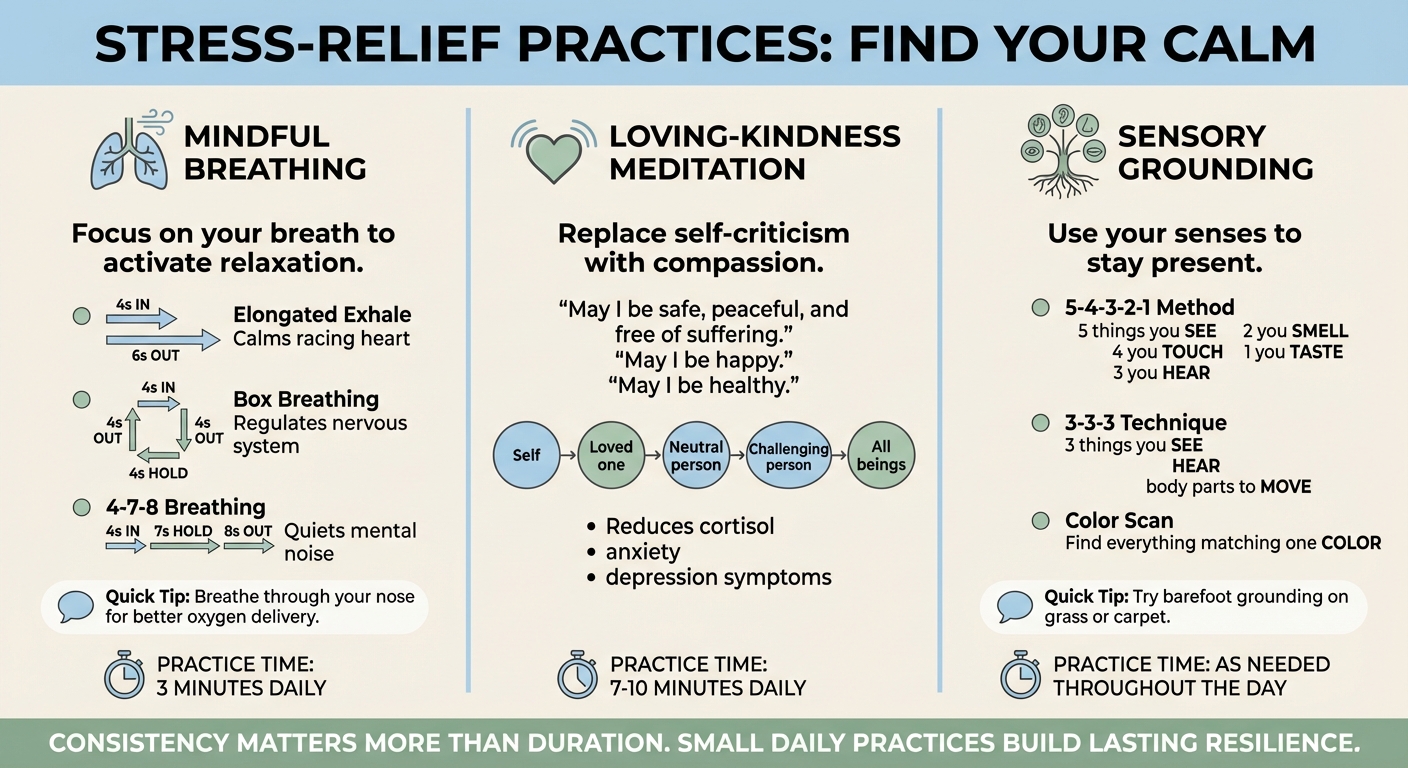
- Mindful Breathing: Focus on your breath to activate your body’s relaxation response. Techniques like elongated exhale, box breathing, and 4-7-8 breathing can lower stress and improve focus.
- Loving-Kindness Meditation: Shift from self-criticism to compassion by silently repeating phrases that promote care for yourself and others.
- Sensory Grounding: Use your senses to stay present. Techniques like the 5-4-3-2-1 method or interacting with your surroundings can ease anxiety.
These small, consistent habits can fit into your daily routine and help you navigate stress with ease.
3 Calming Practices to Reduce Stress and Overwhelm
Practice 1: Mindful Breathing
How Mindful Breathing Works
Your breath is like a portable anchor, always available to ground you in the present moment when your mind starts racing with worry or stress. Buddhist teacher Shaila Catherine explains it well: "a versatile meditation subject... to steer attention away from distractions and anchor attention on a present experience".
When you slow your breathing, particularly your exhale, something remarkable happens. It activates your parasympathetic nervous system, which helps shift your body into "rest and digest" mode - essentially the antidote to the fight-or-flight response. Breath coach Bob Soulliere simplifies it:
"The exhale is the nervous system's downshift. When your exhale lengthens, your body receives a message: we are safe enough to soften".
Research backs this up, showing that deliberate breathing can lower cortisol levels and reduce blood pressure.
How to Practice Mindful Breathing
A straightforward four-step process from the Plum Village tradition can help you get started. Begin by simply noticing your breath - acknowledge that you're breathing in and out. Next, follow the full length of each inhale and exhale. Then, bring awareness to your entire body as you breathe. Finally, release any tension you feel with each exhale.
Here are some specific techniques to try:
| Technique | Pattern | Primary Benefit |
|---|---|---|
| Elongated Exhale | 4s In / 6s Out | Calms a racing heart; signals safety |
| Box Breathing | 4s In / 4s Hold / 4s Out / 4s Hold | Regulates the nervous system; adds structure |
| 4-7-8 Breathing | 4s In / 7s Hold / 8s Out | Quiets mental noise; aids sleep |
Whenever possible, breathe through your nose. Nasal breathing filters the air you inhale and boosts nitric oxide production, improving circulation and oxygen delivery. According to Soulliere, your nose acts as a "throttle", naturally slowing your breath and encouraging deeper, more effective diaphragmatic breathing.
Experiment with these methods during your day to experience their calming benefits.
Using Mindful Breathing Throughout Your Day
Mindful breathing doesn’t require a special setting. You can weave it into everyday moments for ongoing stress relief. Pair it with routine tasks like making coffee or getting dressed in the morning.
Consider practicing during transition moments - before eating breakfast, while commuting, or even during short breaks. Soulliere recommends adopting an "all nasal, all day" approach, which means defaulting to nasal breathing even when exercising. This builds what he calls "calm under load".
The key is consistency. Practicing for just three minutes a day is more effective than a longer, occasional session.
Practice 2: Loving-Kindness Meditation
Understanding Loving-Kindness Meditation
Loving-kindness meditation, or Metta in Buddhist tradition, builds on the calming effects of mindful breathing by introducing a focus on compassion. Instead of centering on the breath, this practice involves silently repeating phrases that promote care and acceptance for yourself and others.
This shift can help replace cycles of self-criticism with a softer, more understanding inner dialogue. Studies suggest that as little as 10 minutes a day can reduce cortisol levels and alleviate symptoms of anxiety, depression, and PTSD. For instance, individuals who practiced loving-kindness meditation daily for seven weeks reported noticeable increases in emotions like joy, gratitude, and hope.
Here’s a straightforward way to get started with this practice.
How to Practice Loving-Kindness Meditation
To begin, find a comfortable position - either seated or lying down - with a straight back and relaxed breathing. Start with a few deep, mindful breaths to settle your mind. Then, repeat phrases such as:
"May I be safe, peaceful, and free of suffering. May I be happy. May I be healthy. May I be strong and confident."
- Silas Day, Meditation Teacher
Begin by directing these phrases toward yourself. Gradually, extend them to others: a loved one, a neutral person, someone you find challenging, and finally, all beings. Practicing for 7 to 10 minutes each day can lead to meaningful benefits over time.
The Four Virtues in Loving-Kindness Practice
Loving-kindness meditation touches on the four Brahmaviharas: loving-kindness, compassion, sympathetic joy, and equanimity. Ayya Khema once called these "the only emotions worth having".
A 2021 clinical trial revealed that participants practicing loving-kindness meditation experienced more significant reductions in depressive symptoms than those undergoing cognitive processing therapy. Sylvia Boorstein beautifully summarized the essence of this practice:
"Heaven is nowhere else but right here on this earth, when we live with friendliness, compassion, joy, and equanimity".
Practice 3: Grounding Through Sensory Awareness
What Grounding Techniques Are
Grounding techniques help bring your focus back to the present moment, making it easier to manage overwhelming emotions. These methods work by shifting your attention from internal stress to what's happening around you, effectively interrupting the fight-or-flight response.
Dr. Melissa Young, a Functional Medicine Specialist at Cleveland Clinic, describes it perfectly:
"Grounding techniques are the thing that can keep you rooted and safe, like a tree in the face of strong winds."
Grounding generally falls into three categories: physical (using your body and senses to anchor yourself), mental (engaging your mind in tasks to distract and calm it), and soothing (practices that promote self-compassion and reduce stress). These approaches are especially useful for handling anxiety, panic attacks, PTSD triggers, dissociation, and sensory overload.
Using Focus to Calm the Mind
Sensory grounding takes the concept of re-centering a step further by focusing on your immediate environment. The beauty of this approach is its simplicity - you don't need any special tools, and you can do it anywhere, whether you're at work, at home, or even commuting. This focus on the senses helps calm your nervous system. Melanie Glassey, LPC at Spring Health, explains:
"Grounding works by using your senses, body, or attention to help your nervous system settle so you can feel safer and more connected right now."
Research supports this idea. For example, labeling your emotions - like saying "I feel overwhelmed" - can help reduce their intensity by engaging the prefrontal cortex of your brain. Similarly, techniques like holding an ice cube or splashing cold water on your face can quickly reset your nervous system by providing a "temperature shock" effect. Even small physical actions, such as pressing your heels into the ground or clenching and releasing your fists, can give anxious energy a physical outlet.
Simple Grounding Practices to Try
If you're ready to try grounding, here are a few simple techniques:
- The 5-4-3-2-1 Method: Identify 5 things you see, 4 things you can touch, 3 things you hear, 2 things you can smell, and 1 thing you can taste. This method is easy to remember and highly effective.
- The 3-3-3 Technique: Quickly name 3 things you can see, 3 things you can hear, and move 3 parts of your body (like your fingers, toes, or shoulders).
- Color Scan: Pick a color and look around the room, identifying everything that matches that shade.
For a more tactile experience, try barefoot grounding - stand on grass, carpet, or tile and focus on how the surface feels under your feet. Some people find "Earthing", or direct contact with the ground, helps balance their energy by neutralizing negative charges. And don't underestimate the calming power of interacting with animals - petting them has been shown to lower cortisol, the stress hormone.
These techniques are simple, effective, and can be incorporated into your daily routine to help you stay grounded and present.
Making These Practices Part of Your Life
Setting Up a Daily Practice
Now that you’ve learned how to calm your mind during stressful moments, it’s time to make these techniques part of your daily routine.
Start small - just 1 to 5 minutes a day can reduce stress hormones and sharpen your focus without overloading your schedule. The trick is to connect mindfulness with something you already do. This strategy, known as habit stacking, involves pairing a new practice with an existing habit.
For example, you could practice mindfulness while brewing your morning coffee, brushing your teeth, or even sitting in traffic. To help make it stick, use reminders like sticky notes or phone alarms to prompt you for the first few weeks. Write down a simple, clear intention - such as "to feel less anxious at work" - and place it somewhere you’ll see it often. This keeps you motivated, even when life gets busy.
Finding Practice Moments During Your Day
One of the best things about these techniques is how easily they fit into your day. Before diving into emails or taking a call, pause for three deep breaths to release tension. While washing your hands, focus entirely on the sensation of the water or the feel of the soap on your skin. Even your commute can become a chance to practice nasal breathing, which naturally slows your breath and promotes calmness.
When switching to a new task, take a brief moment to reconnect with your surroundings. At the end of your lunch break, spend five minutes visualizing someone who supports you and wishing them - and then yourself - happiness. These are small, intentional shifts that turn ordinary moments into opportunities for mindfulness.
Why Regular Practice Matters More Than Length
The key to building resilience lies in regular, consistent practice rather than the amount of time you spend.
Research shows that your brain responds just as well to a short mindful moment as it does to a longer session, as long as your attention is fully engaged. In one study involving about 4,000 participants, even brief five-minute mindfulness exercises boosted focus scores from 3.38 to 3.71 on a 5-point scale. Similarly, ratings for friendliness increased from 3.34 to 3.92. Simply put, frequency matters more than duration - a daily two-minute practice can rewire your brain more effectively than occasional 20-minute sessions.
As breath coach Bob Soulliere puts it:
"Resilience is not never getting stressed. Resilience is being able to come back."
These small, consistent habits prepare you for life’s unpredictable moments - whether it’s a stressful email, a traffic jam, or an unexpected challenge. By regularly refocusing on your breath, body, or intentions, you gradually strengthen your ability to stay present and steady.
4-7-8 Calm Breathing Exercise | 10 Minutes of Deep Relaxation | Anxiety Relief | Pranayama Exercise
Conclusion
Rooted in ancient Buddhist teachings, these simple practices can easily fit into your daily routine to help manage feelings of overwhelm.
When life feels like too much, you don’t need a complicated fix - just three straightforward techniques can help restore a sense of calm. Mindful breathing taps into the power of your exhale, signaling safety to your nervous system. Loving-kindness meditation eases self-criticism and fosters a sense of connection with others. And grounding through sensory awareness brings you out of autopilot and into the present moment. Together, these approaches strengthen your emotional resilience and help you stay anchored in the here and now.
What makes these practices effective isn’t perfection or long sessions - it’s consistency. Studies show that even short mindfulness exercises can improve focus and promote calm when done regularly, as long as you’re fully present. Breath coach Bob Soulliere refers to this as the "minimum effective dose" - a quick, accessible way to regain balance during moments of stress, whether you’re stuck in traffic, dealing with a tough email, or navigating a difficult conversation.
Resilience doesn’t mean avoiding stress altogether. It’s about learning how to find your way back to calm when challenges arise. Each time you take a mindful breath, offer yourself kindness, or ground yourself in the present, you’re creating that vital space between stress and how you respond - the space where calm and resilience thrive.
These simple, accessible tools can make a real difference. Use them to reclaim your sense of calm and navigate life’s challenges with greater ease.
FAQs
Which practice works fastest in a panic moment?
Mindful breathing is one of the fastest ways to regain calm during a moment of panic. By concentrating on slow, deliberate breaths, this practice helps soothe your nervous system and ease stress almost instantly. It’s easy to do, works effectively, and can be practiced anytime, anywhere, offering quick relief when you need it most.
What if breath holds make me feel worse?
If holding your breath makes you feel uncomfortable or worse, it’s okay to adjust or skip that part of the practice. Instead, focus on smooth, steady breathing. Try inhaling deeply into your belly and exhaling slowly, without pushing yourself too hard. The key is to stay comfortable and avoid anything that might heighten discomfort or stress. Gentle, uninterrupted breathing can work just as well to help relax your mind and body.
How do I stay consistent when I’m busy?
To keep mindfulness a part of your daily life, try weaving small, manageable practices into your routine. Activities like mindful breathing, body scans, or even mindful walking can fit seamlessly into a packed schedule. Dedicating just 5–10 minutes a day can help you stay on track. Techniques such as breathwork or RAIN meditation are also great for finding calm and focus during chaotic moments. The key is to keep these practices straightforward and easy to access, making it simpler to stick with them.