

7 Dhammapada Verses for Stillness in Action
Seven Dhammapada verses teaching a simple pause-notice-continue practice—heedfulness, steady effort, restraint—for calmer daily action.
If I want more calm in a busy day, these seven verses point me to one simple move: pause before I act.
This article comes down to 7 plain themes I can use at work, at home, and while walking:
- Dhammapada 21: stay awake instead of running on autopilot
- Dhammapada 23: keep returning to the task without strain
- Dhammapada 24: pair energy with mindfulness and restraint
- Dhammapada 25: build steady inner ground in daily life
- Dhammapada 76: let wise correction show blind spots
- Dhammapada 360–361: guard the senses before impulse turns into action
- Dhammapada 378: bring calm to body, speech, and mind
In plain terms: stillness in action is not doing less. It is doing the next thing with more care. The article also gives one short rhythm I can use anywhere: pause, notice, continue.
A few concrete points stand out right away:
- The article covers 7 verses
- It ends with a 3-step daily practice
- It notes that the app mentioned runs through 423 verses on a 423-day cycle
- It also repeats verses after 7 days, so Day 1 returns on Day 8 and Day 15
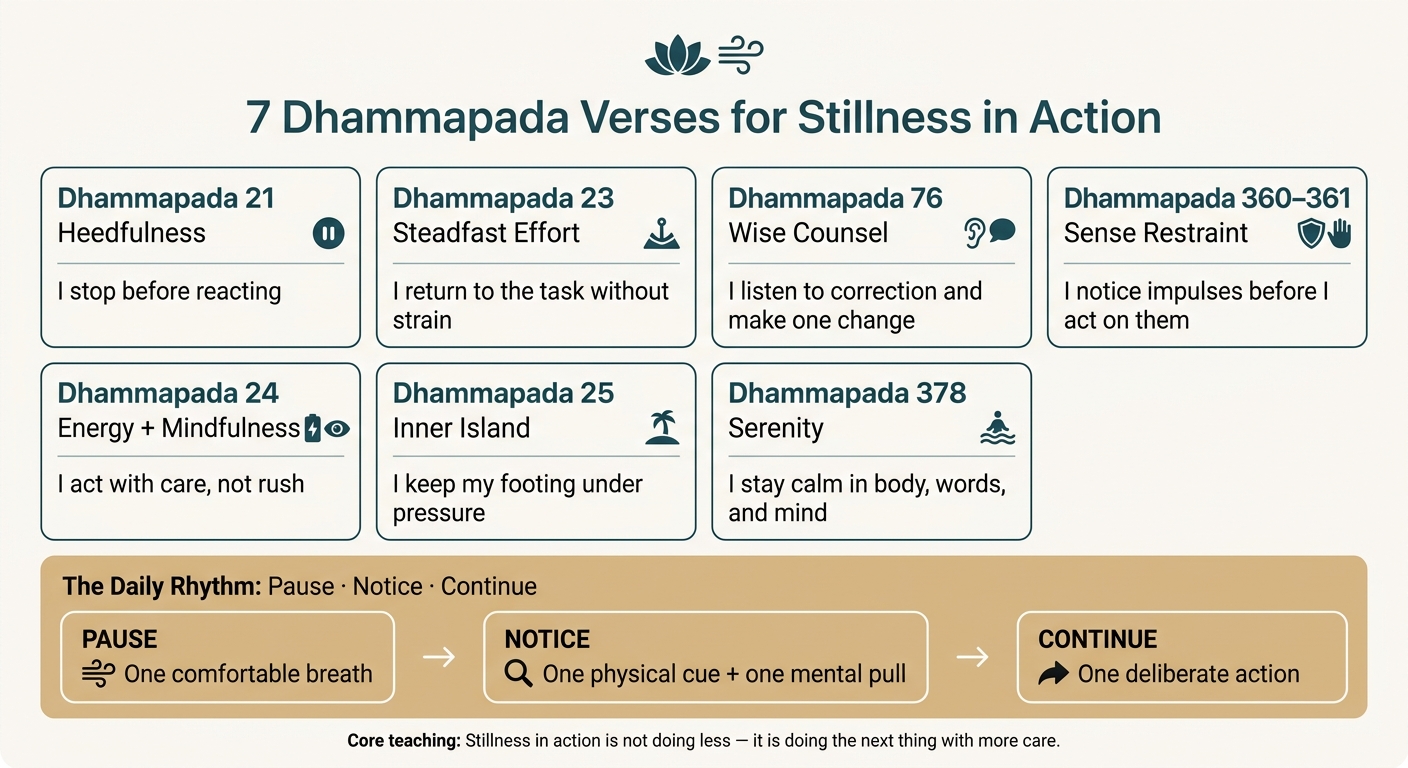
7 Dhammapada Verses for Stillness in Action: A Quick Reference Guide
Dhammapada Verses 21, 22, and 23: The Mindful Never Die
Quick Comparison
| Verse | Main idea | What it looks like in daily life |
|---|---|---|
| 21 | Heedfulness | I stop before reacting |
| 23 | Steady effort | I return to the task without forcing |
| 24 | Energy + mindfulness | I act with care, not rush |
| 25 | Inner island | I keep my footing under pressure |
| 76 | Wise counsel | I listen to correction and make one change |
| 360–361 | Sense restraint | I notice impulses before I click, speak, or chase them |
| 378 | Serenity | I stay calm in body, words, and mind |
The core message is simple: one breath, one pause, one careful next step. That is the thread running through the whole piece.
How to Use These Verses Day to Day
Each entry uses the same simple pattern: verse number, short title, attributed quotation, plain-English meaning, one daily practice, and three prompts - Work, Home, Walking. That repeatable setup helps link each verse to calm, steady attention in daily life. Next comes Dhammapada 21, where heedfulness begins.
English translations differ, so each quotation is credited to a specific translator. The interpretations below are paraphrases, not word-for-word renderings.
Four core terms show up again and again because they shape stillness in action:
| Term | What it means in plain English | How it shows up in daily life |
|---|---|---|
| Heedfulness | Staying awake to what you're doing instead of drifting on autopilot | Catching yourself before sending a rushed, reactive message |
| Effort | Steady, purposeful energy - not frantic busyness | Returning to a task after an interruption |
| Restraint | Pausing before you react | Waiting one breath before replying to a sharp comment |
| Serenity | Calm conduct in body, speech, and mind | Speaking at a measured pace during a tense conversation |
The prompts are brief and practical. Work prompts center on attention and communication. Home prompts center on relationships and transitions. Walking prompts center on embodied awareness; if walking isn't possible, any short, deliberate movement will do. Each prompt asks you to notice one situation, one habit, and one small response.
Use one verse at a time as a daily cue for steadier action: read it in the morning, restate its teaching in one sentence, notice where it shows up during your day, and choose one small visible action before evening. With those terms in view, the verses begin with heedfulness.
1. Dhammapada 21 - Heedfulness
A common translation of Dhammapada 21 says:
"Heedfulness is the path to the Deathless; heedlessness is the path to death. The heedful do not die; the heedless are as if already dead."
In this verse, appamāda points to careful, watchful attention, not just avoiding mistakes. And "the Deathless" refers to liberation, not physical immortality. The last line gives a stark image: a person can keep moving through life on the outside while lacking inner presence or moral awareness.
That’s the heart of heedfulness. It isn’t nervous self-checking or tense monitoring. It’s steadiness. It means noticing your intentions and choices before they slide into carelessness or cause harm. A heedful worker, for example, rereads an important email before sending it because another person will feel the impact of that message.
One simple way to practice this is with a short pause before switching tasks. Take 10 to 20 seconds. Feel one breath. Name the purpose of the task in front of you. Then choose your next action on purpose.
Heedfulness means noticing sooner, then coming back with care.
| Setting | Heedless habit | Heedful alternative |
|---|---|---|
| Work | Replying to a message while emotionally activated | Taking one breath, then rereading before sending |
| Home | Answering a partner's comment from habit, not attention | Pausing to notice bodily tension before responding |
| Walking | Moving through a crosswalk absorbed in your phone | Lifting your gaze, feeling your feet, and taking the next 10 steps without rushing ahead mentally |
Reflection prompt: Where am I acting automatically right now, and what would careful attention look like in the next small step?
From heedfulness, the next verse turns to steady effort.
2. Dhammapada 23 - Steadfast Effort
One translation of Dhammapada 23 says that steady practice is the way to realize Nibbāna. The Pali word phusanti means “to touch,” which points to direct realization, not theory. In daily life, that means staying steady without forcing anything.
Heedfulness turns into steady effort when attention needs to last over time. This is calm persistence: coming back to what matters and staying with it when things get hard. Steady effort is calm attention in motion, guided by mindfulness. If tension starts to build or your attention locks onto a result, pause, drop your shoulders, take one breath, and reset your pace.
Steady effort means returning without strain. Say you’re in a 30-minute email session and notice the pull to check social media whenever a hard message shows up. Instead of reacting, label the impulse, take one breath, answer the next needed email, and repeat. The practice isn’t perfect focus. It’s a calm return.
| Setting | Steadfast effort looks like | What to avoid |
|---|---|---|
| Work | Staying with one task for 10 focused minutes | Switching tasks at the first sign of drift |
| Home | Continuing a simple chore without rushing or mentally rehearsing the next one | Thinking ahead before finishing this one |
| Walking | Feeling each of the next three steps clearly, noticing distraction, and returning without criticism | Treating distraction as failure |
Reflection prompt: Am I continuing with clear attention, or am I tightening around an outcome?
From calm persistence, the next verse turns to the energy that supports it.
3. Dhammapada 24 - Energy and Mindfulness
One translation of Dhammapada 24 describes a person who is energetic, mindful, pure in deed, considerate, self-controlled, right-living, and heedful. It adds that this person’s good reputation steadily grows. If verse 23 is about keeping effort steady, verse 24 is about keeping it careful. The theme stays the same: energy remains calm when mindfulness is in charge.
The verse ties together energy, mindfulness, restraint, and right conduct. These qualities balance one another. Effort without mindfulness turns into rush and strain. Mindfulness without restraint can lose its sharpness when pressure hits.
“Consideration” is often the first thing people drop when stress builds. But it can be as simple as pausing before sending a hard email or firing back after criticism. In that brief pause, ask: Is this true, necessary, timely, and consistent with my values? That small space can stop impulse from taking the wheel.
Restraint works the same way. If you stop scrolling before you planned to keep going, or wait to answer a frustrating message until you’ve cooled down, you’re guarding your attention for what matters.
| Setting | What Dhammapada 24 looks like in practice |
|---|---|
| Work | Choose one task, complete it, pause before starting the next |
| Home | Listen to what is being said before forming a response |
| Walking | Feel each step before the mind moves to the next thing |
Reflection prompts:
- Work: Am I applying steady attention to the task in front of me, or merely appearing busy?
- Home: What would considerate action look like in this conversation?
- Walking: Can I feel this step before the mind moves ahead?
When energy needs an inner anchor, verse 25 turns to refuge.
4. Dhammapada 25 - Making an Inner Island
Dhammapada 25 says that through effort, heedfulness, discipline, and self-mastery, the wise make an island no flood can overwhelm. It’s a plain, strong image: high ground that stays above rising water. This island isn’t about getting away from life. It’s about building steadiness through what you do each day. The verse pulls the earlier qualities into one picture: an inner ground that can hold when pressure hits.
It brings together effort, heedfulness, restraint, and self-mastery: energy, awareness, pause, and control working side by side. Take one away, and the rest start to give way.
The flood is anything that pulls your attention off course before wisdom has time to answer. That might be compulsive phone checking, reactive anger, status anxiety, or simple confusion about what matters right now. This inner ground isn’t built in rare, perfect moments. It’s built in ordinary parts of the day: work, speech, movement.
A short sequence can help almost anywhere: arrive, choose, return. Before a task, pause for one breath and name the immediate priority. While working, stay with one clear action. When distraction shows up, label it quietly and return without attacking yourself for it.
| Setting | What Dhammapada 25 looks like in practice |
|---|---|
| Work | Read an upsetting message twice before replying; name the task before starting it |
| Home | Say "I need a moment before I answer" rather than escalating; finish one chore before starting another |
| Walking | Feel three attentive steps, then continue; ask "What remains steady as I move?" |
Reflection prompts:
- Work: What is the next useful action, and what is pulling me away?
- Home: Where do I lose attention at home, and what small restraint would help?
- Walking: Can I let the world change without following every shift?
Once that ground is steady, the next verse turns to the guidance of the wise.
5. Dhammapada 76 - Learning From Wise Counsel
After building an inner island, the next support is wise correction. Dhammapada 76 says that a person who points out your faults is like someone showing you hidden treasure. The message is plain: stay close to a wise, discerning person who corrects you honestly, because that kind of relationship helps you grow instead of drift downward. Good correction can show you a blind spot that’s hard to see on your own.
Wise correction is specific, respectful, and focused on conduct. For example: “This claim needs evidence before you send it.” That’s very different from “You’re incompetent.” One speaks to an action. The other attacks the person. When useful feedback comes in, the goal is to meet it calmly, not with self-protection.
A simple way to handle correction is to pause, name the behavior, and pick one change. Take one breath before you reply. Ask one clear question: What behavior are you asking me to change? Then take one small step. Maybe you revise an unclear section of a presentation. Maybe you put your phone away during the next conversation at home. That’s how feedback turns into action instead of turning into resistance.
Steady conduct means listening without agitation, admitting blind spots, and adjusting your behavior without scrambling to defend yourself. Treat wise correction as information. Done well, it can reveal hidden capacity.
Reflection prompts:
- Work: What useful correction have I received recently, and what one change will I test today?
- Home: Can I listen to a loved one's concern without preparing a defense?
- Walking: As I move, can I notice one recurring habit - rushing, avoiding, or rehearsing - and meet it with curiosity?
6. Dhammapada 360–361 - Restraint of the Senses
After wise correction comes the next practice: guarding what enters attention. Dhammapada 360–361 speak about restraint across the eye, ear, nose, tongue, body, speech, and mind. Put simply: guard the eyes, ears, nose, and tongue; guard the body, speech, and mind. When each channel is handled with care, behavior becomes less reactive.
Restraint means meeting each sight, sound, thought, or impulse without at once chasing it or pushing it away. That small gap matters. It gives you a chance to notice what is coming in before it turns into action. A chat notification pops up: you see it, feel the pull to click, and then choose whether now is the right time.
The verse repeats this point for a reason. Restraint helps in every area, not just one. Verse 361 extends it to body, speech, and mind, which means calm attention begins before speech and before action. At work, that can mean pausing before opening one more tab. At home, it can mean stopping before replying with a sharp tone. While walking, it can mean hearing a sound without being dragged along by it. In plain terms, what you let in through the senses shapes what you do next.
One simple way to practice this is a three-breath pause at the moment reactivity starts. Pause at the point of entry, before clicking, replying, or speaking. Notice the impulse. Take three breaths. Then decide whether to act now.
Reflection prompts:
- Work: Which notification pulls my attention fastest?
- Home: Before I speak, what feeling or impulse wants to come out?
- Walking: Can I let sights and sounds pass without following them?
7. Dhammapada 378 - Serenity in Body, Speech, and Mind
After restraint of the senses, verse 378 shows what follows: calm in body, speech, and mind. It pulls the earlier practices into one clear result: steady conduct across how you act, how you speak, and how you think. Dhammapada 378 describes a person who is calm in body, speech, and mind, steady, and who has let go of worldly pull; such a person is called thoroughly calmed. This makes serenity more than a private feeling. It shows up in the body, in conversation, and in the mind, with each part supporting the others.
Calm in body means moving without strain. Lower your shoulders before opening a hard email, set your phone down gently, and walk at an even pace. Small actions like these matter. They shape the tone of the next moment.
Calm in speech means speaking on purpose instead of reacting from anger, fear, or the need to win. Before replying to a tense message, pause, name what you mean to say, and give one clear point instead of a defensive reaction. That kind of speech doesn't come from pressure. It comes from steadiness.
Calm in mind means steady composure - seeing irritation, anxiety, or excitement without turning it into action. In practice, that means loosening your grip on approval, distraction, possessions, or the urge to win. The mind sets the pace for the other two. When it stays clear, body and speech are more likely to follow.
These three forms of calm lead straight into the next plain practice: pause, notice, continue. What starts here as integrated calm becomes a daily rhythm you can use in ordinary life.
Reflection prompts:
- Work: Can I do this next task with a calm body, measured speech, and an uncluttered mind?
- Home: What would a serene response look like in my hands, my words, and my thoughts?
- Walking: Can I notice each step, release the urge to rush, and let the next response arise without force?
A Simple Three-Step Practice: Pause, Notice, Continue
Across these seven verses, one thread keeps showing up: a small gap between impulse and action. That gap is where heedfulness, effort, restraint, and calm begin to work together. This three-step rhythm turns that idea into something you can use in ordinary moments, like starting work, switching tasks, walking into a room, or heading out for a walk. It’s a simple prompt, not a full Buddhist practice. Think of it as a daily shorthand for the earlier verses.
Pause for one comfortable breath before you begin something or shift to something else. Stop your hands for a moment, or slow your steps. Feel one inhale and one exhale. Let yourself register that a transition is happening.
Then Notice two things, without judging either one. First, pick up on one physical condition: tight shoulders, a clenched jaw, shallow breathing, or your feet pressing into the floor. Second, name the strongest mental pull in that moment: “answer immediately,” “avoid this,” “check my phone,” or “finish fast.” The point isn’t to get rid of the impulse. It’s just to see it before you act.
Then Continue with one deliberate move. Read the next sentence. Write one factual sentence before sending a reply. Wash one dish and feel the motion. Take the next step at a pace you choose.
Here’s what that rhythm can look like in daily life:
| Moment | Pause | Notice | Continue |
|---|---|---|---|
| Before replying to a tense email | One comfortable breath, hands still | Jaw tension; urge to defend | Write one factual sentence, reread it once |
| Entering the house after work | One comfortable breath at the door | Fatigue in the body; urge to withdraw | Greet someone or put down the bag deliberately |
| Starting a walk | One comfortable breath while standing still | Feet on the ground; urge to rush | Take the next few steps at a comfortable, chosen pace |
Research on workplace mindfulness programs points to modest benefits for stress and well-being. So it helps to keep expectations modest too. A short pause-and-notice exercise may help some people respond with more care, but it won’t erase job stress or promise better performance for everyone.
A good place to start is three steady transitions a day. If your attention drifts, that drift is part of the notice step. If you skip the pause, notice that too. The next section turns this rhythm into a daily verse practice.
A Daily Verse Rhythm With Sutta 423
If you want a simple daily prompt to pause, notice, and continue, Sutta 423 can fill that role. The app sends one Dhammapada verse each morning, arriving at midnight local time, for a brief moment of reflection.
It runs on a 423-day cycle, moving through all 423 verses and then continuing from there. There’s also an echo feature that repeats verses after a week. So, for example, Day 1 returns on Day 8 and Day 15. That kind of natural repetition helps the teaching sink in over time.
Miss a day? Your place stays right where you left it. The app also includes a journal where you can connect the verse to one moment from your day, like a hard conversation at work, a flash of impatience at home, or a quiet walk outside.
That’s what makes it feel useful in day-to-day life. It supports steadier attention without turning practice into another task to manage.
Used with pause, notice, continue, one verse a day keeps the teaching close to ordinary action.
Conclusion
Taken together, these verses point to one practice: steady attention in ordinary action. The thread is simple and direct. Stay awake. Return when attention drifts. Pause before impulse. Let composure guide what you do.
Stillness in action is not passivity. It is restraint that keeps action clear - calm, deliberate conduct without letting anger, stress, or fatigue run the show.
You can see it in the split second before you hit send, before you answer, and before you take the next step. If you miss that moment, the noticing still matters. That awareness becomes the next place to begin. Small, repeated acts are enough: one breath at a transition, one careful sentence, a few attentive steps.
Stillness in action is one awake moment after another: a careful word, a steady breath, a measured step.
FAQs
How do I start with just one verse?
Start with the Sutta 423 app. Open it, read one carefully chosen Dhammapada verse, and then sit with it in silence for a few minutes.
That’s the whole practice. Keep it simple, and don’t put pressure on yourself to do more. Even 2 to 5 minutes each morning can help make reflection part of your daily routine.
What if I keep forgetting to pause before reacting?
Forgetting to pause is part of the process, so don’t beat yourself up over it. A simple trick is to link that pause to moments that already happen every day, like taking three deep breaths when your feet hit the floor or while the coffee brews.
If you react on impulse, just notice it without piling on criticism. Let it pass, then bring your attention back to calm, steady behavior.
Do I need to be Buddhist to use these verses?
No. The Dhammapada shares practical wisdom you can use to handle stress and build patience, kindness, and focus.
These teachings can help with daily life and inner peace, no matter your background. The Sutta 423 app makes them easy to read and reflect on in a simple, distraction-free way.