
Dhammapada verses on speech and inner peace
Six Dhammapada verses on intention, restraint, and Right Speech with practical steps to pause, choose useful words, and cultivate inner calm.
I start with one breath before replying - and check whether my words help or hurt. These six Dhammapada teachings connect speech with the mind, showing how intention, restraint, and clear words support peace.
Here’s what I take from each:
- Verse 102: Work with one useful verse instead of rushing through many.
- Verses 1–2: Check the state of mind behind my words.
- Verse 100: Choose words that bring peace, not just fewer words.
- Verses 231–234: Practice restraint in body, speech, and mind.
- Verse 191: View Right Speech as part of the Noble Eightfold Path.
- Verse 96: Reflect on calm thought, speech, and action while keeping its focus on liberation in view.
My aim is <u>careful speech, not silence at any cost</u>. I can disagree, set boundaries, and address harm without adding insults. I use these verses as reflection practice, not a cure for anger or stress, and choose one small change for tomorrow.
Mindful Speech: From One Breath to Daily Reflection
Practicing Buddhist Right Speech: Pervasive, Wise, and Difficult
How to Read These Verses
Use Acharya Buddharakkhita’s English translation as your reference. Before citing a verse number, check the quotation against a reliable edition. Leave quoted wording and spelling unchanged, and label every summary Paraphrase so readers can tell it apart from the translation.
Keep verse meaning, Buddhist context, and modern use separate. Right Speech is part of the Noble Eightfold Path, but not every verse about speech names that framework.
From there, move into reflection. Read a verse, identify the mental state it describes, and connect it to a recent exchange. Before you speak or send a message, check your intent: Are you trying to clarify, help, defend, or punish? A short pause can sharpen your wording, but it won’t guarantee peace. Treat this as a reflection practice, not a cure for anger or stress, and notice what happens when you try it.
The Dhammapada contains 423 verses, so you can take your time reading it. Sutta 423 offers one verse a day for quiet reading and reflection. Use it as a reading aid, not an authority.
1. Dhammapada 102: Stay With One Meaningful Verse
Paraphrase - Dhammapada 102: One beneficial verse that brings peace and leads to understanding is worth more than many verses that do not produce meaningful change.
One verse can help you stop a harsh habit before it turns into speech. The focus is depth, not quantity: the verse puts usefulness ahead of volume. In practice, “meaningful” means noticing a harsh habit and choosing not to repeat it.
Read the verse 2–3 times. Then write it in your own words and label it Paraphrase. Carry this question with you: What changes in my next conversation if I remember this verse?
Before you send a message, delete one cutting phrase.
Afterward, note whether you followed through. Look for one changed response, not a perfect day. Use that moment to examine the intention behind your speech.
2. Dhammapada 1–2: Check Your Intention Before Speaking
Move from one useful verse to the state of mind behind your words. Speech and action shaped by a troubled mind lead toward suffering; those shaped by a wholesome mind lead toward happiness. Intention matters: a troubled mind tends toward harmful speech, while a clear mind tends toward helpful speech.
Here, “impure” means a mind colored by anger, fear, or contempt. “Wholesome” means honesty, goodwill, patience, and concern for another person. Notice what you’re bringing into a conversation before it sets your tone.
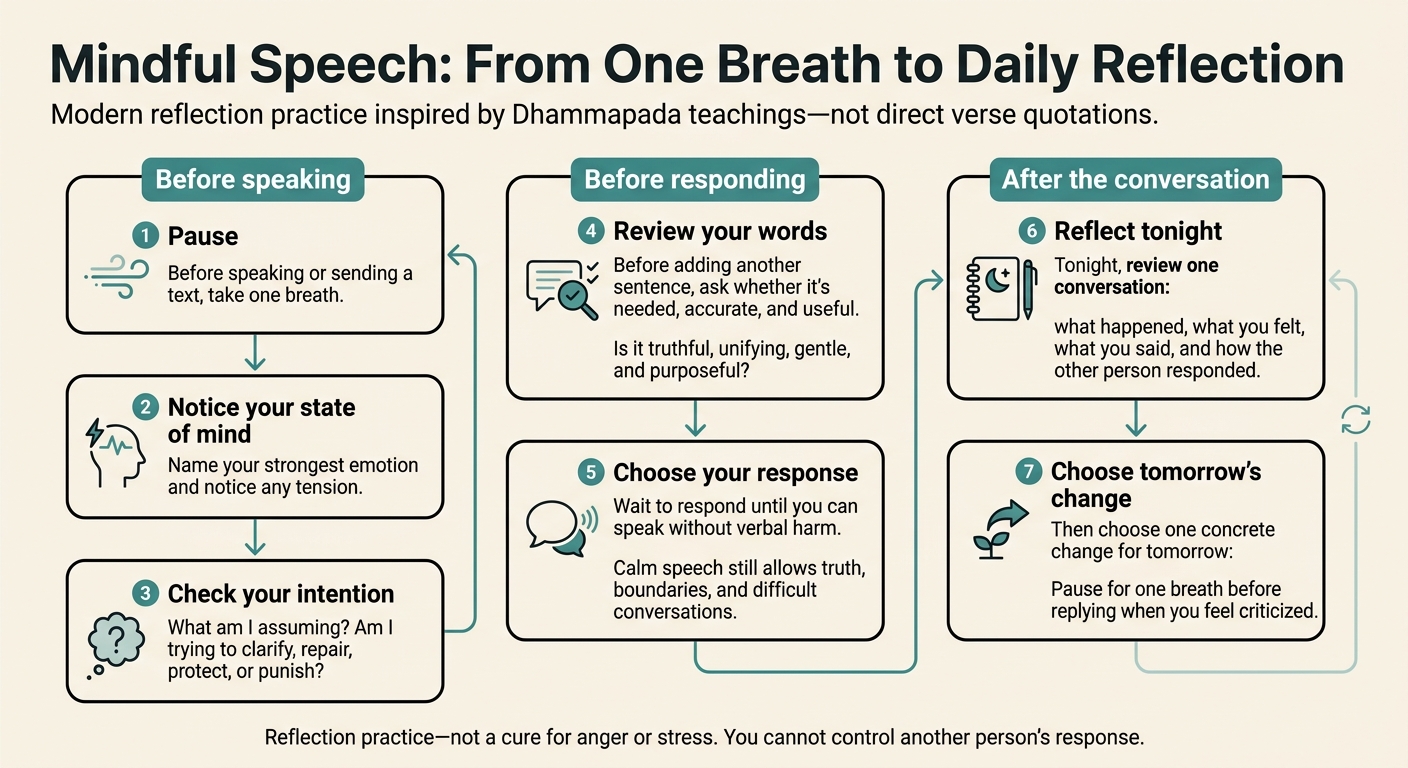
Before speaking or sending a text, take one breath. Name your strongest emotion and notice any tension. Then ask yourself:
What am I assuming? Am I trying to clarify, repair, protect, or punish?
If you feel tense or eager to win, set the draft aside for a few minutes. Reread it from the recipient’s perspective, checking its accuracy, timing, and tone. Good intent does not excuse harmful wording. A short pause can make your next sentence less reactive.
Choose words you can stand behind and reduce avoidable harm, without expecting to control the other person’s reaction. This check also helps you choose speech that brings peace.
3. Dhammapada 100: Choose Words That Bring Peace
After checking your intention, look at the words themselves. Dhammapada 100 contrasts a thousand meaningless words with one meaningful utterance that brings peace. The focus moves from why you speak to whether your words bring peace. Substance matters more than length. A short insult isn’t better than a careful explanation simply because it uses fewer words.
Before adding another sentence, ask whether it’s needed, accurate, and useful. Truthfulness and usefulness help you stick to what actually helps.
At work, turn a complaint into a request:
Let’s review the deadline and agree on the next two steps.
Then pause and let the other person respond rather than repeat the complaint. Peace means naming the problem without adding hostility. Paying attention to tone, timing, and restraint sets up the next teaching on anger in thought, word, and deed.
4. Dhammapada 231–234: Guard Against Anger in Thought, Word, and Deed
Verses 231–234 teach you to train body, speech, and mind together: catch anger early, stop harmful conduct, and bring all three into line. Right speech, in this sense, also calls for restraint in body and mind.
Start by noticing how anger shows up, then look beneath it. A clenched jaw, tight shoulders, a racing heartbeat, or thoughts that keep repeating can warn you before anger turns into a harsh message or reply. These signals are your cue to pause before anger chooses your words.
Wait to respond until you can speak without verbal harm. Before sending a reply, reread it for language that could hurt. The aim isn’t to erase anger - it’s to keep anger from writing the response.
Verse 233 asks you to notice the resentment or ill will behind your words. Are you treating one mistake as proof of who someone is? You can still report misconduct, set a firm boundary, or end an unsafe conversation without revenge, threats, or demeaning language. From here, the focus turns to the Eightfold Path.
5. Dhammapada 191: Understand Speech as Part of the Eightfold Path
After guarding against anger, look beyond restraint to the full path. Dhammapada 191 presents suffering, its origin, its ending, and the Noble Eightfold Path that leads to its end. Right Speech belongs within this path - not as a separate teaching.
Related Buddhist teachings, including the Magga-vibhaṅga Sutta (SN 45.8), describe Right Speech as avoiding false speech, divisive speech, harsh speech, and idle chatter. Idle chatter isn’t ordinary conversation. It means speech that is pointless, careless, or untimely.
Before sending a message, ask: Is it truthful, unifying, gentle, and purposeful? Cut exaggeration, check your claims, and avoid gossip.
Unifying speech can still be firm. Describe someone’s behavior accurately rather than judging their character, and choose the right time to speak. This discipline extends into calm thought, speech, and action.
6. Dhammapada 96: Reflect on Calm Thought, Speech, and Action
Right Speech guides what you say. Dhammapada 96 points to the state of mind behind those words, describing peace as harmony between mind, speech, and action. The verse concerns liberation, not just calm. Treat everyday composure as practice - not proof of liberation.
A calm voice alone isn’t enough. A steady mind helps keep anger, attachment, and agitation from driving your words and actions.
Does my tone match the peace I want?
Watch for impatience, the impulse to defend yourself, or the urge to control the exchange. Calm speech still allows truth, boundaries, and difficult conversations.
Put the verse into practice with a daily check. Tonight, review one conversation: what happened, what you felt, what you said, and how the other person responded. Observe without judgment. Find one moment when your tone drifted from the peace you wanted.
Then choose one concrete change for tomorrow:
Pause for one breath before replying when you feel criticized.
Keep the change small, specific, and easy to repeat tomorrow.
Conclusion: Choose One Change for Tomorrow
After verse 96, choose one small change you can repeat tomorrow. These verses connect speech to the mind: intention shapes words, useful words reduce harm, and restraint in mind, speech, and body protects peace.
Restraint doesn’t mean passive agreement. It means choosing your timing, tone, and purpose while addressing valid concerns without harmful speech.
Think back to one conversation today. Where did you notice clarity, agitation, kindness, or restraint? Did your words clarify or confuse? Did they ease tension or add to it? Focus on that choice, not your whole character. Let that reflection guide one small change for tomorrow:
Pause for one breath before replying, remove one harsh phrase, ask one clarifying question, or delay a nonurgent message until you are calm.
You can’t control someone else’s response, but you can choose your own words with more care and make them more useful.
FAQs
How can I practice Right Speech when others are hostile?
Pause before you react. Notice where your body feels tense, examine your thoughts, and ask whether your words are true, needed, gentle, and helpful. If they aren’t, staying silent may be better than responding to provocation.
Dhammapada verse 223 teaches overcoming anger with non-anger and wrongdoing with goodness. Respond with kindness while setting clear boundaries: patience does not mean accepting abuse. Firmly name the harmful behavior, then bring the conversation back to the issue at hand.
How can I repair harm caused by my words?
The Dhammapada encourages accountability and self-correction, not dwelling on guilt or regret. Pause and consider what led to your words - perhaps anger or carelessness. Take responsibility: correct what you said and sincerely commit to responding differently. Work to repair the situation with truthful, kind, and useful speech. Let your future actions reflect your values instead of repeating old patterns.
Can I practice these teachings without being Buddhist?
You can practice these teachings no matter your background or experience level. The Dhammapada stresses personal accountability, awareness, and mindfulness without requiring you to follow a religion.
Start small: pause before reacting, speak honestly and kindly, and notice your thoughts. These daily habits can help you build inner peace and mental clarity at your own pace.