

10 Dhammapada Verses for Self-Reflection
Use 10 Dhammapada verses as daily prompts—read, pause, act, and review to build heedfulness, self-care, and steadier conduct.
I start self-reflection with one verse, one honest observation, and one action to try tomorrow. Spend 3–5 minutes reviewing a recent choice: what drove it, what happened, and what you could do differently.
My reading path draws on 10 of the Dhammapada’s 423 verses, using Acharya Buddharakkhita’s English translation:
- Verse 1: Notice the thoughts behind your words and actions.
- Verse 21: Choose care over acting on autopilot.
- Verse 26: Guard your attention against distraction.
- Verse 28: Look at pain without adding blame.
- Verse 50: Review what you did - and left undone.
- Verse 158: Practice before giving advice.
- Verse 159: Follow your own advice under pressure.
- Verse 166: Protect your moral and spiritual growth.
- Verse 160: Take responsibility for your conduct.
- Verse 157: Care for yourself through watchful choices.
I treat these verses as prompts for ethical practice, not tests of personal worth. <u>Review the behavior, not your identity.</u> Pause before responding, choose one small change, and check what happened that evening.
For a daily reading cue, Sutta 423 is an optional companion: one verse a day covers the collection in 423 days. My aim is simple: less rumination, more care in what I say and do.
Stop Focusing on Others’ Faults | Buddha’s Teaching on Self-Reflection - Dhammapada 50 #Shorts
Understanding the Dhammapada
The Dhammapada is a Buddhist anthology in the Pali Canon, presented as a collection of the Buddha’s brief teachings on the mind, ethics, conduct, heedfulness, and liberation. Its 423 verses span 26 thematic chapters, making it well suited to reflection on one verse at a time.
This article uses Acharya Buddharakkhita’s English translation, The Dhammapada: The Buddha’s Path of Wisdom.
Two terms need some context. Heedfulness (appamāda) means ethical vigilance and steady practice - not just awareness of the present moment. The Deathless refers to Nibbāna, or liberation - not physical immortality.
Verses 157–160 and 166 call for self-training, not self-absorption: the focus is on bringing your conduct into line with what you teach. Verse 28 describes sorrow; it does not give permission to judge those who suffer. This context frames the verses below as brief prompts for daily review.
1. Dhammapada 1: Notice the Thoughts Behind Your Words and Actions
“Mind precedes all mental states. Mind is their chief; they are all mind-wrought. If with an impure mind a person speaks or acts, suffering follows him like the wheel that follows the foot of the ox.” - Acharya Buddharakkhita, Dhammapada 1
This verse points to the mind behind your words and actions. It doesn’t say thought creates everything. It says the mind shapes what you say, what you do, and what follows. That’s the starting point for steadier heedfulness: notice what’s driving your response.
Before a sharp text message, a defensive remark, or a difficult conversation, pause for 10–30 seconds. Notice bodily tension, name the strongest emotion, and ask what intention is about to lead your words. You need enough space to choose whether to speak, wait, or ask a question.
For evening journaling, trace one moment: situation → mind state → intention → words/action → result → next step. What did you want to protect, avoid, or prove? What effect did your response have? Review what you did without treating a passing state as a verdict on who you are.
Before your next important conversation or message, ask: What mind state is leading this? Wait five minutes before replying or ask one clarifying question before defending your position.
2. Dhammapada 21: Choose Heedfulness Over Neglect
“Heedfulness is the path to the deathless, heedlessness the path to death. The heedful do not die; the heedless are like the dead.”
If verse 1 helps you notice the mind, this verse asks you to keep returning to care. Heedfulness means paying close attention to the consequences of your choices. “Deathless” points to Nibbāna, liberation from suffering. Bring that same care to reviewing where you stayed awake today and where you drifted.
For your evening reflection, divide a journal page into two columns: “Awake” and “On autopilot.” Ask where you were attentive today and where you acted without thinking, then record those moments. Look for conditions you can change instead of treating a lapse as a personal failure.
Choose one situation for tomorrow. Give one task your full attention for 5–10 minutes, then note whether you stayed engaged. Heedfulness means returning to care, not forcing perfect attention. Verse 26 sharpens this point by showing how to guard that care against distraction.
3. Dhammapada 26: Guard Heedfulness Against Distraction
Verse 21 calls for heedfulness; verse 26 shows how to protect it: guard it like a treasure. You don’t need to police every wandering thought. Notice when your attention slips, then bring it back. Transitions and interruptions give you chances to practice.
Before conflict or switching from work to home, take a three-minute pause: feel both feet on the floor, breathe naturally, name the distraction, and choose your next action.
During your evening review, note one moment when you paid attention in time and one when your attention slipped. For the next 24 hours, choose one safeguard:
Silence nonessential notifications, set message-check times, or complete one task without extra media.
4. Dhammapada 28: See Sorrow More Clearly
After guarding heedfulness, Dhammapada 28 uses a mountain-and-ground image to show how clearer attention helps you see suffering. The point is to step back from automatic reactions and notice what’s happening - not to become self-righteous.
Read “free from sorrow” as a Buddhist ideal of freedom from suffering, not a promise that reflection removes grief. Acknowledge pain without adding blame, rumination, or impulsive action.
For a brief reality check, spend 5–10 minutes reviewing one painful personal moment from your day. Make two columns: Facts and What my mind is adding. In the first, note observable facts, feelings, and body sensations. In the second, write down predictions, self-criticism, or repeated stories. This helps separate what happened from what your mind added.
If a thought repeats without new insight, return to breathing, bodily sensations, or one concrete action. Ask what would reduce harm while still respecting your boundaries.
5. Dhammapada 50: Review What You Did and Left Undone
Seeing more clearly brings responsibility. Dhammapada 50 asks you to review what you did and what you left undone.
Put that clarity to work with a five-minute evening review. Write down one action that showed patience, honesty, or care; one that caused harm or confusion; and one important task you didn’t finish. What calls for an apology, a correction, or follow-through tomorrow?
Review conduct, not identity. Be specific about what happened, then choose one concrete next step.
Keep your responsibility separate from theirs. Reviewing your actions doesn’t excuse someone else’s misconduct. Decide whether to speak up, ask for accountability, or seek help.
6. Dhammapada 158: Practice Before You Teach
After reviewing your own conduct, look at the guidance you give others. Dhammapada 158 asks you to check whether your advice matches your actions.
“One should first establish oneself in what is proper; then only should one instruct others. Thus the wise man will not be reproached.”
Practice comes before instruction - not perfection. Live the patience, honesty, or restraint you ask of others.
Before giving feedback, ask yourself: Do I practice this principle? Am I trying to help, or to control? If you spot a gap between your words and actions, start working on it.
For journaling, write down one piece of advice you often give. Compare it with your behavior, then choose one action to bring the two into line tomorrow.
7. Dhammapada 159: Train Yourself to Follow Your Advice
“One should do what one teaches others to do; if one would train others, one should be well controlled oneself. Difficult, indeed, is self-control.”
The last verse stressed practice. This one asks you to follow your own advice under pressure. When you slip, treat it as a cue to adjust your plan.
Choose one action and spell out how you’ll respond:
“If X happens, I will do Y.”
For seven days, record whether you followed the plan, what made it hard, and one adjustment for tomorrow. Use those notes to revise your plan so the next day’s response is simpler and steadier.
8. Dhammapada 166: Protect Your Spiritual Welfare
“Don’t sacrifice your own welfare for that of another, no matter how great. Realizing your own true welfare, be intent on just that.”
After learning to follow your own advice, this verse asks how to protect that practice. Spiritual welfare means moral and spiritual growth, not comfort or status.
This isn’t selfishness. It’s the discipline that keeps your practice intact. Notice when being constantly available leaves no time for meditation, or when giving advice helps you avoid facing your own anger or dishonesty. The aim isn’t to care less, but to care more wisely.
Before accepting another request, take three slow breaths. Ask yourself: What is being requested? What is mine to do? What personal responsibility must I not abandon? Then help now, offer help later with a clear limit, or respectfully decline.
Name one responsibility toward yourself that you’ve neglected. In the next 24 hours, spend 20 minutes reading quietly or repair one broken commitment. Choose one small way to protect your practice tomorrow.
9. Dhammapada 160: Build Self-Reliance Through Discipline
“Oneself indeed is one’s protector, for what other protector could there be? With oneself well-controlled, one obtains a refuge difficult to gain.”
After learning to protect your practice, this verse asks you to take responsibility for it. Verse 160 turns self-reflection into a duty: your choices either protect you or they don’t. Other people can help, but their support cannot replace disciplined conduct or the inner work you must do yourself. Here, refuge means dependable inner ground built through practice - not isolation.
Self-control doesn’t mean hiding your emotions or expecting perfection. It means guiding your attention, speech, and actions in ways that protect your ethical and spiritual well-being. Discipline calls for the next wise action, not self-blame.
Put this into practice with a repeatable pause. For seven days, spend five minutes before bedtime reviewing one moment of skillful self-direction, one moment that needs adjustment, and one specific next step. Describe what happened without judging yourself. Choose one trigger, such as the urge to push back when you feel criticized:
“If I notice myself becoming defensive, then I will take one breath before replying.”
10. Dhammapada 157: Guard Yourself With Care
“If one holds oneself dear, one should protect oneself well. During every one of the three watches the wise person should keep vigil.”
Verse 157 brings self-control into daily care. Caring for yourself is a responsibility: if you value yourself, protect your mind and conduct from harm. That starts with noticing what clouds your judgment or puts you at risk.
The “three watches” refer to the whole night. Commentaries also read them as youth, adulthood, and old age - a reminder to stay watchful throughout life.
When making a self-care choice, ask whether it reduces harm, helps you think clearly tomorrow, and respects others.
Rest can be protective; using rest to avoid every necessary conversation is different.
For the next 24 hours, choose one vulnerability and one safeguard. Give the safeguard a specific time or boundary, and use it as your final check for the day. The next evening, note what happened and adjust without blaming yourself.
A Simple Reading and Evening Review Routine
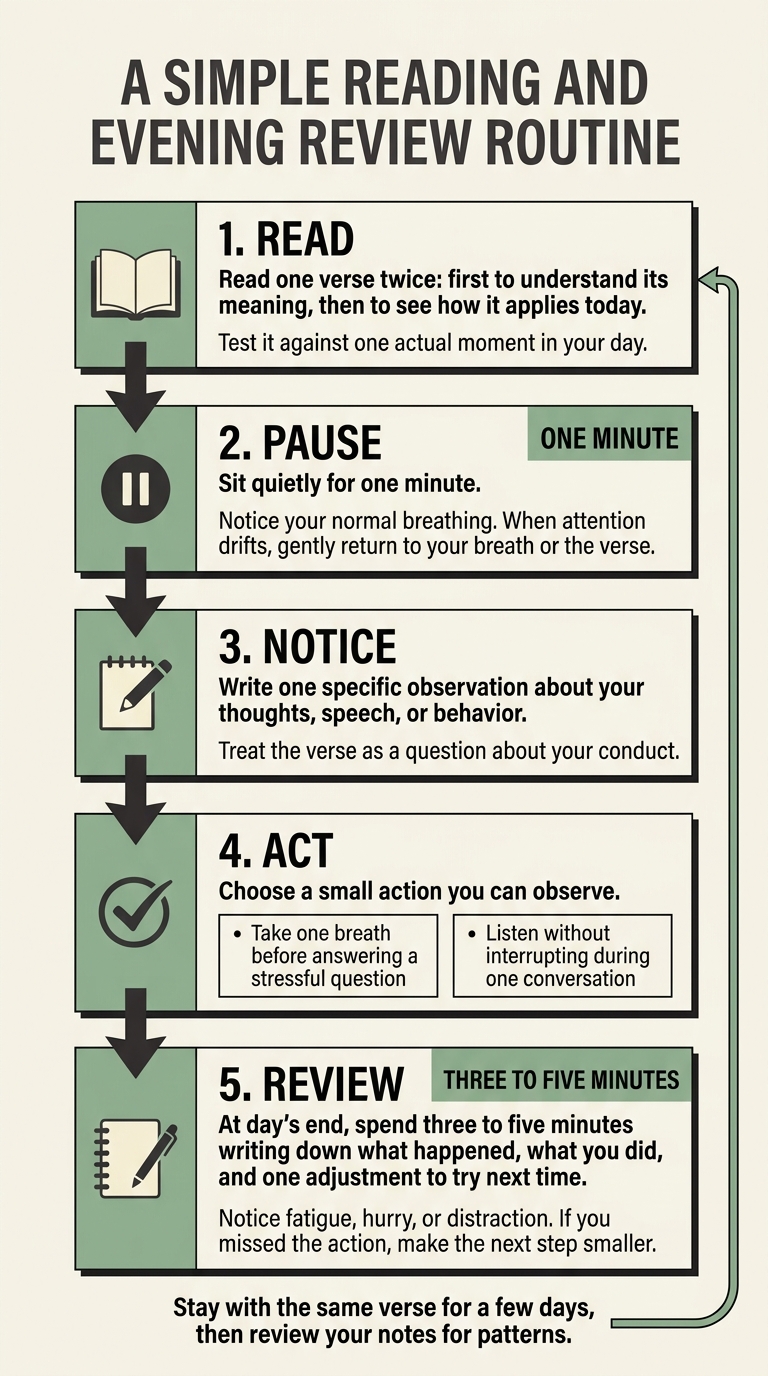
Dhammapada Self-Reflection: A Five-Step Routine
Follow five steps: read, pause, notice, act, and review. Read one verse twice: first to understand its meaning, then to see how it applies today. Test it against one actual moment in your day.
Sit quietly for one minute. If you’re sitting in a chair, put both feet on the floor and notice your normal breathing. When your attention drifts, gently return to your breath or the verse.
Treat the verse as a question about your conduct, not a passage to memorize. Write one specific observation about your thoughts, speech, or behavior. Then choose a small action you can observe:
Take one breath before answering a stressful question, or listen without interrupting during one conversation.
At day’s end, spend three to five minutes writing down what happened, what you did, and one adjustment to try next time. Notice what affected your response - fatigue, hurry, or distraction. If you missed the action, make the next step smaller so you have a clearer starting point tomorrow.
Stay with the same verse for a few days, then review your notes for patterns.
Read a Daily Verse With Sutta 423
Sutta 423 is an optional companion app that delivers one Dhammapada verse each day for reading and reflection. Make it part of your morning, take a brief pause during the day, or read it in the evening.
At one verse a day, the full reading takes 423 days - 58 days longer than a 365-day year. It’s a daily practice, not a seasonal one, and the app continues after day 423.
Keep each journal entry tied to a single verse. Record its number, describe its theme in one or two words, and keep your reflection separate from the verse text.
The app’s English wording may differ from the translation in this article. If it credits a translator, write down that name too. When the wording differs, focus on the meaning, not an exact match.
If you miss a day, pick up with the next verse. No need to build a backlog.
Conclusion: Choose One Verse and One Action
These verses connect quiet reading and self-inquiry through a simple cycle: notice, act, review. Notice what drives your words and actions, trace the causes of harm, and change course. Self-reflection isn’t rumination.
From there, pick the verse that best matches your current difficulty, then write one sentence on what it reveals and one small, observable action for tomorrow. Use this format: if this happens, then I will do this. Try pausing for one breath before replying or apologizing without excuses after speaking harshly.
At day’s end, test the verse against what happened. Review what you noticed, what you did, and what you’ll adjust next. If the action was too ambitious, make it smaller. If you missed it, treat the lapse as information - not proof of failure. The goal is earlier awareness and steadier conduct, not perfection. Sutta 423 can support this daily practice as it continues beyond the first 423 verses.
FAQs
Can I use these verses if I’m not Buddhist?
Yes. The Dhammapada’s short, stand-alone verses offer a simple way to practice mindfulness and self-reflection. You don’t need expertise or a deep understanding of Buddhist concepts to get something out of them. Read a verse, pause, and consider how its message relates to your life, thoughts, or current situation.
How can I tell reflection from rumination?
The difference comes down to your intention and how the process affects you. Reflection means noticing your thoughts and behaviors without judging them. It helps you gain clarity and grow, using a verse to guide your actions toward your values.
Rumination, on the other hand, keeps you stuck in imagined scenarios or mental chatter that pulls you away from the present. To avoid overthinking, focus on the verse’s main message and give its meaning time to settle naturally.
How do I choose a verse for my situation?
Start by checking in with your mood, goals, or challenges. Are you frustrated, restless, or working on patience? Choose a verse that speaks to how you feel or a trait you want to build.
If you don’t know where to start, the Sutta 423 app offers one verse each day to help you keep a regular reflection routine. Whichever approach you choose, focus on putting the verse into practice during your day rather than overanalyzing its meaning.