

5 Dhammapada Verses on Patience
Five Dhammapada verses on khanti explain patience as restraint, kindness, and resilience for everyday challenges.
Patience, or khanti, in the Dhammapada, is more than waiting - it’s about endurance, self-restraint, and staying calm in adversity. These teachings highlight patience as a mental strength that prevents conflict and fosters clarity. The article explores five key verses that show how patience helps in anger, conflict, and daily challenges:
- Verse 184: Patience is the highest self-discipline, surpassing physical hardships.
- Verse 122: Anger is controlled gradually, like filling a pitcher drop by drop.
- Verse 223: Anger is overcome by kindness, not retaliation.
- Verse 399: True strength is enduring criticism and hardship calmly.
- Verse 361: Self-restraint in body, speech, and mind leads to freedom from suffering.
The core idea is simple: patience transforms challenges into opportunities for growth. Each verse provides practical guidance for staying composed, whether in moments of anger, criticism, or daily frustrations. These teachings are tools for cultivating inner peace and resilience.
Dhammapada Verses 183-185: The Teaching of the Buddhas
1. Verse 184: Patience Is the Highest Form of Self-Discipline
"Enduring patience is the highest austerity. 'Nibbana is supreme,' say the Buddhas. He is not a true monk who harms another, nor a true renunciate who oppresses others." - Acharya Buddharakkhita
Verse 184 highlights patience as the pinnacle of spiritual discipline. Traditionally, austerity was associated with physical hardship. However, this verse shifts the focus to mental resilience, emphasizing the importance of enduring life's challenges with a composed mind. This perspective makes patience not just a spiritual ideal but a practical tool for navigating daily struggles.
The verse uses two Pali terms to describe patience. Titikkhā refers to enduring physical or mental difficulties, while khanti suggests maintaining a calm and accepting demeanor in emotional situations. Together, these terms present patience as a multifaceted practice that fosters inner strength across all areas of life.
Additionally, the verse redefines what it means to be a true practitioner. It’s not just about enduring hardships but also about refraining from causing harm or oppressing others. By practicing restraint and compassion in everyday situations, we cultivate the calm and disciplined character this teaching encourages.
2. Verse 122: Use Patience to Overcome Anger
Verse 122, from the Papavagga chapter of the Dhammapada, highlights the importance of gradual self-improvement. It uses the image of water filling a pitcher drop by drop to illustrate how consistent, small acts of goodness can lead to greater self-control and the ability to manage anger. This metaphor serves as a reminder that patience builds inner strength over time, one choice at a time.
Patience - or khanti - is a meditative skill that applies to everyday challenges, whether it's navigating tense conversations at work, sitting in traffic, or resolving family disagreements. Each moment of patience adds to your ability to remain calm and composed.
The verse also draws a distinction between merely suppressing anger and mastering it. True mastery is compared to a skilled charioteer who actively steers a speeding chariot, rather than passively holding the reins. This analogy suggests that overcoming anger requires active engagement and effort, much like how accumulated virtue gradually overpowers negativity.
3. Verse 223: Answer Anger with Calm
Verse 223 comes from the Kodhavaggo, the Dhammapada's chapter focused entirely on anger. Its message is simple but easy to forget when tempers flare:
"Through kindness one should overcome anger, through goodness one should overcome a lack of goodness, through gifts one should overcome stinginess, through truth (one should overcome) lying speech." - Dhammapada Verse 223
The wisdom here lies in the idea of opposites: anger isn't conquered by more anger. Instead, kindness diffuses hostility, generosity counters greed, and truth dismantles deception.
| Negative Quality You Encounter | Your Response |
|---|---|
| Anger | Calmness (akkodhena) |
| Wickedness | Goodness |
| Stinginess | Generosity |
| Lies | Truth |
This teaching has real-world applications, especially in personal relationships. Think about a family member snapping at you after a stressful day or a colleague reacting poorly to constructive feedback. Responding with anger only adds fuel to the fire.
The Sanskrit term akkodhena directly translates to "through non-anger." It describes more than just suppressing anger - it’s about actively choosing patience and maintaining composure. This aligns with the Dhammapada's broader emphasis on self-restraint. It’s in that crucial moment between stimulus and response where true patience is practiced.
While it’s not always easy to embody these responses, this verse provides a clear guide for fostering harmony at home, at work, and beyond. By countering negativity with its opposite, we create space for understanding and peace - a theme that continues in the verses that follow.
4. Verse 399: Accept the Present Moment
Verse 399, from the Brāhmaṇavaggo - the final chapter - emphasizes that genuine spiritual stature stems from inner virtues like patience, rather than external factors such as birth or social standing.
"He who bears without being offended abuse, beating and punishment; whose power, real might, is patience - him do I call a holy man."
This verse redefines patience as a form of true strength, describing it as an "army of strengths" (balānīkaṁ). It challenges the notion that patience is weakness, instead presenting it as a profound inner power. The holy man, rather than responding to hostility with retaliation, demonstrates mastery through acceptance and calm endurance.
Another verse complements this idea: "To the extent the intent to harm wears away, to that extent suffering subsides." This highlights how letting go of resistance to harsh circumstances can ease suffering. Acceptance here doesn’t mean condoning harmful actions - it means choosing not to amplify the negativity by reacting. By doing so, patience becomes a tool for grounding oneself in the present and reducing inner turmoil.
This mindset also creates room for gratitude. A sage who accepts the moment without resentment rises above contempt and finds contentment in the now. This understanding naturally leads into the next teaching, which explores how restraint in body, speech, and mind deepens inner peace.
5. Verse 361: Restrain Body, Speech, and Mind
While earlier teachings focused on acceptance, Verse 361 shifts to the active practice of restraint. It suggests that true acceptance is supported by deliberate self-control - applied to the body, speech, and mind. This verse offers a practical guide to cultivating restraint in daily life.
"Good is restraint in the body; good is restraint in speech; good is restraint in thought. Restraint everywhere is good. The monk restrained in every way is freed from all suffering." - Verse 361, Dhammapada
The term saṃvaro, which translates to "to cover" or "to guard", is central here. It implies creating a protective barrier against impulsive reactions. According to Buddhist commentary, the Buddha shared this teaching to resolve a disagreement among five monks, each claiming that restraint over a specific sense was paramount. His response emphasized the need for restraint across all aspects of life.
This teaching unfolds in three parts:
- Restraint of the body: This involves pausing before reacting physically - whether that means walking away from conflict or maintaining a calm demeanor.
- Restraint of speech: Choosing words carefully to diffuse tension rather than escalate conflict is key here.
- Restraint of thought: The hardest of all, this requires constant mindfulness and self-awareness to manage the mind's unpredictable nature.
To deepen this idea, Verse 380 draws a vivid comparison between self-control and a trader handling a noble steed:
"One is one's own protector, one is one's own refuge. Therefore, one should control oneself, even as a trader controls a noble steed." - Verse 380, Dhammapada
These three forms of restraint - body, speech, and mind - work together to build a foundation for patience. By practicing restraint, one can break free from reactive suffering and nurture a state of enduring inner peace.
Comparison Table
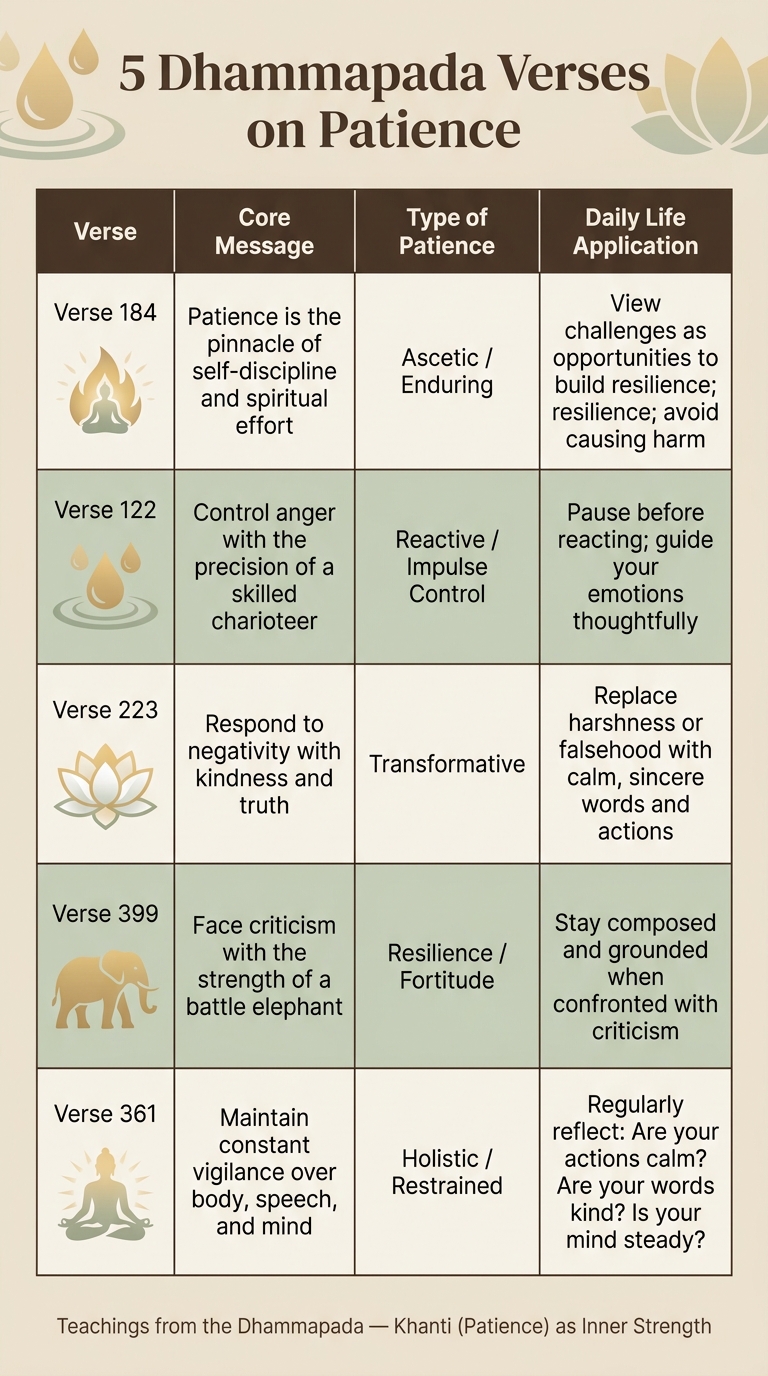
5 Dhammapada Verses on Patience: Core Teachings at a Glance
This table condenses the insights from each verse into actionable lessons for daily life. It showcases how each verse approaches patience and offers practical ways to incorporate these teachings into everyday situations.
| Verse | Core Message | Type of Patience | Daily Life Application |
|---|---|---|---|
| 184 | Patience represents the pinnacle of self-discipline and spiritual effort. | Ascetic/Enduring | View challenges as opportunities to build resilience and avoid causing harm. |
| 122 | Control anger with the precision of a skilled charioteer. | Reactive/Impulse Control | Pause before reacting to anger, taking time to guide your emotions thoughtfully. |
| 223 | Respond to negativity with kindness and truth. | Transformative | Replace harshness or falsehood with calm, sincere words and actions. |
| 399 | Face criticism with the strength of a battle elephant. | Resilience/Fortitude | Stay composed and grounded when confronted with criticism. |
| 361 | Maintain constant vigilance over body, speech, and mind. | Holistic/Restrained | Regularly reflect: Are your actions calm? Are your words kind? Is your mind steady? |
Each verse offers a distinct angle on patience, moving from internal discipline to external interactions. For example, Verse 361 ties everything together by emphasizing the importance of constant mindfulness across all aspects of life. The verses also vary in their focus on reactive versus proactive approaches: Verses 122 and 399 provide guidance for navigating anger and criticism, while Verses 184 and 361 promote a steady, proactive commitment to maintaining inner harmony.
Collectively, these teachings emphasize a timeless truth from the Dhammapada: patience is a profound source of strength. Whether it's through managing impulses, transforming negativity, or cultivating holistic restraint, patience leads to inner peace and freedom from suffering.
Conclusion
These verses reshape the idea of patience, presenting it as an active and disciplined form of strength. It’s not passive endurance but a deliberate practice. Verses 184, 122, 223, 399, and 361 together map a path from cultivating inner discipline to applying it in mindful, everyday actions. They encourage us to turn life’s challenges - whether small frustrations or larger trials - into moments of calm and growth.
This approach is practical for everyday life, whether you’re navigating a heated discussion or enduring a long, grueling commute. The concept of Khanti isn’t just a lofty ideal; it’s a skill you develop, one moment at a time.
If you’d like to explore these teachings further, the Sutta 423 app offers a simple way to engage. It delivers one Dhammapada verse per day - completely free and without any pressure to maintain streaks. As the app explains:
"One verse a day. A small portion. Enough to hold. Enough to return to." - Sutta 423
This gentle, no-rush approach allows these teachings to settle naturally over time. If you’re looking for a way to reflect more deeply, consider starting with a daily verse.
FAQs
What’s the difference between khanti and titikkhā?
Khanti and titikkhā both relate to patience and endurance, though they emphasize slightly different aspects. In Buddhist practice, khanti stands out as a core virtue, emphasizing the ability to endure hardships and provocations without giving in to anger, which aids in spiritual development. On the other hand, titikkhā is often used interchangeably but leans more toward enduring adversity as a form of spiritual discipline. The phrase “khanti paramam tapo titikkhā” illustrates their close relationship, recognizing khanti as the highest form of austerity.
How can I practice patience in the moment when I’m angry?
When anger flares up, take a moment to pause and notice your emotions without immediately reacting. Teachings from the Dhammapada highlight the importance of understanding anger and learning to manage it wisely. Simple practices like deep breathing, reminding yourself that emotions are temporary, or repeating a calming phrase can make a big difference. Incorporating daily reflections - such as those available through the Sutta 423 app - can also help cultivate mindfulness and strengthen patience over time.
Does “acceptance” in Verse 399 mean tolerating mistreatment?
The term “acceptance” in Verse 399 conveys the idea of enduring abuse, punishment, or mistreatment with resilience and without harboring resentment. It emphasizes patience as a demonstration of inner strength rather than a passive or submissive acceptance of harm or injustice.