

5 Dhammapada Verses on Overcoming Suffering
Suffering begins in the mind; five timeless verses teach non-hatred, wholesome action, wisdom, and letting go as the path to lasting peace.
Life often feels like a series of challenges - stressful jobs, strained relationships, and unexpected health issues. The Dhammapada, a collection of 423 Buddhist verses, offers timeless wisdom to navigate these struggles. Rooted in the Four Noble Truths and the Noble Eightfold Path, it provides practical steps to reduce suffering and find inner peace.
Here are five key verses from the Dhammapada that address suffering:
- Hatred is Overcome by Non-Hatred (Verse 5): Break cycles of anger with compassion and kindness.
- Suffering Follows the Wrongdoer (Verse 1): Unethical actions lead to suffering, much like a wheel follows an ox.
- Happiness Follows Good Actions (Verse 2): Pure intentions bring lasting joy, just as a shadow follows its source.
- The Noble Eightfold Path (Verses 273–276): A clear guide to end suffering through wisdom, discipline, and mindfulness.
- Letting Go of Attachment (Verses 216, 336, 348): Craving creates sorrow; releasing attachments leads to freedom.
These teachings remind us that suffering begins in the mind, shaped by our thoughts and actions. By making small, mindful changes, we can shift toward a more peaceful and fulfilling life.
Dhammapada Verse Two: Happiness Follows a Pure Mind
1. Hatred Is Overcome Only By Non-Hatred (Verse 5)
Verse 5 emphasizes a timeless truth: hatred cannot be defeated by more hatred. Instead, it calls for responses rooted in love and compassion - an approach that can guide us through everyday conflicts.
This teaching is vividly illustrated in the story of Kāliyakkhinī, where a cycle of revenge stretched across lifetimes. Each act of retaliation only fueled further animosity until the Buddha introduced Verse 5, demonstrating that revenge perpetuates hatred rather than resolving it.
As the Treasury of Truth explains:
"Those who attempt to conquer hatred by hatred are like warriors who take weapons to overcome others who bear arms. This does not end hatred, but gives it room to grow."
This principle isn't confined to ancient tales - it’s just as relevant in modern life. Think about how conflicts at work or home often escalate when past grievances are revisited. Breaking this cycle is essential for fostering peace.
The Dhammapada offers a clear path forward: replace anger with love, harmful actions with kindness, stinginess with generosity, and dishonesty with truth.
2. Suffering Follows the Wrongdoer (Verse 1)
Verse 1 of the Dhammapada takes us to the root of suffering, showing how it begins within the mind.
"If with an impure mind a person speaks or acts suffering follows him like the wheel that follows the foot of the ox." - Acharya Buddharakkhita
This analogy paints a vivid picture. Just as an ox pulls a cart and its wheel follows without fail, suffering inevitably follows harmful thoughts, words, and actions. The teachings emphasize that the mind is the starting point of all experiences, shaping everything we say and do.
The verse reminds us that our intentions set the course for our lives. A sharp comment made in anger, a selfish decision, or a dishonest act - all of these create ripples that eventually return to us. The Buddhist Publication Society elaborates on this concept:
"Man himself is mainly responsible for his own happiness and misery. He creates his own hell and heaven. He is the architect of his own fate. What he makes he can unmake."
Suffering, then, isn’t some external force punishing us - it’s the natural result of our own choices. Even small unethical actions build up over time, influencing both our character and how others perceive us. The good news? If we are the creators of our suffering, we also have the ability to change our path and rebuild.
A lesson we can take from this verse is to pause and examine our motives before we act. By asking ourselves questions like, "Am I acting out of anger, fear, or selfishness?" we can interrupt the cycle of suffering. This kind of mindful reflection opens the door to more thoughtful actions and, ultimately, a more peaceful life.
3. Happiness Follows the Doer of Good (Verse 2)
Verse 2 shifts the focus from suffering caused by harmful actions to the joy that comes from pure intentions. It highlights a simple yet profound truth: when actions stem from a pure mind, happiness becomes a natural companion.
"If one speaks or acts with pure mind, because of that, happiness follows one, even as one's shadow that never leaves." - Ven. Nārada, Translator
The imagery here is striking. Unlike the heavy, unavoidable suffering described in Verse 1, happiness is portrayed as effortless and constant - like a shadow that never leaves your side. This idea is beautifully illustrated in ancient Buddhist stories.
Take the story of Matthakundali, for instance. On his deathbed, unable to perform any physical acts of charity, he directed a single, sincere thought of faith toward the Buddha. That pure intention alone led to his celestial rebirth. This story reminds us that goodness doesn’t have to be grand. Even small, heartfelt acts can lead to profound and lasting inner peace.
This teaching ties into the Buddhist principle of the law of accumulation. Small, consistent acts of kindness, honesty, and generosity gradually build a deep sense of peace. Like filling a pot drop by drop, these simple actions create a steady and enduring happiness rather than the fleeting satisfaction of external pleasures.
The practical lesson is simple: pay attention to your intentions. Before you act, ask yourself if your motive stems from kindness, honesty, or care. It’s not about being perfect but about aligning your mind with goodness, allowing peace and happiness to follow naturally.
4. Following the Noble Eightfold Path to Move Past Suffering (Verses 273–276)
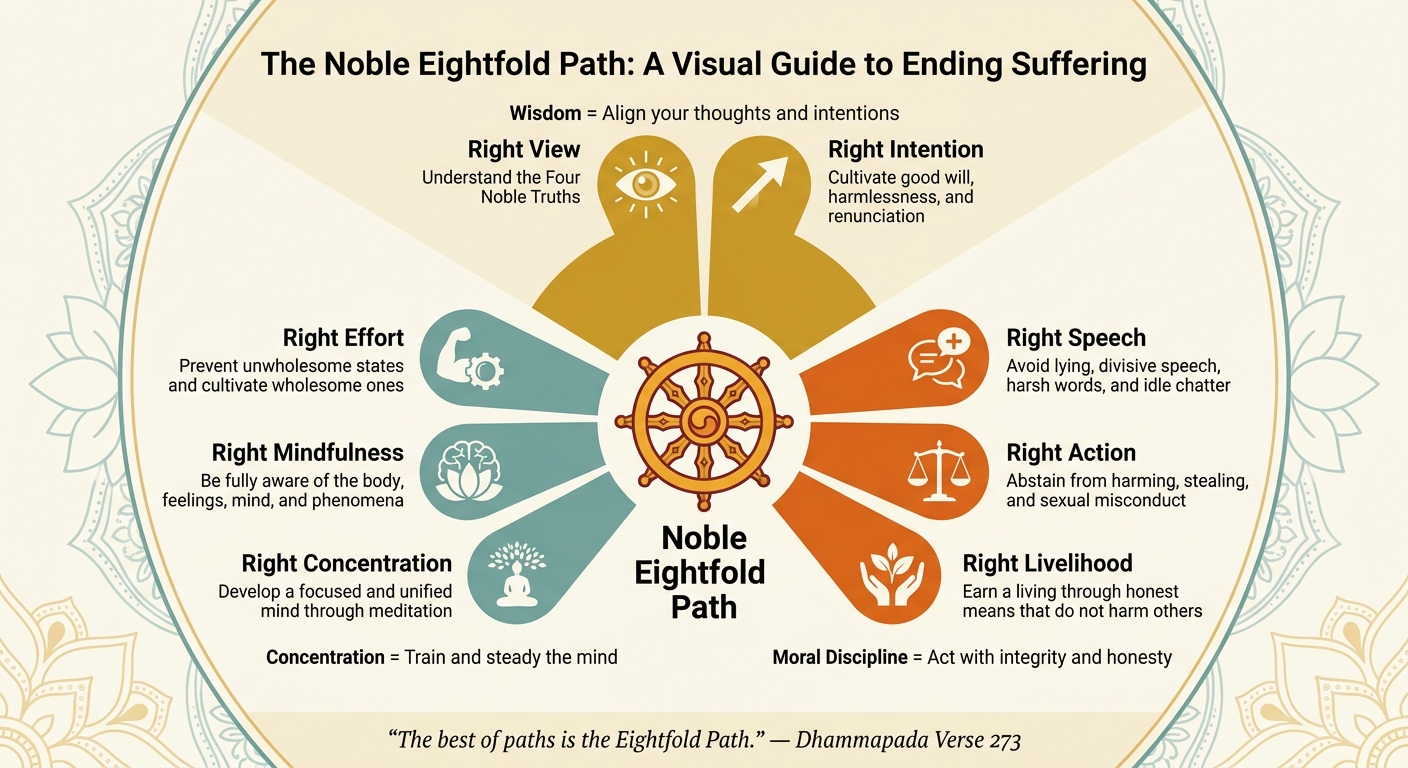
The Noble Eightfold Path: A Visual Guide to Ending Suffering
These verses provide a roadmap for overcoming inner pain, introducing the Noble Eightfold Path - also known as the Middle Way. This framework offers practical guidance to end suffering and achieve Nibbāna. Verse 273 sets the foundation:
"The best of paths is the Eightfold Path. The best of truths are the four Sayings." - Ven. Nārada, Translator
The Noble Eightfold Path is divided into three key areas: Wisdom (right view, right intention), Moral Discipline (right speech, right action, right livelihood), and Concentration (right effort, right mindfulness, right concentration). These elements work together as a cohesive system. By aligning internal intentions with mindful, disciplined actions, the path turns insights into sustainable practices. It builds on earlier teachings about intention and mindfulness, showing how they can lead to deep, lasting transformation.
Verse 275 highlights the outcome of following this path:
"Entering upon that path, you will make an end of pain. Having learnt the removal of thorns, have I taught you the path." - Ven. Nārada, Translator
Here, "thorns" symbolize internal defilements - such as lust or grief - that perpetuate emotional suffering and stress. The verse underscores that liberation from pain is achievable through dedicated practice, offering hope and clarity about the journey ahead.
Verse 276 shifts the focus to personal responsibility:
"Striving should be done by yourselves; the Tathāgatas are only teachers." - Ven. Nārada, Translator
While the Buddha provides guidance, the effort to walk the path and overcome suffering lies entirely in your hands. This reminder empowers individuals to recognize their own strength and capacity for change, making the journey toward freedom a deeply personal and self-driven process.
5. Letting Go of Attachment to End Suffering (Verses on Non-Attachment)
This teaching takes a profound turn by addressing the root cause of suffering: attachment. While earlier lessons emphasized mindfulness and intention, this one delves into how craving intensifies pain and sorrow.
The Dhammapada vividly portrays craving (tanha) as a relentless vine that tightens its grip. Verse 336 captures this idea with striking clarity:
"Whoever overcomes this overwhelming craving, from him sorrows fall away like water from a lotus leaf." - Dhammapada Verse 336
Similarly, verse 216 underscores how craving is the source of both grief and fear:
"From craving, grief and fear arise. No craving, no grief or fear." - Dhammapada Verse 216
Interestingly, attachment isn’t limited to material possessions. The text explains that the most binding chains are not made of iron or wood but are the invisible bonds of desire - whether for things or relationships. Recognizing the impermanence of all things helps loosen these attachments. The Dhammapada reminds us that nothing is permanent - not relationships, not situations, not even our current sense of self.
Building on this theme, Verse 348 provides one of the most profound calls for liberation:
"Let go of the past, let go of the future, let go of the present, and cross over to the farther shore of existence. With mind wholly liberated, you shall come no more to birth and death." - Dhammapada Verse 348
Letting go, then, is not just a practice - it’s a path to freedom from the cycle of suffering.
Conclusion
The teachings of the Dhammapada highlight that suffering stems from our thoughts, actions, and attachments. Throughout the text, there's a recurring reminder: the mind is both the source of our struggles and the key to overcoming them.
Here's a quick look at how the core themes translate into everyday life:
| Theme | Practical Application | Outcome |
|---|---|---|
| Wholesome Action | Replacing anger with love and greed with generosity | Breaks cycles of negativity and cultivates positive karma |
| Wisdom | Understanding how thoughts shape experiences | Encourages thoughtful responses and sharpens clarity |
| Non-Attachment | Letting go of expectations in outcomes and relationships | Reduces fear and sorrow linked to craving |
However, integrating these insights into daily life is no small task - it requires ongoing effort.
As the Dhammapada wisely observes:
"Restless and unstable is the mind; Hard to protect and restrain. The wise make it straight, As a fletcher straightens arrows." - Suddhāso Bhikkhu
This is why consistency in practice is so essential. Transforming deep-seated habits doesn’t happen overnight. Instead, regular engagement - even in small doses - can lead to meaningful change. Each time you notice a shift for the better, it strengthens your resolve to keep going. Over time, this creates a positive feedback loop that builds confidence and fuels further growth.
To make this journey feel approachable, consider tools like the Sutta 423 app. It delivers one verse daily, guiding you through all 423 verses of the Dhammapada over the course of a year. This gentle, step-by-step approach allows the teachings to unfold naturally, one day at a time.
FAQs
How do I practice non-hatred in a real conflict?
To approach conflict with non-hatred, take a moment to pause and reflect on your thoughts before responding. The Dhammapada emphasizes that hatred is overcome not through retaliation but through non-hatred and love. When emotions run high, remain silent, much like a "broken gong", to prevent further escalation. You can also practice Metta Bhavana - a meditation on loving-kindness - by first directing compassion toward yourself and then gradually extending it to others, even those you struggle with. This practice helps shift resentment into understanding and compassion.
What’s the difference between craving and healthy goals?
The key difference is how you relate to the outcome. Craving ties your sense of self-worth to achieving a specific result, creating a feeling of lack and often leading to stress or fear of failure. On the other hand, setting healthy goals lets you aim for something meaningful while staying balanced and present. When you release your grip on the outcome, you can approach your goals with a clear mind and a sense of peace, breaking free from the exhausting loop of constant desire and pursuit.
How can I start the Eightfold Path in daily life?
The Dhammapada serves as a helpful guide to grasp the 'why' behind the Eightfold Path, while the Eightfold Path itself lays out the 'how.' It includes eight key practices: right understanding, intention, speech, action, livelihood, effort, mindfulness, and concentration. Begin by cultivating mindful awareness, anchoring your intentions in compassion, and paying close attention to your speech. Staying consistent in your efforts is essential, and reflecting on a daily verse from the Dhammapada can provide steady guidance along the way.