

7 Dhammapada Verses on Mastering the Mind
Seven key Dhammapada verses explained for practical mind training—reducing anger, releasing grudges, and building focus.
The Dhammapada offers timeless lessons on how the mind shapes our reality. By training the mind, we can reduce suffering and cultivate inner peace. Here are seven key verses from this Buddhist text, simplified for practical use:
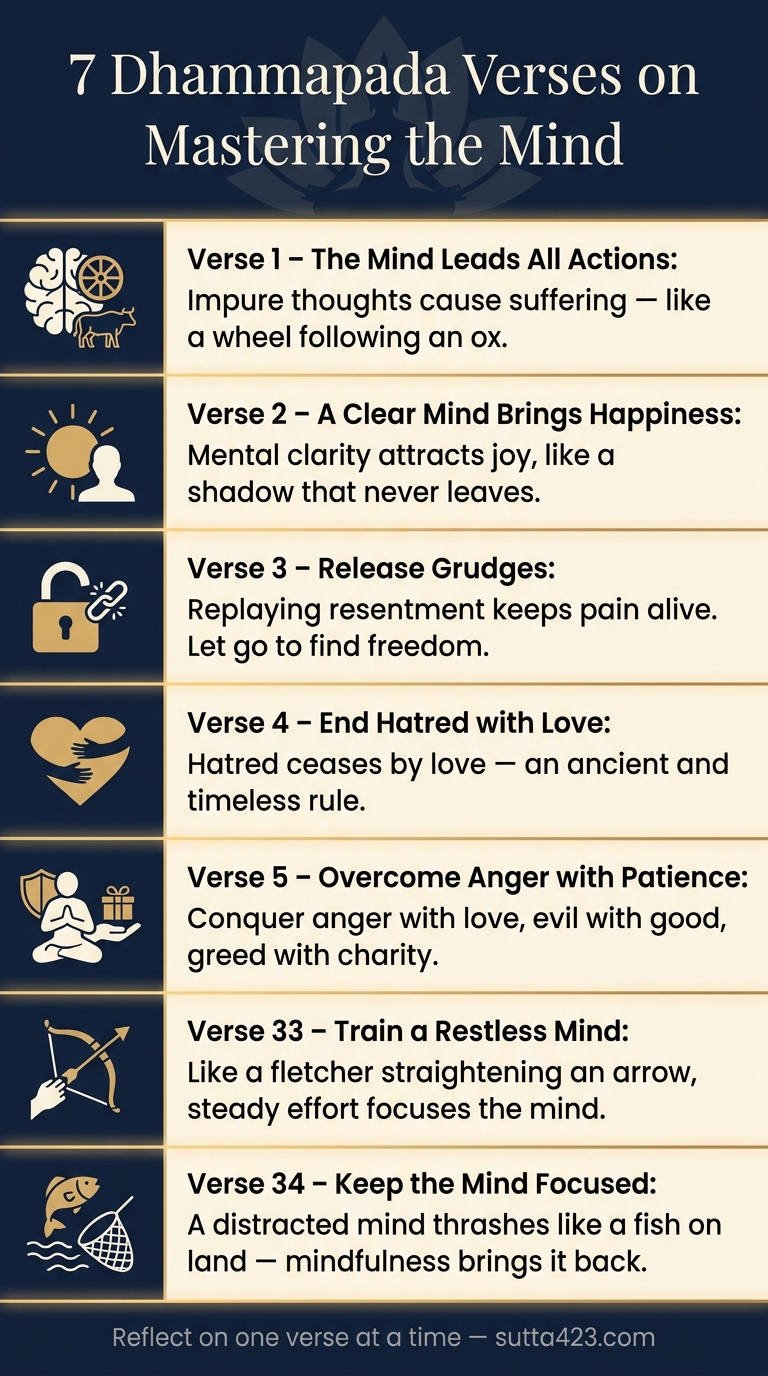
- The Mind Leads All Actions: Thoughts influence actions, and impure thoughts lead to suffering, just as a wheel follows an ox.
- Clear Mind Brings Happiness: A pure mind results in happiness, like a shadow that never leaves.
- Release Grudges: Holding onto resentment keeps pain alive; letting go frees the mind.
- End Hatred with Love: Conflict ends not with retaliation but with kindness and patience.
- Overcome Anger with Patience: Transform anger into calm understanding and strength.
- Train a Restless Mind: Like straightening an arrow, steady effort can focus a wandering mind.
- Keep the Mind Focused: Distraction is natural but can be overcome with mindfulness.
The Dhammapada emphasizes personal accountability and mindfulness. Even small, consistent efforts to apply these teachings can help you develop a calmer, more disciplined mind. Start with one verse at a time and reflect on how it applies to your daily life.
7 Dhammapada Verses on Mastering the Mind
Citta Vagga: Mastering the Mind - Dhammapada Insights with Bhante Sumitta
How the Dhammapada Views Mastering the Mind
The Dhammapada emphasizes that the mind shapes every aspect of our experience. Translator Acharya Buddharakkhita explains it this way:
"Mind precedes all mental states. Mind is their chief; they are all mind-wrought."
This perspective isn’t just theoretical - it provides a practical guide. Since every experience is filtered through the mind, understanding its state becomes essential. The text highlights the contrast between an undeveloped mind and a cultivated mind.
An undeveloped mind is likened to a poorly thatched roof, where passions and impulses easily seep through. On the other hand, a cultivated mind resembles a sturdy, well-constructed roof that keeps disturbances at bay. This transformation isn’t a matter of innate ability or chance - it’s the result of intentional and consistent effort.
To illustrate this, the Dhammapada uses the metaphor of a fletcher carefully straightening an arrow. Similarly, training the mind requires patience and deliberate practice. Bhante Suddhāso, a Buddhist monk and translator, sheds light on this process:
"Through the development of concentration and insight, one can stabilize and tame the mind until it is able to remain rock-solid and steady in all circumstances."
Modern mindfulness practices, like observing thoughts without judgment and managing negative emotions, align with these teachings. Without training, the mind can easily fall into cycles of craving and aversion - what the text refers to as Māra-Dheyya - which disrupt inner peace and balance.
1. Verse 1 – The Mind Leads All Actions
The Dhammapada begins with a profound declaration, setting the tone for the teachings that follow. Acharya Buddharakkhita translates it as:
"Mind precedes all mental states. Mind is their chief; they are all mind-wrought. If with an impure mind a person speaks or acts suffering follows him like the wheel that follows the foot of the ox."
This vivid imagery - the wheel trailing the ox - captures the inescapable nature of suffering born from impure thoughts. When the mind is clouded by anger, greed, or delusion, the consequences are as inevitable as the wheel's movement.
The verse emphasizes personal accountability. Our inner world, shaped by our thoughts, directly influences our external experiences. Ven Nārada explains it succinctly: "Man himself is mainly responsible for his own happiness and misery. He creates his own hell and heaven. He is the architect of his own fate." Simply put, our minds are the driving force behind our joy or suffering.
Interestingly, this ancient wisdom aligns closely with modern psychology. Cognitive Behavioral Therapy (CBT), for example, operates on the idea that distorted thought patterns contribute to emotional distress. By altering these patterns, individuals can transform their emotional state.
Verse 1 also serves as the gateway to the Yamakavagga (Twin Verses) chapter, which contrasts two distinct paths using paired verses. This first verse highlights the repercussions of an undisciplined mind, while the next one explores the rewards of clarity and discipline. Together, they lay the foundation for the lessons that unfold in the subsequent verses.
2. Verse 2 – How a Clear Mind Shapes Happiness
If Verse 1 highlights how a troubled mind leads to suffering, Verse 2 flips the script, showing how clarity of mind brings joy. One translation of this verse reads:
"Mind precedes all knowables, mind's their chief, mind-made are they. If with a clear mind if one speaks or acts, happiness follows caused by that, as one's shadow ne'er departing."
The metaphor of a shadow here is powerful. Just as a shadow naturally follows us wherever we go, happiness effortlessly follows a clear and focused mind. This imagery underscores the idea that joy isn't something we chase - it emerges naturally from a state of mental clarity.
The backstory tied to this verse makes the teaching even more vivid. The Buddha is said to have shared these words in reference to a young man named Maṭṭakuṇḍali. Despite suffering from physical frailty and having a miserly father who denied him proper care, Maṭṭakuṇḍali turned his mind toward the Buddha with unwavering faith and devotion. This pure and focused mindset led to his rebirth in a celestial realm.
As the Buddhist commentary VivekaVani succinctly puts it: "Think wrong and suffer. Think right and be happy."
This verse invites us to practice Cittānupassanā - examining the state of our minds. Are we weighed down by resentment and negativity, or is our mind clear and steady?
3. Verse 3 – Releasing Grudges and Mental Stories
Verse 3 takes the ideas from Verse 2 about mental clarity and digs deeper into the toxic stories we tell ourselves that keep resentment alive. Instead of broadly addressing anger, it zooms in on the specific mental loops we replay:
"He abused me, he struck me, he overpowered me, he robbed me. Those who harbor such thoughts do not still their hatred." – Acharya Buddharakkhita, Translator
This quote lays bare how clinging to labels like "abused" or "struck" keeps old wounds fresh, ensuring the pain sticks around.
The verse highlights that the real issue isn’t just what happened - it’s the narrative we keep repeating in our minds. Acharya Buddharakkhita also translates, "Whatever harm an enemy may do to an enemy, or a hater to a hater, an ill-directed mind inflicts on oneself a greater harm". This is a powerful reminder that holding onto resentment often hurts us more than it impacts the person we’re angry with. Carrying a grudge is like holding onto a burning coal - it does more damage to your hand than to anyone else.
One practical way to embrace this teaching is to pause when resentment bubbles up and ask yourself: "Am I reacting to what’s happening now, or am I stuck replaying an old story?" That brief pause can help you respond thoughtfully instead of falling back into automatic anger. Letting go of these mental scripts isn’t just freeing - it’s a key step toward a calmer, more disciplined mind.
4. Verse 4 – Finding Freedom Through Non-Retaliation
Verse 3 highlighted how holding onto grievances can fuel resentment, but Verse 4 offers a powerful remedy to break the cycle of conflict:
"For hatred does not cease by hatred at any time: hatred ceases by love, this is an old rule." – Friedrich Max Müller, Translator
This ancient wisdom underscores a timeless truth: conflict cannot be resolved by responding with more hostility. The Dhammapada provides a guide for overcoming negativity - countering anger with kindness, evil with goodness, stinginess with generosity, and lies with truth. It’s a call to choose thoughtful action over knee-jerk reactions.
A compelling example of this teaching is the story of Akkosa Bhāradvāja. When he unleashed a barrage of insults at the Buddha, the Buddha met his aggression with silent composure. This refusal to retaliate ultimately diffused the tension and inspired Akkosa to seek peace.
Patience, as described in the Dhammapada, is not about passivity or surrender. Instead, it’s framed as a profound strength. The text likens enduring abuse or provocation without anger to wielding the "power of patience" as a form of inner might. In this sense, staying calm under pressure becomes a transformative force.
These teachings encourage us to incorporate such practices into our daily lives, using patience and non-retaliation as tools for fostering peace and resilience.
5. Verse 5 – Overcoming Anger With Patience
This verse builds on the idea of non-retaliation from the previous one, but it takes things a step further. It encourages us not just to refrain from reacting in anger but to actively transform that anger into calm understanding and patience.
"Conquer anger with love, evil with good, greed with charity and falsehood with truth." – Dhammapada Verse 223
The message here is clear: instead of suppressing anger, we should channel it into something constructive. Patience, in this context, is likened to a skilled charioteer who masterfully controls wild horses. It’s not about bottling up emotions but about redirecting them into a source of inner strength.
A powerful example of this teaching comes from the story of Uttarā, a devoted lay disciple. When faced with an attack by Sirimā, a jealous courtesan who tried to pour boiling butter over her head, Uttarā chose to respond with gratitude and loving-kindness instead of fear or rage. According to tradition, her calm and compassionate mindset shielded her from harm, as the boiling butter failed to burn her. Sirimā, moved by this response, eventually repented. The Buddha used this incident to illustrate how anger is defeated - not through retaliation, but by refusing to fuel it. True strength lies in a calm and measured response.
As the Buddha noted, overcoming anger brings ease and liberation from sorrow. This transformation is not just about avoiding conflict but about finding peace within.
6. Verse 33 – Training a Restless Mind
If you've ever tried meditating and found your thoughts jumping from one idea to the next, you've experienced exactly what this verse is talking about.
"The mind is so fickle and agitated. It is very difficult to protect and very challenging to guard from evil. The wise person straightens his mind as an arrow maker straightens an arrow shaft." – Dhammapada Verse 33
Just like an arrow maker carefully straightens a shaft, steady effort is key to training our naturally restless minds into a source of clarity and wisdom.
This verse reminds us that a wandering mind isn’t a flaw - it’s simply how the untrained mind operates. The focus isn’t on forcing change immediately but on gradually nurturing calmness and concentration over time.
Interestingly, the teachings also highlight that a well-disciplined mind can bring benefits greater than the support of even your closest loved ones. As your mind becomes more focused and steady, it transforms into a wellspring of wisdom and inner strength. This foundation of mental discipline paves the way for the lessons in Verse 34.
7. Verse 34 – Keeping the Mind Focused
Continuing the exploration of managing a restless mind from Verse 33, Verse 34 highlights the natural resistance our minds exhibit when removed from their usual patterns. Instead of viewing distraction as a failure, this verse reframes it as an inevitable challenge when shifting focus.
The verse uses a vivid analogy to describe this struggle:
"As a fish when pulled out of water and cast on land throbs and quivers, even so is this mind agitated. Hence should one abandon the realm of Mara." – Acharya Buddharakkhita
Think about it: whether it's endless scrolling, dwelling on future worries, or replaying past events, this mental agitation isn’t a personal flaw. It’s simply the mind reacting to a break from its comfort zone.
The "realm of Mara" in this context refers to Māra-Dheyya, which symbolizes the habitual tendencies that keep us stuck. Letting go of these ingrained impulses is essential for gaining control over the mind. Recognizing the mind’s unsettled state is a crucial first step toward developing focus and clarity.
Interestingly, the agitation itself can be seen as progress. It shows that you’re actively moving away from distractions. Bhante Suddhāso captures this idea beautifully:
"Just as a fish thrashes and flops around in distress when it is cast on dry land, in the same way our mind thrashes about when caught in its cycles of self-torment." – Bhante Suddhāso
This perspective serves as a powerful reminder of the role mindfulness plays in breaking free from deeply ingrained mental habits.
Putting These Verses Into Daily Practice
Reading these verses is one thing, but weaving them into your daily life - especially during moments of mental chaos - is a different challenge. The difference between simply understanding a teaching and truly living by it boils down to one thing: consistent, deliberate practice.
Start by focusing on just one verse at a time. Choose a verse and dedicate a day or even a week to reflecting on it. Read it slowly each morning, letting its meaning sink in. Then, throughout the day, ask yourself: How does this verse apply to what I’m facing right now? For example, if you find yourself replaying a frustrating conversation in your mind, let Verse 3, which emphasizes releasing mental stories, guide you. If anger starts to bubble up, lean on Verse 5, which highlights the importance of patience. This approach turns abstract teachings into practical tools, reinforcing the idea that the mind plays a central role in shaping your experiences.
As Suddhāso Bhikkhu explains, the real skill lies in catching the mind's movements early:
"Usually we don't notice the movements of mind until they have already built up seemingly insurmountable force... however, as we sharpen our mindfulness, we can become aware of these currents as soon as they begin – and halt them before they escalate."
Repetition is critical. By pausing before reacting, you build confidence and create a positive cycle of mindfulness. This steady, intentional approach aligns beautifully with the practice outlined in Sutta 423.
Sutta 423 offers a practical way to engage with these teachings. The app presents one Dhammapada verse each day, giving you space to reflect quietly and absorb its meaning. With 423 verses spread across a year, it encourages a slow, steady rhythm - just as intended.
Conclusion
Applying these teachings to your daily life can help cultivate a calm, focused mind that transforms obstacles into opportunities for personal growth.
The seven verses highlight a powerful truth: our mind shapes every experience, influencing both our inner emotions and outward actions. Each verse provides practical wisdom - embracing a pure mind leads to joy, releasing grudges brings freedom, patience conquers anger, and even an unsettled mind can be trained, much like how a fletcher carefully straightens an arrow.
"Just as a fletcher straightens an arrow shaft, even so the discerning man straightens his mind - so fickle and unsteady, so difficult to guard." - Acharya Buddharakkhita, Translator
The Dhammapada doesn’t demand perfection; instead, it encourages mindful awareness of your thoughts before they take control. This is a journey anyone can embark on, no matter their background or level of experience.
For an easy way to stay connected to these teachings, Sutta 423 offers one Dhammapada verse each day for free. Over the course of a year, you’ll reflect on all 423 verses - one thoughtful moment at a time.
FAQs
Which verse should I start with first?
Start by relating a single verse to a challenge you're dealing with right now. The Sutta 423 app provides one verse each day, offering a steady and approachable way to reflect. By dedicating time to just one verse daily, you can slowly reshape your mindset and work toward a sense of inner calm through regular practice.
How do I stop replaying grudges in my head?
Recognize that the way you think directly influences your reality. You hold the ability to step away from cycles of resentment. Mindfulness can be a powerful tool here - it allows you to pause and view your thoughts as fleeting, rather than absolute truths. Forgiveness plays a key role too, helping you let go of their grip. Practices like Metta meditation can help reshape your mind, encouraging a compassionate response. By consciously choosing non-hatred, you can interrupt and shift negative thought patterns.
What should I do when my mind won’t stay focused in meditation?
When your mind drifts during meditation, it’s perfectly normal. Rather than fighting it, simply notice the thoughts without judging them and allow them to fade on their own. To bring your focus back, you can try a few approaches:
- Focus on your breath: Pay attention to the natural rhythm of your breathing.
- Return to your meditation anchor: Redirect your awareness to the object of your meditation, whether it’s a mantra, a sensation, or a visual point.
- Be patient and steady: Gently guide your mind back with calm persistence, much like how an arrow-maker carefully straightens a shaft.
Over time, these techniques can help ease the restlessness and deepen your practice.