
Dhammapada Verses on Letting Go
Care without clinging: 18 Dhammapada verses showing how attachment and craving lead to suffering—and simple daily steps to let go.
Letting go in the Dhammapada means this: care without clinging. I can love people, enjoy good moments, and do my work - without making my peace depend on any of it staying the same.
Here’s the core idea in plain English:
- Verses 209–212 warn that attachment to what I love can turn into grief, fear, envy, and pain
- Verses 334–343 show how craving grows by repetition and keeps suffering in motion
- Verses 348, 350, 351, and 360–363 point to release through letting go, restraint, and clear seeing
- The article covers 18 verses total, moving from attachment, to craving, to release
- The main daily question is simple: What am I gripping right now that keeps making me suffer?
A few facts make the structure easy to follow:
- One set of verses comes from Chapter 16 (Piya Vagga)
- Another set comes from Chapter 24 (Tanha Vagga)
- The article uses verse numbers because English translations often differ in wording
- It ends with a 5-step daily reflection: read, identify, notice, release, apply
Quick comparison
| Section | Verse range | Main focus | Main risk | Main move |
|---|---|---|---|---|
| Attachment to what is dear | 209–212 | Love, preference, closeness, aversion | Grief, fear, envy | Loosen possessive clinging |
| Craving | 334–343 | Repeated wanting | Restlessness, panic, repeated suffering | See craving early |
| Release and restraint | 348–363 | Letting go, calming the mind, guarding speech and senses | Habit, reactivity, control | Pause, restrain, release |
The short version: this article says suffering often grows when I treat changing things like they must stay fixed. The verses push me to spot that grip, soften it, and practice small pauses in daily life.
If I want one takeaway before reading the rest, it’s this: I don’t need to stop caring. I need to stop clinging.
Everything Lightens When You Let Go | Buddhist Teachings on Attachment and Letting Go
How to Read These Verses
This is a reflective list, not a doctrinal commentary. Each entry gives you the verse’s main theme, a brief interpretation, and a short prompt for daily reflection.
The best way to read these verses is slowly. Treat each one like a small pause. Read a verse, stop for a moment, and let it sit before moving on.
The prompts help turn each verse into a personal check-in. Ideas like craving, attachment, and impermanence can feel abstract at first. A direct question makes them easier to work with: Where does this show up for me today?
This article is for personal reflection only. It is not a substitute for formal meditation instruction, structured study, or guidance from a qualified teacher. Understanding these teachings at an intellectual level is a starting point, not the destination.
Go at your own pace. Skip ahead if a verse speaks to what you’re dealing with today, or come back later when another one lands differently.
1. Dhammapada 209
Theme: Misdirected effort and the envy that can follow
Dhammapada 209 starts this collection with a blunt observation. In Thanissaro Bhikkhu's translation:
"Practicing what one shouldn't, not practicing what one should, having abandoned the goal, clinging to what is dear envies those who apply themselves."
The verse hits hard because of its contrast. What feels dear in the moment can weaken practice later.
Envy is one sign that attachment has pulled your effort off course. It shows the gap between what you say matters and what you actually give your time to.
The key word is piya, meaning "what is dear" - a person, possession, habit, or experience you cling to. The warning is not about liking things. It is about clinging, when something pleasant starts running your priorities.
A simple example: you reach for your phone instead of meditating, helping at home, or doing focused work. Later, someone who stayed disciplined starts to look enviable. That's the kind of misdirection this verse points to.
Letting go means choosing what matters over what merely feels pleasant right now. Attachment twists effort, and neglected practice chips away at well-being.
The next verse shifts from misplaced effort to the pull of desire itself.
Reflection prompt: What have you been putting off this week - and what have you been reaching for instead?
2. Dhammapada 210
Theme: The pain of clinging and pushing away
If verse 209 shows how attachment can warp effort, verse 210 shows how it can warp relationships. In Āchārya Buddharakkhita's translation:
"Seek no intimacy with the beloved and also not with the unloved, for not to see the beloved and to see the unloved, both are painful."
The suffering starts when you expect life to stay lined up with your likes and dislikes. That doesn't mean you need to become cold, detached, or hard to reach. You can love someone deeply and still not make them the basis of your inner steadiness.
You can see this in ordinary moments. Someone doesn't text back, and your mind starts spinning. Or you have to deal with a person who gets under your skin, and tension shows up before the conversation even starts. Under both reactions, there's often the same demand: this person must act the way I want, or I can't be at ease. Verse 210 points straight at that demand and asks you to soften your grip.
The next verse pushes this further by showing how desire keeps the whole pattern going.
Reflection prompt: Where do you suffer because you insist someone must stay close - or stay away?
3. Dhammapada 211
Theme: Why holding on creates pain
After verse 210 lays out the pain of wanting and not wanting, verse 211 takes the next step and shows why that pain digs in deeper. Dhammapada 211 teaches that when we hold people, experiences, or things as fixed attachments, we set ourselves up for sorrow when separation or loss comes. The hurt starts when we treat what changes as though it were meant to stay.
This verse points to the ties we build with people, things, and life conditions. And it’s not just about close relationships. It also includes anything we’ve made feel necessary for our sense of steadiness, like work, possessions, or approval. When those conditions shift, the pain comes not only from the loss itself, but from the mind’s quiet insistence that things should have stayed where they were. Letting go doesn’t come from shutting down feeling or turning away from life. It comes from seeing impermanence clearly.
There’s another sharp point here: aversion can tie us down just as much as craving. What we resist can grip us as tightly as what we cling to. In that sense, the verse loosens both habits at once - the habit of grasping and the habit of pushing away.
Verse 212 carries this pattern forward by showing how craving keeps the cycle in motion.
Reflection prompt: What are you treating as necessary for your stability?
4. Dhammapada 212
Theme: How affection becomes a source of fear
Building on verse 211, Dhammapada 212 shows how affection can slide into grief and fear when it turns possessive.
The point here isn't to reject love or kindness. It's to let go of the need to hold on. Non-attachment means you can care deeply without trying to control, keep, or claim.
That shift matters. When care tightens into clinging, fear often slips in right behind it: fear of loss, fear of change, fear that someone or something won't stay the way we want. That's the spot to pay attention to. It's also where release can start.
The next verse moves from affection to craving itself.
Reflection prompt: Where does your care carry an unspoken demand?
5. Dhammapada 334
Theme: How craving spreads through heedless living
After the verses on attachment to what is dear, 334 turns to craving itself. Craving is attachment in motion. Dhammapada 334 says that when a person lives without awareness, craving grows like a creeper, and the mind jumps from one desire to the next, like a monkey chasing fruit. This verse opens the Taṇhāvagga, or "Chapter on Craving", and shows how craving spreads.
That image of a creeper matters because craving rarely arrives all at once. It usually begins small, almost harmless. Then it grows through repetition: one more thought, one more check, one more reach for reassurance. Left alone, it starts to wind itself around the mind and wear down inner calm.
You can see the same thing in the way attention moves. One want fades, and another steps in. One hoped-for reward doesn't satisfy, so the mind jumps again - to a phone check, a purchase, or a new worry. Before long, that jumping becomes a habit.
Once you see the pattern, the first move is to interrupt it. A simple way to do that is to name the craving. Notice it as it appears - "wanting", "seeking", "restless" - before you act on it.
The next verse shows the price of this restless pattern.
Reflection prompt: What recurring urge do you follow automatically, without stopping to ask why?
6. Dhammapada 335
Theme: How craving multiplies sorrow
Verse 335 shows the price of letting craving spread. Once it takes hold, sorrow starts to multiply. What seems like one simple desire can turn into the same pain, over and over.
Thanissaro Bhikkhu translates it this way:
"If this sticky, uncouth craving / overcomes you in the world, / your sorrows grow like wild grass / after rain."
Rain doesn’t make grass out of thin air. It gives grass the right conditions to spread. Craving works in much the same way. You can see it in everyday habits: one desire turns into repeated checking, comparing, and worrying. Each return feeds the same distress instead of settling it. The Pali word pavaḍḍhanti gets at this with force: sorrow doesn’t just show up; it builds and grows stronger.
This verse is a warning about craving, not a dismissal of normal care for work, relationships, or health. The issue isn’t caring. The issue is the kind of wanting that grips the mind and won’t let go. Trouble starts when you insist that life must follow your preferences.
A simple way to work with this is to slow the moment down. When a strong desire comes up, write down what you want, what you fear will happen if you don’t get it, and how you feel after you act on it. Then wait 5–10 minutes before doing anything. You’re not trying to crush the craving. You’re making enough room to see it plainly. Does feeding it ease the sorrow, or does it just grow more grass?
Reflection prompt: Notice what you are repeatedly feeding. If a desire grows stronger each time you obey it, pause and ask whether it is bringing freedom or multiplying sorrow.
7. Dhammapada 336
Theme: Sorrow falling away when craving is overcome
If verse 335 shows craving making sorrow grow, verse 336 marks the turn: what happens when craving is overcome. The verse comes after craving has already been named and followed to its source. The image changes too. Instead of sorrow spreading like grass after rain, sorrow now slips away like water from a lotus leaf.
Bhikkhu Sujato translates it this way:
"Whoever prevails over this wretched craving, so hard to get over in the world, their sorrows fall from them, like a drop from a lotus-leaf."
That lotus-leaf image does a lot of work in just a few words. Water touches the leaf, but it doesn't stick. In the same way, sorrow no longer clings when craving starts to loosen its hold. The verse isn't saying a person will never feel sadness or grief. It's pointing to taṇhā - compulsive wanting. You can bend a preference. Craving is different. It digs in its heels.
One simple way to practice this is to ask, What am I insisting must happen? Then ease that grip a little. You might delay an impulse, let a small disagreement sit for a while, or put your phone down instead of reaching for it again. The point isn't to shove the feeling aside. It's to practice non-clinging, the way a lotus leaf lets water roll off without holding on. Each small pause loosens craving's grip. The next verse shows what this kind of release looks like when it starts to settle in.
Reflection prompt: Identify one thing you are mentally gripping right now. Ask whether the sorrow tied to it comes from the situation itself, or from insisting it must be different.
8. Dhammapada 337
Theme: Uprooting craving at its source
Dhammapada 337 speaks straight to the reader. Bhikkhu Sujato sums up the core instruction in plain terms: "dig up the root of craving." The verse then builds on that image with the search for a fragrant root and a warning: don’t let Māra crush you again and again, like a flood flattening a reed. This isn’t about forcing yourself into better behavior. It’s about stopping the pattern where it begins. So the verse works as a direct instruction, not just a caution.
The focus isn’t only on holding back an outward habit. It’s on removing the root that keeps bringing the habit back. You can resist one action today and still repeat it tomorrow if the attachment under it is still there.
Here, Māra points to the force that keeps attachment alive. The image of the flood and the reed makes the danger easy to feel. When craving goes unchecked, a person can get swept up by the same pull over and over.
That leads to a hard but useful question: Am I dealing with the behavior, or the belief under it? Say someone keeps checking messages for reassurance. The behavior is the phone-checking. The craving under it may be a need for certainty or approval. The work, then, is to notice the trigger, name the craving, feel it without acting on it right away, and choose your response on purpose. The next verse shows how that same craving can keep rebuilding itself when it’s fed again.
Reflection prompt: What desire keeps returning even after you satisfy it? What feeling or belief sits underneath it - and are you trying to cut the behavior while leaving that belief untouched?
9. Dhammapada 341
Theme: How pleasure becomes sticky through craving
Dhammapada 341 shows how a pleasant moment can harden into attachment once it starts to feel necessary. The earlier verses warn about craving as something that spreads. Here, the focus gets tighter: even pleasure can turn into a trap when we stop seeing it as passing and start treating it like a need.
Bhikkhu Sujato translates it this way:
"A personage's joys / flow from senses and cravings. / Seekers of happiness, bent on pleasure, / continue to be reborn and grow old."
The verse isn’t attacking simple enjoyment. It points to dependence. When pleasure starts to look like the thing we need in order to feel safe, steady, or at ease, letting go gets much harder. Desire keeps moving because the mind keeps reaching for one more good feeling, one more moment, one more dose of comfort. Pleasure may be easy to enjoy, but it can be hard to set down.
That’s what makes this verse useful in everyday life. It gives you a plain test for attachment while it’s happening. In the middle of a pleasant moment, stop for a second and ask: Am I enjoying this, or am I clinging to it? That small pause can show the difference between simple pleasure and the urge to keep it from slipping away.
The next verse turns to what happens when that demand for pleasure keeps running the show.
Reflection prompt: What pleasure am I trying to hold onto, and what do I fear losing when it fades?
10. Dhammapada 342
Theme: The panic of craving and the trap it sets
Following 341, Dhammapada 342 brings craving into plain view: like a rabbit caught in a snare, frantic and unable to rest. This is craving in its raw form, before it sets into deeper attachment.
Acharya Buddharakkhita translates it this way:
"Beset by craving, people run about like an entrapped hare. Held fast by mental fetters, they come to suffering again and again for a long time."
Saṃyojana means fetters. Craving doesn’t just tug at the mind; it ties it down to a pattern. That’s the heart of the image. The problem isn’t only movement. It’s being trapped inside that movement.
That’s also why letting go can feel so hard. Craving doesn’t merely lure us in; it binds us. The verse lays out a cycle with painful clarity: crave, cling, fear loss, suffer, repeat.
The question here is plain and personal: what am I wanting right now, and what am I afraid will happen if I don’t get it? Seeing that fear clearly can be the first loosened knot.
Reflection prompt: Where in my life am I running in circles, and what am I afraid to stop chasing?
11. Dhammapada 343
Theme: Moving beyond craving
After the trapped-hare image in 342, 343 turns to the other side of the picture: what freedom looks like when the chase ends. Dhammapada 343 points to a mind that is no longer held by craving.
Desire comes and goes; craving hangs on.
That’s the shift in practice. Stop treating people, experiences, or comforts as “mine.” We suffer when we grip, label, and claim. Letting go starts where ownership stops.
Reflection prompt: What am I clinging to right now, and can I let it be for one moment without claiming it?
12. Dhammapada 348
Theme: Letting go across all of time
After the warning about clinging to "mine", this verse opens the lens a bit more. Dhammapada 348 says to let go of the past, the future, and the present. The repeated muñca gives the verse a sense of urgency. This isn't only about regret over what already happened or worry about what's coming next. It also reaches into the present moment: let go of the pull to keep the present fixed or under control.
You can still learn from the past, make plans for the future, and care for other people without clinging. That's the heart of it: freedom from grasping. The verse closes with the image of a mind that no longer returns to birth and aging. In the usual reading, this points to release from conditioned existence.
The next verse shifts from time itself to the subtler habits that keep craving alive.
Reflection prompt: What am I carrying from the past, trying to control in the future, or insisting must stay unchanged right now?
13. Dhammapada 350
Theme: Calming the mind to loosen craving's grip
After verse 348 opens the lens to letting go of past, future, and present, verse 350 moves in closer. It deals with the thought patterns that keep craving fed. The point is simple: when the mind settles down and stops dressing the body up as more than it is, craving starts to lose its hold. This isn't a separate teaching about the body. It's another path for letting attachment drop away.
Nanda Online Dhamma gives this translation:
"He who delights in subduing evil thoughts, who meditates on the impurities and is ever mindful - it is he who will make an end of craving and rend asunder Māra's fetter."
The verse brings together two connected practices:
- calming thoughts shaped by desire
- seeing the body plainly, without fantasy or gloss
Asubha is often rendered as "unattractive", "impure", or "foul." Here, the aim is to weaken attachment, not to stir up self-hatred or aversion toward the body.
That distinction matters. This is not about disgust or shame. It's about seeing clearly instead of seeing through the haze of craving.
In day-to-day life, that might look like stopping for a moment before an impulse buy or a compulsive scroll and asking what story is driving it. Maybe the mind is saying, this will fix something, or this will finally satisfy me. When that story is seen for what it is, Māra's fetter begins to loosen - that is, the bond of sensual desire and restless thinking. This sets up the next verse, which goes further into how craving gets pulled out at the root.
Reflection prompt: When craving feels urgent, what am I pretending it will permanently give me?
14. Dhammapada 351
Theme: The freedom that comes when craving is fully cut away
Verse 350 deals with the mental habits that keep craving alive. Verse 351 moves to the far side of that struggle: craving cut off at the root. Once craving has been seen clearly and weakened, this verse shows what complete release looks like.
Acharya Buddharakkhita translates it this way:
"He who has reached the goal, is fearless, free from craving, passionless, and has plucked out the thorns of existence - for him this is the last body."
Thanissaro Bhikkhu renders the same verse this way:
"Arrived at the finish, unfrightened, unblemished, free of craving, he has cut away the arrows of becoming. This physical heap is his last."
The wording shifts a bit - "thorns" versus "arrows," "last body" versus "this physical heap is his last." But the core point stays the same: no fear, no craving, and no fuel left for rebirth.
That matters because this verse is not just making a sharp psychological point. In early Buddhist thought, it speaks of full liberation. It is not about feeling a little calmer or becoming a better version of yourself. It points to the end of clinging itself. That through-line runs through the whole collection: letting go, more deeply each time, until nothing remains to bind the mind.
You can see the contrast in simple terms. Commitment says, "I will act with care and judgment." Attachment says, "I can't be at peace unless this goes my way." Verse 351 puts that difference in plain view. The next verse shifts from this state of release to the habits that help make it possible.
Reflection prompt: What's one thing I'm holding onto out of fear rather than genuine care?
15. Dhammapada 360
Theme: Restraint of the senses as a path to letting go
After 351 describes release from craving, 360 shifts to the daily training that helps stop craving before it starts. Dhammapada 360 points to restraint of the eye, ear, nose, and tongue as a way of letting go. Instead of chasing every sight, sound, smell, or taste, the practitioner notices sensory contact before it hardens into craving, rejection, or impulse.
This isn't suppression. The key is the small space between contact and reaction. Seeing something attractive doesn't mean you need to buy it. Hearing criticism doesn't mean you need to snap back. The pattern changes: contact, then awareness, then choice - not contact, then craving, then action. Restraint isn't a rejection of life. It's a way out of automatic grasping.
And this can't be half-done. Practice needs to cover all the senses, not just the one that's easiest to handle.
Dhammapada 361 extends this same restraint to body, speech, and mind.
Reflection prompt: Pick one sense for a single day. Notice one moment when it pulled you toward an automatic reaction. What happened when you paused before responding?
16. Dhammapada 361
Theme: Restraint across body, speech, and mind as a complete path to letting go
After the focus on sense restraint in 360, verse 361 opens the frame. It takes the same practice and applies it to body, speech, and mind. Put simply, the verse says that restraint across all three areas is good, and that fuller restraint helps ease suffering.
Bodily restraint can look very ordinary. It might mean not acting on an impulse right away, or pausing before reacting in anger. Restraint in speech can mean stopping to ask whether your words are true, useful, and timely. Restraint of mind means noticing craving, resentment, or worry without letting those states run the show.
The hard part is that feelings and desires may still show up. The practice is not about pretending they don’t exist. It’s about not feeding them through action, speech, or attention. That small gap matters. It loosens attachment by cutting off automatic reaction before it settles into habit.
One simple daily check can help:
- Notice one bodily urge you did not act on
- Notice one thing you chose not to say
- Notice one thought you saw without following
That’s the practical shape of a one-minute pause: small, repeatable, and meant to reduce compulsion. The next verse takes this one step further and looks at the habits that make restraint harder to keep.
Reflection prompt: Think of a recent moment when body, speech, and mind pulled you toward the same reaction. What would one small pause have changed?
17. Dhammapada 362
Theme: Restraint in speech as a doorway to inner freedom
Building on 361, verse 362 turns to speech, which is often where reactivity shows up first. It ties careful speech to less reactivity and less grasping.
When anger or hurt takes over, words tend to come out fast. Verse 362 gives a simple, usable instruction: pause before speaking, especially during conflict or strong emotion. In a tense moment, it helps to ask whether your words are needed right now.
This verse treats speech as one of the clearest places to interrupt reactivity. Our words often show attachment in real time - clinging to anger, the need to control, or the urge to be right. That’s why speech is such a direct test of attachment in daily life.
Reflection prompt: Think of a recent conversation where you spoke quickly out of habit or emotion. What would staying quiet, or saying less, have changed?
18. Dhammapada 363
Theme: Wise, humble speech as a form of letting go
Verse 362 dealt with restraint in speech. Verse 363 shows what that restraint sounds like when it turns into wise, useful speech. Thanissaro Bhikkhu's translation says it in plain terms:
"A monk restrained in his speaking, giving counsel unruffled, declaring the message & meaning: sweet is his speech."
Here, "sweet" doesn't mean flattering, soft for the sake of comfort, or slippery. It means calm, clear, and helpful. The opening phrase points to a monk who is restrained in speech. So the aim isn't silence for its own sake. It's speech that helps, without ego getting in the way. The person speaks to teach, not to show off, and does so without pride or agitation.
This verse also points to a deeper kind of letting go: letting go of the need to be right, admired, or even heard. When that grip loosens, speech changes. It stops trying to win or control. In a disagreement, it might sound as simple as: "I want to understand what happened here." That's a small sentence, but it shifts the whole tone.
A simple practice can help:
- Pause before speaking.
- Name your purpose.
- Let go of the need to control the response.
Reflection prompt: Before your next difficult conversation, what attachment is driving your words?
The Pattern Across These Verses
Dhammapada Letting Go: Attachment → Craving → Release
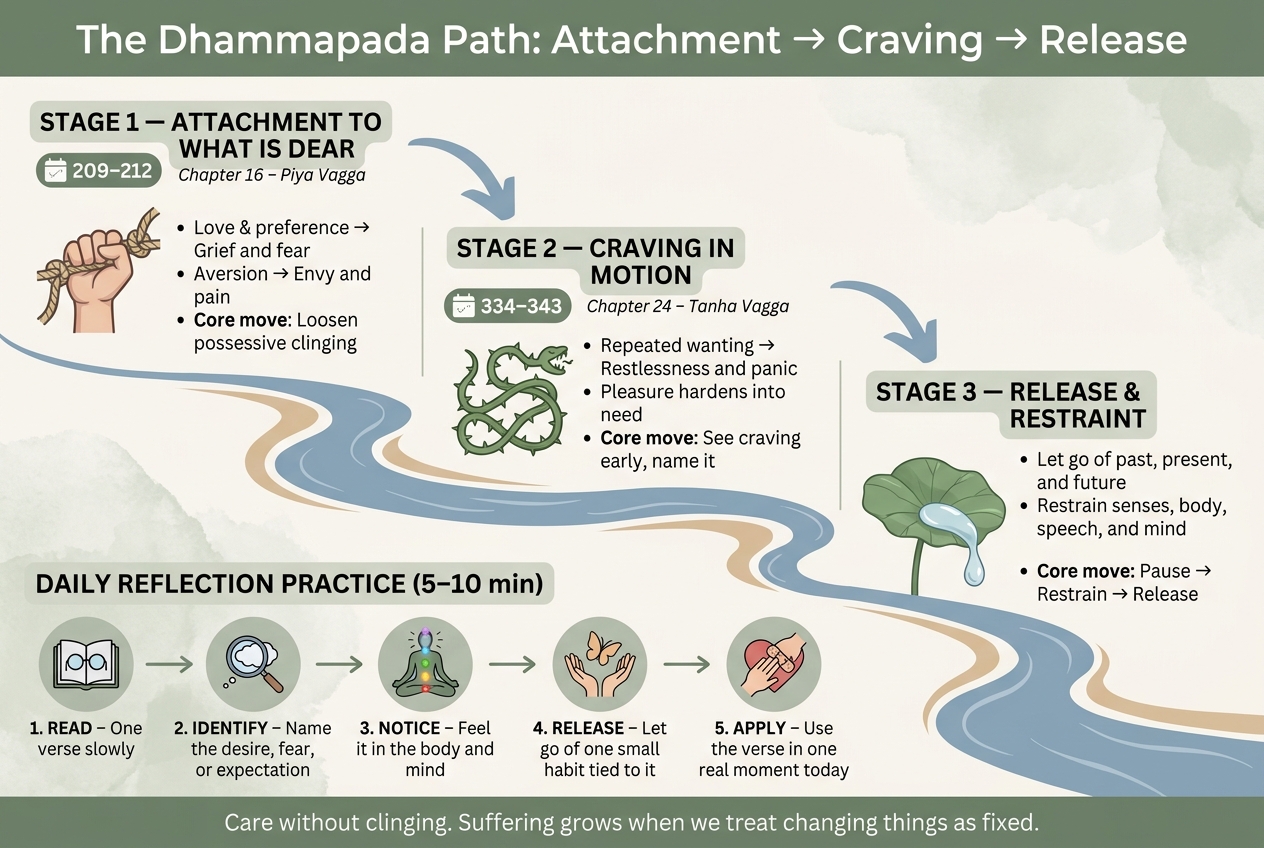
Taken together, these verses follow one clear movement: attachment, craving, release.
Verses 209–212 show what happens when something starts to feel tied to our safety. Once that happens, change doesn’t feel like a normal part of life. It feels like grief and fear. The problem isn’t care itself. It’s possessive clinging.
Verses 334–343 shift the focus to craving. They show how desire grows when pleasure is fed again and again. The object itself matters less than the mind’s habit of going back, then wanting to go back again.
Verses 348 and 350 turn toward release. Letting go doesn’t mean becoming cold or detached in a deadened way. It means dropping the demand that time, people, and events stay the way we want. It means seeing, plainly, that clinging cannot bring peace.
You can see the same pattern in ordinary life too:
| Mind State | Less Skillful Form | Letting-Go Alternative |
|---|---|---|
| Affection | "If this person changes or leaves, I cannot be okay." | Care deeply without making your peace depend on another person. |
| Enjoyment | Remembering pleasure until wanting hardens. | Appreciate pleasure without demanding its repetition. |
| Preference | Treating a desired outcome as essential to well-being. | Act toward an outcome without treating it as essential. |
| Sensual desire | Letting attention become absorbed in objects of pleasure. | Notice pleasure and the craving that follows. |
| Loss | Interpreting change as an intolerable threat. | Meet change without turning it into control. |
That’s why Verse 348 needs a closer look. Different translations vary in how strongly they describe release.
Dhammapada 348: A Look at 2 Translations
Verse 348 comes through in two different English styles, and that shifts how the sense of release lands.
| Translation source | Key wording | Interpretive emphasis |
|---|---|---|
| Ācharya Buddharakkhita | "Let go of the past, let go of the future, let go of the present, and cross over to the farther shore of existence. With mind wholly liberated, you shall come no more to birth and death." | Uses plain time-based language and presents letting go as freedom from attachment across all three periods. |
| Thanissaro Bhikkhu | "Gone to the beyond of becoming, you let go of in front, let go of behind, let go of between. With a heart everywhere let-go, you don't come again to birth & aging." | Keeps the verse's spatial imagery and links "in front", "behind", and "between" to the aggregates tied to the past, future, and present. |
Both translations aim at the same point: letting go of clinging across time. One says past, future, and present outright. The other stays closer to the spatial wording of the verse. Same direction, different phrasing.
That matters because wording shapes how a reader feels the line. Buddharakkhita sounds direct and immediate. Thanissaro Bhikkhu leaves more of the original image in place, which can make the verse feel less like a time chart and more like a shift in how the mind holds experience.
This doesn't mean you should never plan. That's not the point. The practice is noticing when planning slides into replaying old scenes, fearing what's ahead, or trying to freeze the present in place. However the verse is translated, it still points to release from grasping at past, future, and present.
Reflection prompt: What am I replaying, anticipating, or trying to keep fixed?
That makes the next step plain: daily practice.
A Daily Practice for Reflecting on Letting Go
After tracing attachment through the verses, try this short practice to see how one verse meets your actual day. The idea is simple: take one verse a day and turn reflection into action.
This takes about 5–10 minutes and follows five steps: read, identify, notice, release, and apply.
Read the verse slowly. Let one word or phrase stick with you. Then ask yourself: "What desire, fear, expectation, or attachment does this verse bring up for me right now?" It could be a need for approval, a grip on control, fear of loss, or a kind of restlessness you haven't put into words yet.
Next, bring your attention to the body and mind. Grasping often shows up physically: a clenched jaw, raised shoulders, tightness in the chest, or that strong pull to check your phone. Name the feeling in plain language. Then let go of one small habit tied to it. Keep it small and doable, like waiting 10 minutes before sending a tense message or skipping one reassurance check.
Last, apply the verse to one moment in your day when you're likely to need it. That brief pause is what turns reflection into a daily check.
For a daily reading source, Sutta 423 gives you one verse at a time for quiet reflection. It starts with 423 verses and keeps going after a full year.
Consistency matters more than length. One verse and one honest observation are enough.
Conclusion
These verses ask you to care without clinging.
Taken together, they move from attachment to craving to release. The Dhammapada lays out a simple sequence: attention shows you where you're grasping, restraint cuts into that reflex, insight reveals the price of it, and freedom grows through practice.
They point to a steadier way of living: disappointment without collapse, pleasure without panic.
That makes the pattern usable in daily life. In ordinary moments, come back to it: pause, name the fear, expectation, or craving, and act from clarity instead of impulse.
Letting go is less about the thing you hold onto than about the way you meet change.
FAQs
How is letting go different from not caring?
Letting go means choosing to release craving and attachment, so your peace doesn’t depend on whether things change or stay the same.
Not caring is different. It leans more toward indifference or checking out emotionally. That misses the Dhammapada’s focus on clarity, restraint, and wise choice from a calm mind, even when life feels uncertain or hard.
Which Dhammapada verses focus most on craving?
Several verses point to craving as a main cause of suffering. The message is simple: peace comes when we loosen our grip. Verse 6 says the wise don’t cling to desire.
Verse 326 gives a striking image. It compares the mind to a rampaging elephant that has to be steered away from pleasure. You can almost feel the force of it. The mind doesn’t drift gently on its own; it pulls, charges, and lunges after what it wants.
Verse 401 shifts to a calmer picture. It describes non-clinging like water on a lotus leaf. The image matters because water touches the leaf without sticking to it. That’s the idea here too: living in the world without getting trapped by grasping.
How can I practice letting go every day?
Practice letting go by turning your attention away from stuff, status, and short-lived wants. Put that energy into mindfulness and a sense of enough.
One small habit can help a lot: spend a few minutes each day with a single verse from the Dhammapada. Sit with it. Think about what it says. Let it bring you back to the present instead of pulling you into worry or craving.
It also helps to pause before you react to stress. Notice your thoughts as they come up, but don’t pile on blame or shame. Just watch them for a moment. From there, choose the simpler path in what you do and say.
That can mean letting go of the urge to win every argument, measure yourself against other people, or grip so tightly to results. Sometimes peace starts there.