

Top 7 Dhammapada Verses on Karma and Awareness
Seven key Dhammapada verses show how intention, restraint, loving‑kindness, and mindfulness shape karma and free the mind.
The Dhammapada offers timeless wisdom on how our thoughts and actions shape our lives, rooted in the Buddhist principle of karma. This collection of 423 verses emphasizes mindfulness, ethical behavior, and the power of mental awareness to overcome suffering. Here are seven key teachings:
- Mind Shapes Reality (Verses 1-2): Pure thoughts lead to happiness; impure thoughts lead to suffering.
- Greed, Hatred, and Delusion (Verses 5-6): These "three poisons" fuel negative karma and perpetuate conflict.
- Hatred Ends with Love (Verse 5): Retaliation feeds hostility; loving-kindness breaks the cycle.
- Truthful Speech (Verses 261-262): Words rooted in honesty and goodwill create positive karma.
- Restraint in Actions (Verses 231-234): Mindful control of body, speech, and thoughts prevents harm.
- Seeing Impermanence (Verses 277-279): Recognizing life’s transient nature helps release attachments.
- Vigilance in Mindfulness (Verses 21-23): Constant awareness halts negative impulses and fosters liberation.
Each verse underscores the importance of deliberate choices. By practicing mindfulness and reflecting on these teachings daily, you can align your actions with positive intentions and transform your life.
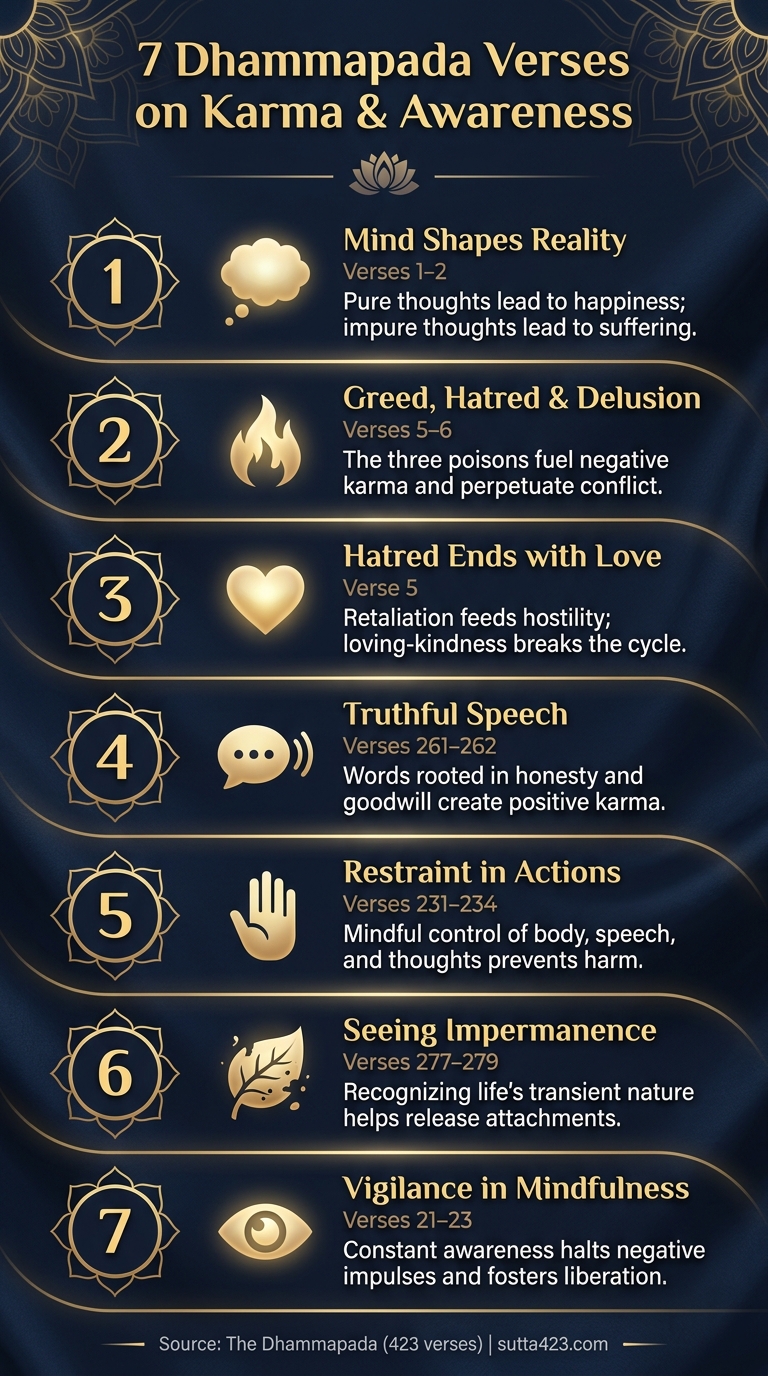
7 Dhammapada Verses on Karma & Awareness: Key Teachings at a Glance
Turning Bad Karma Around: Buddhist Ways to Create Positive Outcomes
1. Mind Precedes All Things (Verse 1-2)
The Dhammapada begins with a core teaching that sets the tone for the rest of the text. Found in the Yamakavagga, or "Twin Verses", the first two verses emphasize a profound truth: the mind is the starting point of everything.
Acharya Buddharakkhita translates these verses as follows:
"Mind precedes all mental states. Mind is their chief; they are all mind-wrought. If with an impure mind a person speaks or acts suffering follows him like the wheel that follows the foot of the ox."
"Mind precedes all mental states. Mind is their chief; they are all mind-wrought. If with a pure mind a person speaks or acts happiness follows him like his never-departing shadow."
The message here is clear: an impure mind inevitably leads to suffering, while a pure mind naturally invites happiness.
This teaching ties directly to the Buddha's explanation of karma. He stated, "I declare that cetanā (volition) is Kamma." In other words, the intention behind our actions shapes our future experiences. For example, a word spoken out of anger carries entirely different consequences than the same word spoken with compassion. It’s the mental state at the time of action that determines the karma created.
Practicing mindfulness allows us to interrupt automatic reactions and make choices that align with positive intentions. By becoming aware of our motivations before we act, we embody the wisdom of these verses and create the conditions for happiness.
In the next section, we'll delve into how greed, hatred, and delusion influence our karma in daily life.
2. Greed, Hatred, and Delusion Shape Karma (Verse 5-6)
If Verses 1–2 highlight the mind as the driving force behind all actions, Verses 5–6 delve into how the "three poisons" - greed, hatred, and delusion - create negative karma. These verses reveal how harmful mental states lay the groundwork for suffering.
Verses 5 and 6 focus specifically on hatred and delusion:
"Hatred is never appeased by hatred in this world. By non-hatred alone is hatred appeased. This is a law eternal." - Dhammapada, Verse 5
"There are those who do not realize that one day we all must die. But those who do realize this settle their quarrels." - Dhammapada, Verse 6
Verse 5 underscores that retaliation only perpetuates suffering. Responding to hostility with more hostility not only fuels external conflict but also deepens internal turmoil. The antidote lies in averena, a Pali term meaning "non-hatred", which calls for patience and compassion in the face of aggression. On the other hand, Verse 6 addresses delusion, particularly the failure to recognize life's impermanence. This lack of awareness makes trivial conflicts feel monumental, leading to unnecessary strife.
While these verses explicitly mention hatred and delusion, greed is an underlying force that connects them. Greed, through attachment, often feeds both hatred and delusion. By cultivating awareness and compassion, we can begin to counteract these destructive tendencies. This awareness not only transforms harmful mental patterns but also lays the groundwork for mindful speech and actions that positively influence our karma.
3. Hatred Is Not Resolved by Hatred (Verse 5)
In the previous section, Verse 5 was introduced as part of the discussion on the three poisons. Here, we dive deeper into its practical message. This verse offers a straightforward yet profound teaching:
"Hatreds never cease through hatred in this world; through love alone they cease. This is an eternal law." - Dhammapada, Verse 5
The word "eternal" highlights a principle that transcends time. Buddhist teachings often liken responding to hostility with more hostility to a battle where warriors endlessly clash - such actions only fuel the flames of hatred.
The antidote to this cycle is metta, or loving-kindness. This doesn’t mean ignoring harm or being passive. Instead, it’s about refusing to let someone else’s anger take root in your heart. The Buddha himself offered this guidance:
"Conquer anger by love. Conquer evil by good. Conquer the stingy by giving. Conquer the liar by truth." - Gautama Buddha
A practical way to embody this teaching is through the Five Ways of Subduing Hatred, a practice in Buddhist traditions. When anger arises, you can consciously redirect your thoughts toward goodwill, equanimity, or the understanding that everyone eventually faces the consequences of their actions. This shift moves the focus away from retaliation and toward the broader reality of karma.
It’s important to remember that patience, in this context, is not a sign of weakness. Buddhist philosophy sees it as the "unfailing strength" of those who are wise. Resisting the urge to retaliate requires more discipline than giving in, and this restraint prevents negative karma from escalating.
The next section will explore how truthful speech plays a role in refining our karmic actions.
4. Truthful Speech and Its Effect on Karma (Verse 261-262)
Every word we speak carries intention, much like our actions, and this intention shapes the karmic outcomes. The Dhammapada verses below bring this concept to life:
"One in whom there is truthfulness, virtue, inoffensiveness, restraint and self-mastery, who is free from defilements and is wise - he is truly called an Elder." - Dhammapada, Verse 261
"Not by mere eloquence nor by beauty of form does a man become accomplished, if he is jealous, selfish and deceitful." - Dhammapada, Verse 262
In this context, the term "Elder" refers to someone who has developed inner purity through truthfulness, self-restraint, and mastery over their impulses. On the other hand, Verse 262 highlights that even the most eloquent and charming speech, if rooted in jealousy or deceit, does not contribute to positive karma. Instead, it undermines it.
In Buddhist teachings, karma is deeply tied to cetanā - intention or volition. Speech serves as a direct expression of intention, making mindfulness in communication crucial. By consistently choosing truthful and kind words, one reinforces positive karmic patterns through deliberate and thoughtful actions.
In challenging situations, take a moment to pause and reflect before speaking. Ask yourself whether your words come from a place of honesty and goodwill. This small act of mindfulness creates a gap between impulse and action, allowing for speech that fosters trust rather than harm. And when no truthful or kind response feels possible, silence often becomes the wisest and most compassionate choice.
5. Restraint in Body, Speech, and Mind (Verse 231-234)
Verses 231–234 of the Dhammapada highlight the importance of restraint across three key areas: body, speech, and mind.
"Guard against ill-tempered deeds, be restrained in body. Giving up bad bodily conduct, conduct yourself well in body." - Dhammapada, Verse 231
"A sage is restrained in body, restrained also in speech, in thought, too, they are restrained: they are restrained in every way." - Dhammapada, Verse 234
The repeated use of "ill-tempered" in these verses points to the destructive impulses that can lead to harm. The teaching encourages vigilance over every channel of intentional action - what we do, say, and think. This interconnected approach underscores the Dhammapada's broader message: mindful restraint leads to ethical behavior.
What makes this teaching resonate is its focus on mindful pause rather than outright suppression. Restraint here isn't about forcing impulses away; it's about creating space to reflect before acting. This moment of awareness allows for more thoughtful, ethical decisions. It's not about denying emotions or thoughts but about ensuring they don't translate into harmful actions.
To apply this practically, consider regularly checking in with yourself: Are your actions, words, and thoughts causing harm, or are they rooted in kindness and goodwill? This doesn't require lengthy meditation sessions. Even a brief pause before responding in a heated situation can make a big difference.
6. Seeing Impermanence Leads to Freedom (Verse 277-279)
Verses 277–279 highlight the three fundamental marks of existence: impermanence (anicca), unsatisfactoriness (dukkha), and non-self (anatta). These teachings delve into why suffering continues and how understanding impermanence can lead to liberation.
Verse 277 declares: "Transient are all conditioned things; when one discerns this with wisdom, one becomes disillusioned with what brings suffering; this is the path to purity." The phrase "disillusioned with suffering" emphasizes the importance of seeing things as they truly are. By recognizing that the things we cling to for happiness are inherently fleeting, we begin to break free from harmful karmic cycles. This understanding of impermanence directly shapes how we perceive karma and its effects.
When we acknowledge impermanence, we can avoid creating negative karma that binds us. Holding onto ideas of permanence - whether in relationships, grudges, or even a fixed sense of self - leads to suffering and perpetuates negative karma. Suddhāso Bhikkhu explains this beautifully:
"Without the delusion of independent self-existence, karma has no power. For such a being, there is absolutely nothing to fear, for there is nothing that has the power to break their serenity and bliss."
Verse 279 broadens this perspective by applying it to all phenomena, including Nibbāna. Ven Nārada elaborates on this point:
"In order to show that even Nibbāna is free from a permanent soul, the Buddha used the term dhamma in the third verse."
Here, the term "dhamma" underscores that even Nibbāna is not tied to permanence, reinforcing the principle of non-self.
To truly internalize these teachings, observe the impermanence in your daily life. Pay attention to the constant shifts in your emotions, desires, and thoughts throughout the day. Even brief moments of mindfulness can help dissolve the illusion of permanence and bring clarity to the nature of existence.
7. Vigilance Helps the Wise Overcome Negative Karma (Verse 21-23)
Verses 21–23 shift from simply recognizing impermanence to consistently acting on that understanding. These verses highlight the importance of vigilance, urging us to maintain steady awareness in our daily lives.
Verse 21 begins with a powerful contrast: "Vigilance is the path to the deathless, negligence is the path of death. The vigilant never die, the negligent are as if already dead." The term "vigilance" comes from the Pali word appamāda, which refers to a state of mindful alertness that remains constant and deliberate.
But what does this look like in practice? Suddhāso Bhikkhu explains:
"Vigilance is indeed our greatest treasure, as it is through constant attention to our minds that we are able to protect it from afflictive tendencies."
This kind of vigilance goes beyond general mindfulness. It involves catching subtle, negative impulses - like irritation or selfishness - before they grow into harmful actions or thoughts. Verse 23 emphasizes this approach: "They meditate continuously, permanently, resolutely; those steadfast ones touch Nibbāna - the unsurpassed freedom from bondage." The key here is the word continuously. Occasional effort won't undo deeply ingrained habits; only sustained focus can.
The Dhammapada Aṭṭhakatha offers a striking example of vigilance in action. It recounts the story of Queen Sāmāvati and her 500 ladies-in-waiting. When their palace caught fire, they remained calm and meditative, refusing to succumb to panic or anger. Even in the face of death, their mindfulness held firm. As a result, some attained Sakadāgāmi Fruition, while others reached Anāgāmi Fruition at the moment of their passing. This story underscores how unwavering mindfulness can significantly influence our karmic outcomes.
The message is simple yet profound: guard your mind as you would your most precious possession. When harmful thoughts like jealousy, resentment, or craving arise, intercept them before they turn into actions. That brief moment between impulse and reaction is where appamāda operates - and where the cycle of negative karma can be stopped.
Putting the Verses into Daily Practice
To truly benefit from these verses, revisit them regularly. Let them subtly influence your thoughts, words, and actions over time.
A practical way to approach this is straightforward: focus on one verse at a time. Start your morning by reflecting on it, carry it with you throughout the day, and revisit it in the evening. Ask yourself: Did this verse guide my choices today? The Buddha's teaching in AN 6.63 makes this deeply relevant to daily life:
"Intention, I tell you, is kamma. Intending, one does kamma by way of body, speech, & intellect."
The goal isn't perfection but awareness. Each moment offers a chance to learn. For example, pausing to reflect on a verse before responding to a frustrating email, handling a tough conversation, or making a hasty decision is exactly the kind of mindfulness these teachings encourage.
Consistency is essential for this practice to take root. Resources like Sutta 423 can help by delivering one Dhammapada verse each day, creating a rhythm of reflection that can guide you through an entire year.
To integrate these teachings into your daily life, align your actions with three fundamental Buddhist principles:
| Pillar | Daily Action | Mental Root to Cultivate |
|---|---|---|
| Avoid Evil | Pause before reacting; avoid causing harm. | Non-attachment (alobha) |
| Cultivate Good | Show generosity, kindness, and mindful speech. | Goodwill (adosa) |
| Purify the Mind | Observe your thoughts without judgment; build focus. | Wisdom (amoha) |
Conclusion
Mindful awareness shapes not just our actions but the very course of our lives. The verses of the Dhammapada emphasize this truth: our intentions and choices pave the way for our destiny. From the first lines of the text to its teachings on vigilance and self-restraint, the message is unmistakable - awareness requires effort and conscious engagement.
These lessons push us toward introspection and accountability. As Dhammapada Verse 165 puts it:
"By oneself the evil is done, and it is oneself who suffers; by oneself the evil is not done, and by oneself one becomes pure. The pure and impure come from oneself; no man can purify another."
True freedom lies in owning our actions. These verses resonate because they speak directly to our daily lives - whether it’s responding to a challenging coworker with patience, approaching frustration with calm, or reconsidering a message before sending it in haste.
Even small moments of reflection, practiced consistently, ensure that these teachings become a living part of how we navigate the world.
FAQs
Does karma depend more on intention than the action itself?
Karma is deeply tied to intention rather than the action alone. According to The Dhammapada, karma is defined as volitional action, meaning its moral significance hinges on the intent and mental state behind it. Since actions stem from the mind, motivations grounded in compassion and wisdom result in happiness. On the other hand, intentions fueled by greed, anger, or ignorance lead to suffering. Essentially, your inner motives play a central role in shaping both your experiences and the ethical consequences of your actions.
How can I stop anger before it turns into harmful speech or behavior?
Anger can often lead to actions we later regret, but learning to recognize it early can make a big difference. By cultivating mindful awareness, you can catch those feelings before they take over. When anger surfaces, take a moment to pause - observe your thoughts rather than jumping into a reaction.
The Dhammapada offers a timeless piece of advice: be like a broken gong that stays silent when struck. In other words, practice restraint and avoid reacting impulsively. Instead of giving in to anger, try replacing it with compassion and kindness. Practices like Metta meditation - which focuses on developing loving-kindness - can help you retrain your mind to respond with intention and self-control.
What’s a simple daily way to practice these seven Dhammapada verses?
Daily quiet reading and reflection is a simple yet meaningful way to engage with these verses. Dedicate a few minutes each day to focus on a single verse, allowing its message to resonate and guide your actions. For a structured approach, the Sutta 423 app provides one verse daily, making it easy to explore all 423 verses over the course of a year. This method encourages mindfulness and thoughtful living without feeling overwhelming.