

7 Dhammapada Verses on Inner Peace
Seven Dhammapada verses present practical steps to train the mind, release craving, and cultivate compassion for lasting inner peace.
The Dhammapada, a collection of 423 verses from Buddhist teachings, offers timeless advice for finding inner peace. These teachings focus on mastering the mind, letting go of anger, and cultivating calmness. Below are seven key verses and their practical lessons for daily life:
- Hatred ends with love (Verse 5): Break cycles of anger by responding with compassion, not retaliation. Practices like loving-kindness meditation can help.
- Mindfulness leads to happiness (Verse 35): A calm, disciplined mind brings lasting joy. Observing emotions without attachment is key.
- Master your thoughts (Verse 37): Taming the restless mind frees you from inner turmoil. Focus on one thought at a time to regain control.
- Stay steady through life’s ups and downs (Verse 83): Wise individuals remain calm, unaffected by external pleasures or pains.
- Let go of craving (Verse 202): True peace begins when you release desires, which act like weights on the mind.
- Discipline brings freedom (Verse 223): Training the mind creates a pause between stimulus and response, allowing thoughtful actions.
- Overcome anger with love (Verse 223): Replace anger with kindness, evil with good, and greed with generosity for a more peaceful existence.
These teachings emphasize that inner peace is achieved through small, mindful actions - calming the mind, letting go of negativity, and embracing compassion. Start with one verse, reflect on its meaning, and apply it in your daily life for lasting change.
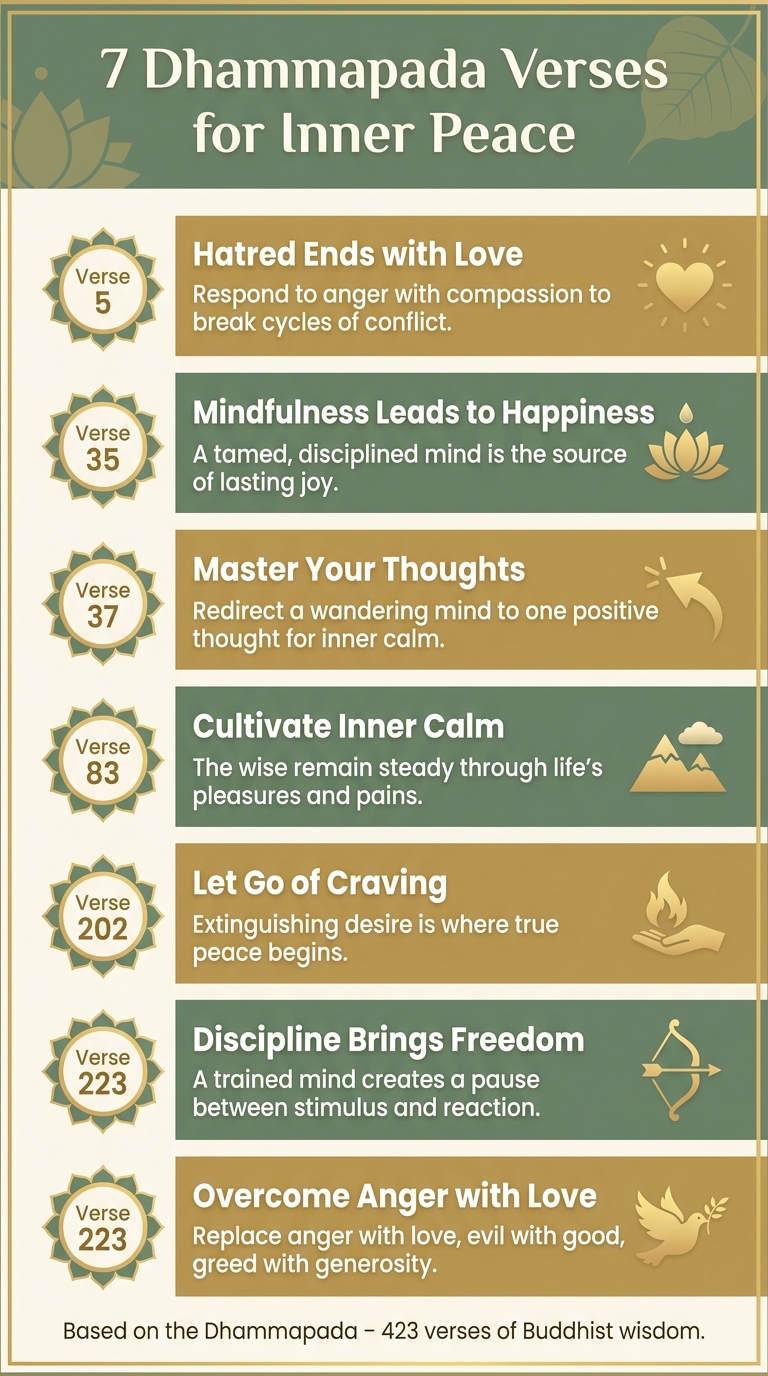
7 Dhammapada Verses for Inner Peace: Key Teachings at a Glance
The Dhammapada - Ancient Wisdom for Inner Peace
1. Hatred is never appeased by hatred (Verse 5)
"Hatred is never appeased by hatred in this world. By non-hatred alone is hatred appeased. This is a law eternal."
This verse delivers a powerful message: the cycle of hatred and retaliation only deepens conflict. True resolution comes through a deliberate choice to respond with compassion, breaking the chain of animosity. This idea resonates universally, whether in large-scale global matters or the small, personal struggles of daily life.
A striking example of this teaching in action occurred in 1951. A Sri Lankan minister, inspired by this verse, refused to demand war reparations, which fostered goodwill on an international scale. Today, a monument in Tokyo honors this moment of reconciliation. On a personal level, harboring anger often causes more harm to oneself than to anyone else, making forgiveness a path to inner peace.
To put this into practice, Metta (loving-kindness) meditation offers a structured approach. It involves systematically cultivating goodwill: first toward yourself, then extending it to a friend, a neutral person, someone you find challenging, and finally to all living beings. This practice helps rewire the mind to respond to conflict with calm and kindness, gradually replacing resentment with a deeper sense of peace.
2. Mindfulness leads to happiness (Verse 35)
"Wonderful, indeed, it is to subdue the mind, so difficult to subdue, ever swift, and seizing whatever it desires. A tamed mind brings happiness." - Acharya Buddharakkhita, Translator
The mind is like a restless traveler - it leaps from one thought to another, clings to worries, replays past conflicts, and eagerly chases fleeting distractions. Verse 35 perfectly captures this nature, describing the mind as "swift" and "fickle", always grasping at whatever catches its attention. This is the hallmark of an untrained mind, and learning to tame it becomes a crucial step toward achieving lasting happiness.
The verse emphasizes a profound truth: genuine happiness doesn’t come from wealth or external conditions but from mastering the inner workings of our mind. The Pali word "damatho" refers to the act of taming or disciplining the mind - a process that requires consistent effort and patience.
Bhante Suddhāso explains this beautifully:
"The mind changes rapidly; fresh impulses arise continuously... It takes time and effort, patience and perseverance, to train the mind to be steady and calm."
A significant part of this practice involves learning not to identify with our emotions. VivekaVani offers a helpful perspective:
"Our emotions are impersonal processes. They are not what we do. That is why they are difficult to control. It is only by not identifying with them that they can be stopped."
Rather than suppressing thoughts or forcing stillness, mindfulness encourages us to observe our mental patterns with quiet awareness. By noticing emotions and thoughts as they arise and letting them pass naturally, we create space for a deeper, enduring peace within.
3. Master your thoughts for peace (Verse 37)
"Dwelling in the cave (of the heart), the mind, without form, wanders far and solitary. Those who subdue this mind are liberated from the bonds of Mara." - Acharya Buddharakkhita, Translator and Scholar
Verse 37 delves into the mind's elusive and restless nature, building on the idea of taming it introduced in Verse 35. Four Pali terms - dūraṅgamaṃ (far-wandering), ekacaraṃ (solitary), asarīraṃ (formless), and guhāsayaṃ (dwelling in the cave) - paint a vivid picture of the mind's tendency to drift and its inherent instability. This verse shifts the focus from external distractions to the internal challenge of mastering the wandering mind.
The "cave" of the heart symbolizes our inner consciousness, a space where the mind often leaps between the past and imagined futures. This constant movement can create a sense of instability, making it harder to find peace.
An early Buddhist story illustrates this perfectly. A young monk, plagued by distraction, repeatedly made mistakes that hindered his progress. Through disciplined focus, he eventually achieved sotāpatti (stream-entry), demonstrating the transformative power of mastering one's thoughts.
The term ekacaraṃ offers a practical takeaway: the mind can only hold one thought at a time. Suddhāso Bhikkhu emphasizes this potential, stating:
"The mind is inherently boundless and limitless, capable of instantaneously accessing any abstraction... Learning how to keep the mind from veering down self-destructive paths is a vital skill for those who wish to attain liberation."
When you notice your thoughts spiraling - whether you're replaying arguments, imagining worst-case scenarios, or dwelling on worries - try redirecting your focus to a single positive thought. Anchoring your mind in this way can be a powerful step toward achieving inner calm. This practice of guiding the mind aligns naturally with broader efforts to cultivate lasting peace.
4. The wise cultivate inner calm (Verse 83)
"Everything the good renounce, the peaceful chatter not of fond delights, and whether touched by pleasure or pain not joy nor woe in the wise is seen." - Dhammapada Verse 83
Verse 83 speaks to the profound steadiness of the wise. They remain unshaken by the ups and downs of life - whether it’s pleasure or pain, gain or loss. Unlike those easily swayed by emotions or circumstances, the wise achieve a state of calm that breaks free from this constant ebb and flow.
"It is in the nature of the foolish to be full of sorrow and feel depressed when things go wrong, and to be full of gladness and feel elated when things go well. The wise, however, can withstand the ups and downs of life." - Gautama Buddha
This teaching points to the eight vicissitudes - gain and loss, fame and obscurity, praise and blame, pleasure and pain. These external forces often dictate the emotions of those attached to worldly things. But, for the wise, calm prevails. They avoid the emotional highs and lows (uccāvacaṃ) that unsettle others.
A poignant example comes from a famine in Verañjā. While monks lived on shriveled grain offered by horse-traders, they maintained their composure. In contrast, laypeople, shaken by the scarcity, became unruly. This story illustrates how inner calm provides stability, no matter the external chaos.
To cultivate this calm, one must detach from external circumstances and practice restraint, especially in speech. Ven. Weagoda Sarada Maha Thero explains:
"The disciplined persons do not talk desiring worldly things, material benefits or sensual delights."
This verse, like earlier ones, underscores a vital lesson: true inner peace comes from mastering your reactions, not from controlling the world around you. It’s about finding stability within, even as life continues to change.
5. Peace comes from letting go of craving (Verse 202)
"There is no fire like passion, there is no offence like hatred, there is no suffering like the components (of mind and body), no happiness other than peace." - Dhammapada Verse 202
Craving is described in Verse 202 as a fire that consumes the mind and destroys tranquility. The message is clear: true peace comes not from managing desire but from extinguishing it entirely.
Our daily lives are filled with thoughts and sensations that often weigh us down, leading to suffering. Yet, none of these fleeting experiences can compare to the deep calm of Nirvana. This verse reminds us that peace - referred to as santi - isn’t some far-off, unattainable state. It begins the moment we stop fueling the fires of craving.
Another verse reinforces this idea:
"From craving arises sorrow; from craving arises fear. To him who is free from craving there is no sorrow. Whence fear?" - Dhammapada Verse 216
Craving shows up in subtle, everyday ways - whether it’s the urge to check your phone, the need to win an argument, or the desire to control every situation. Imagine your mind as a boat, weighed down by these desires. The more you let go of these weights, the easier it becomes for your inner peace to emerge.
One way to start is by practicing a deliberate pause. When you feel a craving arise, take a deep breath and observe it without judgment. In the space between the craving and your reaction, peace begins to take root.
These small, intentional steps can help you navigate the path toward lasting inner calm.
6. The disciplined mind brings freedom (Verse 223)
Verse 223 builds on the idea from Verse 35, comparing the process of disciplining the mind to a fletcher straightening an arrow. This metaphor highlights how consistent mental training can lead to freedom. The verse emphasizes that self-regulation creates a pause - a small but powerful gap between an event and your reaction. It’s in this pause that true freedom is found. This idea ties closely to earlier teachings on mindfulness and self-control.
An undisciplined mind tends to wander and react impulsively, often becoming a victim of its own whims or external pressures. Without training, every frustration or challenge triggers an automatic reaction, disrupting your inner peace. On the other hand, a disciplined mind introduces that essential pause, allowing for thoughtful and deliberate responses instead of reflexive reactions.
Cultivating this discipline doesn’t require grand gestures. It’s the small, daily efforts that make the difference. For example, pausing before responding to a tense email, noticing when your thoughts start to spiral, or taking a slow, deep breath before a difficult conversation. These tiny moments of awareness, practiced consistently, gradually transform how your mind operates. Over time, these habits shift you from reactive patterns to more conscious, grounded responses. In this way, discipline not only refines your reactions but also brings you closer to true inner freedom.
7. Overcome Anger with Love (Verse 223)
Verse 223 focuses on mental discipline, offering a practical way to turn moments of anger into opportunities for positive action. It provides a step-by-step guide to replace harmful impulses with virtues, paving the way toward inner peace.
"Conquer anger with love, evil with good, greed with charity and falsehood with truth." - Dhammapada Verse 223
This verse is a cornerstone of the Kodhavagga, the 17th chapter of the Dhammapada, which centers entirely on the theme of anger. The Pali term akkodhena can be understood as "non-anger", "kindness", or "love." The teaching goes beyond merely suppressing anger - it advocates for transforming it into love.
Verse 223 outlines a simple yet profound framework:
- Respond to anger with love.
- Counter evil with goodness.
- Replace greed with generosity.
- Meet lies with truth.
Each negative emotion is neutralized by its positive counterpart, creating a path for personal growth and harmony.
The Buddha emphasized that true victory isn't achieved through force but through transforming anger into virtue. Anger acts like fire - it burns the person holding onto it, clouding their peace of mind.
To practice this, try cognitive reframing. When you feel wronged, see the situation as a chance to cultivate patience or generosity. By shifting your perspective, you can dissolve resentment and foster inner calm.
How Sutta 423 Can Support Your Path to Inner Peace

The verses in Sutta 423 offer guidance on achieving inner peace - whether it's letting go of hatred or reshaping greed. Incorporating these teachings into your daily life can amplify their transformative power over time. A consistent practice helps you absorb and apply these insights more deeply.
The Sutta 423 app makes this process accessible by delivering one verse each day for reflection. Over the course of a year, you'll journey through all 423 verses of the Dhammapada. And once you've completed the cycle, the app continues, giving you the chance to revisit familiar verses with fresh perspectives shaped by your ongoing experiences. Its clean, distraction-free design avoids unnecessary features like gamification, keeping your focus on the practice itself.
To support your journey, the app includes tools like a built-in journal where you can record your reflections. These daily notes allow you to track your growth, offering a personal record of how your understanding and responses evolve over time.
The app provides the daily verse for free, with optional paid features for those looking to dive deeper. For instance, you can save favorite verses for future reference while also contributing to the app's continued development. It's available now on the iOS App Store.
Conclusion
These seven verses highlight that inner peace is built step by step, through intentional choices in everyday life. Whether it’s catching anger before it takes hold, loosening the grip of craving, or calming a restless mind, the message is clear: the path to peace lies in small, deliberate actions.
Practices like mindfulness, letting go of anger, and nurturing love all work together. When the mind becomes steady through awareness, resentment fades, creating space for compassion to grow.
As the Dhammapada beautifully states:
"Who checks arising anger as with chariot away, that one I call a charioteer, others merely grip the reins." - Dhammapada Verse 222
While many hold tightly to the reins of their emotions, true mastery lies in knowing when - and how - to release.
These teachings offer practical guidance for everyday situations. Finding peace doesn’t demand a complete overhaul of your routine. It begins with simple awareness: noticing a flash of irritation at work, recognizing a lingering grudge, or pausing before an anxious thought spirals out of control. Each mindful decision strengthens the balance between thought and emotion, bringing the verses to life in the most ordinary moments. They serve as a gentle reminder that change happens one mindful choice at a time.
FAQs
How do I stop reacting in anger in the moment?
To handle anger effectively, try practicing mindfulness. This means taking a moment to observe your thoughts before reacting. Another helpful technique is the "broken gong" approach - remaining silent during conflict to avoid saying something hurtful. Instead of letting anger take over, focus on cultivating kindness and replacing resentment with forgiveness. You can build this habit by reflecting daily on verses from the Dhammapada.
By being mindful of your actions - whether physical, verbal, or mental - you allow yourself the space to respond with calmness rather than impulsiveness. For extra support, the Sutta 423 app provides daily verses to guide and reinforce this practice.
What’s a simple way to let go of craving day to day?
To ease the grip of craving in daily life, take a moment to pause whenever a desire surfaces. Ask yourself: Is this something you genuinely need, or is it just a habitual urge? This simple pause can reduce the power of the craving. Try to see desires as fleeting experiences rather than something that defines who you are. Let go of the need for external validation or the urge to compete with others. By focusing on the present and releasing attachment to specific outcomes, you can cultivate a sense of balance and inner calm. For guidance, Sutta 423 offers valuable insights to support this practice.
How can I use one verse a day to build inner peace?
Reflecting on a single verse each day can ground your thoughts and encourage mindfulness. Starting your morning with a verse helps create a sense of calm that carries through the day. When stress arises, revisiting that verse can help you pause and respond with intention rather than reacting on impulse. This small but impactful habit can break negative cycles, promote self-awareness, and bring a sense of inner harmony. Apps like Sutta 423 can be a helpful companion for maintaining this daily practice.