

Top 7 Dhammapada Verses on Impermanence
Seven Dhammapada verses on impermanence, non‑self, and suffering—clear explanations and simple daily reflection practices.
Impermanence is one of Buddhism's core teachings, reminding us that everything in life - our bodies, thoughts, relationships, and the natural world - is constantly changing. The Dhammapada, a revered Buddhist text, explores this truth through concise verses, offering insights into the fleeting nature of existence and how understanding it can lead to inner peace.
Here are the 7 key verses on impermanence from the Dhammapada:
- Verse 277: "All conditioned things are impermanent." A reminder that everything arising from conditions will eventually fade, fostering detachment and wisdom.
- Verse 278: "All conditioned things are suffering." Highlights how impermanence leads to dissatisfaction, as nothing provides lasting fulfillment.
- Verse 279: "All things are without self." Emphasizes that neither body nor mind holds a permanent identity, encouraging freedom from attachment.
- Verse 46: "As a bubble, as a mirage, so should one view the world." Vivid imagery showing life’s fragile and deceptive nature.
- Verse 170: "Look upon the world as a decorated royal chariot." Warns against being captivated by life’s fleeting allure.
- Verse 113: "A single day of insight is better than a lifetime of ignorance." Stresses the value of mindfulness over longevity without awareness.
- Verses 153-154: The Buddha’s reflection after enlightenment, describing liberation from the cycle of birth and death.
These verses teach us to observe impermanence in daily life, letting go of attachments and appreciating the present moment. By integrating these insights into meditation and reflection, we can move closer to peace and freedom from suffering.
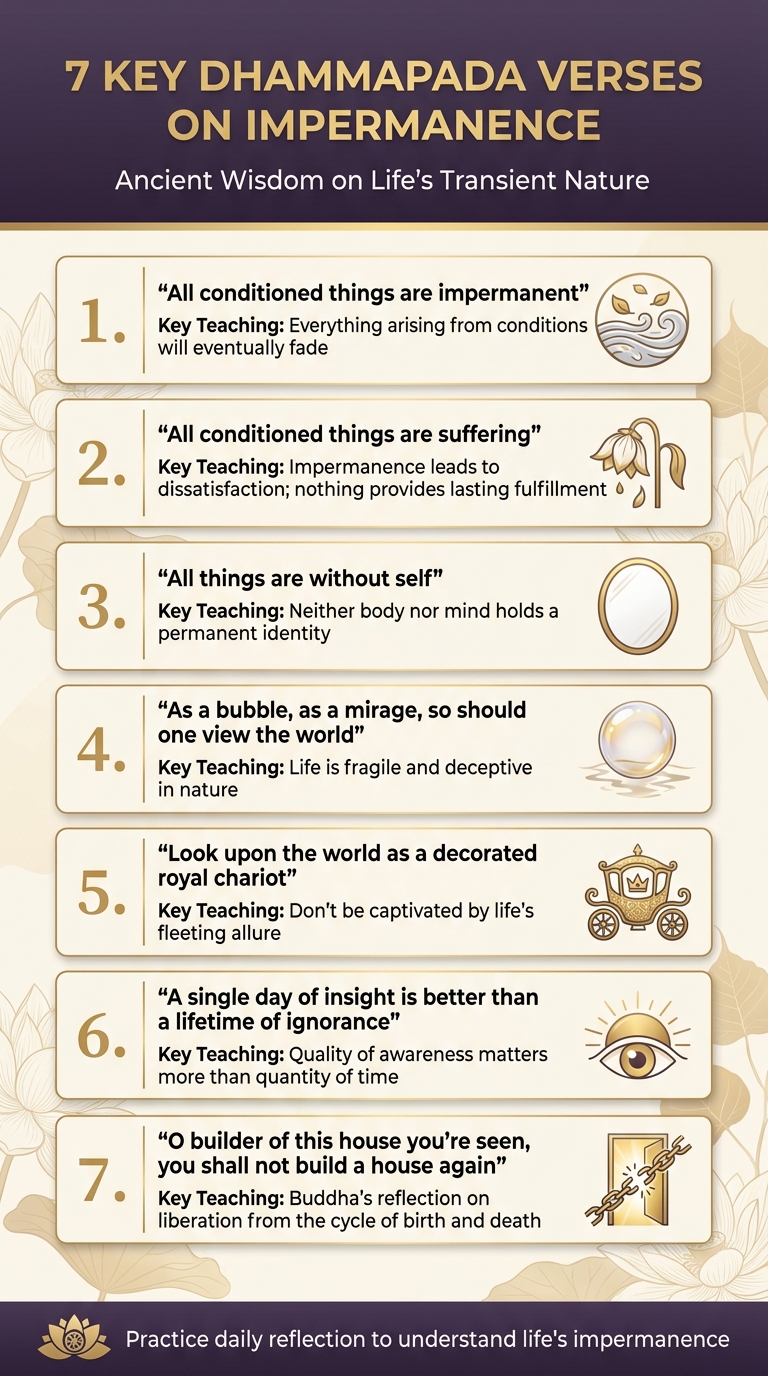
7 Key Dhammapada Verses on Impermanence and Their Meanings
Dhammapada Verse 46: Where the King of Death Cannot See
Understanding Impermanence in the Dhammapada
The Dhammapada is a collection of 423 verses, divided into 26 chapters, and forms part of the Khuddaka Nikāya (Minor Collection) within the Pāli Canon of Theravāda Buddhism. This anthology gathers key teachings from the Pāli Canon into a concise and approachable format. The title combines the words dhamma (meaning doctrine, truth, or phenomena) and pada (meaning foot, path, or verse), often translated as "The Path of Truth" or "Verses of the Doctrine". This structure creates a foundation for delving into impermanence, a central theme throughout the text.
Buddhist scholar Glenn Wallis highlights the enduring relevance of the Dhammapada:
"By distilling the complex models, theories, rhetorical style and sheer volume of the Buddha's teachings into concise, crystalline verses, the Dhammapada makes the Buddhist way of life available to anyone."
This clarity and simplicity make the text especially effective in conveying the concept of impermanence.
Impermanence is a core focus of the Dhammapada. The verses repeatedly stress that all "conditioned phenomena" are subject to change, decay, and eventual disappearance. Developing an understanding of the "rise and passing of things" is key to the wisdom the text seeks to impart. Buddhaghosa, a 5th-century CE commentator, enriches the verses further with 305 contextual stories.
The Dhammapada serves multiple purposes: it acts as a guide for everyday living, a tool for monastic instruction, and a resource for spiritual contemplation. While over half of its verses are found elsewhere in the Pāli Canon, what sets the Dhammapada apart is its ability to present these enduring truths in a format that is both practical and memorable. Since F. Max Müller’s first complete English translation in 1870, it has become one of the most widely translated and studied Buddhist texts across the globe.
1. Verse 277: 'All conditioned things are impermanent'
Verse 277 conveys one of Buddhism's core teachings: "Sabbe saṅkhārā aniccā" - "All conditioned phenomena are impermanent." The term saṅkhāra refers to all phenomena that arise due to causes and conditions, encompassing both the external world and the internal components of our being. In essence, everything that depends on conditions is transient, subject to change, and ultimately fades away.
This verse highlights that simply understanding impermanence on an intellectual level isn't enough. To fully grasp this truth, one must develop vipassana panna (insight-wisdom) through meditation. The Buddha explained it this way:
"All conditioned phenomena are impermanent; when one sees this with Insight-wisdom, one becomes weary of dukkha. This is the Path to Purity."
This teaching, when shared with 500 monks who had meditated extensively during the time of Kassapa Buddha, had a profound effect. It immediately led them to attain Arahatship (enlightenment), illustrating the transformative power of directly perceiving impermanence.
Recognizing impermanence with wisdom naturally fosters detachment from suffering (dukkha). This isn't about withdrawing from life in a negative way but rather about letting go of the clinging that causes pain. Impermanence, therefore, governs all aspects of existence, reminding us of the fleeting nature of everything we experience.
While this verse focuses on impermanence (anicca), the Dhammapada complements it with teachings on suffering (dukkha) and non-self (anatta) in the following verses (278 and 279). Together, these teachings provide a complete framework for understanding reality and progressing on the Path to Purity. The next verse delves deeper into the connection between impermanence and the suffering inherent in conditioned existence.
2. Verse 278: "All conditioned things are suffering"
Building on the idea of impermanence, Verse 278 introduces the second key aspect of existence: "Sabbe saṅkhārā dukkhā" - "All conditioned phenomena are suffering." This verse highlights a natural consequence of impermanence. Since everything is subject to change and decay, nothing can provide lasting satisfaction. The term dukkha extends beyond physical pain, describing the uncomfortable and unsatisfying nature of all conditioned things, including every part of our existence.
The Buddha elaborated on this truth:
"Bhikkhus, all khandha aggregates are oppressive and unsatisfactory; thus all khandhas are dukkha."
This teaching touches on a universal human challenge: our tendency to seek permanent happiness in things that are inherently temporary. Whether it's material possessions, relationships, or personal achievements, these things inevitably change and fail to deliver lasting fulfillment.
The historical backdrop of this verse is particularly compelling. The Buddha shared it with 500 monks who were struggling in their meditation practice. Aware that they had previously reflected on the nature of suffering, he offered this verse as a reminder of life's inherent unsatisfactoriness. This teaching helped guide those monks to attain Arahatship.
The verse emphasizes that understanding this truth through insight-wisdom (Vipassana panna) leads to detachment from suffering. This perspective isn't about pessimism but rather a clear and honest acknowledgment of reality. Recognizing that conditioned things cannot bring ultimate satisfaction allows one to stop resisting the impermanent nature of life. This understanding fosters peaceful detachment and advances one along the Path to Purity (visuddhiyā maggo).
To apply this teaching, try observing your inner experiences during meditation. Pay attention to how feelings, emotions, and sensations arise and fade away. The aim is to maintain a detached awareness, allowing you to see their unsatisfactory nature clearly. This practice moves beyond intellectual understanding, helping you develop the wisdom necessary to free yourself from suffering. By directly observing the impermanence of existence, you deepen your insight and prepare for further contemplation on the nature of suffering.
3. Verse 279: "All things are without self"
This verse concludes the exploration of the Three Marks of Existence by addressing the concept of non-self. The Buddha declares, "Sabbe dhammā anattā" - all phenomena lack a self. Unlike earlier verses that focus on conditioned phenomena (sankhara), this verse uses the term dhamma, which encompasses both conditioned phenomena and the unconditioned state of Nibbāna. This subtle shift underscores the teaching that no phenomenon, whether physical or mental, possesses a lasting self. It lays the groundwork for understanding why neither the body nor the mind can be seen as an enduring identity.
This teaching challenges the common belief that body and mind form a stable, unified whole. In reality, everything is in a state of constant change, leaving no element with the permanence required to qualify as a self.
The Buddha illustrated this truth clearly:
"Bhikkhus, all khandha aggregates are insubstantial; they are not subject to one's control."
If the body or mind were truly permanent, they would not be susceptible to pain or change. Yet, their continuous transformation demonstrates that they cannot be regarded as enduring entities. This realization is central to deepening the practice of vipassana, as it encourages a direct encounter with the nature of non-self.
Understanding non-self is not just an intellectual exercise - it requires direct experience through meditation. By observing that nothing in your experience represents a permanent self, you naturally begin to release attachments. This process opens the door to profound inner peace. Moreover, recognizing non-self can inspire a sense of gratitude for the transient beauty of life.
4. Verse 46: "As a bubble, as a mirage, so should one view the world"
Verse 46 uses vivid metaphors to highlight the fleeting and deceptive nature of existence. The Buddha expressed this teaching with the following words:
"One who knows that this body is impermanent like froth, and comprehends that it is illusory like a mirage, will cut the flowers of Mara... and pass out of sight of the King of Death."
These comparisons offer a deeper insight into the impermanence discussed in earlier verses.
The term phepnupamam draws a parallel between the body and froth or bubbles, underscoring how short-lived and fragile physical existence is. Similarly, maricidhammam compares life to a mirage - something that seems real and tangible from a distance but dissolves under closer examination. Think of a mirage in a desert: it might seem like water, but as you approach, it disappears. Here, "the world" refers specifically to the five khandhas (aggregates) that make up our experience of self and reality.
These metaphors encourage us to see both the temporary and illusory aspects of existence. This understanding naturally fosters detachment from things that cannot bring lasting fulfillment.
A story illustrates this well: a monk, struggling with meditation, observed a mirage and froth on a river. These images helped him grasp life's impermanence, leading to his attainment of arahatship. Similarly, a group of 500 monks gained deeper insight into impermanence by watching rain bubbles form and vanish. Such reflections show how nature itself can guide us toward profound truths.
5. Verse 170: "Look upon the world as a decorated royal chariot, which fools are enamored with, but the wise see as empty"
Verse 170 introduces a vivid cultural metaphor - a decorated royal chariot - to convey a timeless lesson. The verse states:
"If a man looks at the world (i.e., the five khandhas) in the same way as one looks at a bubble or a mirage, the King of Death will not find him."
Unlike earlier verses that leaned on natural imagery, this one uses a symbol of wealth and power to emphasize the same idea.
The royal chariot represents the material world and the five aggregates (khandhas), which may seem alluring but are ultimately fleeting. Its beauty and grandeur mask its transient and deceptive nature.
This verse highlights a stark difference between two mindsets. Those who cling to worldly pleasures are captivated by the "decorations" - the allure of beauty, status, or indulgence. In contrast, the wise see through this illusion, understanding the emptiness and impermanence at the core of all things. They remain unattached, untroubled by the transient nature of life.
A story from Jetavana illustrates this truth, recounting how 500 monks came to recognize life's fleeting nature, leading to their deeper insight.
This teaching feels especially relevant today. Consider modern "decorated chariots" - luxury cars, designer brands, or the picture-perfect lives displayed on social media. These symbols of success and happiness often hide their inability to provide lasting fulfillment. By seeing their emptiness, we can let go of attachment, moving closer to inner peace and wisdom. This verse deepens our understanding of impermanence and urges us to seek deeper truths beyond superficial allure.
6. Verse 113: A Single Day of Insight
Verse 113 shifts attention inward, focusing on our personal experience of impermanence. Moving away from external imagery, the Buddha offers this teaching:
"Better than a hundred years in the life of a person who does not perceive the arising and dissolving of the five aggregates (khandhas), is a day in the life of one who perceives the arising and dissolving of the five aggregates."
Here, the emphasis is on the quality of awareness rather than the quantity of time. A single day spent mindfully observing the arising and dissolving of the five aggregates - body, feelings, perceptions, mental formations, and consciousness - can lead us closer to the peace of Nibbana. This idea is beautifully reflected in the story of Patacara.
Patacara’s life was shattered in a single day when she lost her family, leaving her engulfed in grief. The Buddha shared with her a profound teaching: the tears she had shed over countless lifetimes surpassed the waters of the four oceans. This realization brought clarity to her sorrow. Later, while washing her feet at Jetavana monastery, she noticed how water flowed and disappeared into the ground at varying distances. This simple observation became a powerful metaphor for life’s transience, ultimately guiding her to attain Arahatship.
Her journey underscores the transformative power of recognizing impermanence. The Buddha further explained:
"One who does not perceive the impermanence, unsatisfactoriness and insubstantiality of the aggregates is useless, even if he were to live for a hundred years."
7. Verse 153-154: The Buddha's reflection on breaking free from the cycle of birth and death
These verses are deeply significant in Buddhist tradition - they mark the Buddha's first words after achieving Enlightenment under the Bodhi tree. Known as the Udāna (a joyful exclamation), they capture the profound sense of freedom and relief he felt in that transformative moment.
"Across many births in saṃsāra, I hastened seeking, finding not the builder of this house: pain is birth again, again."
"O builder of this house you're seen, you shall not build a house again, all your beams have crumbled and your rafters decayed, mind to the Unconditioned gone, exhaustion of craving has it reached."
In these lines, the Buddha uses the metaphor of a house to represent the body and the constructed sense of self. For countless lifetimes, he searched for the "architect" of this house - the force responsible for the cycle of birth and suffering. Enlightenment brought the realization that this architect was not an external entity but Craving (taṇhā), a mental process rooted within.
Ven. Weagoda Sarada Maha Thero explains this discovery as "an introspective awareness of the mental process", which, once understood, halts the cycle and leads to arahatship - the state of liberation.
The metaphor of the house extends further: the "rafters" symbolize passions and defilements, while the "roof-tree" represents ignorance. By dismantling these supports with insight and wisdom, the Buddha's mind reached the Unconditioned state of Nibbāna - a state where craving is extinguished, and the cycle of rebirth ceases. This imagery is a powerful reminder that suffering, while pervasive, is impermanent. Its transient nature means it can be overcome.
For modern readers, these verses offer a timeless message of hope. The mental constructs that fuel stress and dissatisfaction can be recognized and dismantled. By addressing the "architect" within, we too can work toward breaking free from cycles of mental and emotional struggle.
How to Practice Daily Reflection with These Verses
Reflecting on impermanence helps you grasp the fleeting nature of life, as these verses illustrate. Their true power emerges when you incorporate them into your daily routine. Pay attention to how your body, emotions, and thoughts are in constant flux. Buddhist meditation teacher Scott Tusa highlights this by saying, "Impermanence, on a more practical level, is a key to unlocking fluidity and letting go. It allows us to prioritize what truly matters and stop wasting energy on things that don't". By applying this insight, you bring the concept of impermanence to life.
Try setting aside time each morning or evening for quiet reflection. The Sutta 423 app can support this practice by delivering a verse from the Dhammapada daily, giving you a consistent point for contemplation. This habit helps you "bear the Dhamma well in mind" and align with its teachings. As the Dhammapada states, "The monk who abides in the Dhamma, delights in the Dhamma, meditates on the Dhamma, and bears the Dhamma well in mind - he does not fall away from the sublime Dhamma".
To deepen this reflective mindset, incorporate formal meditation into your day. Choose a specific focus, such as a physical sensation or a fleeting thought, and observe how it arises and fades. This practice turns intellectual understanding into direct experience, fostering joy and contentment. Here, you're not just contemplating impermanence - you’re witnessing it in action.
Take this awareness beyond meditation by engaging in mindful walks outdoors. Observe the wind moving through the trees, water flowing in a stream, or clouds shifting in the sky - each a reminder of life's constant changes. Reflecting on your own mortality can also reshape how you see life. As Tusa puts it, "Knowing that my time here is finite reframes the very question of life's meaning".
This practice invites you to explore how change manifests moment by moment. What attachments are you holding onto that are destined to change? Such inquiry encourages self-awareness and mindfulness, echoing the wisdom of the Dhammapada and guiding you toward a deeper sense of peace and happiness.
Conclusion
Taking time each day to reflect on these verses brings clarity to the fleeting nature of life. The seven verses discussed highlight a simple yet profound truth: all conditioned things are subject to change. From the impermanence of physical forms to the transient nature of experiences, these teachings point you toward Vipassana panna - the wisdom that arises from understanding life's impermanence. By embracing this truth, you let go of suffering (dukkha) and move closer to the Buddha's "Path to Purity."
This insight isn't meant to dishearten you. Instead, it offers freedom from the pain of holding onto things that are bound to fade. The commentary even recounts how monks achieved arahantship by meditating on impermanence, unsatisfactoriness, and non-self. When practiced daily, this understanding brings a deep and lasting peace.
As the text reminds us, a single day of mindfulness surpasses a hundred years of living in ignorance. This perspective helps you focus on what truly matters, leaving behind distractions that don't serve your higher purpose.
For a practical way to integrate these teachings, the Sutta 423 app delivers a daily Dhammapada verse for reflection throughout the year. By contemplating impermanence, you uncover what is essential and take steps toward lasting peace. Let the Sutta 423 app support you in keeping this wisdom alive every day.
FAQs
What does “conditioned things” mean in the Dhammapada?
In the Dhammapada, the term “conditioned things” encompasses all phenomena that are transient, ever-changing, and devoid of a permanent self. Gaining an understanding of this reality through insight and wisdom encourages a sense of detachment, ultimately paving the way for inner clarity and peace.
How is impermanence different from non-self?
Impermanence (anicca) refers to the idea that all conditioned phenomena are fleeting and always in a state of change. Recognizing this helps to lessen attachment and, in turn, suffering. Non-self (anatta) points out that nothing, not even the self, possesses a permanent or unchanging essence. While anicca emphasizes the constant nature of change, anatta focuses on the lack of a fixed identity. These teachings are deeply linked but highlight different facets of understanding reality in Buddhism.
How can I reflect on these verses daily without a long meditation session?
To integrate daily reflection on Dhammapada verses without committing to lengthy meditation sessions, carve out a few minutes each day. Here's how you can do it:
- Read with intention: Choose a verse, such as one on impermanence, and read it slowly, either in the morning or evening.
- Pause for reflection: Take a moment to consider how the verse connects to your life or the events of your day.
- Leverage helpful tools: Apps like Sutta 423 can deliver a daily verse, making it easier to pause and reflect quietly.
Even brief moments of mindful contemplation can bring insight and peace to your day.