

Dhammapada Verses on Impermanence and Suffering
Examines Dhammapada verses on impermanence, suffering, and non‑self, with practical reflections to lessen attachment and ease suffering.
The Dhammapada, a collection of 423 verses attributed to the Buddha, focuses on key themes like impermanence (anicca) and suffering (dukkha). These teachings explain how all things are fleeting and why clinging to them leads to dissatisfaction. By understanding this, one can reduce attachment, ease suffering, and move toward liberation.
Key Takeaways:
- Impermanence: Everything changes - relationships, emotions, even the self. Verses like 277 remind us that seeing this truth with wisdom helps reduce suffering.
- Suffering: Craving and attachment are the roots of pain, as highlighted in verses 216 and 338.
- Practical Advice: Let go lightly, like plucking a flower (verse 285), and reflect daily on these teachings for clarity.
These timeless lessons remain relevant today, offering guidance for navigating change and finding peace in a constantly shifting world.
Key Teachings on Impermanence in the Dhammapada
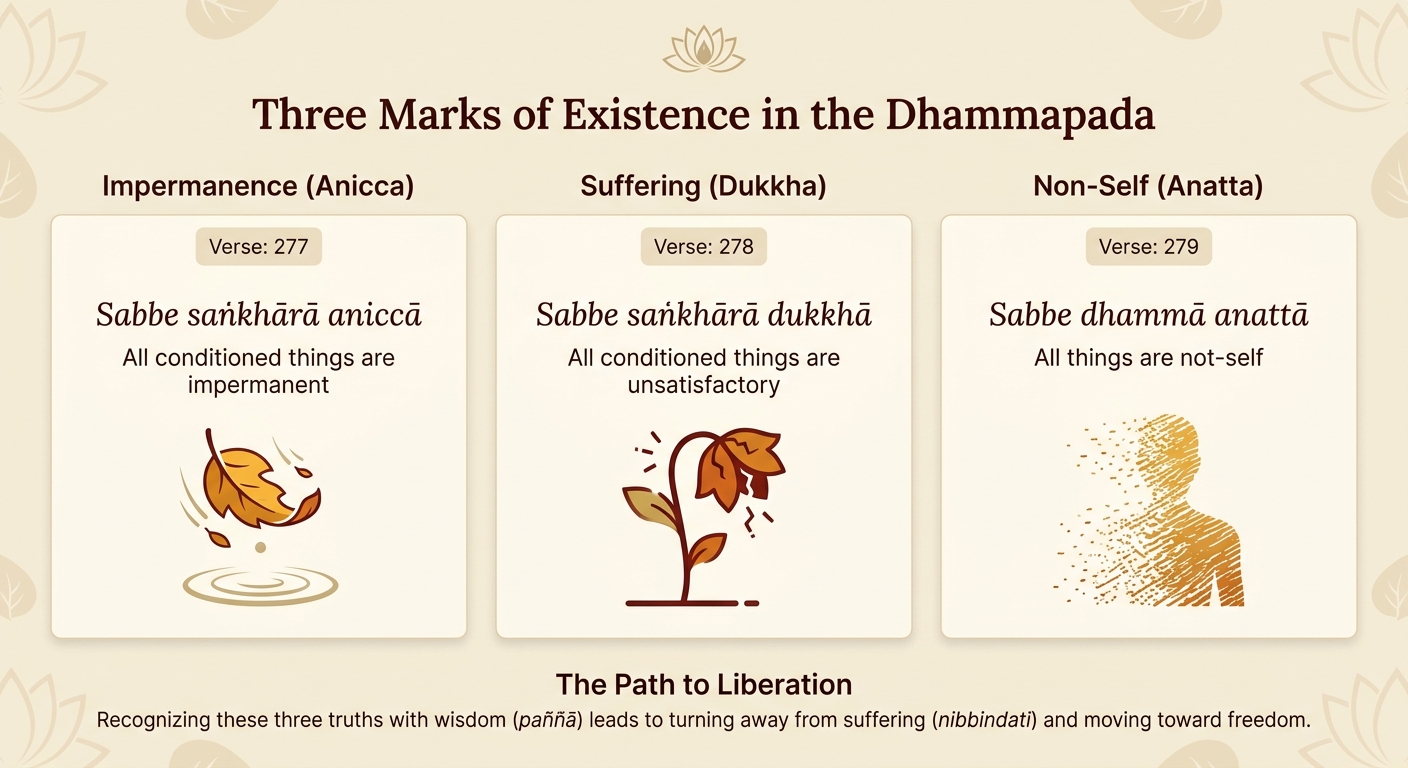
Three Marks of Existence: Key Dhammapada Verses on Impermanence & Suffering
Understanding Impermanence
The Dhammapada emphasizes the ever-changing nature of everything we encounter. Impermanence (anicca) is a central theme, highlighting that all conditioned phenomena - whether physical, emotional, or mental - are temporary and fleeting. This includes the world around us, our thoughts, and even the sense of self. Nothing born from conditions is built to endure forever.
The Dhammapada suggests that true wisdom (paññā) arises when we fully grasp this reality. This understanding encourages us to release our attachments. When impermanence is deeply understood - not just intellectually but experientially - the tendency to cling diminishes. This letting go is where freedom begins, as described in the text.
Selected Verses on Impermanence
Chapter 20 of the Dhammapada (Maggavagga) contains verses 277–279, which outline the Three Marks of Existence. Each verse builds upon the previous one, creating a powerful sequence:
| Verse | Pāli Phrase | English Translation | Focus |
|---|---|---|---|
| 277 | Sabbe saṅkhārā aniccā | "All conditioned things are impermanent" | Impermanence (Anicca) |
| 278 | Sabbe saṅkhārā dukkhā | "All conditioned things are unsatisfactory" | Suffering (Dukkha) |
| 279 | Sabbe dhammā anattā | "All things are not-self" | Non-self (Anatta) |
Take verse 277 as an example:
"All conditioned things are impermanent - when one sees this with wisdom, one turns away from suffering. This is the path to purification." - Dhammapada 277
The term nibbindati in the verse is often translated as "turns away from", but its meaning goes deeper. Derived from the root vid (to know) with the prefix ni (away), it conveys a profound, lived disillusionment with the transient nature of things - not just an intellectual realization. This insight doesn’t remain abstract; it transforms how we relate to the world, loosening the grip of clinging.
Commentaries on this teaching reveal its specific significance. The Buddha shared these verses with a group of 500 monks who, in a previous life under Buddha Kassapa, had meditated on impermanence for 20,000 years. For them, this teaching was the most effective path to spiritual awakening.
Applying Impermanence to Modern Life
The principle of impermanence is as relevant today as it was centuries ago. In modern life, everything - jobs, relationships, health - is subject to change. Verse 287 captures this vividly:
"As a great flood carries away a sleeping village, so death seizes and carries away the man with a clinging mind, doting on his children and cattle." - Dhammapada 287
This imagery underscores how attachment amplifies the pain of change. Whether it’s the loss of a job, the end of a relationship, or a health setback, clinging to what is impermanent only deepens suffering.
Verse 285 offers a practical approach:
"Cut off your affection in the manner of a man who plucks with his hand an autumn lotus." - Dhammapada 285
This doesn’t mean becoming indifferent or cold. Instead, it’s about holding life’s experiences and relationships lightly - cherishing them while they last, without trying to force permanence. By doing so, we can navigate life’s inevitable changes with greater ease and open the door to lasting freedom from suffering.
The Nature of Suffering in the Dhammapada
Defining Suffering (Dukkha)
In Buddhism, dukkha refers to more than just pain or discomfort - it captures the full spectrum of human suffering, from physical pain to mental anguish and even the dissatisfaction that comes with life’s fleeting nature. The Dhammapada encapsulates this in verse 203:
"hunger is the greatest disease, conditioned things the greatest suffering." - Dhammapada Verse 203, Bhikkhu Bodhi
Buddhist teachings break dukkha into three categories: dukkha-dukkha, the obvious pain from physical or emotional experiences; viparinama-dukkha, the distress caused by change or impermanence; and the subtler, all-encompassing dissatisfaction present in conditioned existence. This layered understanding sets the groundwork for examining what the Dhammapada says about the roots of suffering.
Verses on the Roots of Suffering
The Dhammapada points directly to craving (tanha) as the source of suffering. Verses 216 and 338 emphasize how craving leads to both grief and recurring pain, stressing the importance of addressing it at its core:
"From craving there arises grief, from craving there arises fear, for one who is free from craving there is no grief, how is there fear?" - Dhammapada Verse 216
"until the craving that lies dormant is rooted out, suffering springs up again and again" - Dhammapada Verse 338, Acharya Buddharakkhita
These verses make it clear: temporary fixes won’t work. Craving must be removed entirely to break free from suffering’s cycle.
The Dhammapada also highlights the mind’s role in creating suffering. Verse 1 illustrates this vividly:
"Mind precedes all mental states. All deeds are led by mind, created by mind. If one speaks or acts with a corrupt mind, suffering follows, as the wheel follows the foot of the ox." - Dhammapada Verse 1
This verse places responsibility for suffering on our mental patterns rather than external events. Recognizing this connection allows us to take control, letting go of attachments and breaking free from suffering’s grip. It’s not just about understanding impermanence - it’s about seeing how our thoughts and habits shape our experience.
The text goes deeper by identifying specific mental states that fuel this cycle of suffering.
The Three Poisons and Their Role in Suffering
The Dhammapada pinpoints three key mental afflictions - passion (raga), hatred (dosa), and delusion (moha) - as the primary drivers of human suffering. Verse 251 puts it bluntly:
"There is no fire that is like passion, there is nothing that takes a hold like hatred, there is no snare like delusion, there is no flood like craving." - Dhammapada Verse 251
These three are further described in verses 356–358 as the "bane of mankind." Using an agricultural metaphor, the text compares these afflictions to weeds overtaking a field. Just like weeds, passion, hatred, and delusion can choke out clarity and peace of mind. Overcoming them requires cultivating mindfulness and practicing restraint, allowing us to uproot these poisons and move toward liberation.
How Impermanence and Suffering Connect in the Dhammapada
The Doctrinal Link Between Impermanence and Suffering
In the Dhammapada, impermanence and suffering are deeply intertwined - they're like two sides of the same coin. The text teaches that because all conditioned things are impermanent, they are also inherently unsatisfactory. This connection is clearly illustrated in verses 277 and 278, which explain that recognizing impermanence naturally helps one let go of suffering. At the heart of this process is panna - a wisdom rooted in deep insight. With this wisdom, a person truly understands the fleeting nature of all things and experiences nibbindati, a sense of "turning away from" or "growing tired of" suffering. This shift in perspective changes how we relate to both change and suffering, laying a foundation for practical application in daily life.
Putting These Teachings Into Practice
With this understanding in mind, the teachings of the Dhammapada can be applied to navigate the challenges of everyday life. When we encounter inevitable changes - like the end of a relationship, losing a job, or dealing with health issues - the Dhammapada suggests that the pain in these moments doesn't come from the changes themselves. Instead, it stems from the clinging mind that resists change and expects permanence. Verse 287 paints this vividly:
"As a great flood carries away a sleeping village, so death seizes and carries away the man with a clinging mind, doting on his children and cattle." - Acharya Buddharakkhita
The metaphor of the "sleeping village" highlights how suffering often arises from being unprepared for life's inevitable shifts. By recognizing impermanence ahead of time, we can "wake up" and face challenges without being overwhelmed.
Another metaphor, found in verse 285, compares detachment to plucking an autumn lotus: letting go of attachments to things destined to pass, just as one might pick a flower before it wilts. This isn't about becoming indifferent or unfeeling. Instead, it's about holding life's experiences lightly - appreciating them without clinging so tightly that their eventual change becomes unbearable.
The Dhammapada also cautions against rigid expectations, as fixed plans often clash with life's unpredictability. Reflecting on this truth can help ease the anxiety that comes from trying to control what is ultimately beyond our control.
Practical Ways to Reflect on Dhammapada Verses
Daily Reflection Practices
Begin your day by reading a single verse from the Dhammapada. Allow its wisdom to settle within you, guiding your thoughts and actions. This simple practice can transform your day into a journey of mindfulness and insight. Acharya Buddharakkhita, a noted translator and scholar, beautifully described the Dhammapada:
"For the simple and unsophisticated the Dhammapada is a sympathetic counselor; for the intellectually overburdened its clear and direct teachings inspire humility and reflection; for the earnest seeker it is a perennial source of inspiration and practical instruction."
Carry the verse with you throughout the day. During moments of stress or uncertainty, pause and recall its teaching. This approach, often called "mindful anchoring", turns a brief morning reading into a dynamic meditation that stays with you.
To deepen your understanding, revisit the same verse on Day 8 and Day 15. This "Echo" method helps the verse take root, offering fresh insights each time you reflect on it.
For a more structured practice, consider incorporating Sutta 423 into your routine.
Using Sutta 423 for Daily Reflection

Sutta 423 is a valuable resource for anyone seeking a steady, low-pressure way to engage with the Dhammapada. The app delivers one verse each morning, guiding users through all 423 verses over the span of a year. If you miss a day, there’s no penalty - your progress is saved, and you can pick up right where you left off. This flexible approach makes it easy to stay consistent without feeling overwhelmed.
As the app itself explains:
"In 423 days, you'll have walked through the entire Dhammapada - not just read it, but lived with it."
The app also allows you to bookmark verses for deeper reflection, making it particularly helpful during meditation sessions. This is especially useful when exploring profound themes like impermanence or suffering. While the app offers optional support tiers (ranging from $0.99 to $99.99), the daily verse feature is always free.
Verses Worth Reflecting On
Certain verses from the Dhammapada are especially powerful when reflecting on impermanence, suffering, and self-mastery. These themes can help anchor your practice and provide clarity during challenging times. Here are a few key verses to consider:
| Theme | Verse(s) | What to Reflect On |
|---|---|---|
| Impermanence | 148, 170 | The body is fragile; the world is fleeting, like a bubble or mirage. |
| Nature of Suffering | 1, 202 | Suffering begins in the mind; existence itself carries dissatisfaction. |
| Letting Go | 90, 91 | Those who release grief and attachment free themselves from further suffering. |
| Aging and Mortality | 147–150 | The body ages and perishes - reflecting on this can ease attachment to physical identity. |
| Self-Mastery | 103, 160 | Overcoming oneself is the greatest victory, surpassing any external achievement. |
If impermanence feels abstract, start with Verse 170:
"Look upon the world as a bubble, look upon it as a mirage: the king of death does not see him who thus looks down upon the world." - Friedrich Max Müller
For moments when suffering feels particularly immediate, turn to Verse 1. This verse reminds us that our mind often shapes our experience of pain before external circumstances even come into play.
Conclusion
The Dhammapada sheds light on the roots of suffering and offers a path to freedom. By understanding that all conditioned things are fleeting and that suffering originates in the mind, you can begin to let go of attachment. This realization paves the way for meaningful personal growth.
As Acharya Buddharakkhita highlights, true wisdom emerges through practice, with meditation serving as the key to deeper insight. Ultimately, the journey is deeply personal - only you can walk the path.
Transformation doesn't require grand gestures; it begins with small, consistent efforts. Even reading a single verse each morning can lead to profound change over time. As the text wisely puts it:
"Drop by drop is the water pot filled."
For those seeking a steady, manageable way to engage with the Dhammapada, Sutta 423 offers a daily verse, guiding you through the entire collection in a year - one small step at a time.
FAQs
How is letting go different from being indifferent?
Letting go involves consciously choosing to release attachments to things that are temporary, fostering both wisdom and a sense of inner freedom. On the other hand, indifference reflects a lack of emotional involvement or concern, which can sometimes result in neglecting mindful and ethical actions. While letting go requires active awareness and intention, indifference leans toward passivity and disengagement.
What does “not-self” (anatta) mean in everyday life?
In daily life, the concept of “not-self” (anatta) encourages us to see that our body, emotions, perceptions, thoughts, and awareness are fleeting, unreliable, and not something we can fully own. By acknowledging this, we can let go of excessive attachment and reduce suffering, leading to a calmer, more balanced way of living without being overly tied to things or experiences.
How can I practice these verses daily without feeling overwhelmed?
Start by setting aside just a few minutes each morning to read and reflect on a single verse from the Dhammapada. After reading, take a moment to sit quietly and let the verse sink in. Throughout your day, try to carry its message with you, thinking about how it connects to your own life. There’s no need to rush or tackle multiple verses at once - this calm and steady practice allows for a deeper connection and understanding to develop naturally over time.