

5 Dhammapada Verses on Change
Five Dhammapada verses on impermanence, non-self, and letting go to build calm and resilience amid change.
Change is inevitable, but how we respond to it can shape our peace of mind. The Dhammapada, a collection of 423 teachings attributed to the Buddha, offers timeless guidance on navigating life's uncertainties. Its core principles - impermanence (anicca), suffering (dukkha), and non-self (anattā) - help us understand why change feels challenging and how to approach it with clarity.
Here are five key verses that address change:
-
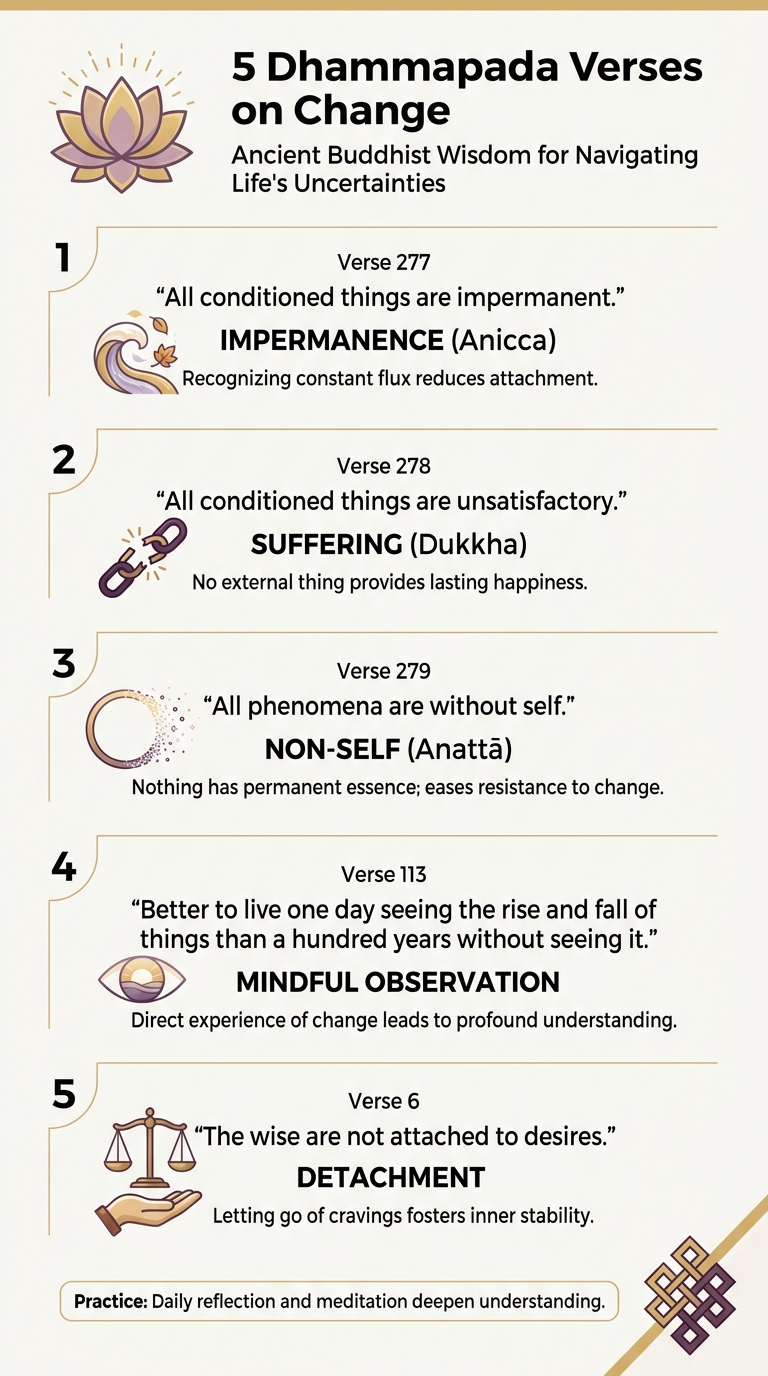
Verse 277: "All conditioned things are impermanent."
Recognizing that everything is in constant flux helps reduce attachment to fleeting things. -
Verse 278: "All conditioned things are unsatisfactory."
No external phenomenon can provide lasting happiness, encouraging detachment from temporary pleasures. -
Verse 279: "All phenomena are without self."
Understanding that nothing has a permanent essence eases resistance to change. -
Verse 113: "Better it is to live one day seeing the rise and fall of things than to live a hundred years without ever seeing the rise and fall of things."
Observing life’s natural rhythms, even briefly, can lead to profound understanding. -
Verse 6: "Those who are wise are not attached to desires."
Letting go of cravings fosters inner stability and peace, regardless of circumstances.
These teachings emphasize mindfulness, detachment, and the acceptance of impermanence as tools to navigate change with resilience. Daily reflection and meditation on these verses can deepen understanding and promote inner calm.
5 Dhammapada Verses on Change and Impermanence
Overcoming the Fear of Change - Buddhist Wisdom on Impermanence and Inner Peace
1. Verse 277: "All conditioned things are impermanent."
This verse translates the Pali phrase "Sabbe sankhara anicca". The term sankhara, meaning "conditioned things", encompasses all phenomena that arise due to causes and conditions - our bodies, emotions, thoughts, relationships, and possessions all fall under this category. Nothing exists independently; everything is interconnected and relies on something else for its existence. Understanding this truth helps us better handle life's inevitable changes.
Everything conditioned, from our physical selves to our emotional states, is in constant flux. For instance, our feelings and bodily sensations shift moment by moment. The Buddha emphasized that grasping this truth is not merely about intellectual understanding - it requires Insight-wisdom (Vipassana panna). This deeper awareness opens the door to further realizations about impermanence as taught in the Dhammapada.
"All conditioned phenomena are impermanent; when one sees this with Insight-wisdom, one becomes weary of dukkha. This is the Path to Purity." – Dhammapada Verse 277
The Buddha first shared this teaching at Jetavana, where it led 500 monks to comprehend impermanence and attain enlightenment.
When you truly see that nothing lasts forever, your attachment to fleeting things begins to fade. This shift in perspective frees you from clinging to what is inherently unstable. By accepting the natural flow of change, you align yourself more peacefully with life’s rhythms.
2. Verse 278: "All conditioned things are unsatisfactory."
Building on the concept of impermanence, Verse 278 introduces the idea of "Sabbe sankhara dukkha" – all conditioned phenomena are unsatisfactory. While impermanence highlights the fleeting nature of things, this verse goes a step further, showing that no conditioned phenomenon can bring lasting happiness. This understanding encourages us to loosen our attachments to the transient.
The term dukkha encompasses a wide range of experiences: physical pain, mental distress, and the inherent dissatisfaction of existence itself. Even pleasures born from craving are temporary, and the five aggregates (physical phenomena, feelings, perception, volitional activities, and consciousness) are impermanent and unable to provide true fulfillment.
"All conditioned phenomena are dukkha; when one sees this with Insight-wisdom, one becomes weary of dukkha. This is the Path to Purity." – Dhammapada Verse 278
According to tradition, the Buddha shared this verse with 500 monks. Through meditating on the nature of suffering, these monks achieved Arahatship by gaining direct insight (Vipassana panna).
Understanding that conditioned things cannot offer permanent satisfaction naturally leads to a loosening of attachment. This "weariness" isn't a sense of despair but a healthy detachment that liberates us from chasing fleeting pleasures. By recognizing the unsatisfactory nature of conditioned things, we develop a sense of detachment and begin to move in harmony with life's impermanent nature.
3. Verse 279: "All phenomena are without self."
The third verse wraps up the Buddha’s teachings on change by introducing anatta - the concept of non-self. While impermanence and unsatisfactoriness help us understand and accept change, the realization of non-self takes this understanding even deeper. Verse 279 broadens the scope, applying this principle to all phenomena, including the unconditioned state of Nibbāna.
"All phenomena (dhammas) are without Self; when one sees this with Insight-wisdom, one becomes weary of dukkha. This is the Path to Purity." – Dhammapada Verse 279
Non-self, or anatta, means that there is no unchanging soul or eternal essence within us or anything else. What we think of as "self" - our body, emotions, thoughts, and consciousness - is not a permanent entity but a constantly shifting process. Buddhism points out that the rapid changes in these components often trick us into believing the illusion of a unified, fixed self.
This understanding reshapes how we approach change. Since these elements are "not-self", we cannot demand that they remain the same. In the Anattalakkhaṇa Sutta, the Buddha explained this through a simple yet profound observation: if form were truly self, we would have control over it, saying, "May my form be like this! May it not be like that!" But because our experiences are fleeting and beyond our control, resisting change only leads to suffering. By embracing the natural flow of change, we free ourselves from the frustration of clinging to what cannot be held.
This realization doesn’t just ease our struggles - it opens the door to deeper reflection and liberation. According to tradition, when the Buddha shared this teaching with 500 monks, all of them attained Arahatship, achieving complete freedom from suffering.
4. Verse 113: "Better it is to live one day seeing the rise and fall of things than to live a hundred years without ever seeing the rise and fall of things."
This verse highlights the transformative power of truly understanding the nature of change. When we grasp the truths of impermanence, unsatisfactoriness, and non-self, a deeper clarity emerges. Verse 113 reminds us that even a single day spent observing life’s constant changes can be more impactful than an entire lifetime lived without such awareness.
"Better it is to live one day seeing the rise and fall of things than to live a hundred years without ever seeing the rise and fall of things." – Dhammapada Verse 113
The message here is simple yet profound: direct experience of life’s ebb and flow leads to genuine inner peace.
The story of Patacara beautifully illustrates this teaching. After enduring unimaginable personal losses, she sought solace at Jetavana, where she encountered the Buddha. Through his compassionate guidance and the teaching of the Anamatagga Sutta, she found clarity. Observing the rise and fall of water deeply resonated with her, and this simple act of mindfulness led her to attain Arahatship. Her journey shows how even the smallest observations, when done with mindfulness, can lead to profound liberation.
When we face significant changes or losses, mindful observation becomes a powerful tool. By watching the natural rise and fall of our thoughts, emotions, and experiences, we begin to release attachments and embrace life’s impermanence. This practice brings a sense of peace and prepares us for further insights, particularly on the topic of detachment, explored in the next verse.
5. Verse 6: "Those who are wise are not attached to desires."
Verse 6 builds on the themes of impermanence and the concept of non-self, focusing on how desire contributes to suffering. Life is full of change, and clinging to desires or fixed outcomes only magnifies the pain when things don’t go as planned - whether it’s losing a job, the end of a relationship, or seeing carefully laid plans fall apart.
The wise, as described in earlier verses, approach these changes with calmness and clarity. They understand that craving pleasure or desperately trying to hold onto what is fleeting only deepens suffering. In contrast, those who lack this understanding often ride an emotional rollercoaster, swaying between joy and despair as circumstances shift. The wise, however, cultivate equanimity - a balanced state of mind that remains steady regardless of what life throws at them.
This teaching emphasizes the importance of equanimity, which allows one to remain unaffected by external forces like praise or criticism. Think of it like a sturdy rock that doesn’t budge in the face of strong winds. By letting go of attachments to fleeting pleasures and impermanent things, the wise achieve a sense of inner stability.
A story from the Buddhist tradition highlights this principle. During a famine in Veranja, a group of Five Hundred Bhikkhus demonstrated remarkable contentment. Despite surviving on nothing more than shriveled grains, they stayed peaceful and disciplined. In contrast, another group of monks, when faced with better conditions and an abundance of food, indulged excessively, causing disruption. This illustrates how attachment to desires can lead to undisciplined behavior, while practicing contentment - even in hardship - prevents greed and fosters balance when circumstances improve.
The Benefits of Daily Reflection
The wisdom of these verses truly comes to life when paired with consistent, mindful reflection. Simply reading them once won’t immediately transform how you approach change. It’s through meditation and repeated engagement that their deeper meanings unfold over time. As John Richards eloquently translates:
"A whole waterpot will fill up from dripping drops of water. A wise man fills himself with good, just a little at a time".
This is the essence of daily reflection. Buddhist scholar Glenn Wallis highlights the Dhammapada’s effectiveness by pointing out how it condenses the Buddha’s vast teachings into "concise, crystalline verses", making the path accessible to anyone. You don’t need years of study - just the patience to take in one meaningful teaching at a time.
The story of Culapanthaka beautifully illustrates this principle. Struggling to memorize even a single verse after four months, Culapanthaka was given a simple task: rub a clean cloth while repeating a short phrase. Over time, he noticed the cloth becoming soiled, which led him to grasp the impermanence of all conditioned things. This daily focus on a simple truth eventually brought him to arahatship and profound insight.
For modern practitioners, tools like the Sutta 423 app make daily reflection even more accessible. The app delivers one Dhammapada verse each day for quiet contemplation, cycling through all 423 verses over the course of a year - and beyond. It aligns with the teaching that "better than a thousand meaningless words is one meaningful word that brings peace to the one who hears it". The app also offers a journaling feature, allowing users to record their thoughts and deepen their connection to each verse.
This practice of regular reflection builds what the Dhammapada describes as an "island which no flood can overwhelm". Over time, these teachings become so deeply ingrained that they naturally guide your responses to life’s challenges, without requiring conscious effort. By reinforcing the core principles of impermanence, unsatisfactoriness, and non-self, daily reflection not only strengthens your mental resilience but also paves the way for profound personal insight.
Conclusion
Change is a constant part of life, but it doesn’t have to overwhelm you. Verses like 277, 278, 279, 113, and 6 remind us to accept impermanence, let go of attachments, and approach change with balance and understanding. These teachings guide us to see that all conditioned things are fleeting, unsatisfactory, and without a permanent self. By internalizing this perspective, we can stop chasing stability in an ever-changing world and instead find peace in adapting to life’s natural flow.
The key lies in consistent practice. As the Buddha emphasized in Verse 167: "Do not follow ignoble ways, do not live in negligence, do not embrace wrong views, do not be the one to prolong samsara". This serves as a powerful reminder to stay grounded in mindfulness and to approach every transition with awareness. Rather than focusing on external distractions or the actions of others, bring your attention back to your own experiences.
Strengthen your foundation - build an "island which no flood can overthrow" - through steady practice and by choosing words and actions that promote harmony rather than discord. Use your abilities thoughtfully, as the Buddha warned: "The skill of a fool can only harm him; it destroys his merit and his wisdom".
Daily reflection is a powerful tool for cultivating wisdom. Many of life’s struggles arise not from external events but from our own attitudes. By staying mindful during transitions, even in the small, everyday moments, meditation on impermanence can deepen your understanding and transform your approach to challenges. Recognizing the transient nature of life empowers you to respond with clarity and resilience.
Start today - one verse, one reflection, one mindful choice at a time.
FAQs
What does “conditioned things” mean in the Dhammapada?
In the Dhammapada, the term “conditioned things” (sankhāra) refers to all phenomena that are temporary, always in flux, and devoid of any fixed or permanent self. These phenomena have no unchanging essence, as they continuously arise and fade away, emphasizing the fleeting nature of existence.
How can non-self help me handle change without feeling numb?
Non-self (anatta) offers a way to navigate change by highlighting the impermanence and absence of fixed identity in everything around us. This understanding helps lessen attachment and aversion, allowing for the development of equanimity and a sense of acceptance. Rather than leading to emotional detachment, it encourages a balanced mindset - one that approaches change with a sense of clarity and calm.
What’s a simple daily practice to reflect on these verses?
A straightforward way to engage with Dhammapada verses about change is by dedicating a few quiet minutes each day to reading and reflecting. Pick a peaceful moment, read one verse slowly, and take time to consider its meaning and how it relates to your personal experiences. This simple practice encourages mindfulness and a sense of acceptance, allowing the teachings on impermanence and change to resonate more deeply over time.