
What the Dhammapada Teaches About Ignorance
Ignorance in the Dhammapada is a removable veil: honest reflection, meditation, and ethical practice gradually reveal clearer seeing.
Ignorance, in the Dhammapada, means not seeing your experience clearly. It is less about lack of education and more about missing the causes of suffering, repeating the same habits, and mistaking confusion for wisdom.
Here’s the short version:
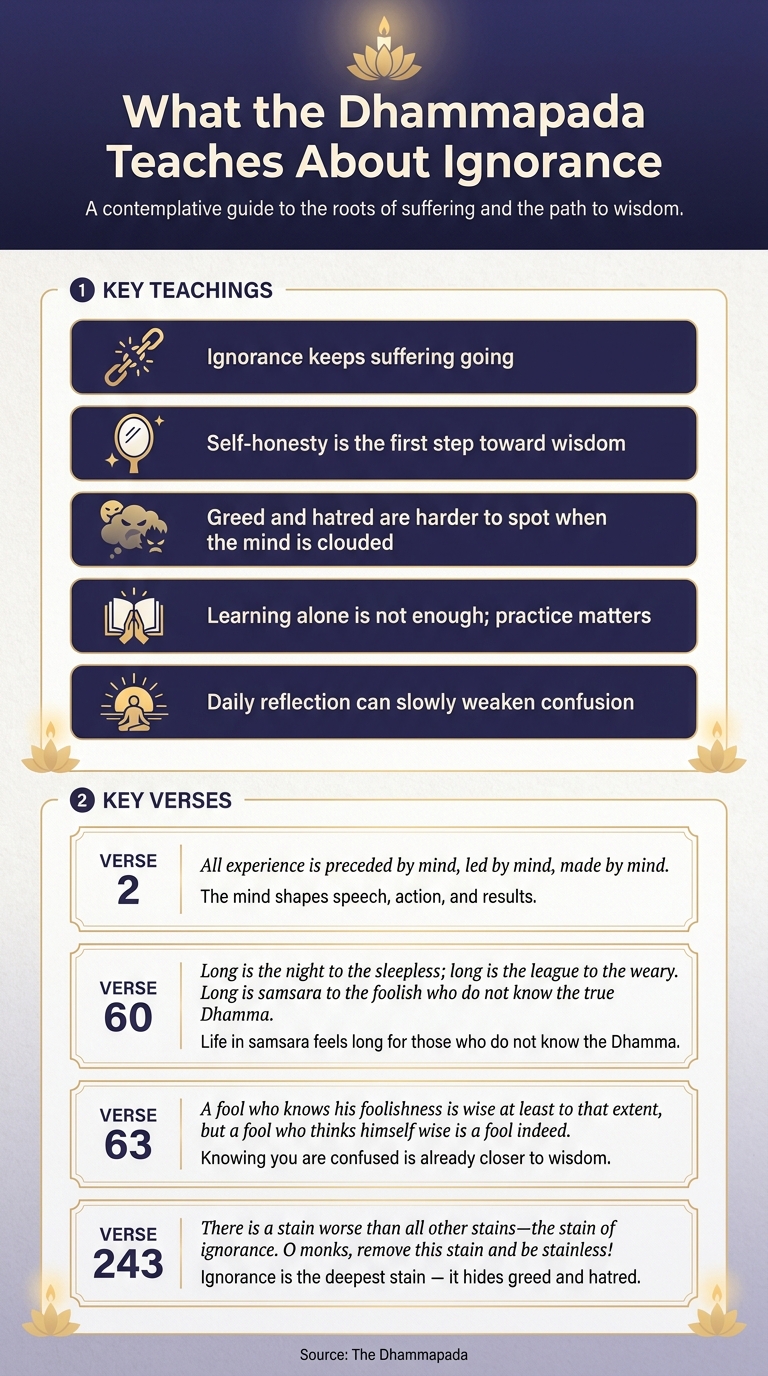
- Ignorance keeps suffering going
- Self-honesty is the first step toward wisdom
- Greed and hatred are harder to spot when the mind is clouded
- Learning alone is not enough; practice matters
- Daily reflection can slowly weaken confusion
A few key verses shape this view:
- Verse 60: life in samsara feels long for those who do not know the Dhamma
- Verse 63: if you know you are confused, you are already closer to wisdom
- Verse 243: ignorance is called the deepest stain
- Verse 2: the mind shapes speech, action, and results
What stands out to me is this: the text treats ignorance as something you can reduce. Not all at once. But bit by bit, through reflection, watching your mind, and changing how you act.
If I put the whole article into one plain sentence, it would be this: the Dhammapada says clear seeing starts when I stop pretending I already understand.
Dhammapada on Ignorance: Key Verses & Teachings
Buddha on Ignorance: The Darkness That Rules You
How the Dhammapada Describes Ignorance and Its Effects
The Dhammapada treats ignorance as a practical problem. It warps judgment, feeds dissatisfaction, and blocks clear seeing.
How Not Knowing the Dhamma Extends Suffering
Verse 60 describes samsara - the cycle of existence - as long and tiring for people who do not understand the Dhamma. The point is simple: the cycle feels endless because the same painful patterns keep showing up again and again.
That repeated loop helps explain why the Dhammapada treats self-awareness as the start of wisdom. If you can’t see the pattern, you stay stuck in it.
Why Recognizing Your Own Confusion Is Already Progress
Verse 63 draws a sharp line. A person who knows they are confused is already nearer to wisdom than someone who wrongly thinks they see things clearly. The Dhammapada says that a fool who knows their foolishness is wise in that measure, while a person who thinks they are wise but is still confused remains a fool.
There’s something blunt and human about that idea. Saying, “I do not fully understand this,” is not failure. It’s the first move toward clearer sight.
Why the Dhammapada Calls Ignorance the Greatest Taint
Verse 243 goes even further. It names ignorance as the deepest harmful state of all. Ignorance works like a veil: when it is there, people cannot clearly see other harmful states such as greed and hatred. Those states stay hidden, or worse, they start to look justified.
That’s why ignorance is called the deepest taint. It covers over greed and hatred before a person can even spot them for what they are.
So the next step is not just learning more facts. It’s learning how wisdom starts to wear ignorance down.
What the Dhammapada Says About Moving Toward Wisdom
If ignorance clouds the way we see, practice is what clears the view. In the Dhammapada, wisdom isn't treated as theory. It has to change how you live.
Learning, Reflection, and Honest Self-Observation
One simple way to work with this is to read one verse slowly each day, then watch how it applies to your thoughts, words, and behavior. That's why slow, repeated reflection matters more than rushing through pages. It's less about finishing the text and more about letting the text work on you.
"Mind precedes all mental states. Mind is their chief; they are all mind-wrought. If with a pure mind a person speaks or acts, happiness follows him like his never-departing shadow." - Dhammapada, Verse 2
The point is plain: the mind shapes speech and action, so reflection has to reach conduct.
Why Letting Go Matters as Much as Knowing More
Wisdom is not just about knowing more. It also depends on practices that help insight hold steady over time. Meditation steadies attention, reflection clears judgment, and ethical conduct puts insight into action. Taken together, these practices bring confusion into view instead of just piling on more ideas. That's the logic behind reading one verse a day too: small, steady attention slowly weakens ignorance.
How Daily Reflection Can Support Clearer Seeing
Daily reflection turns clearer seeing into something you can actually do.
Using One Verse a Day as a Reflection Practice
Read one verse slowly, sit with it for a moment, and carry it with you through the day. It doesn’t need to take long. What matters is what stays with you after you’ve read it.
When you return to a verse again and again, you start to notice your assumptions, your reactions, and your habits of mind. That kind of noticing helps reduce ignorance.
Sutta 423 works well for this kind of practice. It delivers one verse a day, moves through the full 423-verse sequence in a little over a year, and repeats verses on days 8 and 15 to deepen understanding.
A tool can help support reflection, but honest observation is the part that reduces confusion. Paying attention to how the verse shows up in your thoughts, speech, and actions is what weakens ignorance - not simply receiving it.
Conclusion: Ignorance in the Dhammapada Is a Lack of Insight That Can Be Reduced
Taken as a whole, the Dhammapada’s teaching on ignorance points in one direction: seeing more clearly. In this text, ignorance is not a problem of low intelligence. It is a problem of not seeing things as they are. And when that happens, wisdom gets blocked.
The Dhammapada presents ignorance as something that can lessen through honesty, learning, reflection, and letting go. Its call to avoid evil, do good, and purify the mind pushes toward that same shift. That’s the practical path the text lays out.
Clear seeing does not appear all at once. It grows bit by bit, and over time it can take the place of confusion.
FAQs
How is ignorance different from a lack of knowledge?
In the Dhammapada, ignorance means more than just missing a fact or not knowing enough. It points to a deep confusion about how life actually works.
More specifically, it is the failure to see impermanence, unsatisfactoriness, and the absence of an enduring self. So this isn't just a gap in knowledge. It's a deep mental defilement that clouds judgment and keeps suffering in motion.
Why does admitting confusion matter in the Dhammapada?
In the Dhammapada, admitting confusion matters because it helps you see delusion for what it is: a force that feeds suffering. That shift is small but powerful. It moves you from automatic reaction to mindful awareness.
That kind of honesty gives you room to look at your intentions more closely. Are they coming from wisdom, or from unskillful states like greed and anger? If you stay curious and keep your heart open, confusion can become a path to deeper understanding.
How can I practice reducing ignorance every day?
To reduce ignorance day by day, build a simple habit of mindfulness and ethical discipline through steady reflection. Set aside 5 to 10 minutes each morning or evening to sit with one Dhammapada verse. Let it shape how you think, speak, and act.
It also helps to look closely at your intentions. Pay special attention to thoughts driven by greed, anger, or confusion. Meditation gives you space to notice these patterns more clearly, then shift away from harmful habits and move toward generosity, patience, and wiser action.