

How Dhammapada Teaches Wisdom for Liberation
Practical guidance from the Dhammapada on ethics, meditation, and insight to reduce suffering and cultivate inner freedom.
The Dhammapada is a collection of teachings from the Buddha, offering practical steps to reduce suffering and find inner freedom. It emphasizes ethical living, mindfulness, and understanding life’s impermanence. The text highlights three key areas for personal growth:
- Ethics (Sīla): Building integrity by avoiding harm and following moral principles.
- Concentration (Samādhi): Developing mental clarity through meditation.
- Wisdom (Paññā): Gaining insight into impermanence, suffering, and the lack of a fixed self.
Everyday challenges, like anger or criticism, are seen as opportunities to practice patience, mindfulness, and self-awareness. By reflecting on verses, applying their lessons, and observing your actions, you can gradually cultivate wisdom. Tools like daily verse apps can help integrate these teachings into daily life. Ultimately, the Dhammapada guides readers toward a life of peace and liberation through small, consistent efforts.
Core Teachings of Wisdom in the Dhammapada
The Four Noble Truths and Wisdom
The Dhammapada makes it clear that wisdom is about seeing reality for what it is, allowing one to end suffering. Verse 273 emphasizes this by stating, "of all the truths the Four Noble Truths are the best". These truths form the foundation for cultivating paññā (wisdom).
The Four Noble Truths outline that suffering exists, it is caused by craving, and it can end through direct understanding of these truths. Verse 277 illustrates this perfectly:
"All conditioned things are impermanent - when one perceives this with wisdom, one turns away from suffering. This is the path to purification."
The phrase "perceives this with wisdom" is crucial. In the Dhammapada, wisdom isn't about holding beliefs; it's about experiencing and verifying the truth for yourself. This kind of insight lays the groundwork for the structured approach known as the Threefold Training.
The Threefold Training: Ethics, Concentration, and Wisdom
The Dhammapada presents the path to liberation as a progression through three interconnected stages, with each step supporting the next:
| Training | Pali Term | Purpose |
|---|---|---|
| Ethics | Sīla | Builds personal integrity and prevents harm to oneself and others (vv. 183, 246–247) |
| Concentration | Samādhi | Calms the mind, creating the clarity needed to see reality as it is (vv. 373–374) |
| Wisdom | Paññā | Provides direct insight into impermanence, suffering, and non-self, ending craving (vv. 277–279) |
These stages form a solid foundation for transformation. The text also warns about the consequences of neglecting meditation, stating in Verse 282: "Wisdom springs from meditation; without meditation wisdom wanes".
Qualities of the Wise Person
The Dhammapada doesn't leave wisdom as an abstract concept. It paints a clear picture of the qualities that define a truly wise person, referred to as the pandita. Wisdom, according to the text, is demonstrated through observable traits and practical behavior.
The wise are likened to a fletcher shaping an arrow or a carpenter working with wood - their self-mastery is deliberate and disciplined. They remain steady, unshaken by external circumstances like blame or praise. Verse 81 captures this resilience:
"Just as solid rock is not shaken by the wind, so the wise are not moved by blame or praise."
Another hallmark of wisdom is the ability to accept correction. The Dhammapada likens someone who points out your faults to a guide revealing "hidden treasure" - a valuable ally, not a threat. Traits like truthfulness, patience, and compassion are not optional extras but essential components of wisdom as described in the text.
The Dhammapada: The Buddha's Path of Wisdom
Practical Steps to Build Wisdom Using the Dhammapada
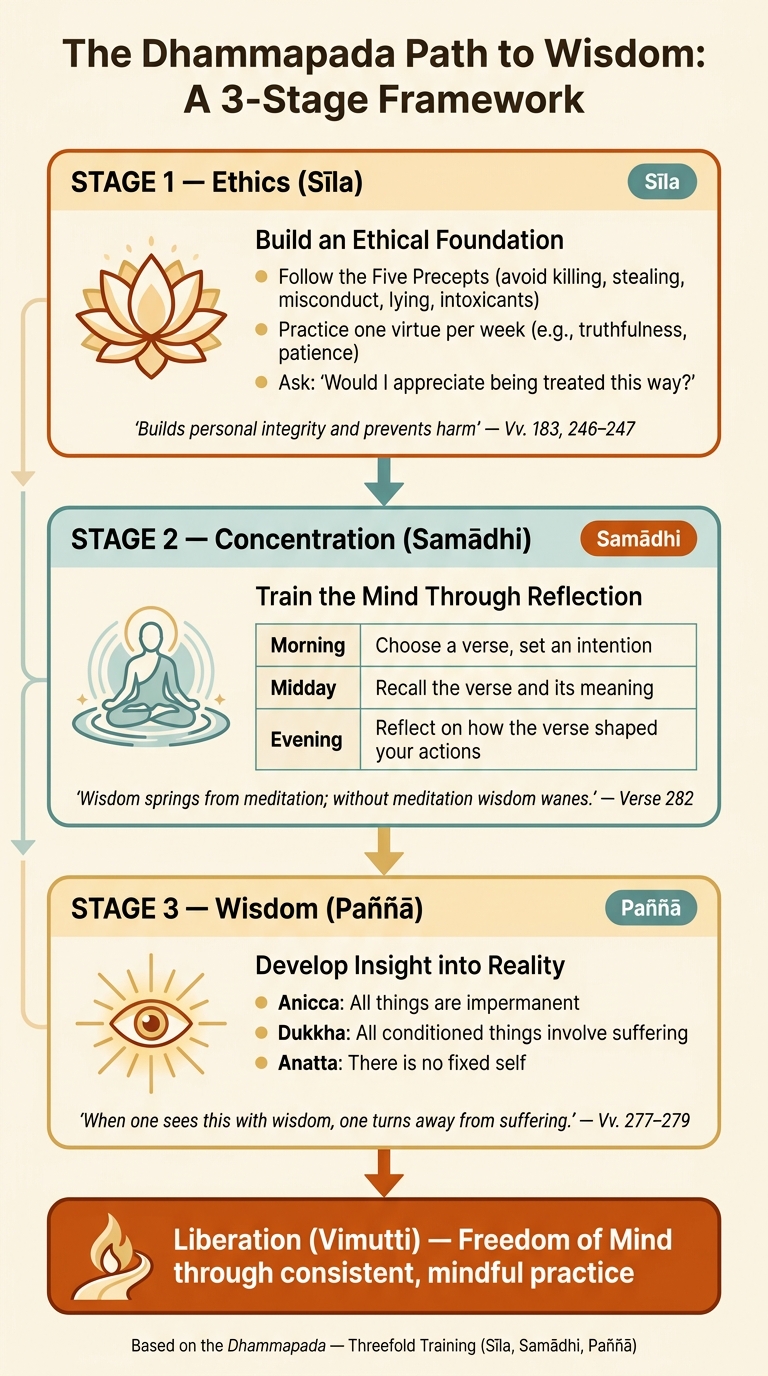
The Dhammapada Path to Wisdom: A 3-Stage Framework
Building an Ethical Foundation
The Dhammapada teaches that living ethically is key to cultivating wisdom. The Five Precepts - avoiding killing, stealing, sexual misconduct, lying, and intoxicants - are more than just rules; they’re practices that help prevent "digging up your own root". To integrate these values into daily life, try focusing on one virtue, like truthfulness or patience, for an entire week. Look for chances to apply it in your interactions. Before making a decision, ask yourself: “Would I appreciate being treated this way?” Verses 129–130 remind us that understanding others' fear of pain and loss naturally leads to non-harm. This simple ethical check-in becomes a step toward liberation. With this solid ethical base, you can move on to calming your mind through reflection and meditation.
Training the Mind Through Reflection and Meditation
With ethics in place, the next step is calming the mind. You can do this by weaving moments of mindfulness into your daily routine. Here’s a simple guide:
| Time of Day | Practice | Purpose |
|---|---|---|
| Morning | Choose a verse and set an intention | Begin the day with mindfulness |
| Midday | Recall the verse and its meaning | Stay grounded during the day |
| Evening | Reflect on how the verse shaped your actions | Build self-awareness |
Verse 50 encourages examining your own actions rather than focusing on others' faults. This habit of self-reflection transforms daily mindfulness into meaningful insight. Over time, this clarity helps you better understand impermanence, suffering, and the concept of not-self.
Developing Insight into Impermanence, Suffering, and Not-Self
The Dhammapada invites us to see life through the principles of anicca (impermanence), dukkha (suffering), and anatta (not-self). Verses 277–279 express it beautifully:
"All conditioned things are impermanent... All conditioned things are suffering... All things are not self. When one sees this with wisdom, then one turns away from suffering. This is the path of purification."
Apply these ideas to your daily experiences - whether it’s a moment of frustration or joy. Ask yourself: Is this feeling permanent? Does it involve dissatisfaction? Is there a fixed "self" behind it? As you practice, the insights described in verses 373–374 unfold: by observing the rise and fall of experiences, you’ll discover joy and freedom from attachment. This isn’t a distant goal; it’s a natural result of honest, consistent observation.
For a structured way to engage with the Dhammapada, consider using the Sutta 423 app. It offers one verse daily for reflection, helping you explore all 423 verses over a year.
Using Everyday Challenges to Deepen Wisdom
The Dhammapada doesn't suggest waiting for a retreat or a serene moment to practice wisdom. Instead, it highlights everyday challenges as the real training ground. As the text states:
"Mind is the forerunner of all actions. All deeds are led by mind, created by mind. If one speaks or acts with a corrupt mind, suffering follows, as the wheel follows the hoof of the ox."
This means that every difficult situation is an opportunity - a chance to observe your thoughts, understand your habits, and work toward changing your reactions. These daily struggles become the perfect setting for applying wisdom in practical ways.
Responding to Anger, Loss, and Criticism
The Dhammapada doesn’t mince words when it comes to anger. It likens holding onto anger to gripping a hot coal with the intent of throwing it at someone else - you're the one who gets burned. This metaphor drives home the idea that anger, even when directed outward, only increases personal suffering.
When facing criticism, the text encourages a shift in perspective. Instead of seeing it as an attack, treat it as valuable feedback that can guide your growth. This mindset transforms criticism from something painful into a tool for self-improvement.
Similarly, when dealing with loss, the teaching of impermanence offers a steadying perspective. By understanding that nothing is permanent, it becomes easier to face loss with calm acceptance, knowing that no single event has to define your emotional state.
A Simple Framework for Mindful Responses
To turn everyday challenges into opportunities for growth, try this straightforward three-step approach:
- Notice the trigger. Pay attention to the moment your mind becomes reactive - whether it’s anger, defensiveness, or restlessness. Think of it as catching a chariot before it runs wild.
-
Recall a verse. Bring a teaching to mind that fits the situation. For anger, the "hot coal" image is a vivid reminder. If caught in conflict, Verse 6 offers guidance:
"Hatred is never appeased by hatred in this world. By non-hatred alone is hatred appeased. This is a law eternal."
- Choose a mindful response. Instead of reacting impulsively, opt for patience, silence, or kindness. This reflects the teaching that "the self is the master of the self". It’s not about suppressing emotions but refusing to let them control your actions.
The Dhammapada emphasizes that character is built gradually, like filling a jar drop by drop. Each small act of patience or self-restraint adds to a larger practice. There’s no need for dramatic changes - steadily applying these principles to everyday situations leads to true inner freedom.
Making the Dhammapada's Wisdom a Lifelong Practice
Small, consistent efforts add up, much like filling a pot drop by drop.
Building a Regular Practice Framework
The Dhammapada is divided into 26 chapters, each centered on themes like "The Mind", "Anger", and "The Wise Man." This structure makes it perfect for a weekly study plan. Dedicate one chapter per week, allowing its lessons to resonate and settle into your daily life.
Start each morning by reading a single verse and reflect on its relevance throughout the day. Pay special attention to verses that challenge or unsettle you - they often highlight areas ripe for growth. At the end of the week, review how these teachings have influenced your actions and mindset. For extra support, tools like the Sutta 423 app can offer daily insights.
"The Dhammapada is looked upon as the scriptural kalyanamitta par excellence, a small embodiment in verse of the boundless wisdom and great compassion of the Master." - Bhikkhu Bodhi, Buddhist Monk and Scholar
A key element of this framework is self-observation. Progress isn't about how many chapters you've read but how clearly you can observe your own reactions and behaviors. Verse 50 reminds us to focus on understanding our own actions instead of fixating on the faults of others.
This disciplined approach sets the foundation for experiencing the transformative effects of wisdom.
The Fruits of Wisdom: Liberation from Suffering
Over time, the benefits of this practice begin to show in everyday life. The teachings gradually shape your character, making you more kind, calm, and unattached. This isn’t some distant, unreachable goal - it’s a natural outcome of steady practice.
By grounding yourself in ethical behavior, you reduce inner turmoil caused by guilt or conflict. A quieter mind allows for clearer perception, which, in turn, loosens the grip of craving and reactivity. As craving diminishes, suffering starts to fade. Acharya Buddharakkhita, a respected translator of the Dhammapada, expressed it beautifully:
"Whoever earnestly practices the teachings found in the Dhammapada will taste the bliss of emancipation."
This is the essence of heedfulness, which the Dhammapada calls the path to the Deathless. In contrast, negligence leads to suffering, or what it calls the path to death. By living with clarity and mindfulness, you can break free from the cycle of suffering, embodying the timeless wisdom of the Dhammapada.
Conclusion: Walking the Dhammapada's Path to Liberation
The Dhammapada serves as a timeless guide, offering wisdom and direction at every stage of life. Its teachings, rooted in ethics, mindful reflection, and insight, encourage consistent practice rather than unattainable perfection. These lessons not only shine a light on the path forward but also inspire meaningful change in daily life.
This steady, intentional approach aligns with the Dhammapada's message: to turn everyday challenges into opportunities for growth and liberation.
"Just as the great ocean has but one taste, the taste of salt, so this doctrine-and-discipline has but one taste, the taste of freedom." - The Buddha
One way to stay connected with these teachings is by incorporating them into your daily routine. Tools like the Sutta 423 app make this easier, offering a single verse each day to reflect on, allowing its wisdom to naturally integrate into your life.
The ultimate goal is to nurture vimutti - freedom of mind - through mindful engagement, one verse and one moment at a time. Each step brings you closer to the liberation that the Dhammapada so beautifully illuminates.
FAQs
How do I know if I’m gaining real wisdom, not just ideas?
You know you’re gaining genuine insight when you grasp the Four Noble Truths on a profound level, recognize the nature of impermanence, suffering, and the absence of a fixed self, and cultivate mindfulness to clear your mind. This kind of understanding helps free you from craving and builds greater self-awareness.
What’s a simple daily plan to practice the Threefold Training?
A straightforward daily routine can include dedicating a few moments to reading and contemplating a verse from the Dhammapada. Here's how you can approach it:
- Choose a quiet spot: Start by finding a calm and peaceful place where you can focus without distractions.
- Read a single verse: Take your time to read one verse slowly and attentively.
- Reflect deeply: Think about how the verse connects to principles like moral discipline, concentration, and wisdom.
- Bring it into your life: Consider how its message can guide your actions, especially in areas like mindfulness, thoughtful speech, and understanding.
Make this a daily habit to nurture mindfulness and wisdom in your everyday life.
How can I use a Dhammapada verse when I get angry?
When anger arises, consider the wisdom of the Dhammapada. Verse 222, for instance, encourages mastering anger much like a skilled charioteer controls their horses. By reflecting on teachings like this, you can cultivate mindfulness and choose compassion over impulsive reactions. Regularly engaging with these reflections can guide you toward maintaining emotional balance, even in difficult situations.