

How Dhammapada Teaches Forgiveness
Forgiveness in the Dhammapada: freeing yourself from anger through compassion, mindful speech, and daily practice.
Forgiveness in the Dhammapada is about freeing yourself from anger and resentment, not excusing harm. It teaches that hatred only leads to more hatred, while love and compassion break the cycle. Key lessons include:
- Hatred is overcome by love: Verse 5 emphasizes that only love can end hatred, describing this as an eternal truth.
- Anger harms the holder: Verses 1 and 201 highlight how holding onto anger causes suffering and inner turmoil.
- Forgiveness is personal freedom: It’s not tied to apologies or reconciliation but is about letting go for your own peace of mind.
- Compassion for wrongdoers: Seeing those who harm you as acting out of ignorance can help you release grudges.
- Practical steps: Reflect on the cost of anger, practice lovingkindness meditation, pause before reacting, and focus on your growth instead of others’ faults.
Forgiveness, as taught in the Dhammapada, is a daily practice that leads to inner peace and self-mastery.
What the Dhammapada Teaches About Forgiveness
Hatred Is Not Overcome by Hatred
The Dhammapada emphasizes that hatred cannot be extinguished by more hatred - it’s a cycle that only non-hatred can break. Verse 5 conveys this truth, describing non-hatred (averena) as an eternal law: "esa dhammo sanantano."
A striking example of this is the Kāliyakkhinī story. In this account, a deep-seated feud spanned lifetimes, with revenge fueling endless conflict. The cycle ended only when the Buddha shared Verse 5, guiding the ogress to resolve her anger and attain the first stage of enlightenment. This teaching underscores the transformative power of forgiveness, not just in thought but in how we speak and act.
Guarding Speech and Responding Calmly
While non-hatred reshapes our inner world, mindful speech transforms how we interact with others. The Dhammapada highlights the impact of words on anger. Verse 133 warns that harsh words provoke harsh responses, perpetuating conflict. In contrast, Verse 134 offers a different approach:
"If, like a shattered metal plate (gong), thou utter not, then thou hast reached Nirvana; contention is not known to thee." - Dhammapada Verse 134
The metaphor of a broken gong - silent and incapable of making noise - illustrates the strength in choosing silence over retaliation. This isn’t about passivity; it’s about consciously breaking the chain of anger. In real life, this could mean holding back from sending an impulsive, angry text or taking a moment to breathe during a heated workplace disagreement.
How Anger Harms the Person Holding It
The Dhammapada also points out that anger harms the one who holds onto it. In Verse 1, suffering is likened to a wheel following the hoof of an ox, symbolizing how anger creates ongoing inner turmoil. Verse 201 adds another layer to this insight:
"Winning gives birth to hatred. Losing, one lies down in pain. The pacified rest happily, abandoning victory and defeat." - Dhammapada Verse 201
This verse highlights the futility of clinging to victory or defeat, as both fuel resentment. Letting go of the need to win or lose brings peace. Understanding how anger undermines our well-being can be a powerful motivator for embracing forgiveness and finding lasting calm.
What Forgiveness Really Means in the Dhammapada
Forgiveness Without Apology or Reconciliation
Forgiveness, according to the Dhammapada, is not tied to receiving an apology or explanation. Instead, it’s a personal decision - a way to let go, regardless of what the other person does or doesn’t do.
The Pali word khama highlights this idea. Interestingly, it also translates to "earth", symbolizing steadiness and the ability to remain unmoved. As Ṭhānissaro Bhikkhu explains:
"The Pali word for forgiveness - khama - also means 'the earth.' A mind like the earth is non-reactive and unperturbed."
Just as the earth absorbs everything without retaliation, a forgiving mind lets go of the urge to strike back. This is different from reconciliation (patisaraniya-kamma), which requires mutual effort, trust, and acknowledgment of harm. Forgiveness, on the other hand, is about releasing the desire for revenge - it’s something you do for yourself.
This approach shifts the idea of forgiveness from being about others to being a form of personal freedom.
Seeing Wrongdoers with Compassion
The Dhammapada also encourages a shift in how we view those who harm us. It doesn’t ask you to ignore the harm done but instead invites you to see it through a lens of compassion. Wrongdoers, it teaches, act out of ignorance - a state that perpetuates suffering.
Verse 6 offers a profound reminder: when you recognize that everyone, including those who hurt you, is subject to mortality, holding onto grudges seems like a waste of time. The word vera, meaning vengeful animosity, loses its hold when viewed this way.
Consider the story of Uttarā, a lay-disciple attacked by Sirimā, a jealous courtesan. Sirimā poured boiling butter over Uttarā’s head, yet Uttarā remained unharmed. Instead of reacting with anger, she used the moment to deepen her practice, saying:
"If I bear any ill will towards Sirimā may this boiling-hot butter burn me; if I have no ill will towards her may it not burn me."
Her calm and forgiving nature earned the Buddha’s praise, a sentiment echoed in Dhammapada Verse 223:
"Conquer anger with love, evil with good, greed with charity and falsehood with truth."
Forgiveness as a Release from Suffering
The Dhammapada frames forgiveness as a path to self-liberation. It doesn’t erase the wrongs committed or their karmic consequences. Instead, it frees you from the additional suffering caused by holding onto resentment. As Ṭhānissaro Bhikkhu notes:
"When you forgive someone who's wronged you, it doesn't erase that person's karma in having done wrong... Forgiveness may not be able to undo old bad kamma, but it can prevent new bad karma from being done."
This teaching is reinforced in Verses 3 and 4, which emphasize that enmity fades not by forgetting the offense but by choosing not to dwell on it. Acknowledging what happened without constantly reliving it paves the way for inner peace, showing that forgiveness is as much about healing yourself as it is about letting go of the past.
The Forgiving Heart Dharma Talk - Jack Kornfield
How to Practice Forgiveness Using the Dhammapada
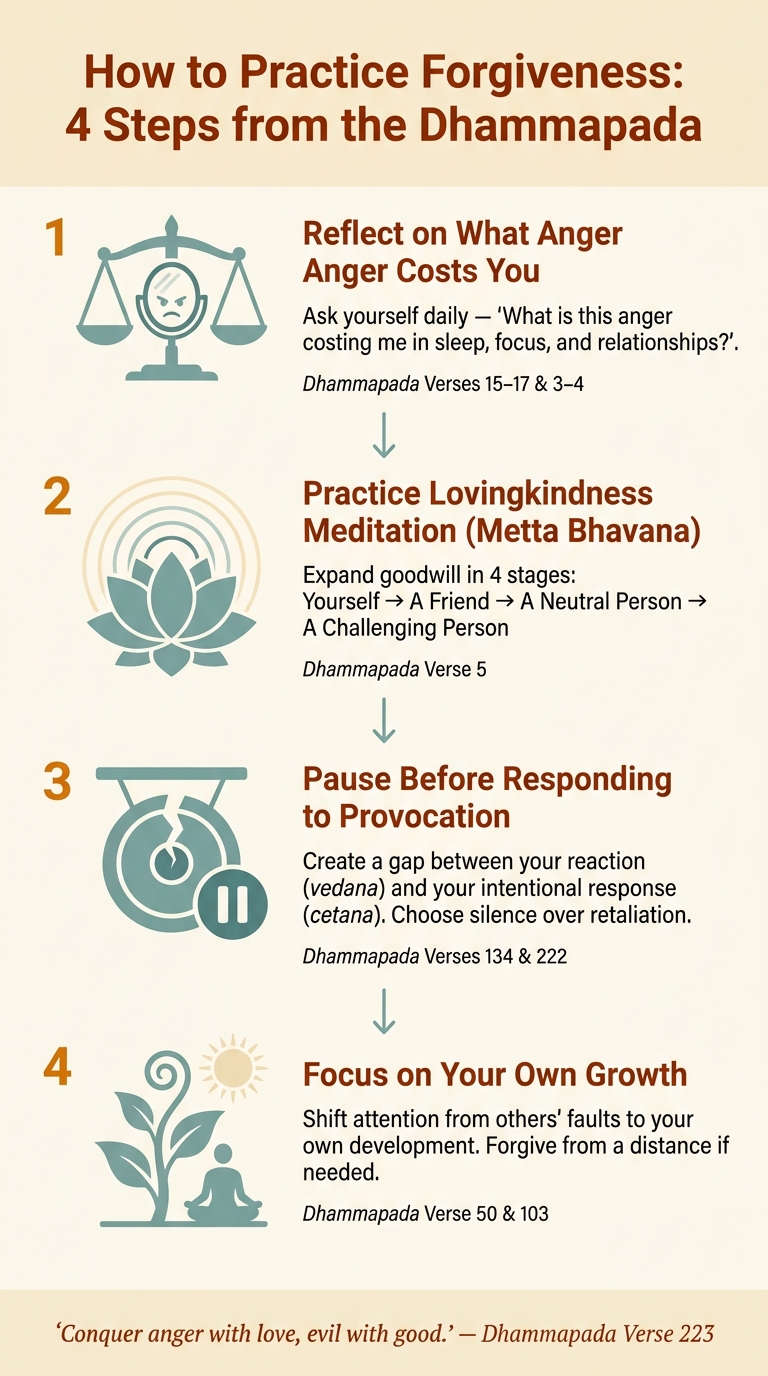
How to Practice Forgiveness: 4 Steps from the Dhammapada
Drawing from the teachings of the Dhammapada, these practices offer actionable steps to cultivate forgiveness in daily life.
Reflecting on What Anger Costs You
The Dhammapada emphasizes that holding onto anger harms you more than the person who wronged you. Verses 15–17 explain that anger burdens the individual carrying it, causing suffering now and in the future.
Take time each day to reflect on how anger affects you. When feelings of resentment surface, ask yourself: What is this anger costing me? Pay attention to how it impacts your sleep, focus, or personal relationships. Verses 3 and 4 highlight how replaying grievances over and over only deepens bitterness. Releasing such ruminations can help you break free from the grip of hostility.
Replacing Hatred with Lovingkindness
Verse 5 of the Dhammapada delivers a profound truth:
"Hatreds never cease through hatred in this world; through love alone they cease. This is an eternal law."
One way to live out this teaching is through metta bhavana, or lovingkindness meditation. This practice mirrors the Dhammapada's guidance to overcome hatred with love by gradually expanding your circle of goodwill:
- Start with Yourself: Cultivate compassion and kindness toward yourself. True warmth for others begins with self-compassion.
- Extend to a Friend: Direct kindness toward a friend who naturally inspires positive feelings.
- Include a Neutral Person: Focus on someone you feel neither strong affection nor aversion toward.
- Reach a Challenging Person: Offer goodwill to someone you find difficult to forgive, embodying the Dhammapada's call to conquer anger with non-anger.
This meditation doesn't ignore harm done but instead chooses to break free from the bitterness it creates.
Pausing Before Responding to Provocation
In Verse 222, the Dhammapada compares mastering anger to a skilled charioteer guiding a racing vehicle, while others merely hold the reins. When provoked - whether by harsh words, unfair criticism, or dismissive behavior - it advises taking a deliberate pause. Verse 134 illustrates this with a vivid metaphor:
"If, like a shattered metal plate (gong), thou utter not, then thou hast reached Nirvana; contention is not known to thee."
Like a broken gong that no longer sounds, silence can disrupt the cycle of anger. A brief pause - observing where tension arises in your body and resisting the urge to retaliate - can prevent new resentment from taking root.
Verse 399 adds another layer, describing the strength found in enduring insults with patience. It portrays this restraint as a powerful choice, not a sign of weakness. By choosing patience, you align with the Dhammapada's broader call for inner calm and peace. These steps not only help you manage anger but also guide you toward a more peaceful state of mind.
Bringing Forgiveness into Your Daily Routine
Forgiveness is something we cultivate through small, deliberate choices every day. The Dhammapada emphasizes this approach - not through dramatic gestures, but through habits that gradually transform how we respond to hurt. By weaving these practices into daily life, the timeless wisdom of the Dhammapada becomes a practical guide for modern living.
Reading and Reflecting on a Daily Verse
Begin your day with a single verse from the Dhammapada. This simple act can help center your mind on forgiveness and give you a fresh perspective for the day ahead. A single verse serves as a lens, helping you interpret and navigate the challenges that arise.
The Sutta 423 app is a great tool for this. It provides one verse from the Dhammapada each day, guiding you through all 423 verses over the span of a year. For example, if the verse of the day touches on themes like anger or patience, watch how these ideas play out in real-life situations - a frustrating email, a heated conversation, or even a moment of road rage. This practice makes forgiveness feel tangible and actionable.
Journaling to Work Through Resentment
Journaling can disrupt the cycle of anger by allowing you to process your emotions on paper. The Paṭhama āghātapaṭivinaya sutta outlines five approaches for letting go of resentment: cultivating loving-kindness, compassion, equanimity, disregarding the event, or recognizing the other person as responsible for their own actions.
One powerful exercise is to write down the phrase: "This person is the owner of their actions, heir to their actions - whatever they do, they will be the heir of those." This shift in perspective can move your focus away from retaliation and toward release. You might also journal about specific moments when you chose patience instead of reacting, reinforcing this positive pattern over time.
The Sutta 423 app also includes journaling features, making it easier to track how the daily verses influence your responses to conflict and irritation.
Applying Forgiveness in Common Situations
The Dhammapada’s teachings on forgiveness aren’t just meant for major betrayals - they’re equally relevant in everyday situations. Think about the small irritations: a dismissive comment from a coworker, a recurring disagreement with a family member, or the frustration of being cut off in traffic.
In these moments, try to create a pause between your immediate reaction (vedana) and your intentional response (cetana). Verse 50 of the Dhammapada offers a helpful reminder: focus on your own growth and shortcomings instead of fixating on others’ faults. And if a relationship feels toxic or harmful, forgiveness doesn’t mean staying in it. You can wish someone well from a distance, extending kindness without forcing reconciliation.
Conclusion: Building Inner Peace Through Forgiveness
The teachings of the Dhammapada provide a timeless guide to freeing ourselves from inner turmoil. Forgiveness, as emphasized, is not about granting a favor to someone else - it's about releasing yourself from the grip of resentment. Holding onto vera (hostility) only prolongs suffering, while letting it go breaks the cycle of pain.
The Dhammapada offers a practical and direct approach: resolve the inner battles fueled by anger and bitterness. Mindfully guard your thoughts, words, and actions, and respond to negativity with compassion. Verse 223 encapsulates this beautifully:
"Conquer anger with love, evil with good, greed with charity and falsehood with truth."
Similarly, Verse 103 provides a powerful reminder of where true strength lies:
"Greater in battle than the man who would conquer a thousand-thousand men, is he who would conquer just one - himself."
This verse highlights that genuine peace stems from mastering one’s own aversions, desires, and misunderstandings - a deeply personal and intentional journey.
Daily habits, such as reading a verse each morning, pausing before reacting, and actively practicing goodwill, can steadily pave the way to lasting inner calm. These small, consistent acts reinforce the wisdom of the Dhammapada, helping you cultivate resilience and peace. For added support, the Sutta 423 app delivers a Dhammapada verse daily, keeping these teachings alive and accessible in your everyday life.
FAQs
Does forgiveness mean I have to trust them again?
Forgiveness doesn’t automatically mean you have to trust the person again. In Buddhism, forgiveness focuses on releasing resentment and anger to bring emotional peace to yourself. Trust and reconciliation, on the other hand, are entirely different matters. They require effort from both sides and may not always be feasible. It’s possible to forgive someone within your heart without re-establishing the relationship or rebuilding trust, especially if doing so wouldn’t be healthy or appropriate.
How can I forgive if I still feel angry?
Forgiving while still feeling angry is about making a conscious choice to release resentment rather than letting it take over. The Dhammapada wisely reminds us that hatred cannot be overcome with more hatred. When anger surfaces, take a moment to pause, resist the urge to act on impulse, and embrace the practice of non-anger by choosing not to retaliate. Engaging in Metta meditation - which centers on cultivating loving-kindness for both yourself and others - can be a powerful way to break this cycle and free yourself from the grip of lingering bitterness.
What Dhammapada verses help with everyday conflicts?
The Dhammapada provides straightforward advice for handling everyday conflicts. Verses 3 and 4 highlight the importance of releasing resentment to put an end to hostility. Verse 5 takes it further, urging us to counter hatred with loving-kindness. Similarly, Verse 223 lays out a practical roadmap: overcome anger with love, combat evil with goodness, address stinginess with generosity, and counter lies with truth. These timeless lessons are brought to life daily through the Sutta 423 app.