
Dhammapada on Solitude: Key Lessons
Short, intentional solitude from the Dhammapada trains attention—one verse, minutes of silence, and a line of reflection.
Solitude, in the Dhammapada, is not about cutting people off. It is about training the mind. If I had to sum up the article in one line, it would be this: time alone helps only when it leads to calmer action, better choices, and steadier conduct.
Here’s the article in plain terms:
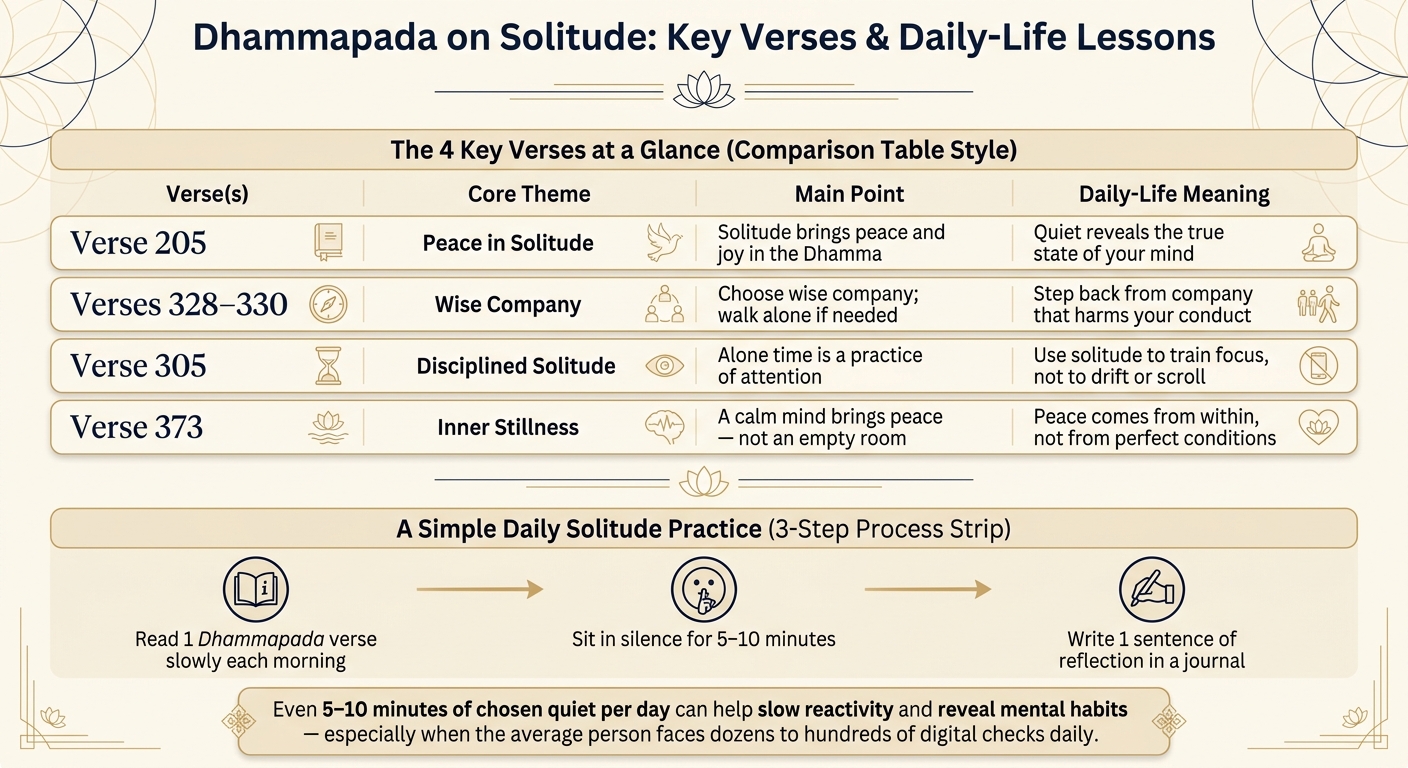
- Verse 205: I see solitude linked with peace, relief, and joy in the Dhamma.
- Verses 328–330: I’m told to keep wise company, avoid harmful company, and walk alone if that is the better option.
- Verse 305: I’m reminded that being alone is a practice of attention, whether sitting, walking, or resting.
- Verse 373: I see that a quiet place matters less than a settled mind.
- Daily use: I can keep this simple - 1 verse, 1 short period of silence, and 1 written line of reflection each day.
A few facts make this hit harder. The average person now faces dozens to hundreds of digital checks per day, and many adults report feeling stressed by constant connection. In that setting, even 5 to 10 minutes of chosen quiet can help me slow down and see my habits more clearly.
| Verse(s) | Main point | Daily-life meaning |
|---|---|---|
| 205 | Solitude brings peace | Quiet shows me the state of my mind |
| 328–330 | Choose wise company | If company harms conduct, step back |
| 305 | Practice alone with care | Alone time should train attention |
| 373 | Calm mind, calm space | Peace comes from the mind, not the room |
So the core message is simple: solitude is useful when it sharpens attention, protects conduct, and makes me less reactive later. The article then shows how to do that in normal life, even in a small apartment, on a commute, or in a busy home.
Dhammapada on Solitude: Key Verses & Daily-Life Lessons
Solitude: Its Advantages and Drawbacks in Buddhist Practice
Verse 205: The taste of peace in solitude
Verse 205 ties solitude to peace, relief from distress, and joy in the Dhamma. It treats solitude as practice in itself: a kind of quiet that lets you see the mind with more honesty and steadiness. This isn't about running from life. It's about making enough room to notice what's happening inside.
That’s why this verse lands so well in a time shaped by distraction, overwork, and the urge to fill every empty moment.
How quiet reveals the state of the mind
When the noise fades, the mind’s patterns stand out. You can see restlessness more plainly. And once you see that, peace is easier to notice too.
If stillness feels uncomfortable, that doesn’t mean you’re doing it wrong. It means you’re learning something. The discomfort is part of what quiet makes visible.
Applying verse 205 to distraction and overwork
One simple practice is to read a single verse slowly, then sit with it in silence for a minute. Sutta 423 supports that rhythm by sending one verse each day for quiet reading and reflection, without turning practice into another thing to chase.
The same care applies to the people you spend time with, the habits you repeat, and the places you put yourself in. Some settings support stillness. Others wear it down. Verse 205 shows the felt sense of solitude; the next verses turn to why wise company matters just as much.
Verses 328–330: Choose wise company or walk alone
Solitude shows you your own mind. Company, on the other hand, leaves its mark on how that mind develops. Verses 328–330 make the rule plain: stay close to wise people, leave harmful company, and if better company isn’t there, walk alone.
This isn’t a call to hide from the world. It’s about choosing what helps practice and what gets in its way. In that sense, companionship is a moral choice, not just a matter of liking certain people more than others.
Wise companionship, harmful company, and purposeful solitude
Wise company strengthens conduct and clears the mind. Harmful company does the opposite. It pulls attention outward, stirs confusion, and chips away at restraint.
And when good company can’t be found, solitude becomes the better path. Not because being alone is automatically higher or purer, but because it guards attention and protects conduct.
Modern examples: peer pressure, online habits, and unhealthy circles
You can see this in everyday life: friendships, work settings, and online spaces all shape habit. Online life makes the point fast. Some digital spaces train people to react all the time instead of reflect. The result is a restless mind, and that restlessness weakens the steady conduct practice depends on.
Stepping back from that kind of space isn’t failure. It’s self-protection.
So when company starts to erode conduct, these verses lean toward solitude. Then the next task is to bring discipline into that solitude.
Verses 305 and 373: Discipline, empty space, and inner stillness
Choosing solitude is one thing. Knowing how to use it is another. Verses 305 and 373 make a simple point: time alone helps only when your attention is steady and your mind is calm.
Verse 305: Sitting, walking, and resting alone with diligence
Verse 305 treats solitude as a practice, not a mood. Whether you are sitting, walking, or resting alone, the focus stays the same: be attentive, be composed, and don’t let the mind drift. Time alone is not just the lack of company. It is attention with purpose.
That lands hard in modern life. It’s easy for alone time to turn into withdrawal, distraction, or numb scrolling. Verse 305 points in another direction. Use solitude to get more grounded, not more distant. If your time alone leaves you clearer, steadier, and more deliberate, then it is doing its job.
Verse 373: Entering an empty dwelling with a settled mind
If verse 305 shows the method, verse 373 shows the result: the quiet that comes from a settled mind. An empty room by itself does not bring peace. A calm mind brings peace into the room.
That makes the teaching useful even in busy homes, small apartments, and packed schedules. You do not need perfect conditions before you begin. Work with the time and space you have. Settle the mind as best you can, so solitude supports inner quiet instead of becoming just a change of scenery.
A realistic solitude practice for modern life
These verses all point in the same direction. They become most useful when they turn into a small daily routine - something simple enough to repeat without much friction, and steady enough to keep your attention from drifting all over the place. The aim isn’t to step away from ordinary life. It’s to build a practice you can return to, so attention stays steady and your actions stay deliberate.
It can be very simple: one verse, a few quiet minutes, and one line of reflection.
A daily rhythm built around one verse and a few quiet minutes
In the morning, read one Dhammapada verse. Sit with it for a few quiet minutes. Then write one sentence in a journal about how it connects to something concrete in your day - a conversation, a habit, or a choice you need to make. After that, move into your day on purpose. That short rhythm can act like an anchor, helping you stay present and a bit more careful in how you respond.
Sutta 423 is a free app that delivers one Dhammapada verse a day for quiet reading and reflection. Its Echo feature repeats earlier verses later to reinforce memory and understanding.
Fitting solitude into apartments, family life, and work schedules
A quiet room helps, but you don’t need one. Use the space you already have. Even a commute can work. What matters most is intention, not having extra time.
If your space is shared, make the practice shorter. The goal is not to run from noise. The goal is to train inner steadiness right in the middle of it. One verse in the morning, carried with you through the day, is enough. What counts is showing up again and again over weeks. That’s what makes solitude something you can actually use in daily life.
Conclusion: Solitude that deepens peace and conduct
Taken together, these verses make one point clear: solitude matters only when it supports peace, sound judgment, and disciplined conduct. The real question isn't whether solitude feels pleasant. It's whether it changes how you live.
Quiet time helps when it leads to calmer responses, better decisions, and less reactivity. That's the test. Not the mood it creates in the moment, but the effect it has on your actions later.
The Dhammapada's answer is simple: make solitude regular, brief, and intentional. It presents solitude as a repeated discipline, not a retreat from life. Think small, steady intervals of quiet that train attention and shape conduct.
That makes solitude a practical discipline for any life.
FAQs
How is solitude different from isolation?
In the Dhammapada, solitude is a deliberate practice of self-discipline. It creates space for mindfulness, self-reflection, and inner calm. In that sense, it helps support tranquility and spiritual growth.
Isolation is different. It is usually not chosen, and it can bring loneliness or emotional pain. That kind of separation may get in the way of spiritual growth.
How can I practice solitude in a busy home?
Practice solitude as an act of self-discipline, not just as time away from other people. Pick one quiet place and return to it often - a chair, a corner, or even a small setup you can move from room to room. That steady place can help train your mind to settle.
If a quiet space isn't an option, build solitude internally through mindfulness. Come back to your breath to stay grounded. And in tense moments, choose silence when you can. Sometimes saying less is how you guard your inner peace.
How do I know if solitude is helping my conduct?
Pay attention to where your intentions come from. If your thoughts and actions grow out of understanding, contentment, and kindness, then solitude is serving you well. If they come from confusion, craving, and anger, solitude may be feeding distress instead.
Mindful reflection helps you spot these states as they show up. When you use solitude with purpose, rather than slipping into plain isolation, it can open up space for inner peace, clearer thinking, and less reactive behavior.