

Dhammapada Lessons on Choices
Daily choices shape your life—apply Dhammapada wisdom on mindfulness, intention, non-attachment, and wise speech.
The Dhammapada, a revered Buddhist text with 423 verses, offers practical guidance on mindful living and ethical decision-making. Its teachings emphasize how our thoughts, words, and actions shape our lives through the principle of cause and effect (karma). Here’s what you need to know:
- Mindful Awareness: Pause and observe your thoughts before acting. A well-trained mind leads to better choices and happiness.
- Intentional Actions: Decisions are shaped by intention, not just action. Choices grounded in compassion lead to positive outcomes.
- Non-Attachment: Avoid clinging to desires or outcomes. Letting go fosters clarity and balanced decision-making.
- Wise Speech: Words carry weight. Speak with care, and sometimes silence is the best choice.
- Long-Term Perspective: Short-term gratification often leads to regret. Think beyond immediate desires and consider lasting impacts.
These timeless lessons remain relevant today, helping us navigate challenges like stress, relationships, and digital distractions. By applying these principles daily, you can make better decisions and build a meaningful life. For daily inspiration, reflect on a verse at Sutta 423.
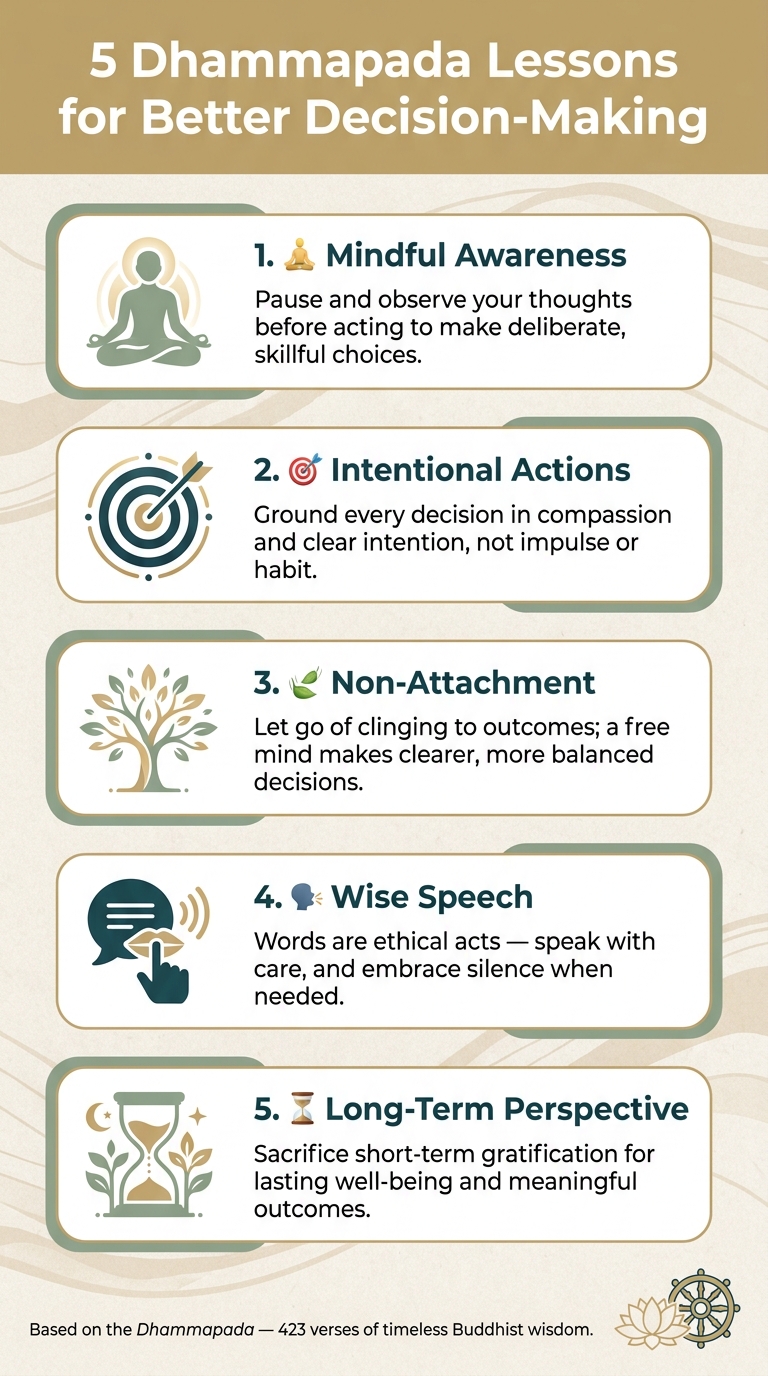
5 Dhammapada Lessons for Better Decision-Making
DHAMMAPADA Decoded: How Small Choices Shape Your Entire Life (Chapters 6-10)
1. Mindful Awareness
Pause and observe before making a move. This is a central idea from the Dhammapada, urging us to make thoughtful, deliberate choices.
The teaching highlights that the mind is at the heart of every action. Whether it's a life-altering decision or a minor everyday choice, our actions reflect the state of our mind. Imagine a house with no roof - just as it lets in rain, an unguarded mind leaves us vulnerable to impulsive reactions.
"Let the discerning man guard the mind, so difficult to detect and extremely subtle, seizing whatever it desires. A guarded mind brings happiness." - Acharya Buddharakkhita
Bodhipaksa, a Buddhist teacher and author, puts it simply: "When we have mindfulness we have choice. Without mindful observation of the mind, it's impossible for us to choose to act skillfully rather than unskillfully." Without this awareness, we often find ourselves running on autopilot, reacting without intention.
Much like a fletcher carefully crafts an arrow, training the mind requires focused effort. This effort not only sharpens our awareness but also lays the groundwork for deliberate, purposeful actions. In fact, the teachings suggest that a well-directed mind can prove to be a more valuable ally than even the closest family members. This foundation of mindful awareness prepares us to approach intentional actions with clarity and purpose.
2. Intentional Actions
Every decision we make carries a moral significance - and that significance stems from our intention, not just the action itself.
Intentional actions go hand in hand with mindful observation. The key here is having a clear motivation driving your choices. The Dhammapada highlights this concept through its definition of kamma (karma) as volitional action. In other words, intention is what shapes our experiences. Buddhist scholar and monk Bhikkhu Bodhi elaborates on this idea:
"Kamma means volitional action, action springing from intention, which may manifest itself outwardly as bodily deeds or speech, or remain internally as unexpressed thoughts, desires and emotions."
The focus should always be on the motivation behind your actions. Take a moment to reflect: Is your intention grounded in compassion (kusala), or does it stem from greed, anger, or confusion (akusala)? This is an important distinction because actions rooted in compassion and wisdom lead to happiness, while unskillful actions often result in pain and regret.
Building character is a gradual process. The Dhammapada reminds us that character is formed "drop by drop" through small, intentional decisions. Each deliberate choice you make contributes to who you become over time.
"It's good, the doing of the deed that, once it's done, you don't regret, whose result you reap gratified, happy at heart." - Dhammapada, Verse 68
3. Non-Attachment
Attachment clouds clear decision-making.
The Dhammapada describes non-attachment as being "unfettered" - a state of mind that resists being tied down by sensual pleasures, possessions, or the constraints of time and circumstances. Importantly, this teaching isn’t about becoming detached in a cold or indifferent way. Instead, it’s about making choices from a calm and steady mindset, free from the pull of craving.
A striking image from the text illustrates this principle: non-attachment is like a drop of water resting on a lotus leaf. The water doesn’t cling. As Verse 401 of the Dhammapada beautifully puts it:
"Like water on a lotus leaf, or a mustard seed on the point of a needle, he who does not cling to sensual pleasures - him do I call a holy man." - Dhammapada, Verse 401
When we attach ourselves to specific outcomes, relationships, or even our self-image, our choices can become reactive and overly limited. Peter Vredeveld, author and founder of Original Buddhas, explains this further:
"By letting go of attachment, individuals can better avoid the extremes of indulgence and denial, which can lead to suffering."
Non-attachment creates space for what the Dhammapada refers to as the Middle Way - a balanced path that avoids both clinging to desires and falling into extreme self-denial. In this balanced state, you’re free to explore fresh possibilities without feeling tied to protecting what you have or chasing after what you think you need. From this liberated perspective, it becomes much easier to choose words and actions that reflect clarity and balance.
4. Wise Speech
Every word carries weight.
The Dhammapada emphasizes that words are not just casual expressions; they are ethical decisions. Each word has the power to either illuminate or harm. Wise speech is highlighted as one of the three key actions - alongside mental and physical deeds - that must be refined on the path to enlightenment:
"Let a man be watchful of speech, well controlled in mind, and not commit evil in bodily action. Let him purify these three courses of action, and win the path made known by the Great Sage." - Acharya Buddharakkhita, Translator
This teaching aligns with the earlier discussions on mindfulness and intentional living, showing that thoughtful communication is a cornerstone of ethical behavior.
Less can mean more when it comes to words. Verse 258 reminds us:
"A man is not spiritually mature (or: learned) merely because he talks a lot. He is said to be spiritually mature who is secure (in himself), friendly, and without fear." - Dhammapada, Verse 258
True spiritual growth isn’t measured by how much someone speaks, but by the integrity and calmness behind their words.
The Dhammapada also advocates for silence as a powerful strategy, especially in moments of tension. Verse 134 offers this perspective:
"If, like a broken gong, you silence yourself, you have approached Nibbāna, for vindictiveness is no longer in you." - Dhammapada, Verse 134
Choosing silence in heated situations can prevent conflict and maintain inner peace. Just as mindfulness and intentional actions guide ethical living, wise speech helps us navigate daily life with clarity and compassion.
5. Long-Term Perspective
Quick gratification often comes with hidden costs.
The Dhammapada emphasizes that every decision we make carries consequences - some immediate, others that unfold over time. Verse 69 captures this idea vividly:
"As long as the evil deed done does not bear fruit, the fool thinks it is like honey; but when it ripens, then the fool suffers grief." - Dhammapada, Verse 69
In other words, chasing short-term pleasures may feel rewarding initially, but the aftermath can bring regret. Acting on fleeting impulses often leads to temporary satisfaction but leaves lasting discomfort or harm. Verse 71 drives this point further by highlighting how consequences may not be immediately visible:
"An evil deed, when done, doesn't - like ready milk - come out right away. It follows the fool, slowly emerging like hidden embers." - Dhammapada, Verse 71
This delay in outcomes reminds us to approach decisions with care and foresight. It aligns with earlier discussions on mindfulness, reinforcing the need to think beyond immediate desires and consider the broader impact of our actions.
The Dhammapada also teaches that sacrificing smaller, short-term pleasures can lead to enduring happiness. Verse 290 emphasizes this principle, while Verse 256 underscores the importance of weighing both benefits and drawbacks before making a choice:
"He is not a 'man of principle' who rashly judges what is advantageous. The spiritually mature person who judges both what is advantageous and disadvantageous... is said to be 'a man of principle'." - Dhammapada, Verse 256
True fulfillment doesn't come from a single wise decision but from consistently choosing actions that build a foundation for lasting well-being. Over time, these choices shape not only our happiness but also our character.
Conclusion
The Dhammapada's 423 verses, written over 2,500 years ago, still resonate deeply with the challenges we face today - whether in our jobs, relationships, or even in moments of solitude. Its central message is straightforward yet profound: you hold the power to shape your own life.
"We are the makers and masters of ourselves, the protectors or destroyers of ourselves, we are our own saviours and there is no one else who can save us." - Bhikkhu Bodhi, Buddhist Monk and Scholar
This perspective shifts accountability into a source of strength. It’s not about carrying a heavy burden - it’s about embracing your freedom. Every choice becomes a chance to favor clarity over harm. The Dhammapada doesn’t demand perfection; it encourages awareness. Whether it’s pausing before reacting, choosing generosity over self-interest, or thinking long-term instead of opting for a quick fix, these small, mindful actions build a meaningful life.
What keeps the Dhammapada so relevant today is its practicality. Scholars often compare its guidance to modern Cognitive Behavioral Therapy (CBT), which focuses on reshaping thought patterns to influence feelings and actions. You don’t need to retreat to a monastery to apply its teachings - just pay attention.
For those looking to bring this wisdom into their daily routines, Sutta 423 offers a simple approach: reflect on one verse each day. This small, consistent practice can sharpen your decision-making and weave mindfulness into every corner of your life.
FAQs
How do I pause before reacting in the moment?
The Dhammapada emphasizes that our minds play a central role in shaping our actions. By creating a brief pause before reacting, we can introduce a moment of awareness between the stimulus and our response. This could mean taking a deep, intentional breath or simply observing your thoughts and emotions without immediately acting on them. Such a pause allows you to respond with greater understanding and kindness, steering clear of impulsive reactions and encouraging more thoughtful, mindful choices.
How can I tell if my intention is skillful or unskillful?
To figure out if your intention is on the right path, ask yourself: Does it come from understanding, satisfaction, and kindness, which bring joy? Or is it driven by confusion, desire, and anger, which lead to distress? Mindfulness plays a key role here - it helps you notice these mental states and steers you toward choices that are ethical and beneficial.
What does non-attachment look like in real relationships?
Non-attachment in relationships is about loving freely, without the grip of clinging or possessiveness. It means being able to handle distance or separation without falling into distress. Often, attachment and craving can bring about feelings of fear and sorrow. By releasing these tendencies, you open the door to inner calm and balance. This mindset nurtures connections that are healthier and more harmonious.