

Dhammapada Lessons on Gratitude in Love
Apply Dhammapada wisdom to love: pause before reacting, speak truthfully, repair harm gently, hold boundaries, and read one verse daily.
Gratitude in love is not just a feeling. It is a way of acting when things get hard.
If I boil this article down, the message is simple: I show gratitude in love by pausing before I react, telling the truth, being kind without becoming passive, repairing harm in small steps, and keeping clear boundaries. The article also ties this to a daily reading habit: 1 verse a day out of 423 verses can help turn these ideas into steady action.
Here’s the full idea in plain terms:
- In conflict: I answer anger with calm, harm with care, stinginess with giving, and falsehood with truth.
- In daily life: I make gratitude visible through patience, honest speech, follow-through, and support.
- In close bonds: I do not treat love like debt or scorekeeping.
- In repair: I slow down, settle my body, and choose the least harmful next step.
- In boundaries: Gratitude does not mean accepting mistreatment or staying where I am unsafe.
- In reflection: A short 5–10 minute daily practice can keep appreciation from fading into habit or resentment.
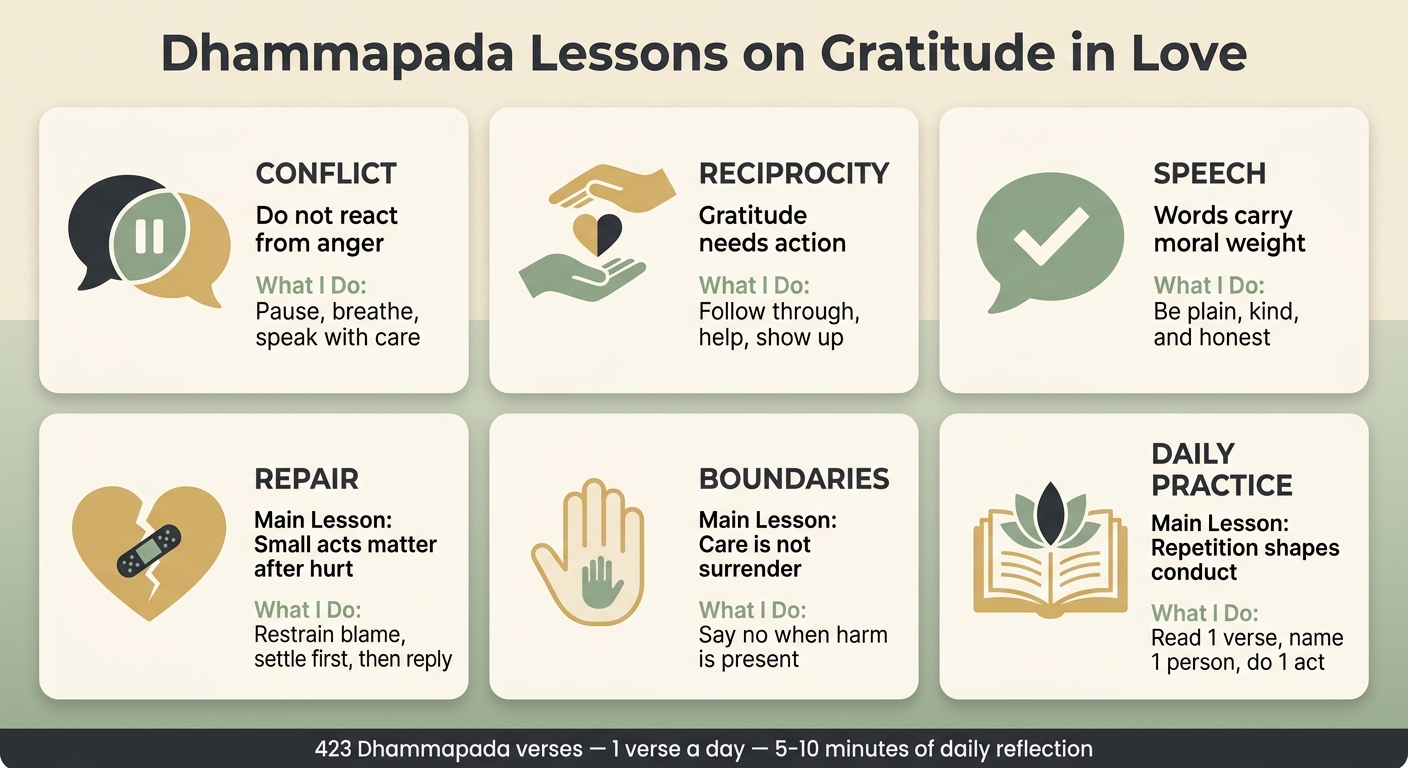
Dhammapada Gratitude in Love: 6 Core Areas at a Glance
Gratitude and Generosity Dharma Talk - Jack Kornfield
Quick Comparison
| Area | Main Lesson | What I do |
|---|---|---|
| Conflict | Do not react from anger | Pause, breathe, speak with care |
| Reciprocity | Gratitude needs action | Follow through, help, show up |
| Speech | Words carry moral weight | Be plain, kind, and honest |
| Repair | Small acts matter after hurt | Restrain blame, settle first, then reply |
| Boundaries | Care is not surrender | Say no when harm is present |
| Daily practice | Repetition shapes conduct | Read 1 verse, name 1 person, do 1 act |
What I like here is that the article does not turn gratitude into flattery, silence, or people-pleasing. It keeps the focus on love with truth, patience, and moral discipline - especially when emotions run high.
Overcome Anger With Love, Truth, and Generosity
Conflict is where gratitude turns into action. It matters most when someone you love has hurt you. That’s the test: gratitude in love has to hold up in conflict, not just in calm moments.
What Verse 223 Offers During Conflict
Dhammapada verse 223 gives four plain pairings: overcome anger with non-anger, overcome harm with goodness, overcome stinginess with generosity, and overcome falsehood with truth. In a relationship, that’s not abstract advice. It’s a set of redirects for the exact moment you’re about to say something you may regret later.
Each response points you back to ethical action, even when emotions are running hot.
| Conflict Element | Verse 223 Remedy | Practical Application |
|---|---|---|
| Anger | Non-anger / Love | Pause and respond with calm kindness. |
| Harm | Goodness | Choose a response that reduces harm rather than retaliating. |
| Stinginess | Generosity | Offer presence or forgiveness instead of withdrawing. |
| Falsehood | Truth | Speak clearly and honestly about feelings without manipulation. |
Goodwill does not mean you have to accept harm.
When anger is met with restraint, gratitude has room to move from raw reaction into steady care.
A 4-Step Pause Before Reacting
When a disagreement flares up, the space between feeling and response is where this verse starts to help. A short pause can stop the automatic reaction before it leaves a mark.
- Pause - Take three slow breaths and notice where your body is holding tension. Stay there long enough to choose what comes next.
- Recognize - Name one specific kindness you have received from the other person.
- Reflect - Separate what actually happened from the story your mind is building around it. Ask: what are the facts here, and what am I adding?
- Respond - Choose the least harmful action. That may mean speaking honestly, offering presence, or simply not saying the thing that would make it worse.
This moves you from reaction to intention. After conflict, gratitude should show up as everyday reciprocity.
Turn Appreciation Into Ethical Reciprocity
After restraint in conflict, gratitude needs a positive form: a way to respond to help or care you’ve received. This teaching breaks gratitude into two parts. Kataññutā means recognizing a benefit received. Kataveditā means responding with fitting action. In plain terms, gratitude isn’t just something you feel. It shows up in what you do.
That recognition does not mean you have to stay in an unsafe relationship. Loving-kindness can still include clear, firm boundaries.
From Inner Appreciation to Outward Care
Recognition becomes real when it moves into action. If you notice a partner’s effort or sacrifice, that awareness can take shape in simple, direct ways. You might say it out loud. You might follow through on something you promised. Either way, the point is the same: appreciation should be visible, not locked away as a private feeling.
How Gratitude Looks in Romantic, Family, and Friendship Bonds
That response changes with the relationship, but the moral pattern stays the same. In romantic relationships, it means being dependable and present without clinging. In family relationships, especially with parents, the teaching points away from paying them back in a material sense and toward helping their growth in generosity, virtue, and wisdom. In friendships, good friendship built on honesty and shared values frames reciprocity as honest help freely given, without keeping score.
Intention matters here. Reciprocity rooted in care feels very different from reciprocity driven by pressure, guilt, or debt.
Recognition, Thanks, Reciprocity, and Support: A Comparison
These four layers help separate real gratitude from empty politeness.
| Aspect of Gratitude | Purpose | Healthy Expression | Distortion to Avoid |
|---|---|---|---|
| Recognition | Awareness of benefit received | Notice effort | Take it for granted |
| Thanks | Verbal acknowledgment | Say it plainly | Use it to flatter |
| Reciprocity | Practical action in response | Follow through | Keep score |
| Support | Compassionate presence | Help with boundaries | People-please |
Each layer takes gratitude one step further: notice, thank, act, and support without turning care into a transaction. The next step is to bring that same practice into speech and daily conduct.
Practice Loving-Kindness Through Speech and Daily Conduct
Once gratitude turns into reciprocity, you usually hear it first in the way someone speaks. It stops being just a private feeling and starts showing up in daily conduct.
"Mind precedes all mental states. Mind is their chief; they are all mind-wrought. If with a pure mind a person speaks or acts, happiness follows him like his never-departing shadow." - Dhammapada, Verse 2
So gratitude has to come through in speech that is honest and grounded, not just in silent feeling.
Speak Appreciation Clearly and Truthfully
Say thank you in a plain, kind, timely way. Clear appreciation often means more than ornate words. You don't need embellishment for sincerity to land.
Use Patience and Generosity Without Losing Boundaries
Patience can keep a relationship from sliding into reaction and heat. Generosity can support that patience, but it still needs balance, restraint, and healthy boundaries. The point is not to take harm without limit. The point is to respond without adding more anger to the moment.
Repair After Hurt With Small Ethical Actions
When hurt comes up, repair often starts with restraint, not explanation.
After hurt, pause before speaking. Drop the story that "he hurt me"; it feeds resentment. Keep criticism impersonal - blame is universal, so not every criticism needs to feel personal. Before you reply, take one slow 4-4-8 breath cycle.
| Scenario | Dhammapada Wisdom | Practical Action |
|---|---|---|
| Argument | Verse 222 - self-mastery | Pause and control the urge to react impulsively |
| Persistent resentment | Verse 5 - Non-hatred | Drop the story that "he hurt me"; it feeds resentment |
| Criticism | Verse 227 - Universal Blame | Blame is universal; don't personalize every criticism |
| Agitation | Verse 233 - Mental Guard | Settle the body before replying |
Rejoice in Another Person's Goodness and Build a Daily Reflection Habit
After restraint and repair, gratitude can grow into something larger: taking joy in another person's goodness. It isn't just about fixing harm. It's also about being glad for someone else's effort, kindness, and growth even when there's nothing in it for you.
Appreciation Versus Flattery or Possessiveness
Sincere appreciation is plain and honest. It notices a person's patience, effort, or kindness and names it without trying to get something back.
Flattery is different. It stretches the truth, or it picks certain traits to win favor or dodge tension. Possessiveness is quieter, but it can be just as distorting. On the surface, it may look like admiration. Underneath, though, it's more about keeping someone near than honoring who they are.
Rejoicing in another person's goodness means you can feel glad when your partner grows in a way that doesn't revolve around you, when a friend does well at something you found hard, or when a family member gets praise that never came your way.
A 5–10 Minute Daily Dhammapada Reflection
Once appreciation becomes clear, daily reflection helps turn it into a habit. Read one verse slowly. Let it sit for a moment. Then name one person whose care has helped you.
Next, notice what gets in the way of appreciation: irritation, pride, resentment. Don't dress it up. Just name it plainly, then choose one small, truthful act of care for that day.
With 423 verses, the Dhammapada fits a one-verse-a-day rhythm that can carry you through the year and past it. The Sutta 423 app is free to download and use for daily verses. Use it as a steady rhythm, not one more task hanging over your head.
That short daily pause keeps gratitude alive in ordinary relationships, not only during conflict.
Conclusion: Core Lessons on Gratitude in Love
Gratitude in Buddhist practice is not passive. It is active, ethical, and relational. You can see it in how you speak, how you repair, how you receive another person's goodness, and how you set limits without turning cold. Love grows through truth, patience, and generosity, but appreciation should never erase the boundaries that keep a relationship honest and safe. A steady daily reading habit - even five minutes with a single verse - can help turn these teachings from ideas into lived behavior.
FAQs
How is gratitude different from people-pleasing in love?
In Buddhist teachings, gratitude means noticing, with care, the kindness and support that come your way. It helps steady your sense of right action, brings inner peace, and deepens your connection with other people.
People-pleasing is different. It often grows out of a need for approval or a wish to avoid conflict. Gratitude comes from wisdom and humility. People-pleasing, on the other hand, can push you into reactive choices that blur your judgment and hold back spiritual growth.
What should I do if gratitude and boundaries feel in conflict?
When gratitude and boundaries seem to pull in opposite directions, it helps to remember one simple thing: gratitude does not mean you have to accept harm, excuse bad behavior, or ignore your own well-being.
The Dhammapada points toward clear boundaries held without anger. You can say no, step back, or protect your space without bitterness. That’s the heart of it.
Responding with compassion instead of hostility can help you protect your peace while staying aligned with your values.
How can one Dhammapada verse a day change a relationship?
Reflecting on one Dhammapada verse each day can change a relationship in a simple but powerful way. It creates a mental pause. That pause gives you a chance to stop an impulsive reaction before it turns into harsh words, and to meet tension with more patience and understanding instead.
Over time, this daily habit can shift your attention away from what feels missing and toward your partner’s kindness. Little by little, that means more mindfulness, less resentment, and a calmer, more compassionate connection.