

10 Lessons From Dhammapada for Daily Life
Ten practical Dhammapada lessons to train your mind, reduce stress, and build daily mindfulness.
The Dhammapada, a revered Buddhist text with 423 verses, offers timeless wisdom for navigating everyday life. Its teachings focus on practical steps to improve mindset, relationships, and inner peace. Here are the 10 key lessons you can apply daily:
- Your Mind Shapes Your Experience: Your thoughts determine how you perceive challenges. Train your mind to shift perspectives for healthier reactions.
- Accepting Impermanence: Stress often comes from resisting change. Embrace life's constant shifts to let go of unnecessary worry.
- Choosing Words With Care: Thoughtful speech builds trust and harmony. Avoid lying, harshness, or divisive language.
- Practicing Patience: Anger harms you more than others. Respond with calmness to maintain inner balance.
- Taking Responsibility: Growth comes from consistent effort and owning your actions. Small, daily steps matter.
- Staying Present: Mindfulness helps reduce anxiety. Focus on the present moment instead of dwelling on the past or future.
- Positive Influences: Surround yourself with people who inspire growth and avoid those who encourage negativity.
- Finding Peace in Simplicity: Let go of material and emotional attachments to cultivate clarity and contentment.
- Acting With Compassion: Treat others kindly and avoid causing harm, even in small, everyday interactions.
- Steady Practice for Growth: Transformation happens through regular, intentional actions.
These lessons are not about perfection but about small, meaningful changes that enhance your daily life. Whether it’s training your mind, choosing your words carefully, or practicing mindfulness, the Dhammapada offers a guide to living with greater balance and peace.
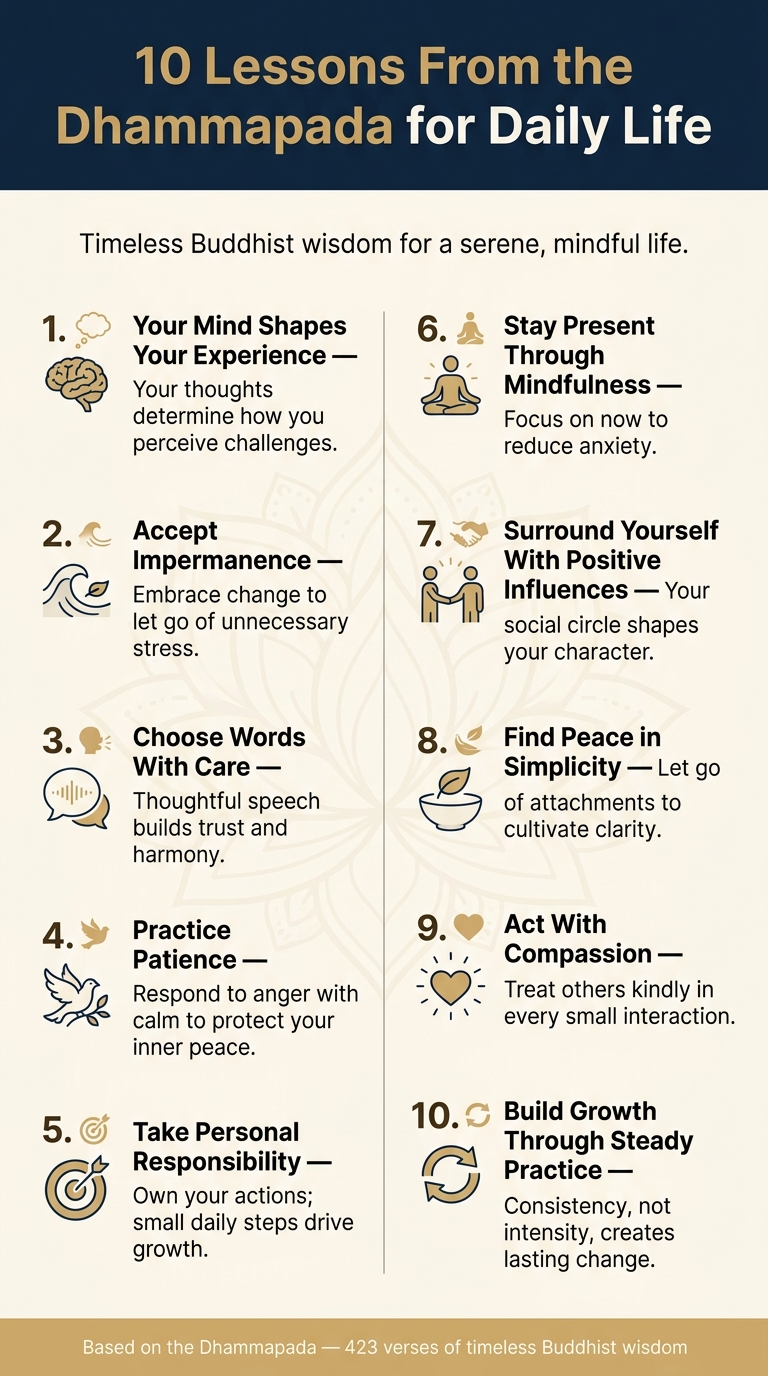
10 Lessons From the Dhammapada for Daily Life
Changing Your Life with Buddhism | The Dhammapada
1. Your Mind Shapes Your Experience
The Dhammapada begins with a powerful insight: your mind is the foundation of everything you go through. This idea plays out in the most ordinary moments, whether it’s dealing with a tricky email at work or navigating personal conflicts. Before anything is said or done, your mind sets the stage.
"Mind is the forerunner of all actions. Every deed is led and created by the mind. If one speaks or acts with a corrupt mind, suffering follows, as the wheel follows the hoof of the ox." - Gautama Buddha
Take, for example, a terse email from a coworker. Two people might read the exact same message but react in completely different ways. One might feel criticized and stew over it all day, while the other shrugs it off as direct but harmless and moves on. The email itself doesn’t change - it’s how your mind interprets it that shapes your experience.
The Dhammapada also highlights the risks of leaving the mind untrained. An unsteady mind tends to dwell on past hurts, blow small issues out of proportion, and create unnecessary anxiety. But the text reassures us that the mind can be trained. Like a fletcher straightening an arrow, consistent effort can reshape your mental habits.
This teaching challenges you to shift your perspective. Instead of asking, “Why is this happening to me?”, try asking, “What mindset am I bringing to this situation?” Small, steady changes in how you think can lead to profound shifts in how you handle stress, resolve conflicts, and build stronger connections.
2. Accepting Impermanence to Let Go of Stress
Let’s explore how your mind not only shapes experiences but also influences attachments. Embracing change is just as important for mindfulness as nurturing a positive outlook. The Dhammapada reminds us that all conditioned things are impermanent - and holding onto people, outcomes, or situations as if they’ll last forever is often where stress begins. This understanding invites you to loosen your grip on expectations, making it easier to handle life’s daily hurdles.
"All conditioned things are impermanent. When one sees this with wisdom, one turns away from suffering. This is the path of purification." - Dhammapada (vv. 277-279)
Think about a time when a project went off track or a plan fell apart. The frustration you felt likely wasn’t caused by the change itself but by resisting it. Buddhist meditation teacher Scott Tusa explains it well: "Impermanence is a key to unlocking fluidity and letting go. It allows us to prioritize what truly matters and stop wasting energy on things that don't."
Here’s the key: detachment isn’t about indifference - it’s about perspective. It doesn’t mean you stop caring; it means you stop seeing every setback as the end of the road. When challenges arise, remind yourself that they’re temporary and bound to shift over time.
Take a moment to quietly observe your emotions. Notice how frustration or worry naturally rises and fades. Simply recognizing this ebb and flow can help reduce the hold any stressor has over you.
3. Choosing Words With Care
The way we use language has a profound impact on our interactions. Just as managing thoughts and stress helps us navigate life’s changes, the words we choose shape how others perceive and experience us. The Dhammapada offers a timeless insight: speech mirrors the mind. If your words stem from inner chaos, they can lead to conflict. But when they reflect clarity, they foster harmony. In the same way that mental clarity brings inner peace, thoughtful speech can strengthen - or weaken - the connections we share.
"If one speaks or acts with a pure mind, happiness follows, like a shadow that never leaves." - The Buddha
The Dhammapada also warns against four damaging speech habits: lying, divisiveness, harshness, and idle chatter. These habits, though seemingly small, can erode trust over time. A quick, thoughtless remark to a coworker or an impatient comment to a loved one might seem trivial in the moment, but such patterns shape how others see us - and how we see ourselves. As Matthew Abrahams, a Stanford lecturer, puts it: "Mastering our minds begins with mastering our mouths." In tense situations, taking a moment to pause and consider whether your words will help or harm can make all the difference. This practice ties directly to mindfulness, reinforcing earlier lessons about cultivating inner clarity.
Adopting two straightforward habits can improve your communication. First, begin each morning by setting a quiet intention for how you’ll communicate throughout the day. Second, at the end of the day, reflect on your interactions: Were you truthful? Did your words unintentionally hurt someone? Use this reflection not as a source of guilt but as an opportunity to recognize and adjust unhelpful patterns. Over time, this daily practice can transform mindful speech into a natural part of your life.
4. Practicing Patience and Letting Go of Anger
Stopping anger in its tracks is as much about self-preservation as it is about maintaining harmony with others. The Dhammapada offers a powerful image to illustrate this: harboring anger is like holding a burning coal - it harms the one holding it far more than anyone else. This shifts the perspective on anger from being just a social issue to recognizing it as a deeply personal one.
A striking metaphor in the text compares anger management to a charioteer guiding a swerving chariot. Simply holding the reins isn’t enough; true control comes from actively steering. Without this deliberate effort, emotions take over, leaving us at their mercy.
"He who checks rising anger as a charioteer checks a rolling chariot, him I call a true charioteer. Others only hold the reins." - Acharya Buddharakkhita, Translator
This wisdom emphasizes responding to anger and unkindness with calm and kindness. It’s not about passively enduring mistreatment but summoning the inner strength to choose a measured, constructive response.
Patience, as described here, is not limited to controlling visible actions or words - it extends to managing the internal dialogue where anger often lingers the longest. When frustration begins to bubble up, take a moment to identify the root cause and interrupt the cycle before it spirals further. Practicing this daily can help defuse anger before it disrupts your relationships or peace of mind.
5. Taking Consistent Action and Personal Responsibility
Personal growth starts and ends with you. Your actions - and your willingness to take responsibility for them - shape your progress. As the Dhammapada puts it:
"The self is the master of the self. Who else could be the master? With a well-trained self, one gains a master hard to find." - The Buddha, Dhammapada Verse 160
Blaming others or external circumstances only stalls progress. Owning your choices, however uncomfortable, creates the momentum needed to move forward.
The text also reminds us that doing what’s right often requires effort:
"Easy to do are things that are bad and harmful to oneself. What is good and beneficial is extremely hard to do."
This rings true for many of us. It’s far easier to procrastinate, distract ourselves, or avoid challenges than to engage in the hard work that leads to real growth.
This idea of personal accountability ties directly to the importance of building habits that last. The Dhammapada emphasizes that meaningful progress happens gradually, not all at once. Small, consistent actions add up over time:
"Drop by drop is the water pot filled. Likewise, the fool, gathering it little by little, is filled with evil."
The same principle applies to positive habits. Even dedicating 20 minutes a day to a meaningful practice can lead to more growth than waiting for the “perfect” time to start. Consistency, not intensity, is what builds lasting change - whether you’re working on self-discipline, focus, or any other skill.
A simple way to incorporate this wisdom into daily life is to end each day with a quick reflection. Identify one moment when you acted with intention and one when you didn’t. The goal isn’t to judge yourself but to build awareness. This small habit of self-review mirrors the gradual, intentional progress the Dhammapada highlights as the cornerstone of meaningful transformation.
6. Staying Present Through Mindfulness
Anxiety often stems from replaying past events or worrying about what’s to come, rather than focusing on the here and now. The Dhammapada captures this idea perfectly:
"Whatever an enemy might do to an enemy, or a foe to a foe, the ill-directed mind can do to you far worse." - The Buddha, Dhammapada
This timeless teaching reminds us that an undisciplined mind can become our greatest adversary. The text describes the mind as restless and challenging to manage, emphasizing the importance of steady focus and deliberate effort to maintain control.
This is where mindfulness comes into play. The Dhammapada introduces the concept of Appamada, which translates to mindfulness, and dedicates Chapter 2 to its significance. In this chapter, mindfulness is described as "the path to the deathless", while negligence is equated with "the path to death". These words underscore the life-changing power of staying present.
Incorporating mindfulness into daily life doesn’t require drastic changes or extended meditation retreats. Even something as simple as pausing for three slow, intentional breaths during moments of stress can help you regain composure and respond thoughtfully. These small actions make mindfulness approachable and effective, especially in today’s fast-paced world.
To ease into this practice, you might start your mornings by reading a single verse from the Dhammapada. Let its wisdom guide your mindset for the day. For added convenience, the Sutta 423 app delivers a daily verse, offering a brief but meaningful moment for reflection without feeling overwhelming.
7. Surrounding Yourself With Positive Influences
The people you spend time with have a profound impact on your character. The Dhammapada explains this as a kind of psychological osmosis - our minds naturally absorb the behaviors, attitudes, and values of those around us. It likens the mind to a chameleon, adapting to its environment: spending time with individuals who exhibit harmful traits can subtly shape your own character, while surrounding yourself with thoughtful and grounded people fosters personal growth. Just as your inner thoughts influence your actions, your social circle plays a key role in your journey toward mindful living.
Bhikkhu Bodhi eloquently captures this idea:
"The human mind... remains a highly malleable entity continually remolding itself in response to its social interactions."
The Dhammapada offers straightforward advice:
"Don't associate with bad friends. Don't associate with the low. Associate with admirable friends. Associate with the best." - Dhammapada, Verse 78
In practical terms, this means assessing whether the people in your life encourage growth or lead you toward distraction. The Buddha emphasized that bad friendships can cultivate harmful qualities, while good friendships (kalyanamittata) provide essential support for developing positive traits.
8. Finding Peace Through Contentment and Simplicity
What you pursue in life deeply influences your inner state. The Dhammapada puts it plainly: greed is like a fire - it continues to consume until you decide to stop fueling it.
"There is no fire like greed, no illness like hatred, no suffering like the aggregates of existence, no happiness higher than peace." - Dhammapada
This wisdom opens the door to a life grounded in simplicity and peace.
"Make the boat light, bhikku! Emptied, it will travel swifter." - Dhammapada
This doesn't mean you must give everything away. Instead, it’s about understanding that attachments - whether material or emotional - sap energy that could be used to cultivate clarity and inner calm.
The Dhammapada emphasizes that simplicity is something you nurture in every aspect of life: your thoughts, words, and actions. Living simply might look like being fully present in the moment, speaking only when it adds value, and letting go of grudges or excessive worries about the future. This approach strengthens the mindful awareness that lies at the heart of all the teachings in the Dhammapada.
"No malice, no injury, disciplined eating and behaving, high thinking and simple living – this is the teaching of the enlightened ones." - Dhammapada
Contentment, as described here, isn’t about giving up or settling for less. Instead, it’s an active acknowledgment that you already have enough. The endless pursuit of “more” only stirs up restlessness, while contentment brings a quiet sense of fulfillment and peace.
9. Acting With Compassion and Avoiding Harm
The Dhammapada offers a simple yet profound guideline for how we should treat others: use yourself as the measure. Everyone values their life and fears pain. Recognizing this shared human experience lays the groundwork for compassion. Just like mindfulness shapes our personal choices, extending that same care to how we interact with others nurtures a life rooted in kindness.
"All tremble at violence; all fear death. Putting oneself in the place of another, one should not kill nor cause another to kill." - Dhammapada, Verses 129–130
This teaching doesn't just apply to extreme situations - it’s equally relevant in the small, everyday moments. Whether it's resisting the urge to send a sharp email, staying calm during a frustrating commute, or letting go of a lingering grudge, compassion is woven into how we react to life's minor conflicts.
Compassion isn't about dramatic, heroic acts. It grows through small, steady efforts - listening without interrupting, choosing not to escalate a heated exchange, or offering a kind word when it might feel easier to stay silent. These seemingly small choices create a ripple effect in how we connect with others.
A practical way to nurture this mindset is through metta, or loving-kindness meditation. This practice involves consciously sending goodwill to others, even those who may frustrate or challenge you. Simple phrases like "May you be safe, peaceful, and free of suffering" can help shift your perspective and interrupt the impulse to react with anger or frustration. Over time, this practice fosters a more measured, compassionate response.
"One who conquers anger by non-anger, who conquers evil by good, who conquers the miser by generosity, and the liar by truth: that one I call a brahmin." - Dhammapada, Verse 223
In this way, avoiding harm is not just about holding back from negative actions. It becomes an active practice of integrity, one that strengthens relationships quietly yet powerfully.
For more daily inspiration, consider reflecting on the Dhammapada verse found in Sutta 423.
10. Building Growth Through Steady, Daily Practice
This lesson emphasizes the power of consistent, small actions in driving personal growth. True transformation doesn't happen overnight - it’s the result of steady, incremental progress over time.
"Drop by drop is the water pot filled. Likewise, the fool, gathering it little by little, is filled with evil." - Dhammapada
The message here is clear: every small, mindful effort adds up. Whether it's practicing patience, honesty, or self-restraint, these daily actions gradually shape who we are. The Dhammapada uses the analogy of a fletcher straightening an arrow to illustrate how gentle, consistent effort leads to meaningful and lasting change. On the other hand, trying to force growth through intensity often leads to resistance or burnout.
Another profound teaching from the Dhammapada reminds us: "We ourselves must make the effort, for the Buddhas only point out the way." This reinforces the idea that sustainable growth comes from our own steady, intentional actions.
A simple way to incorporate this philosophy into daily life is to establish a rhythm of reflection. For example, start your morning by reading a single verse and end your day by asking yourself reflective questions like, "What went well today? What could I improve tomorrow?" These small habits build resilience over time. Tools like the Sutta 423 app can help by delivering one Dhammapada verse each day, allowing for quiet contemplation throughout the year.
The key is consistency, not intensity. By embracing small, manageable steps each day, you can nurture meaningful and lasting change.
Conclusion
Rooted in practical challenges faced in everyday American life, these teachings offer straightforward ways to improve how we think and act. The ten lessons from the Dhammapada serve as a practical guide for daily living - addressing how to shape your mindset, adapt to change, communicate effectively, handle frustration, take accountability, stay present, choose supportive relationships, embrace simplicity, show compassion, and encourage personal growth. Together, they provide tools for reducing stress, building stronger relationships, and cultivating mindfulness.
One way to internalize these lessons is by dedicating each day of the week to a specific focus - starting with mindset on Monday and ending with steady practice on Sunday. At the end of the week, take just ten minutes to reflect: Which lesson felt easiest to apply? Which one challenged me the most? Often, the areas that feel most difficult are the ones that deserve more attention. This routine keeps these teachings woven into your daily life.
The idea of self-mastery runs through this entire framework. What makes it so effective is its simplicity. You don’t need to make sweeping changes to see the benefits - reading a single verse in the morning can influence how you handle a tough conversation, navigate a hectic commute, or manage moments of self-doubt. For added support, the Sutta 423 app cycles through all 423 verses over the course of a year, making it easy to integrate this practice into your day.
The Dhammapada is designed for ongoing reflection. As Bhikkhu Bodhi, a respected monk and author, describes it: it is "the scriptural kalyanamitta [spiritual friend] par excellence, a small embodiment in verse of the boundless wisdom and great compassion of the Master." This wisdom isn’t about striving for perfection - it’s about taking small, daily steps to nurture inner growth and stay aligned with your values.
FAQs
How do I apply a Dhammapada verse to my day in under 5 minutes?
To bring a Dhammapada verse into your day in less than 5 minutes, start by selecting a verse using the Sutta 423 app. Find a quiet moment where you won’t be disturbed, then read the verse slowly and thoughtfully. Take a moment to reflect on its meaning and how it connects to your current thoughts or actions. This simple practice encourages mindfulness and helps weave the Dhammapada's teachings into your daily routine with ease.
What’s the difference between detachment and not caring?
Detachment, as described in the Dhammapada, involves mindfully releasing attachments to outcomes or desires while staying anchored in compassion and clarity. This practice nurtures inner peace and cultivates wisdom. On the other hand, not caring often stems from indifference or an unwillingness to take responsibility. Unlike detachment, it lacks the awareness and compassion needed for meaningful connection. While detachment promotes understanding and empathy, not caring can create barriers to personal growth and harm relationships.
How can I practice patience when someone is being rude or unfair?
To cultivate patience, it's essential to understand that negativity can't be resolved by adding more negativity to the mix. Instead, try to face challenging situations with love and a calm mindset. Keep in mind that anger and judgment often lead to more pain and frustration. By opting for compassion and understanding, you can disrupt the cycle of negativity and create a sense of peace within yourself.