

Dhammapada Insights for Inner Peace
Use one Dhammapada verse a day with 5-minute practices, notice triggers, train attention, speak with care, and loosen attachment.
I start with one verse, one action, and 5 minutes a day - not a demand to feel calm. My aim is to notice my reactions, reduce harm, and loosen my grip on outcomes.
The Dhammapada’s 423 verses across 26 chapters guide four habits I can practice:
- Pay attention: Notice a trigger before acting.
- Train the mind: Recognize my mental state and choose my response.
- Act with care: Speak truthfully and avoid hurtful words.
- Let go: Accept change without giving up duties or boundaries.
For daily reading, I can use Sutta 423, keep track of the verse and translator, and review what I did that evening. I keep <u>the Buddhist teaching separate from modern practice tools</u>, such as breathing pauses and journaling.
My measure of progress? Less harm and a better response - not perfect calm. These practices support reflection, not a replacement for professional care.
Checklist for Heedfulness and Mind Training
Practice Heedfulness: Verses 21–32
Appamāda means heedful vigilance: paying attention to the consequences of thought, speech, and action. It’s not just productivity or passive presence. Verse 21 contrasts heedfulness with heedlessness and points to the Deathless - understood here as Nibbāna, not bodily immortality.
For each practice, briefly record the trigger, your response, and what helped. Aim for a better response, not perfect calm.
- Verse 21 - Notice an automatic behavior. Name what you’re doing and what prompted it.
- Verses 22–24 - Give one task full attention for 5–10 minutes, noticing any distractions.
- Verses 25–27 - Set a safeguard. Take three natural breaths before acting on an impulse. Ask what’s driving it.
- Verses 28–32 - Check the choice. Note whether the pause changed your response and which safeguard helped.
Once you see the trigger, turn your attention to the mind that produced it.
Train the Mind: Verses 33–43
Use that same pause to observe the mind itself. Briefly record the trigger, your choice, and whether harm decreased.
- Verses 33–34 - Name the mental state without judging yourself. Verse 33 compares training the restless mind to a fletcher straightening an arrow: repeated adjustment matters.
- Verses 35–36 - Return gently. Take three slow breaths, then redirect your attention. This is a modern application, not a direct instruction in the verses or a promise to erase difficult thoughts.
- Verses 42–43 - Choose a constructive response and check its effect. These verses contrast a misdirected mind with a trained one. Before responding, pause, clarify, or speak in a measured tone. Afterward, check whether you recognized the trigger earlier and reduced harm.
Checklist for Ethical Conduct and Letting Go
Speak With Care and Reduce Harm: Verses 183, 224, and 233
After training your attention, put it to work in speech and conduct.
Verse 183 describes ethics as avoiding harm, doing good, and purifying the mind. Verses 224 and 233 add truthful speech and self-correction. Use these teachings to reduce conflict and regret.
Measure success by less harm, not immediate calm.
Before sending a tense work email:
- Check its purpose: solve a problem, set a boundary, or request information.
- Separate verified facts from assumptions.
- Remove insults, sarcasm, threats, and words like “always” or “never.”
- State the issue and the action you need.
- If it is not urgent, save the draft for 10 minutes, then reread it.
- Add one small, fitting kindness, such as sharing useful information or offering limited help.
Notice Craving and Change: Verses 216, 277, and 334–359
Next, notice how wanting responds when plans change.
Verse 216 links craving with distress. Verse 277 teaches that conditioned things change: disappointment doesn't mean the day is ruined. Verses 334–359 describe how repeated wanting deepens attachment and keeps attention circling around an object or outcome.
When plans change, name the outcome you feel you must recover. Then move from noticing to action:
- Notice the tension, name the wanting, and choose one responsible action. Check the feeling when it starts, after 5 minutes, and after one ordinary task to see whether the urge loosens.
If you'd like, rate its intensity from 0–10 as a rough log. The feeling may remain strong. Also note whether you delayed a reactive response.
Letting go means loosening the demand for one outcome. It doesn't mean suppressing disappointment, neglecting duties, or abandoning boundaries.
You can still reschedule, ask for a refund, or seek fair treatment.
The Dhammapada | Buddha’s Timeless Teachings for Inner Peace and Self-Mastery | Audiobook
Checklist for Daily Verse Reflection
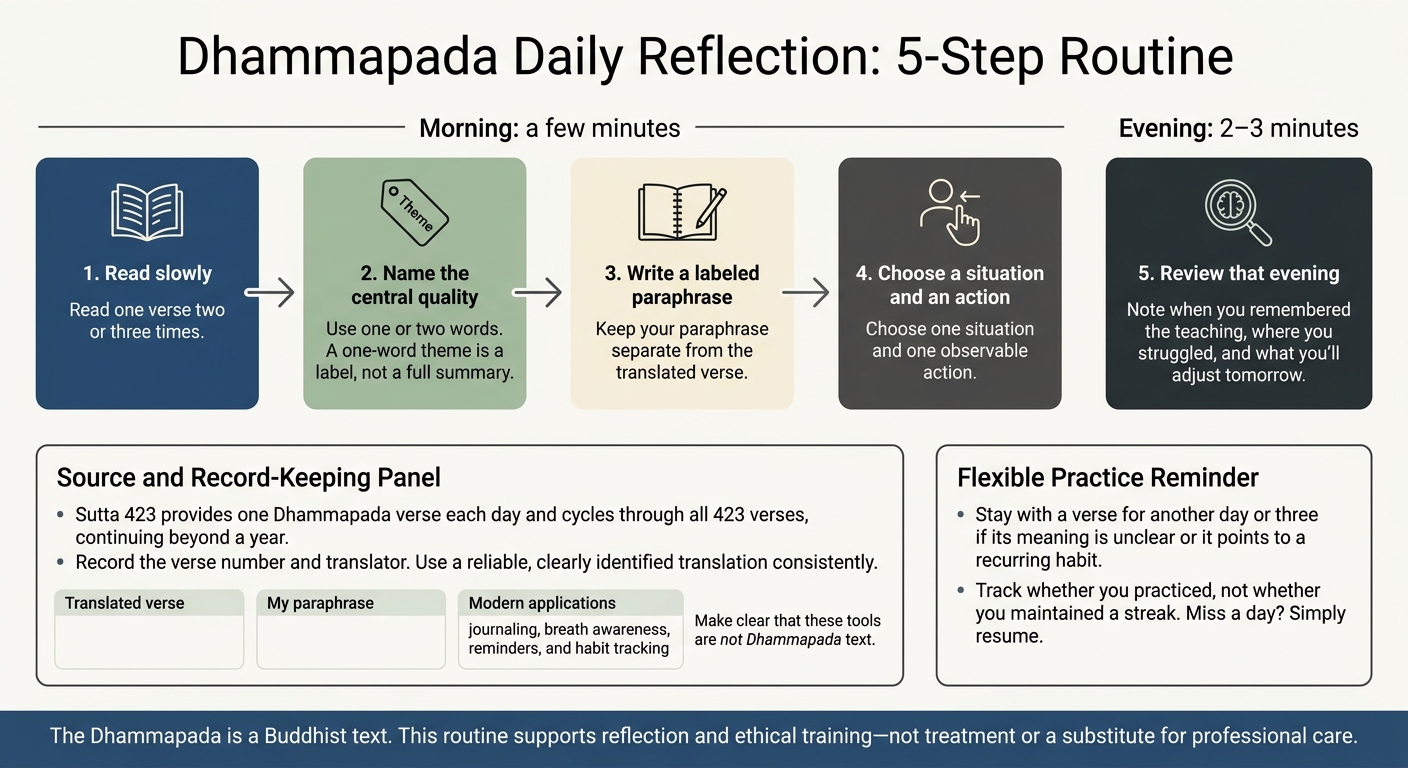
Dhammapada Daily Reflection: 5-Step Routine
Read a Daily Verse With Sutta 423
Keep the earlier heedfulness practice active with a daily reading. Sutta 423 provides one Dhammapada verse each day for quiet reading and reflection. It cycles through all 423 verses, covering a year of daily reading and continuing afterward. Treat each verse as a chance to practice - not a box to check.
Follow this five-step routine: read slowly two or three times; name the central quality in one or two words; write a labeled paraphrase; choose one situation and one observable action; and review your experience that evening. Spend a few minutes in the morning and 2–3 minutes at night. Note when you remembered the teaching, where you struggled, and what you’ll adjust tomorrow.
Stay with a verse for another day or three if its meaning is unclear or it points to a recurring habit. Track whether you practiced, not whether you maintained a streak. Miss a day? Simply resume.
Separate Textual Teachings From Modern Practices
Keep the verse separate from your notes and methods. Clear labels help distinguish the text from the tools you use to practice. Record the verse number and translator alongside your notes. Use a reliable, clearly identified translation consistently, since English wording varies between translations.
Keep the translated verse separate from your paraphrase. Label journaling, breath awareness, reminders, and habit tracking as modern applications, not Dhammapada text.
The Dhammapada is a Buddhist text, even when people from other backgrounds use it for reflection. A one-word theme is a label, not a full summary. Use this routine for reflection and ethical training - not as treatment or a substitute for professional care.
Conclusion: Choose One Verse and One Practice
These four habits work as a loop: notice, respond, act ethically, and loosen attachment.
For the next week, pick one verse and one everyday situation. Turn the teaching into an if–then plan: identify the cue first, then decide how you’ll respond.
Afterward, jot down your first impulse, what changed in your words or actions, and what you’d try next time. Progress means noticing and returning - not perfect concentration or guaranteed calm.
One verse, one pause, one observation.
FAQs
Can I practice these teachings without being Buddhist?
You don’t need to be Buddhist to put these teachings into practice. The Dhammapada offers guidance for personal growth and everyday mindfulness, whatever your background or spiritual path.
The Sutta 423 app gives you a simple, distraction-free way to reflect on one verse each day. It helps you bring these teachings into daily life, work through challenges, and find inner peace.
How can I tell letting go from avoiding a problem?
The difference lies in your intention and the effect of your actions. Letting go means mindfully loosening your attachment to harmful thoughts, grievances, or the need to control outcomes. Avoidance is often a passive response driven by fear or delusion: you escape reality instead of working through it with care.
Ask yourself whether your choice brings clarity and inner peace without causing harm - or simply pushes discomfort aside and lets negative patterns continue.
What if pausing doesn’t stop my reactions?
Mindfulness means observing your reactions, not trying to stop them right away. When anger or frustration comes up, notice it as a passing feeling - not a fixed part of who you are.
Reflecting on a daily verse in the Sutta 423 app can help you build patience and self-awareness, giving you more space between an impulse and your response. Over time, this gentle practice helps you pause and respond calmly and with care instead of acting on impulse.