

How Dhammapada Guides Habit Transformation
Use Dhammapada's mindfulness and four-step practice—identify, pause, replace, sustain—to break harmful habits and build positive ones.
The Dhammapada, a revered Buddhist text, offers practical guidance for transforming habits through mindfulness and intentional action. With 423 verses, it emphasizes the mind's role in shaping actions and outcomes, teaching that awareness and reflection are key to breaking harmful patterns and building positive ones.
Key Takeaways:
- Habits and Karma: Thoughts and actions leave mental imprints, creating tendencies that shape behavior. Recognizing these patterns is the first step to change.
- Mindfulness and Reflection: Daily introspection interrupts automatic reactions, replacing unskillful habits with constructive ones.
- 4 Steps to Change Habits:
- Identify the habit's impact by observing its effects without judgment.
- Stop actions that reinforce the habit by eliminating triggers and practicing mindful pauses.
- Replace negative habits with positive actions, guided by compassion and intentional effort.
- Build awareness and commitment through daily mindfulness and supportive environments.
For modern practice, tools like the Sutta 423 app deliver daily verses from the Dhammapada, encouraging consistent reflection and growth. By applying these teachings, you can reshape your habits and lead a more intentional life.
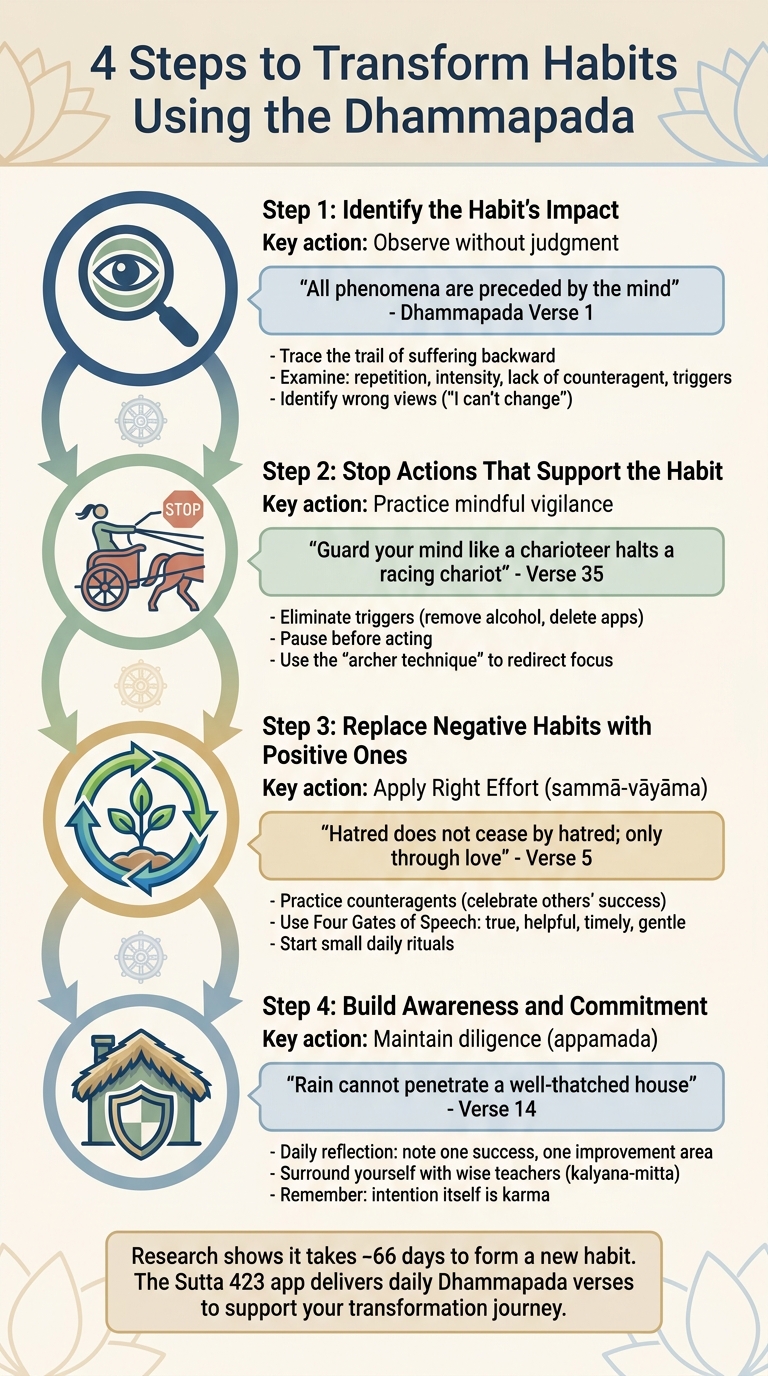
4 Steps to Transform Habits Using Dhammapada Teachings
How a Single Thought Can Change Your Life – Ancient Wisdom from the Buddha
Dhammapada Teachings on Mind and Intentional Action
The Dhammapada emphasizes how deeply our thoughts influence our actions and, ultimately, the course of our lives. By understanding the connection between mind, intention, and action, we gain the ability to break free from even the most entrenched habits.
The Mind's Role in Forming Habits
From the very beginning, the Dhammapada highlights that our habits are born from mental intentions. When actions stem from a mind clouded by greed, anger, or confusion, suffering becomes inevitable. On the other hand, actions guided by clarity and compassion naturally lead to happiness.
However, calming the mind is no easy task. As the Buddha, in Gil Fronsdal’s translation, points out:
"The mind, hard to control, Flighty - alighting where it wishes - One does well to tame. The disciplined mind brings happiness."
Our minds tend to wander, often allowing harmful habits to take root without our awareness. The first step in overcoming this restlessness is cultivating mindfulness. With a steady mind, we can lay the groundwork for intentional actions that align with our values and shape our karma.
Intentional Action and Karma
The Dhammapada makes a clear distinction between skillful actions (kusala) - rooted in insight, compassion, and contentment - and unskillful actions (akusala), which arise from greed, hatred, and delusion. Recognizing this difference is key to breaking free from automatic reactions and choosing more constructive responses.
Buddhist teacher Bodhipaksa underscores the importance of repetition in forming positive habits:
"If a man should do good, He should do it again and again. He should take delight in it; Happiness stems from the accumulation of meritorious action."
By consistently practicing small acts of kindness or mindfulness, we can gradually rewire our mental patterns. Mindfulness, in particular, creates a vital pause between impulse and action, giving us the chance to respond in ways that reflect our deeper intentions.
But habits run deeper than just conscious decisions. The concept of gati explains how repeated actions leave lasting imprints on our consciousness.
Gati: Understanding Habitual Tendencies
Gati, also known as vāsanā, refers to the habitual tendencies ingrained in our consciousness over time. These tendencies are shaped by repeated actions, leaving behind patterns that influence our behavior. The Dhammapada teaches that while these patterns may feel like fate, they are actually the result of a chain of cause and effect - one that can be broken with mindful effort.
Although reactions like anger or avoidance may feel automatic, their origins in the mind mean they can be changed. Transformation begins with a single mindful choice. When faced with a familiar trigger, taking a moment to pause and reflect allows us to override impulsive reactions. Over time, these conscious choices replace old patterns with more skillful behaviors.
This approach reminds us that change happens gradually - one thought, one choice, and one moment at a time.
4 Steps to Transform Habits Using the Dhammapada
The Dhammapada offers timeless wisdom for reshaping habits, providing a practical guide to break harmful patterns and build healthier ones. These four steps outline a path for intentional change.
Step 1: Identify the Habit's Impact
The first step to changing a habit is understanding its effects on your life. According to the Dhammapada, habits begin with mental intention - our minds shape our actions and their outcomes. Verse 1 illustrates this vividly:
"All phenomena are preceded by the mind, led by the mind, and originated from the mind; if one speaks or acts with an evil mind, suffering follows them like a cart-wheel following the ox's hoof."
This metaphor of the "wheel following the ox" highlights how negative habits leave behind a trail of suffering. To uncover a habit's impact, trace this trail backward: What suffering stems from this thought or action?
The key here is neutral observation. Buddhist teacher Dzigar Kongtrul Rinpoche advises:
"Our first priority is to become self-aware of our habits and patterns. We want to withhold judgment and learn to observe ourselves in these moments like a neutral but interested third party might do."
Avoid self-judgment, as it only deepens negativity. Instead, examine the factors that reinforce the habit: repetition (how often it occurs), intensity (the emotional force behind it), lack of counteragent (absence of self-reflection), and availability of triggers (situations that feed it).
Many destructive habits are rooted in "wrong views" - internal narratives like "I can't change" or "I'm not good enough." These beliefs create a cycle where negative actions reinforce the mindset that started them. Identifying this cycle is the first step toward transformation.
Step 2: Stop Actions That Support the Habit
Once you’ve recognized the habit’s impact, the next step is to stop the actions that sustain it. The Dhammapada acknowledges the mind’s restlessness but assures us it can be mastered. Verse 35 provides guidance:
"The one who sees danger can skillfully guard their mind, like a good charioteer halts a racing chariot."
This "charioteer" analogy shows that even when your mind feels out of control, you have the power to steer it. Practicing mindful vigilance helps you prevent harmful thoughts, words, and actions from taking hold.
To disrupt the habit cycle, eliminate triggers - remove alcohol from your home or delete distracting apps from your phone. Dzigar Kongtrul Rinpoche explains:
"With regard to negative habits, applying the four factors that form habits in an opposite manner - that is, ceasing to engage the habit repeatedly or consistently, lowering the volume of our intensity if we do engage in the habitual activity, applying a counteragent when the habit is present, and removing the availability of the field - can dismantle almost any negative habit."
When a trigger arises, pause before acting. Verse 33 offers the "archer" technique: when your mind drifts toward a harmful habit, use deliberate effort to redirect your focus toward a wholesome activity. This pause creates a critical moment for change.
Avoid responding to bad habits with self-hatred - it only reinforces negativity. Instead, adopt a narrative that acknowledges your potential for growth.
Step 3: Replace Negative Habits with Positive Ones
Stopping a harmful habit creates a void that needs to be filled with positive actions. This is where Right Effort (sammā-vāyāma) comes in - actively replacing negativity with wholesome alternatives. This involves preventing unwholesome states, eliminating existing ones, fostering new positive states, and maintaining them.
For example, if you're working to overcome jealousy, practice celebrating others' successes. If you're breaking a habit of harsh speech, follow the Four Gates of Speech: ask yourself if what you're about to say is true, helpful, timely, and gentle. Verse 5 captures this principle:
"In this world, hatred does not cease by hatred; it is only through love that hatred is quelled; this is an eternal law."
Positive habits act as counteragents, naturally weakening harmful tendencies. Start small with daily rituals - morning reflections to set your intentions or mindful breathing to manage stress. Over time, these practices create new mental pathways, replacing destructive patterns.
The Dhammapada reminds us that a pure mind brings lasting happiness: "Happiness follows a pure mind like a shadow that never leaves" (Verse 2). By consistently choosing positive actions, you’re not just breaking old habits - you’re building a foundation for enduring well-being.
Step 4: Build Awareness and Commitment
The final step is maintaining awareness and commitment to ensure the changes last. Diligence, or appamada, is described in the Dhammapada as the "moat" that protects your progress from procrastination and relapse.
Mindfulness (sati) acts as your guard, weakening unwholesome tendencies as it grows stronger. Reflecting at the end of each day helps you stay accountable: note one instance where you maintained awareness and one area for improvement.
The Dhammapada uses the image of a well-thatched house: "Rain cannot penetrate a house that is well-thatched" (Verse 14). Your commitment to mindfulness is like that sturdy roof - it keeps harmful habits from sneaking back in.
Your environment also plays a crucial role. Surround yourself with supportive influences - wise teachers (kalyana-mitta) and positive companions - while avoiding those who might undermine your progress.
Finally, remember that intention itself is a form of karma. Each time you pause, reflect, and choose differently, you’re reshaping your mind - one thought, one decision, and one moment at a time.
Using the Sutta 423 App for Daily Practice

The Sutta 423 app offers a practical way to weave the teachings of the Dhammapada into your daily life. Since carrying a physical text isn't always convenient, this app serves as a bridge between ancient teachings and modern routines, helping you stay consistent in your practice.
How Sutta 423 Delivers Daily Verses
The app provides one verse from the Dhammapada each day, making the teachings easy to digest and reflect on. This "small portion" approach ensures you can focus on a single piece of wisdom throughout your day without feeling overwhelmed.
With its "no streaks, no pressure" philosophy, the app allows you to engage at your own pace. If you miss a day, there's no penalty; the app simply holds your place. The goal is straightforward: "Read it. Sit with it." A few quiet moments each day can lead to meaningful growth.
Each verse is presented with full context to maintain its original meaning. New verses become available at midnight in your local time zone, and you can set reminders to ensure you don’t miss them. For teachings that resonate deeply, the app offers a save feature, along with optional tools to support your personal journey.
Creating a Daily Reflection Habit
The app is designed to naturally encourage a habit of daily reflection. Over 423 days, you'll not only read the entire Dhammapada but also live with its teachings. The Echo feature revisits verses at intervals - such as Day 1, Day 8, and Day 15 - helping you deepen your understanding over time. This repetition allows you to notice how your perspective shifts as your habits evolve.
A great way to start is by incorporating the daily verse into your morning routine. As you work on mindfulness and awareness, the app acts as a gentle accountability partner, keeping you on track without adding stress. When faced with moments of procrastination, negative thoughts, or harsh reactions, you can reflect on that morning’s teaching to guide your response.
For verses that feel especially relevant to your personal growth, the save feature lets you create a library of meaningful teachings. Whenever you feel yourself slipping into old patterns, these saved verses can serve as a quick source of inspiration. The app syncs your progress across devices, so your journey through the 423 verses remains uninterrupted, whether you’re using your phone or tablet.
Real-Life Examples: Applying Dhammapada Teachings to Common Habits
Building on the principles discussed earlier, here are some practical ways to apply the wisdom of the Dhammapada to everyday habits.
Changing Negative Thought Patterns
Negative self-talk can feel like an automatic loop, playing in your mind without your consent. The Dhammapada emphasizes that the mind is the root of all mental states, shaping our reality. For instance, when thoughts like "I'm not good enough" or "I always fail" arise, they reflect deeply ingrained patterns, or vasana, created by repeated actions.
Thich Nhat Hanh shared a story about a young man who struggled with inherited restlessness. By practicing mindful breathing and gently acknowledging his emotions with the phrase, "Hello, my little habit energy, I know you are there", he found a way to restore peace.
You can adopt a similar approach by recognizing negative thoughts without resisting them. The Dhammapada offers this timeless wisdom:
"In this world, hatred does not cease by hatred; it is only through love that hatred is quelled; this is an eternal law."
When self-critical thoughts arise, try replacing them with affirmations like, "May I be safe, peaceful, and happy." This simple shift can help counteract the cycle of negativity.
Breaking the Procrastination Habit
Procrastination isn't about laziness; it's more about what the Dhammapada calls indulgence (pamāda), where the mind drifts into habitual patterns without awareness. The text cautions:
"Not being indulgent is the path of the king of death; indulgence is a dead end. The non-indulgent do not die; the indulgent are as if already dead."
When you put off a task, you're allowing unconscious habits to take control. The Dhammapada encourages action:
"If you see something that should be done, you should diligently act; if a bhikkhu does not act, they will later experience regret."
The message is clear: the present moment is the only time you can choose to act. Delaying today means your future self will carry the burden of regret.
To tackle procrastination, try the "stop" (zhi) technique. When you catch yourself avoiding a task, pause, take three deep breaths, and ask yourself if you're genuinely resting or just making excuses. As the Dhammapada notes:
"The charioteer directs a fine chariot; the wise direct their hearts."
Just as a skilled charioteer controls their vehicle, you can guide your mind with intention. This same practice can help reshape other habits, such as embracing gratitude and kindness.
Developing Gratitude and Kindness
Gratitude and kindness are habits that grow with conscious effort. The Dhammapada teaches:
"The doer of good rejoices here and hereafter; he rejoices in both the worlds. He rejoices and exults, recollecting his own pure deeds."
Begin your day by reflecting on a kind act or a moment of goodness. This practice fosters joy and mental clarity. To nurture kindness, the Dhammapada advises releasing grudges and resentments, such as thoughts of "he wronged me" or "she hurt me." Letting go of these narratives helps dissolve hatred.
When someone speaks harshly to you, practice patience instead of reacting. Guard your mind as a charioteer would their chariot, and when negative thoughts creep in, redirect them toward positive intentions. The Dhammapada reminds us that true success isn't about outdoing others but about overcoming our own inner struggles, like greed and anger.
Conclusion: Starting Your Transformation with the Dhammapada
The Dhammapada captures the essence of Buddhist ethics in 423 concise and memorable verses. At its heart lies the teaching that the mind is the forerunner of all mental states. By cultivating mindfulness and awareness, you can reshape the patterns that influence your experiences.
Start simple: reflect each morning on guarding your speech and fostering compassion. When tension arises, try pausing for three deep breaths to recenter yourself.
To make this practice part of your routine, the Sutta 423 app offers a practical tool. It delivers one verse from the Dhammapada daily, encouraging quiet reflection and focus. Over time, these 423 verses help establish a steady habit of mindfulness, supporting positive actions. As the Bodhi Path Buddhist Studies Network puts it:
"When we begin with a verse and embody awareness in every daily detail, we can live out the coolness and brilliance of ancient wisdom in modern life."
Interestingly, research suggests it takes about 66 days to form a new habit. By tying your practice to a daily verse, you create a reliable anchor for mindful responses. At the end of each day, reflect on your actions - acknowledge one moment where awareness guided you and identify one area for improvement tomorrow. This consistent rhythm transforms the Dhammapada from a collection of teachings into a daily practice, helping you cultivate mindfulness and intention, one day at a time.
FAQs
How is karma connected to habit change?
In Buddhism, karma is deeply connected to the process of habit change. Creating positive karma means making deliberate decisions and developing habits that lead to beneficial outcomes. The Dhammapada, a key Buddhist text, emphasizes how mindful practice can gradually reshape our internal tendencies and behaviors, leading to meaningful transformation over time.
What should I do when a trigger hits in the moment?
When something triggers you, take a moment to pause and observe without jumping into a reaction. See this as a chance to practice awareness instead of responding on impulse.
Give yourself time to notice your thoughts and emotions, then deliberately choose a response that reflects your values. This mindful practice, rooted in the teachings of the Dhammapada, encourages self-control and helps build healthier habits.
How can Sutta 423 help me stay consistent daily?
Sutta 423 offers a simple way to build daily consistency by sharing one meaningful verse from the Dhammapada each day. These short, reflective readings encourage mindful engagement with Buddhist teachings, helping to create a steady habit of introspection. With 423 verses - enough to guide you through an entire year and beyond - the app makes it easier to weave moments of wisdom seamlessly into your everyday life.