

Dependent Origination in Buddhism
Explains how suffering arises via the Twelve Links and how insight into interdependence, no-self, and mindfulness ends it.
Dependent Origination, or Pratītyasamutpāda, is a core Buddhist teaching that explains how all phenomena arise due to interdependent conditions. It’s summed up as: "When this exists, that arises; when this ceases, that ceases." This principle reveals the interconnected nature of reality, emphasizing that nothing exists independently.
Key points:
- It explains the cycle of suffering (samsara) through the Twelve Links, starting with ignorance and leading to aging and death.
- It’s central to understanding the Four Noble Truths, karma, and rebirth.
- Dependent Origination aligns with the concepts of emptiness (no inherent existence) and no-self (an ever-changing process instead of a fixed identity).
- Practicing awareness of this principle can help break the cycle of suffering by interrupting habitual reactions, especially at the stages of contact or feeling.
This teaching invites us to see life as a web of causes and effects, offering insights into mindfulness and liberation. By understanding interdependence, we can transform our perspective and reduce suffering in daily life.
Historical and Scriptural Background
Dependent Origination in Early Buddhist Texts
The concept of dependent origination is explored extensively in the Nidāna Saṃyutta of the Saṃyutta Nikāya within the Pali Canon, as well as its Chinese counterpart, the Saṁyukta Āgama. These collections offer numerous discourses that examine the teaching from various perspectives.
Key suttas provide foundational insights into this doctrine. For example, SN 12.1 (Paṭiccasamuppādasutta) outlines the standard twelve links, explaining both the arising and cessation of suffering. SN 12.2 (Vibhaṅga Sutta) goes a step further by offering formal definitions for each of these twelve links. Meanwhile, the Paccaya Sutta (SN 12.20) distinguishes between the unchanging principle of conditionality and the ever-changing processes that arise within it.
The Mahānidānasutta (DN 15) highlights the depth of this teaching, with the Buddha emphasizing how misunderstanding it perpetuates the cycle of rebirth. Similarly, the Mahāhatthipadopama Sutta (MN 28) underscores the centrality of dependent origination to the Dharma, presenting it as an essential element of Buddhist thought.
A condensed version of this teaching, encapsulated in the phrase ye dharmā hetu, states: "Of those dharmas which arise from a cause, the Tathagata has stated the cause, and also their cessation." This summary became so integral to Buddhist identity that it was inscribed on artifacts, such as a fifth-century Gupta period brick found in Uttar Pradesh.
While the twelve-link framework became the standard, early texts reveal variations with ten or eleven links. This suggests that the twelve-link model was a synthesis of earlier, shorter formulations. These scriptural variations provide a foundation for understanding the broader, universal principle of conditionality.
The Principle of Conditionality
The teachings on dependent origination introduce a universal principle known as idappaccayatā, meaning "this/that conditionality". This principle operates as a natural law, akin to gravity, functioning independently of acknowledgment or belief.
The Paccaya Sutta articulates this idea:
Whether or not there are Buddhas who see it, this elemental fact stands.
While the law of conditionality itself remains constant (dhammaniyāmatā), the phenomena it describes are impermanent and subject to cessation.
This principle serves as the logical underpinning of the Four Noble Truths. The Second Noble Truth (the origin of suffering) reflects conditionality in its forward sequence, while the Third Noble Truth (the cessation of suffering) applies it in reverse. By grasping this principle, one sees that all conditioned phenomena arise through interdependence - nothing exists in isolation or possesses an unchanging essence.
The Buddha also used dependent origination to refute Vedic creation myths. Unlike the Vedic view of the world being "created" or "sacrificed" into existence, the Buddha described existence as a process of interdependence, free from a first cause. This teaching charted a middle path, steering clear of eternalism (belief in permanent existence) and nihilism (belief in complete non-existence after death).
What is Dependent Origination in Early Buddhism?
The 12 Links of Dependent Origination
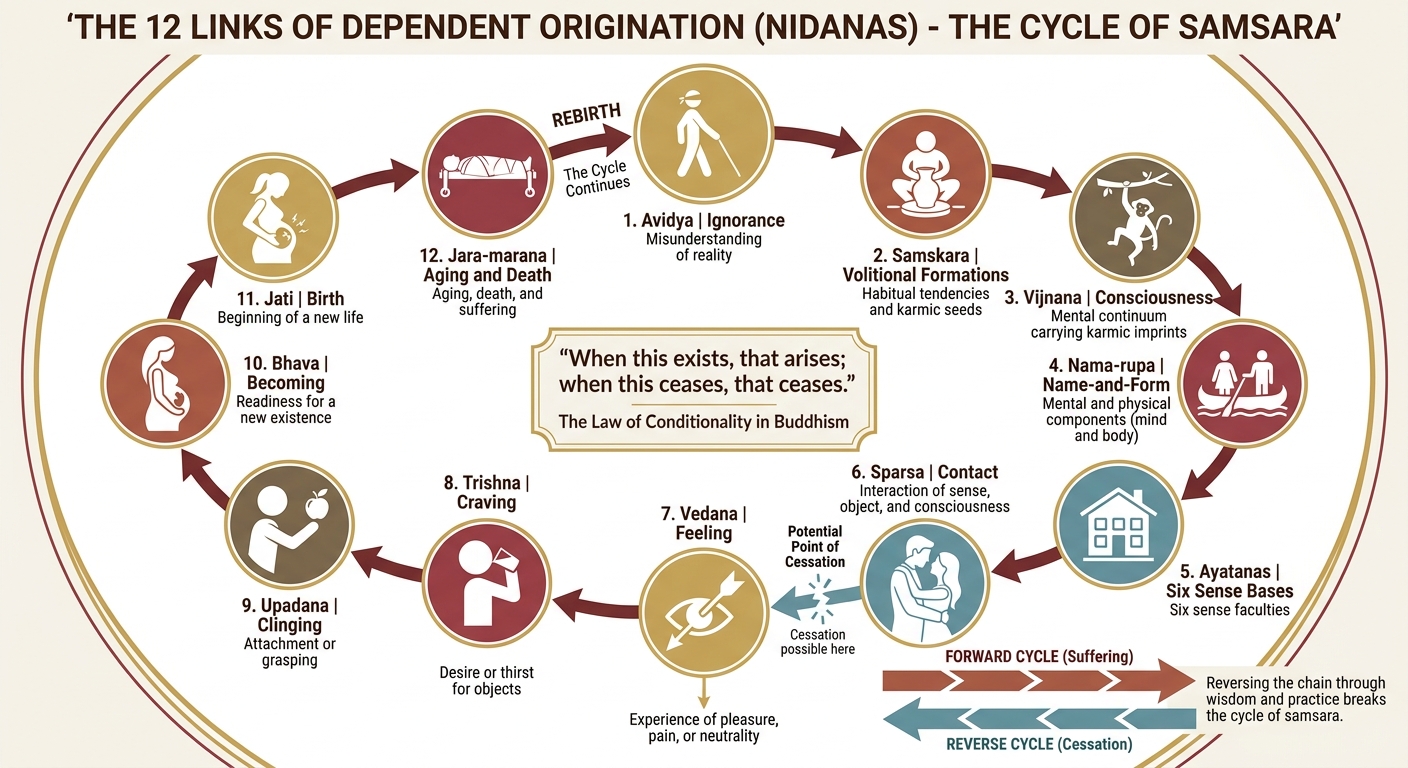
The 12 Links of Dependent Origination in Buddhism
Breaking Down the 12 Links
The twelve links - known as nidanas in Sanskrit - outline how beings become caught in the cycle of samsara. Each link sets the stage for the next, creating a chain of interconnected conditions.
At the root of this chain is ignorance (avidya), which refers to a deep misunderstanding of reality - specifically, the mistaken belief in an inherently existing self. Jeffrey Hopkins describes this as a fundamental misperception of the world. In traditional imagery, ignorance is symbolized by a blind person with a cane.
Ignorance fuels volitional formations (samskara), which are habitual tendencies and karmic potentials born from misperception. These, in turn, condition consciousness (vijnana), the mental stream that carries karmic imprints and drives rebirth. Consciousness gives rise to name-and-form (nama-rupa), the mental and physical components that make up a being.
Next, the six sense bases (ayatanas) - the faculties of sight, hearing, smell, taste, touch, and mind - enable perception. When these faculties engage with objects and consciousness, contact (sparsa) occurs, which leads to feeling (vedana), the experience of pleasure, pain, or neutrality.
Feeling can lead to craving (trishna), a yearning that directs the mind toward objects of desire. This craving intensifies into clinging (upadana), a grasping attachment to objects, ideas, or experiences. Clinging sets the stage for becoming (bhava), the readiness for a new existence, which culminates in birth (jati), the start of a new life. Inevitably, birth leads to aging and death (jara-marana), accompanied by grief and suffering.
| Link | Sanskrit Term | Description | Traditional Symbol |
|---|---|---|---|
| 1 | Avidya | Misunderstanding of reality | Blind person with cane |
| 2 | Samskara | Habitual tendencies and karmic seeds | Potter shaping a vase |
| 3 | Vijnana | Mental continuum carrying karmic imprints | Monkey swinging from tree |
| 4 | Nama-rupa | Mental and physical components (mind and body) | Two men in a boat |
| 5 | Ayatanas | Six sense faculties | House with six windows |
| 6 | Sparsa | Interaction of sense, object, and consciousness | Couple embracing |
| 7 | Vedana | Experience of pleasure, pain, or neutrality | Arrow in the eye |
| 8 | Trishna | Desire or thirst for objects | Person drinking |
| 9 | Upadana | Attachment or clinging | Person picking fruit |
| 10 | Bhava | Readiness for a new existence | Pregnant woman |
| 11 | Jati | Beginning of a new life | Woman giving birth |
| 12 | Jara-marana | Aging, death, and suffering | Corpse being carried |
This framework provides a clear picture of how these links operate together, forming the cycle of existence.
Understanding the Non-Linear Nature of the Links
The twelve links don't follow a rigid, step-by-step sequence. Instead, they function as a network of interdependent conditions. As Ajahn Sucitto explains:
The connection between the factors is not one of an inevitable causal sequence... the conditionality of dependent origination carries the potential for dukkha or its cessation.
This means that while the links are connected, they are not locked into a fixed order. For example, feeling does not always lead to craving - other factors, like mindfulness or wisdom, can intervene and disrupt the chain. Think of it like breaking an electrical circuit: interrupting the flow at any point halts the entire process.
Dependent origination operates on two levels. Moment by moment, all twelve links can unfold within a single instant of consciousness. On a broader scale, they represent stages of existence that span past, present, and future lives. By recognizing these interconnections, practitioners can identify opportunities to interrupt the cycle and move closer to liberation.
Dependent Origination and the Path to Liberation
The Cycle of Suffering (Samsara) and Its Cessation
The twelve links of dependent origination illustrate how suffering comes into being and how it can be brought to an end by reversing the chain of causation. This is summed up in the principle: "When this does not exist, that does not come to be. With the cessation of this, that ceases".
At the heart of this cycle is ignorance, which fuels the entire process. Bhikkhu Bodhi explains:
Ignorance sustains the round of dukkha, and when ignorance comes to an end, the entire network of conditions also ends.
By replacing ignorance with wisdom and clear understanding, the subsequent links - such as volitional formations, craving, and clinging - lose their power. Without ignorance, the chain collapses, halting the cycle of suffering entirely.
This process highlights how past causes influence the present and how present actions shape the future. Recognizing this dynamic allows for intervention in the present moment, breaking the cycle and preventing further suffering. It also deepens the understanding of the interconnected nature of existence, which aligns with the teachings of the Four Noble Truths.
How It Relates to the Four Noble Truths
Dependent origination and the Four Noble Truths are deeply interconnected, both rooted in the principle of cause and effect. The twelve links directly correspond to the Second Noble Truth (the origin of suffering) and the Third Noble Truth (the cessation of suffering). Meanwhile, the Eightfold Path provides the practical means to disrupt the causal chain and end suffering.
Early Buddhist texts emphasize the importance of understanding dependent origination before realizing nirvana. As the Buddha stated:
One who sees dependent origination sees the Dharma. One who sees the Dharma sees dependent origination.
This insight into causality is foundational. It reveals how suffering arises and how it can be undone, offering a clear framework for liberation.
Connection to Emptiness and No-Self
Dependent origination also sheds light on two core Buddhist insights: emptiness and no-self. It demonstrates that all phenomena lack inherent existence because they arise from causes and conditions. As the 14th Dalai Lama explains:
Dependent-arising... is explained as the main reason why phenomena are empty of inherent existence.
This teaching dismantles the notion of a fixed self. What we perceive as "self" is merely a process shaped by interdependent conditions - an illusion of "I" and "mine" that emerges from contact, feeling, and grasping. Nagarjuna, the founder of the Madhyamaka school, stated:
Whatever arises dependently / Is explained as empty. / Thus dependent attribution / Is the middle way.
This perspective avoids two extremes: eternalism (the belief in a permanent soul) and annihilationism (the belief that nothing exists or matters). Bhikkhu Bodhi describes dependent origination as:
A 'teaching by the middle' that avoids these two extremes.
Through this lens, existence is neither static nor meaningless. Instead, it is a dynamic web of causes and conditions - one that can be understood, interrupted, and ultimately transcended.
Applying Dependent Origination in Daily Life
Observing Interdependence in Everyday Experiences
A simple way to start applying dependent origination is by noticing the interconnectedness of everyday moments. This concept highlights how countless factors come together to create even the most ordinary experiences.
Carl Sagan captured this idea perfectly when he said:
If you wish to make an apple pie from scratch, you must first invent the entire universe.
Take your morning coffee, for example. That cup exists because of many interconnected elements: the soil where the beans grew, the rain that nourished the plants, the farmers who harvested them, the transportation systems that brought them to your store, and so much more. In the fast-paced lifestyle common in the U.S., pausing to recognize these connections can provide a grounding sense of perspective. Buddhist teacher Elizabeth Mattis Namgyel explains this shift in understanding:
This is a very sensitive system, and we are citizens of this system of contingencies. So we're not really big - we can't be. We're not so important. And yet we're not insignificant.
This realization helps reduce the ego's grip, allowing you to see yourself as part of a vast, interconnected web rather than as an isolated individual. With this mindset, you can begin to approach life's challenges from a place of awareness and connection.
Using Dependent Origination to Address Modern Challenges
Once you start observing interdependence in daily life, you can apply the twelve links of dependent origination to address challenges and reduce suffering. These links provide a framework for understanding how suffering arises and where it can be interrupted. The key is to intervene early - at the point of contact - before craving sets in.
Zen teacher Kuden Paul Boyle explains this concept:
The point of studying dependent origination is to provide us with a way to understand the true nature of our own experience and knowing where the links in the chain dragging us toward suffering are most easily broken. It turns out that this weak links are at contact and/or sensation.
Here’s a practical example: Imagine feeling stressed at work. If you notice the initial physical tension - perhaps a tightness in your shoulders - before your mind starts spinning a narrative of overwhelm, you can stop the cycle before it escalates. By staying with the physical sensation instead of jumping into a story, you can prevent stress from snowballing into full-blown suffering.
Meditation offers a great way to practice this skill. For instance, when you feel an itch or discomfort, resist the urge to move. Instead, observe the sensation as it arises, changes, and fades. This practice helps weaken deeply ingrained patterns of desire, aversion, and ignorance that drive habitual reactions.
Another insight comes from recognizing that the sense of self is not fixed but constantly shaped by interdependent conditions. William S. Waldron, author of Making Sense of Mind Only, puts it this way:
Our sense of self is the most entrenched and pernicious habit of all.
When emotions like anxiety or anger arise, reminding yourself that "I am my thoughts" is just a habit can help you see these experiences as dynamic processes rather than personal flaws. This perspective creates space to respond more skillfully.
Benefits and Challenges in Practice
Applying dependent origination can transform how you interact with yourself and the world, but it’s not without its hurdles. Here’s an overview of the benefits and challenges:
| Aspect | Benefits | Challenges |
|---|---|---|
| Self-Perception | Reduces attachment by seeing the self as a collection of habits rather than a fixed entity. | Letting go of a fixed sense of self can feel unsettling and take time to fully understand. |
| Habit Management | Provides a clear framework - the 12 links - to identify and interrupt negative behaviors. | Deeply ingrained habits tied to muscle memory and neural patterns can be slow to change. |
| Emotional Regulation | Encourages openness to painful emotions, making them easier to process and release. | Requires mindfulness to catch the critical moment between sensation and craving. |
| Environmental Interaction | Promotes a sense of interconnectedness, seeing oneself as part of a dynamic system. | Modern environments often reinforce craving and grasping through constant sensory stimulation. |
Patience is essential. Even brief moments of staying present with discomfort can slowly weaken the chain of suffering. As the Buddha’s disciple Ajnata Kaundinya wisely observed:
Whatever is subject to origination is all subject to cessation.
Deepening Practice with Dhammapada Reflections
How Sutta 423 Supports Reflection

Daily reflection on Buddhist teachings can significantly deepen your understanding of interdependence and the causal links it highlights. The Sutta 423 app is a practical tool for this purpose, delivering a daily Dhammapada verse to reflect on. Over the course of a year, it covers all 423 verses and continues beyond, offering a steady path to internalize the concept of dependent origination.
This daily practice is particularly helpful because dependent origination is often described as a profound principle - one that goes beyond simple rational analysis. Starting each day with a single verse provides a tangible focus for your mind, allowing your insights to develop gradually. As understanding grows one step at a time, the teachings begin to resonate more deeply.
The app also nurtures the focus required to identify causal patterns in daily life. As the Buddha explained in MN 28: "One who sees dependent origination sees the Dharma. One who sees the Dharma sees dependent origination." These daily verses help transform an intellectual grasp of the teachings into something more personal and experiential, bridging the gap between theory and practice.
Benefits of Daily Verses for Understanding Interconnectedness
Engaging with daily verses fosters what is known as "knowledge of Dhamma-stability" (dhamma-tthiti-ñānam), which is a direct awareness of how causality operates. This practice demonstrates how Buddhist insights apply to everyday situations, reinforcing the foundational principles discussed earlier.
It also helps cultivate a balanced view, steering you away from extremes like clinging to the idea of a permanent self or falling into nihilistic thinking. Instead, you begin to notice how your mental states influence one another moment by moment. For example, reflecting on a verse about craving could help you recognize subtle habits, like the impulse to check your phone. Similarly, contemplating impermanence might reveal how tension in your body naturally eases over time.
As stated in SN 12.70: "Knowledge of Dhamma-stability comes first, then comes knowledge of nirvana." Observing how experiences arise and fade due to conditions can lead to what is sometimes known as "emptiness concentration." This consistent practice gradually unveils the principles of not-self and emptiness, showing that no phenomenon - including the sense of "I" - exists independently or inherently. Over time, this insight becomes a cornerstone of deeper understanding.
Conclusion
Dependent origination isn't just a concept - it's the heart of the Dharma. It explains how suffering emerges from specific causes, like ignorance and craving, and shows that by addressing these root causes, suffering can come to an end.
This teaching has a practical edge: it shifts your focus from blaming external circumstances to examining your own actions. Instead of feeling stuck, you can actively introduce skillful actions in the present. Your current experience is shaped by both past and present actions, which means you have the power to influence what comes next. This interplay between theory and practice is where dependent origination truly comes alive.
Understanding that the self is an interconnected process helps loosen the hold of ego-driven attachments. This insight into emptiness and the absence of a fixed self is a key step toward liberation. The 14th Dalai Lama captures this beautifully:
Karma is one particular instance of the natural causal laws that operate throughout the universe where... things and events come into being purely as a result of the combination of causes and conditions.
Padmasambhava’s teaching further clarifies the balance needed:
One's view should be as vast as the sky, and one's action should be as subtle and fine as grains of flour.
While keeping the grand interconnectedness of life in mind, it’s the small, everyday choices that truly matter - how you handle frustration, the thoughts you entertain, the way you treat others. These seemingly minor decisions are the seeds that shape your future.
Dependent origination provides more than just understanding; it offers a practical guide for personal growth and mindfulness. By applying this principle in your daily life, you're not only deepening your understanding of Buddhism but also actively walking the path to awakening.
FAQs
Is dependent origination the same as karma?
Dependent origination, also known as pratityasamutpada, describes how all phenomena come into being through a web of causes and conditions. It emphasizes the interconnected nature of existence and the lack of any truly independent entities. This principle touches on ideas like suffering and rebirth but shouldn't be confused with karma.
Karma, in contrast, focuses specifically on moral causation - how our actions lead to outcomes that shape future experiences. While karma operates within the framework of dependent origination, the two concepts address different dimensions of existence. Dependent origination explains the broader mechanics of how things arise and interrelate, whereas karma zeroes in on the ethical consequences of actions.
Do the 12 links happen in one moment or across lifetimes?
The 12 links of dependent origination describe a process that unfolds over multiple lifetimes, illustrating the cycle of rebirth within saṁsāra. These links don’t occur all at once; instead, they represent an ongoing chain of cause and effect that connects past, present, and future existences in a continuous loop.
How can I break the chain in daily life?
Breaking the chain, as explained through dependent origination, involves recognizing and disrupting the causes of suffering. By practicing mindfulness and paying close attention to your thoughts, emotions, and actions, you can change the conditions that fuel negative experiences. The focus should be on lessening craving and ignorance - two core links in this cycle. Through ethical behavior, mindful awareness, and cultivating wisdom, you can stop the chain of suffering from perpetuating.