

7 Ways Daily Verse Reading Builds Inner Peace
Read one Dhammapada verse daily to build mindfulness, reduce anger, cultivate self-discipline and ethical living for lasting inner calm.
Reading a verse daily from the Dhammapada can help you find calm and balance in a fast-paced world. This Buddhist text offers timeless guidance on mindfulness, self-reflection, and ethical living. Here’s a quick summary of how this practice can transform your mental and emotional well-being:
- Mindfulness: Start your day with focus and awareness by reflecting on a verse.
- Self-Reflection: Shift attention inward to assess your actions and thoughts honestly.
- Anger Management: Learn to pause and respond calmly instead of reacting impulsively.
- Self-Control: Strengthen discipline to resist fleeting desires and distractions.
- Detachment: Reduce emotional dependence on impermanent things to ease suffering.
- Ethical Choices: Align your actions with thoughtful, moral decisions.
- Peaceful Recitation: Reciting verses aloud can calm your mind and reduce stress.
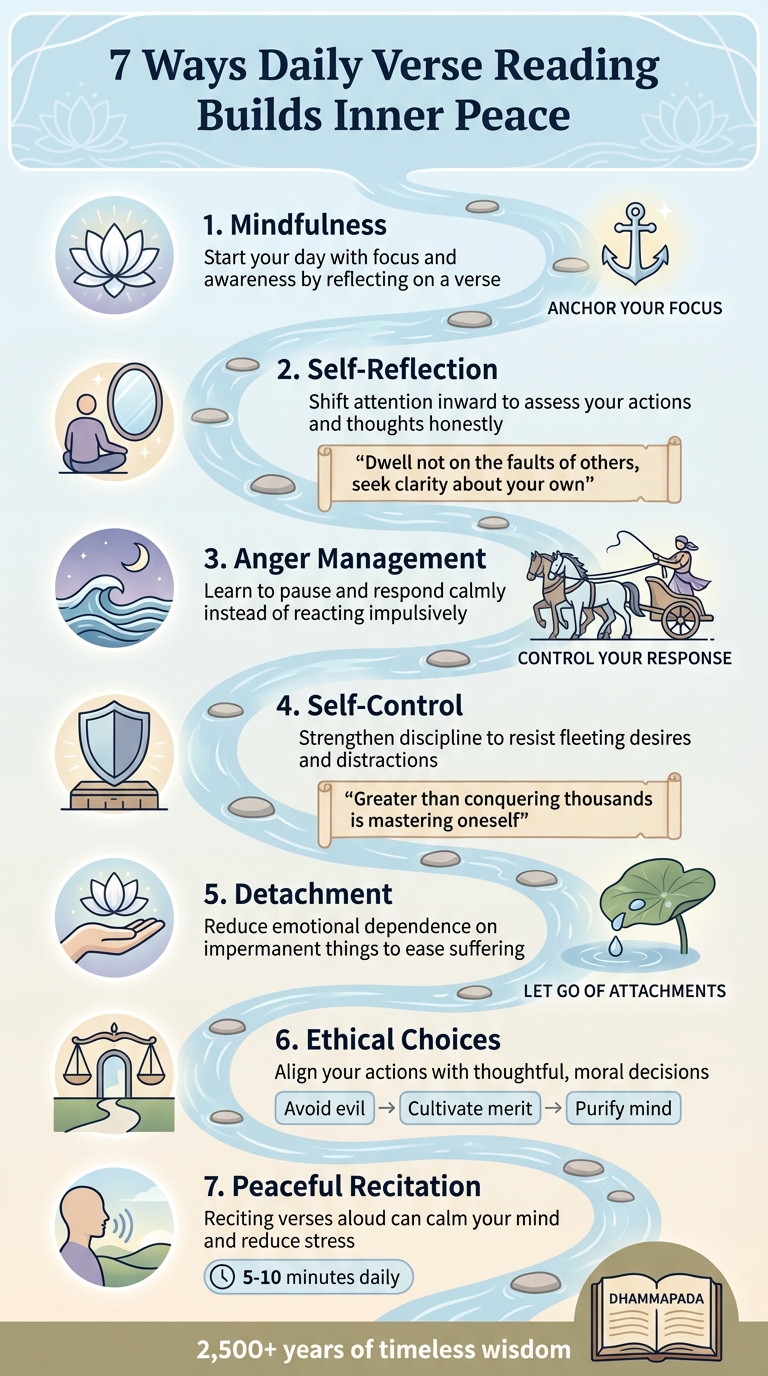
7 Ways Daily Verse Reading Builds Inner Peace Infographic
DHAMMAPADA Pure Reading: Chapters 1-5 | Buddha’s Teachings | Audio Book
1. Develops Mindfulness in the Present Moment
Starting your day with a verse from the Dhammapada acts as an anchor for your attention, offering a deliberate pause to center your thoughts. These short, impactful sayings naturally slow your reading pace, helping you step out of autopilot and focus on the present moment. This mindful beginning can set the tone for better self-awareness and emotional balance throughout your day.
The Buddha likened a trained mind to a well-thatched roof: "Rain cannot penetrate a house that is well-thatched". Just as a sturdy roof keeps out rain, the daily practice of reading a verse helps shield your mind from distractions and impulsive reactions. This mental discipline builds over time, with each verse reinforcing your ability to stay present.
The process encourages you to observe your thoughts and physical sensations. As Verse 379 states, "The self-guarded and mindful monk will always live in happiness". By reading a verse, you set an intention to stay aware of your mental and sensory responses, grounding yourself in the here and now. This heightened mindfulness becomes the foundation for deeper self-reflection and ethical living, which are explored further in the text.
To make this practice effective, start with a single verse and reflect on how it relates to your daily experiences. Highlight meaningful passages and revisit them often to absorb their lessons. This approach turns reading into a form of meditative focus. As Verse 372 explains, "There is no meditative concentration for him who lacks insight, and no insight for him who lacks meditative concentration". These two qualities - mindfulness and insight - work together, strengthening your awareness with consistent practice.
Over time, this daily habit can lead to profound clarity and joy. Verse 374 captures this transformation: "Whenever he sees with insight the rise and fall of the aggregates, he is full of joy and happiness". By observing life's natural ebb and flow without attachment or resistance, you cultivate a sense of peace - not by escaping reality, but by fully engaging with each moment as it unfolds.
2. Promotes Deep Self-Reflection
Reading these verses encourages a profound level of self-reflection, building on the mindful awareness discussed earlier. As Verse 50 puts it, "Dwell not on the faults and shortcomings of others, instead, seek clarity about your own." This advice shifts your focus from judging others to examining your own actions and thoughts, fostering genuine self-awareness. By turning inward, you create the foundation for meaningful self-assessment.
The verses serve as a reflective mirror, contrasting qualities like vigilance and negligence, or truth and deceit, to help you evaluate your character. Verse 319 captures this process: "The clear seeing that knows that which is flawed as flawed, and that which is pure as pure, can lead beings to transcend misery." Recognizing these contrasts in your own behavior sharpens your clarity and sets the stage for personal growth.
This isn’t about passive reading - it’s an active practice. Verse 379 underscores the importance of accountability: "By oneself one must censure oneself and scrutinize oneself. The self-guarded and mindful monk will always live in happiness." Revisiting verses that resonate with your experiences can reinforce this habit of honest self-examination.
Verse 394 delivers a striking reminder that external changes alone won’t cleanse internal struggles: "O foolish one! What is the use of wearing matted hair? What is the use of your wearing a garment made of antelope skin? In you, there is a forest (of moral defilements); you clean yourself only externally." This highlights how clinging to superficial changes or impulsive reactions can hinder true self-improvement, emphasizing the need for deeper self-control.
To make this practice part of your daily routine, use the verses as a tool for self-audit. When tempted to criticize others, pause and reflect on your own actions instead. Highlight passages that challenge you and revisit them during moments of quiet reflection. This consistent inward focus can build a strong foundation for ethical living and emotional balance.
3. Reduces Anger and Hatred Through Non-Reactivity
Reading verses daily helps train your mind to pause before reacting, breaking the automatic cycle of anger. Verse 5 teaches, "Hatred is never appeased by hatred in this world. By non-hatred alone is hatred appeased. This is a law eternal." This wisdom encourages understanding rather than emotional suppression. Reacting with more anger only deepens the cycle, but taking a moment to pause allows you to approach anger with a fresh perspective.
These verses act as a mental reset when provoked. Verse 222 offers a powerful metaphor: "Whoever should hold back arisen anger just like a swerving chariot, that one I say is a charioteer, other people are just rein-holders." This vivid image illustrates the importance of managing anger instead of letting it control you. Practicing mindfulness to rein in irritation is key to achieving lasting inner peace.
The teachings also redefine victory, shifting the focus inward. Instead of triumphing over others, true success lies in mastering oneself. As the text says, "Though one may win over others a hundred thousand times, it is not as good as winning over oneself once; this is the greatest victory." Overcoming your own anger is an accomplishment that no external force can take away.
Furthermore, the verses emphasize letting go of past grievances. Verse 4 advises, "He abused me, he struck me, he overpowered me, he robbed me. Those who do not harbor such thoughts still their hatred." This doesn't mean forgetting what happened but choosing not to let past wrongs dictate your present emotions. By releasing these thoughts, anger gradually loses its grip.
Finally, Verse 223 offers practical guidance: "Through kindness one should overcome anger, through goodness one should overcome a lack of goodness, through gifts one should overcome stinginess, through truth (one should overcome) lying speech." When anger surfaces, consciously replace it with its opposite - kindness, generosity, or truth. Protecting your body, speech, and mind from reactive outbursts helps preserve your inner peace, ensuring anger doesn’t consume you.
4. Strengthens Self-Control and Discipline
Daily verse reading goes beyond calming anger - it builds lasting self-control and discipline. By engaging with these teachings regularly, you strengthen your mind against impulsive desires. Verse 14 of the Dhammapada beautifully illustrates this:
"Just as rain cannot penetrate a well-roofed house, so also, passion (raga) cannot penetrate a mind well-cultivated in tranquility and Insight Development (Samatha and Vipassana)."
This daily practice nurtures mental resilience, helping you respond thoughtfully rather than react impulsively.
The discipline encouraged by these verses isn’t about rigid obedience; it’s rooted in understanding cause and effect. Dr. Alexander Berzin, a respected Buddhist scholar, explains:
"What is a disturbing emotion? It's an emotion that, when it arises, makes us lose our peace of mind and self-control."
By reflecting on these teachings, you start seeing emotions as signals for mindful action instead of triggers for impulsive behavior. Think of it like avoiding a hot stove - you don’t need strict rules to stop you because you inherently understand the harm it can cause. This awareness becomes a natural guide, leading to better choices and, ultimately, mastery over oneself.
Verse 103 redefines what it means to achieve victory:
"Greater than conquering thousands is the triumph of mastering oneself."
This kind of triumph is unshakable. Unlike external successes, the self-control developed through mindful practice cannot be undone by outside forces. The Dhammapada further emphasizes this with another verse:
"Better than a hundred years lived apathetic & unenergetic, is one day lived energetic & firm."
The story of Thera Nanda highlights this transformative journey. Initially distracted and driven by desire, his mind was like an "ill-roofed house", vulnerable to the storms of passion. However, through consistent effort and dedication to the Dhamma, he achieved arahatship, transforming his mind into a "well-roofed house" that could withstand any disruption. His story serves as a powerful reminder that discipline isn’t about achieving perfection but about steady, mindful effort. This kind of discipline creates a foundation for ethical and mindful living in everyday life.
To apply these lessons, try meditating on the verses and reflecting on moments when impulsive actions caused unhappiness. Use these reflections to strengthen your resolve for change. Dr. Berzin offers a helpful perspective:
"Karma is that which drives us into acting and brings about suffering, and Dharma is that which will protect us from suffering."
5. Creates Detachment from Temporary Desires
Daily verse reading sheds light on how attachment can lead to suffering. The Dhammapada teaches that grief and fear often stem from clinging to things we hold dear. One verse beautifully captures this idea:
"From what's dear is born grief, from what's dear is born fear. For one freed from what's dear there's no grief - so how fear?"
This wisdom encourages a mindful detachment from attachments that ultimately bring pain. Whether it’s possessions, relationships, or experiences, fixating on impermanent things leads to suffering. By practicing detachment, you build on the self-control discussed earlier, freeing yourself from the emotional weight of fleeting desires.
The verses also use vivid metaphors to describe craving. Craving, they say, grows like a creeping vine, entangling those who live heedlessly. One verse illustrates this vividly:
"The craving of one given to heedless living grows like a creeper. Like the monkey seeking fruits in the forest, he leaps from life to life."
Unchecked desires are likened to a spider caught in its own web - a powerful image of how craving can trap us.
Interestingly, mental attachments often feel even stronger than physical ones. The Dhammapada highlights this with another verse:
"That's not a strong bond - so say the enlightened - the one made of iron, of wood, or of grass. To be smitten, enthralled, with jewels and ornaments, longing for children and wives: that's the strong bond."
Through regular reflection, your focus begins to shift away from fleeting pleasures toward "the taste of the Dharma." As desire loosens its grip, sorrow falls away, much like water sliding off a lotus leaf. This practice of mindful detachment fosters a deeper connection to a life guided by enduring wisdom.
6. Offers a Daily Guide for Ethical Living
The Dhammapada isn't just about philosophical musings - it’s a practical guide for making ethical choices in everyday life. Its teachings emphasize the connection between your mental state and your actions, offering a roadmap for living with integrity. One verse lays this out clearly:
"Mind precedes all mental states. Mind is their chief; they are all mind-wrought. If with an impure mind a person speaks or acts suffering follows him like the wheel that follows the foot of the ox."
This verse highlights the importance of checking in with yourself before making decisions. Is your mind calm? Are you approaching the situation without bias? These moments of reflection are key to ensuring your actions align with the mindful discipline cultivated through daily verse reading.
The text also reminds us to weigh our choices carefully:
"He is not just if he decides a case arbitrarily; the wise man should decide after considering both what is right and what is wrong."
Through this lens, the Dhammapada reinforces the idea that every action carries consequences - there’s no escaping the ripple effects of what we do. As another verse warns:
"Not in the sky, not in the midst of the sea, not if one enters a mountain cleft, is there any place on earth where one may escape from the consequences of an evil deed."
To put these teachings into practice, the text suggests a simple framework for ethical living: avoid evil, cultivate merit, and purify your mind. This can even serve as a nightly review. Ask yourself: Did I avoid harmful actions today? Did I contribute positively? Did I work on clearing my mind? By following this approach, your actions naturally align with the inner peace and mindfulness you’ve been nurturing.
7. Brings Peace Through Meaningful Recitation
Reciting verses aloud takes mindful reading to the next level, turning quiet reflection into a deeply engaging experience. This practice isn't just about speaking words - it's about immersing yourself in the moment. When you vocalize a verse, you engage multiple senses, creating a calming effect that can ease the tensions of the day and bring a profound sense of peace.
The Dhammapada beautifully underscores the importance of focusing on the quality of recitation rather than the quantity:
"Better than if there were thousands of meaningless verses is one meaningful verse that on hearing brings peace."
This wisdom reminds us that it's not about how much you recite but how deeply you connect with the words. You don't need to memorize long passages. Instead, select a single verse that speaks to you. Let it guide your thoughts and actions throughout the day. The true power lies in the meaning you draw from the words and how they resonate with your inner self.
Reciting softly, especially before bed, can help reduce stress and prepare your body for rest. Studies show that daily practitioners experience lower anxiety levels. The rhythmic nature of recitation and its deliberate pace can calm your nervous system, making it easier to wind down for a peaceful night's sleep.
As you continue this practice, the verse you recite can become a part of your daily life. The Dhammapada cautions against empty recitation, emphasizing that words alone hold no value unless paired with action. When you carry the essence of the verse into your day - letting it shape your decisions and interactions - it transforms from a simple reading to a meaningful practice. This integration strengthens your mindfulness, enriches your self-awareness, and nurtures a lasting sense of inner peace.
Conclusion
Reading a daily verse from the Dhammapada can nurture mindfulness, encourage deep self-reflection, promote calm responses to anger, strengthen self-discipline, and inspire ethical living. It also helps cultivate a healthy detachment from fleeting desires, offering peace through the simple act of recitation.
The teachings of the Dhammapada emphasize gradual growth, much like water filling a pot drop by drop. Verses 121–122 remind us that even small acts of virtue can lead to lasting peace and fulfillment. This same principle applies to your reading practice - dedicating just five to ten minutes each day can profoundly influence your sense of inner tranquility.
Zen teacher Gil Fronsdal, who has spent over 25 years revisiting the Dhammapada, describes its verses as:
"direct, wise, and inspirational", pointing to "a possibility of peace and freedom that I find breathtakingly simple in its profundity".
This simplicity makes the practice approachable for anyone, regardless of their background or familiarity with Buddhist teachings. For over 2,500 years, the Dhammapada has guided people toward peace, and its timeless wisdom continues to resonate today.
Begin small. Choose one verse that resonates with you. Read it slowly, reflect on its meaning, and let it shape your thoughts throughout the day. Allow these teachings to influence your actions, helping you become a steady, calming presence for yourself and those around you.
Inner peace develops gradually - verse by verse, reflection by reflection, moment by moment. The practice doesn’t demand perfection, only consistency and sincerity. By anchoring your day in these timeless teachings, you can uncover how ancient wisdom can bring clarity and calm to your modern life. To make this practice even easier, try the Sutta 423 app, which delivers a daily verse from the Dhammapada to inspire your journey.
FAQs
Which Dhammapada verse should I start with?
Verse 394 serves as a powerful reminder that inner moral purity outweighs outward appearances. It's often referenced in discussions about mindfulness and self-awareness, making it a fantastic starting point for anyone looking to deepen their understanding of these concepts.
How do I reflect on a verse without overthinking it?
To reflect on a verse without overcomplicating it, focus on its main message and how it speaks to your life right now. Trust your intuition and let your imagination bridge the verse to shared human experiences. Instead of dissecting every detail, stay present and allow the meaning to settle naturally. This mindful approach encourages clarity and brings a sense of calm without spiraling into overthinking.
What’s the best time to read or recite a daily verse?
The ideal time for mindfulness and reflection is during a peaceful, quiet part of your day - usually in the morning or evening. These moments allow you to focus without distractions. However, the key is consistency. Pick a time that fits seamlessly into your routine and stick with it.