

How to Create a Daily Mindfulness Routine
Simple steps to build a daily mindfulness practice: set intentions, use breath and movement, and weave short practices into your day.
Mindfulness is about focusing on the present moment to reduce stress, improve focus, and manage emotions. Building a daily mindfulness routine doesn’t have to be complicated. Here’s how you can start:
- Set Intentions: Begin with clear goals based on compassion and focus. Ask yourself, “What if I approach today with kindness?”
- Create a Space: Choose a quiet, consistent spot for your practice. It could be a chair, a corner, or even a portable setup.
- Practice Simple Techniques:
- Mindful Breathing: Focus on your breath wherever you are.
- Body Awareness: Pay attention to movements like walking or stretching.
- Integrate Mindfulness into Daily Tasks: Be present during activities like eating, brushing your teeth, or commuting.
- Stay Consistent: Start small with 2-minute practices and adjust based on your schedule and energy.
Use tools like apps or short verses to stay on track, and remember, mindfulness is about progress, not perfection. Small, regular efforts can lead to big changes in how you experience life.
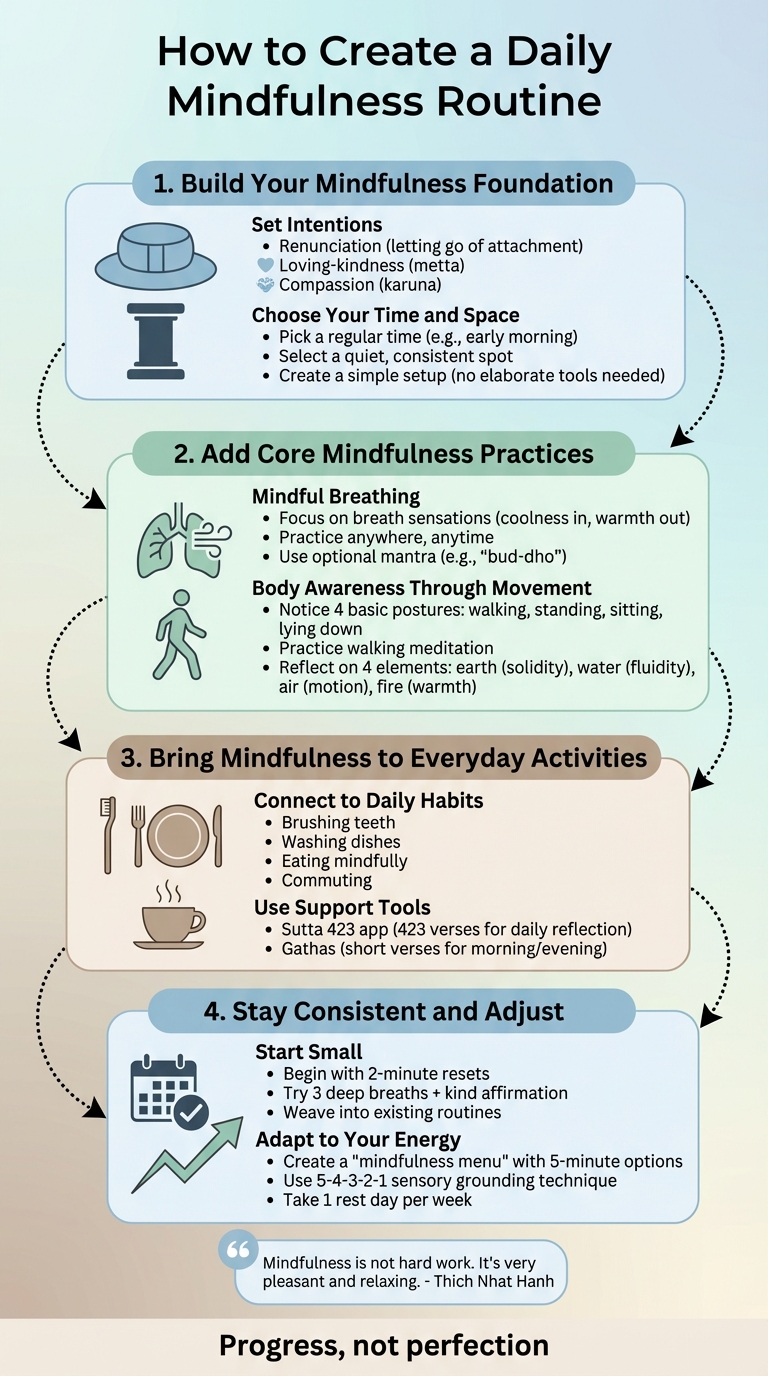
4-Step Daily Mindfulness Routine Guide
4 Simple Mindfulness Practices For Everyday Life
Step 1: Build Your Mindfulness Foundation
A strong foundation ensures your mindfulness practice remains steady over time. The Dhammapada teaches that the mind is the origin of all mental states - it's the driving force behind your experiences. This wisdom highlights how your intentions shape your reality: clear intentions lead to happiness, while unclear ones can bring suffering. With this in mind, you can define compassionate and focused intentions to guide your practice.
Set Intentions Using the Dhammapada
Start by clarifying your purpose through the lessons of the Dhammapada. The Buddhist idea of Right Intention (samma sankappa) is built on three essential qualities: letting go of attachment (renunciation), cultivating loving-kindness (metta), and fostering compassion (karuna). These principles ground your practice in care and non-harm.
If setting a flawless intention feels daunting, try the "What if…?" approach. Instead of declaring, "I will be more patient", consider asking, "What if I approach today with loving-kindness?" This shift reduces the pressure of rigid goals and opens the door to exploration.
The Dhammapada offers this reminder:
"The mind, hard to control,
Flighty - alighting where it wishes -
One does well to tame.
The disciplined mind brings happiness".
Let this verse be a guide as you create your daily routine. The aim isn't perfection but gently bringing your "flighty" mind back to the present moment, again and again. Once you've set your intentions, decide on the time and place to support your practice.
Choose Your Time and Space
Consistency is more important than complexity. Choose a regular time, like early morning, and a quiet spot to set the tone for your day. This could be a spare room, a corner of your bedroom, or even a specific chair in your living room when it's free. If a permanent space isn't an option, a portable setup works just as well.
As Buddhist teacher Alan Peto explains:
"A Buddhist daily practice is similar to going to working out for a muscular, toned, or healthy body... you are dedicated and consistent in order to achieve your goal".
You don't need elaborate tools or decorations. A simple setup - a small table with a fresh cup of water as an offering - can help establish your space and intention. If you include a Buddha statue or image, place it respectfully on a shelf or table, avoiding lower or unsuitable areas.
The secret is routine. Your mind thrives on repetition. Practicing at the same time and place daily trains your mind to recognize: "This is my time to return to stillness."
Step 2: Add Core Mindfulness Practices
Once you've established a foundation, it's time to incorporate key practices that help you stay rooted in the present. These simple exercises don't need special tools or long time commitments - just a moment to pause and refocus.
Practice Mindful Breathing
Your breath is a constant companion, making it an ideal anchor for mindfulness. Buddhist teacher Shaila Catherine calls mindful breathing a "portable vehicle" for cultivating calmness, awareness, and deeper understanding. The beauty of this practice is its flexibility - you can do it anywhere, whether you're at work, waiting in line, or preparing for a tough conversation.
Start by observing the sensation of your breath: feel the coolness as you inhale and the warmth as you exhale. Let the natural rhythm of your breathing guide you without trying to control it. If your mind wanders, gently bring your focus back to your breath. The Buddha taught that mindfulness of breathing lays the groundwork for profound insight and wisdom. To deepen the experience, try consciously relaxing tense areas like your shoulders or jaw. You might also use a simple mantra, such as "bud-dho", to help maintain focus.
As you grow more comfortable with mindful breathing, you can expand your practice to include awareness of your body's movements, creating a stronger connection to the present.
Develop Body Awareness Through Movement
Mindful movement is another way to tune in to the present by paying attention to your body's sensations. Begin by noticing the four basic postures: walking, standing, sitting, and lying down. Arrow River Forest Hermitage explains, "The exercise here is simply to be aware at all times of the disposition of the body".
Incorporate this practice into your daily routines. For example, when you get out of bed, pause and think, "I am standing." As you walk through your home, silently acknowledge each step with, "I am walking", as suggested by Thanissaro Bhikkhu. These small moments of mindfulness can transform ordinary activities into opportunities for awareness.
Walking meditation is an excellent way to explore mindful movement. Choose a short path, like a hallway, and walk slowly, focusing on the sensation of each step as your weight shifts from heel to toe. Plum Village emphasizes the connection between mindful breathing and movement, noting how awareness of the present moment naturally extends to physical actions.
To deepen your connection, reflect on your body through the lens of the four elements: solidity (earth), fluidity (water), motion (air), and warmth (fire). For instance, when stretching in the morning, notice the firmness of your bones, the flexibility of your muscles, the movement of your limbs, and the warmth that gradually spreads through your body. This practice highlights the impermanence of physical sensations, a key teaching in Buddhism that encourages letting go.
Whether you have just a couple of minutes or more time to spare, you can always return to mindful breathing or bring awareness to your movements to reconnect with the present moment.
Step 3: Bring Mindfulness to Everyday Activities
Once you've established a mindfulness practice, the next step is weaving that awareness into your daily life. The beauty of mindfulness is that it doesn't require carving out extra time. Everyday tasks - like eating breakfast, brushing your teeth, or walking to your car - can become opportunities to be fully present. As Thich Nhat Hanh explained, mindfulness is the energy of bringing your mind back to your body. He also emphasized that mindfulness is not only calming but also enjoyable, making it a natural fit for your daily routine.
Connect Mindfulness to Your Daily Habits
Start with simple, routine activities. For example, when brushing your teeth, focus on the feel of the bristles against your gums or the flavor of your toothpaste. Washing dishes? Pay attention to the warmth of the water and the smoothness of the plates. Eating can also transform into a mindful experience - chew each bite slowly, pause between bites, and truly savor your food. In the Plum Village tradition, practitioners recite five contemplations before meals, recognizing food as a "gift of the earth and sky", which fosters gratitude and a sense of connection to the planet.
Even moments that might seem mundane, like commuting, can be opportunities for mindfulness. Stuck in traffic or waiting in line? Notice feelings of impatience or frustration as they arise. Silently name the emotion - "This is stress" - and gently shift your focus back to your breath.
These small shifts in your habits create a foundation for mindfulness and make it easier to integrate digital tools to support your practice.
Use Tools to Support Your Practice
To keep mindfulness alive throughout the day, consider using digital tools and short contemplative verses. For instance, the Sutta 423 app offers a daily verse from the Dhammapada for reflection, providing 423 verses to guide you through more than a year of mindful living.
Incorporating gathas - short verses - into your routine can also help. When you wake up, set an intention like, "I will make this day meaningful and support others." At the end of the day, reflect on your actions, acknowledging any mistakes without self-judgment and celebrating acts of kindness and wisdom.
These practices, whether analog or digital, can help you stay grounded and present as you go about your day.
Step 4: Stay Consistent and Adjust as Needed
Mindfulness works best when practiced consistently, even if it's not perfect. Start with small steps and let your practice grow naturally to fit your lifestyle. This way, it stays manageable, no matter how your day unfolds.
Start Small With Brief Practices
When you're beginning, shorter practices are a great starting point. Think of it like easing into exercise - you wouldn't jump straight into a marathon. Try a "two-minute reset" by taking three deep breaths and offering yourself a kind affirmation. You can also weave mindfulness into your daily routines. For example, focus on your breathing while brushing your teeth or reflect on something you're grateful for as your coffee brews.
Thich Nhat Hanh put it beautifully: "Mindfulness is not hard work. It's very pleasant and relaxing, and we don't need extra time to do it". Even a single mindful breath counts. If you miss a day, simply begin again without self-criticism.
Adapt to Your Energy and Life Changes
Once you’re comfortable with shorter practices, adjust your routine to match your energy and daily schedule. Life can be unpredictable, so flexibility is key. Create a "mindfulness menu" with a few options - like a five-minute meditation, mindful stretching, or a sensory scan - and pick the one that feels right for the moment.
On days when energy is low, you might try gentle stretching or savoring a warm drink. When stress is high, ground yourself by naming five things you see, four you can touch, three you hear, two you smell, and one you taste.
To avoid burnout, consider setting aside one rest day each week to simply be. As the Dhammapada suggests, stay rooted in mindfulness while navigating life's changes. Small reminders, like a sticky note on your mirror or a designated mindfulness corner in your home, can help you stay on track when life gets hectic. Over time, consistency matters far more than being perfect every single day.
Conclusion
A daily mindfulness routine flourishes with intention rather than striving for perfection. Grounding your practice in the timeless wisdom of the Dhammapada can reshape both your mindset and your life. As the Buddha wisely stated, "Mind precedes all mental states. Mind is their chief; they are all mind-wrought. If with a pure mind a person speaks or acts, happiness follows him like his never-departing shadow".
This approach supports every aspect of your well-being - from finding peace in the present moment to fostering long-term spiritual growth and achieving greater freedom. Whether it’s setting intentions in the morning, practicing mindful breathing during the day, or reflecting on your experiences before bed, mindfulness becomes a journey toward deeper self-awareness. The Dhammapada, as Bhikkhu Bodhi describes it, is "the scriptural kalyanamitta par excellence, a small embodiment in verse of the boundless wisdom and great compassion of the Master".
To keep your practice consistent and meaningful, modern tools can provide helpful reminders. For example, the Sutta 423 app offers a daily Dhammapada verse for contemplation. With all 423 verses available, the app allows you to explore a full year of teachings, helping you set clear intentions, expand your understanding, and stay connected to the purpose behind your practice. By integrating these ancient teachings into your daily life, even through something as simple as your phone, each mindful moment can lead you toward lasting transformation.
FAQs
How do I pick one intention to focus on each day?
To start, choose a goal that resonates with your journey toward spiritual growth and mindfulness. Think about qualities you’d like to nurture - such as gratitude, kindness, or patience. Make it a habit to set this intention at the beginning of your day, and take time to reflect on it during moments of mindfulness throughout your routine. By keeping this focus consistent, you can heighten your self-awareness and strengthen your personal growth.
What should I do when my mind keeps wandering during breathing practice?
If your thoughts start to drift during a breathing exercise, don’t be hard on yourself. Instead, calmly guide your attention back to your breath. Acknowledge the distraction without judgment, release it, and bring your focus back to the present. This simple act of redirection helps build mindfulness and encourages a sense of calm by teaching your mind to refocus whenever it strays.
How can I stay consistent when my schedule changes?
To keep up with your mindfulness routine during shifts in your schedule, lean into adaptable practices like mindful breathing, walking, or eating - things you can do no matter where you are. Begin your day by setting clear intentions to stay engaged, even when life gets hectic. Using tools like mindfulness apps or timers can serve as helpful nudges to take a moment and refocus. The beauty of mindfulness is that it’s not bound to a particular time or place - it can seamlessly blend into any part of your day.