

Compassion in Action: Lessons from the Dhammapada
Compassion reshapes daily life: Buddhist verses teach mindful non-harming, turning anger into wise action.
The Dhammapada, a revered Buddhist text, offers 423 verses that focus on living with compassion (karuṇā) and non-harming (ahiṃsā). These teachings guide ethical living, mindful decision-making, and overcoming harmful emotions like anger. Key lessons include:
- Golden Rule: Reflect on shared vulnerability before causing harm (Verse 129).
- Hatred Ceases Through Love: Break cycles of hostility with kindness (Verse 5).
- Threefold Training: Ethical actions (sīla), mental calm (samādhi), and wisdom (paññā) form the foundation of compassion.
Practical steps for daily application:
- Recognize and redirect harmful emotions like anger.
- Use methods like goodwill, compassion, or equanimity to manage conflict.
- Practice mindful speech and listening to build stronger connections.
- Reflect on one verse daily to internalize these teachings.
Core Dhammapada Teachings on Compassion
What Dhamma and Dhammapada Mean
The word Dhammapada comes from two Pali terms: dhamma, which translates to teaching, virtue, or truth, and pada, meaning step, path, or verse. Together, they describe a "Path of Virtue" that provides a step-by-step guide to living with compassion. This foundation shapes the teachings discussed in this section.
The text acts as a practical guide, much like a spiritual companion (kalyanamitta), offering wisdom to navigate moral challenges and apply these lessons in daily life.
Key Verses on Non-Harming
Verses 129–130 emphasize the universal fear of suffering:
"Everyone trembles at the stick, everyone is in fear of death, comparing oneself (with others), one should not hurt or have (them) hurt." - Dhammapada Verse 129
This teaching, known as attānaṁ upamaṁ katvā (making oneself the example), mirrors the principle of the Golden Rule. It urges us to pause and reflect on our shared vulnerability before causing harm to others.
Another cornerstone is Verse 5, which states: "Hatreds never cease through hatred in this world; through love alone they cease. This is an eternal law." The term sanantana, meaning timeless or universal, highlights that this truth transcends cultural and temporal boundaries.
These verses lay the groundwork for the Threefold Training, a framework for compassionate living.
The Threefold Training for Compassionate Living
The Dhammapada structures its teachings on compassion around the Threefold Training, a framework of three interconnected principles:
| Pillar | Pali Term | What It Involves |
|---|---|---|
| Ethical Discipline | Sīla | Avoiding harmful actions in both speech and deeds |
| Concentration | Samādhi | Calming the mind to overcome anger and passion |
| Wisdom | Paññā | Understanding that all beings fear suffering |
These pillars guide daily actions, fostering thoughtful and compassionate choices. Verse 281 highlights the importance of aligning ethical, mental, and physical restraint, stressing that pure intentions are the foundation of true compassion. A calm mind, mindful speech, and deliberate actions work together to create a life grounded in compassion.
Verse 183 encapsulates this entire approach: "Not to commit any sin, to do good, and to purify one's mind, that is the teaching of (all) the Awakened." This concise statement ties together the principles of sīla, samādhi, and paññā, offering a clear blueprint for compassionate living.
Identifying and Changing Harmful Intentions
What Harmful Mental States Look Like
To cultivate compassion, it's crucial to recognize the mental states that undermine it. According to the Dhammapada, three core defilements fuel harmful behavior: lust, hatred, and delusion. Among these, hatred and anger are particularly damaging, as they can cloud judgment and disrupt inner peace.
Anger often manifests subtly, through physical sensations like a racing heart, a tight stomach, or tense shoulders. It distorts how we see situations, narrowing our focus and disconnecting us from our values and the potential consequences of our actions. This emotional state is frequently sustained by replaying past grievances, with thoughts such as "he abused me", "he struck me", or "he robbed me". Thanissaro Bhikkhu, Abbot of Metta Forest Monastery, offers a stark reminder:
"Under the power of anger, you will do precisely the things that your enemy would wish to see you do."
Steps for Inner Change
The Dhammapada not only identifies these harmful states but also provides guidance for overcoming them. The journey begins with honest self-reflection: ask yourself why anger might feel satisfying or justified.
The Āghatāvinaya Sutta (AN 5:161) outlines five practical methods for managing hatred toward a specific person:
| Method | How to Apply It |
|---|---|
| Goodwill (Metta) | Consciously wish for the other person's happiness and well-being. |
| Compassion (Karuṇā) | Acknowledge their suffering or ignorance as the root of their behavior. |
| Equanimity (Upekkhā) | Strive for a neutral, calm state if kindness feels unattainable. |
| Non-attention | Stop giving mental energy to the source of your anger. |
| Ownership of Kamma | Accept that your actions shape your future, focusing on what you can control. |
If one method doesn’t work, move on to the next until the anger subsides. These approaches help redirect harmful intentions, laying the groundwork for applying compassion, even in challenging moments.
Applying Compassion to Everyday Stressors
Hatred doesn’t only appear in major conflicts - it often sneaks into the small frustrations of daily life. A dismissive remark from a coworker, a familiar argument with a family member, or the irritation of being cut off in traffic can all trigger anger.
In these moments, the Dhammapada offers a helpful perspective: when feeling provoked, pause and ask yourself, "What should I expect?". This isn’t about giving up but about recognizing that difficulties are part of the shared human experience.
Verse 223 provides a practical guide: "Overcome anger with non-anger, and falsehood with truth". In practice, this might mean taking a deep breath before replying to a sharp email, choosing a calm tone during a heated discussion, or staying patient in a traffic jam. These small, deliberate choices bring the Dhammapada’s wisdom into everyday life, turning abstract teachings into real-world habits.
Christina Feldman – Introduction to the Dhammapada
How to Practice Compassionate Action Daily
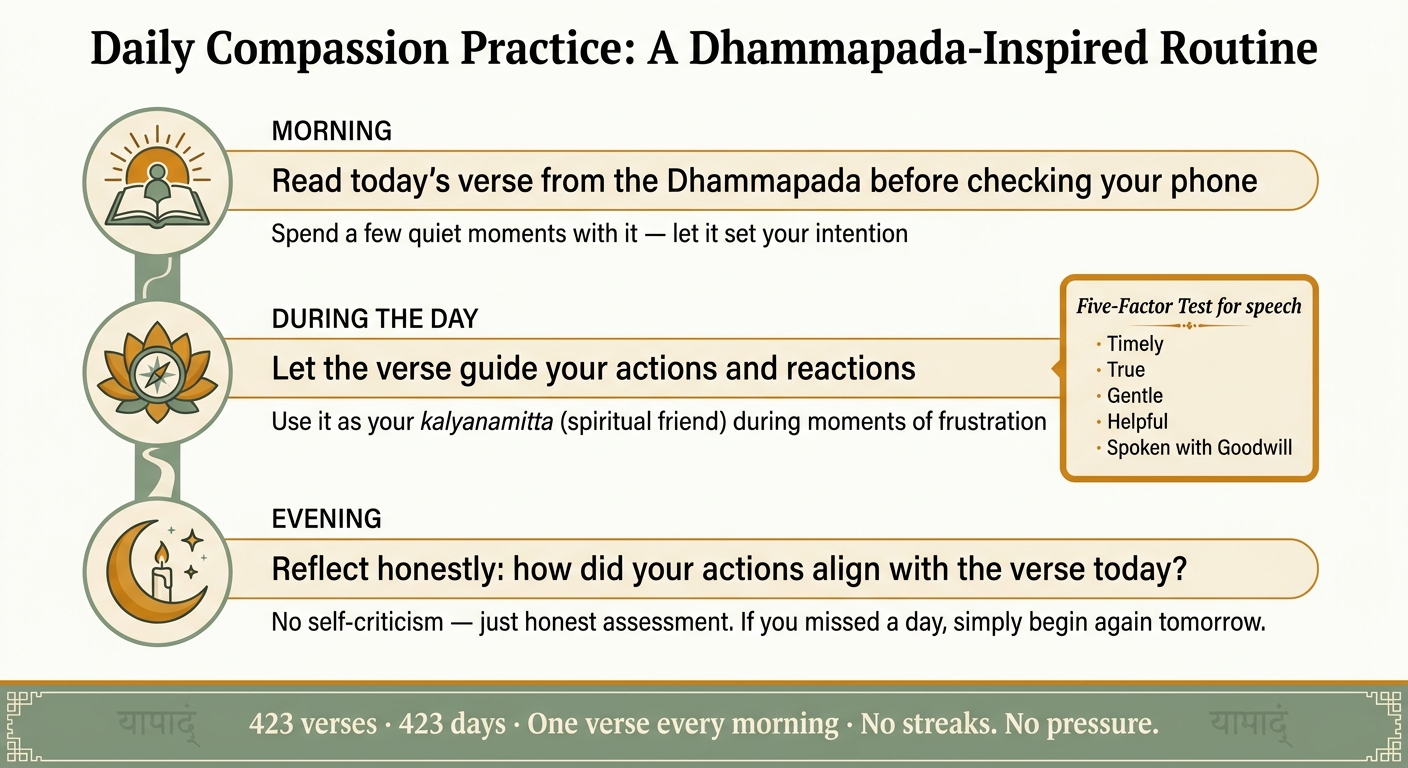
Daily Compassion Practice: The Dhammapada 3-Step Routine
Inspired by the Dhammapada's teachings on ethical and mindful living, here are some practical ways to bring compassion into your everyday life.
Mindful Speech and Listening
Our words have power - they shape not only our relationships but also our inner selves. The Dhammapada emphasizes that speech reflects character, urging us to speak only what is truthful and helpful. The Buddha outlined this guideline in MN 58, offering a simple yet profound standard.
A helpful tool for practicing this is the Five-Factor Test: before speaking, ask yourself if your words are timely, true, gentle, helpful, and spoken with goodwill. If your words don’t meet even one of these criteria, consider pausing. Venerable Vaṅgīsa, a disciple of the Buddha, captured this beautifully:
"Speak only such words that do not hurt yourself nor harm others; such speech is truly well spoken."
Listening, too, is a key part of compassionate communication. When someone shares something difficult, try pausing to take three deep breaths before responding. This simple act shifts your focus from what you want to say to what the other person truly needs to be heard.
By practicing mindful speech and deep listening, you create a foundation for compassion that can ripple out into every interaction.
Compassion at Work and in the Community
Workplaces and community spaces can often feel overwhelming or emotionally draining. In stressful environments, it’s easy to withdraw emotionally, but this "coldness" can cause harm in subtle ways.
Buddhism’s teaching on interdependence (pratītya-samutpāda) reminds us that our shared environment is shaped by everyone’s actions and attitudes. Your choices - whether it’s how you respond to a stressed colleague or how you contribute to a group discussion - can influence the collective atmosphere. These moments are opportunities to practice the Threefold Training: ethical conduct in your words, mental composure in your reactions, and wisdom in understanding others’ struggles.
"When you see that your well-being and the well-being of others are intertwined, compassion stops being an optional extra. It becomes the only thing that makes sense." - J.W. Bertolotti, Author, Perennial Meditations
One way to bring compassion into these spaces is to stop viewing coworkers or peers as just roles or obstacles. Instead, recognize them as individuals navigating their own challenges. Balancing compassion with clear boundaries allows you to address issues directly without letting frustration or resentment take over.
Turning Anger into Patience
Compassionate action also involves transforming anger into patience. This builds on mindful communication and care for others, reinforcing your daily commitment to kindness.
The Dhammapada warns that anger is like a "fierce fire that can burn the forest of merit". It’s not about suppressing anger but learning to catch it early and redirect it into something constructive.
One approach is Selective Attention. When someone frustrates you, focus on a single positive trait they have - perhaps a kind word they’ve said or a helpful action they’ve taken. If you can’t find anything positive, try to see them with the same compassion you’d offer someone who is seriously ill and in need of care.
Sakka, Ruler of the Gods, summed this up perfectly:
"Not giving anger for anger, one wins a double victory. He behaves for the good of both: himself and the other person."
The Dhammapada also teaches that conquering your own anger is a far greater achievement than winning any external battle. Patience, in this sense, is a choice - a deliberate decision to hold back anger to avoid actions you might regret.
Making Daily Reflection a Habit
Occasional practice won't shape character; daily reflection will.
Why Reflecting on One Verse a Day Matters
The Dhammapada begins with a powerful idea: the mind is the "forerunner of all states." Every action, word, and reaction starts in the mind. That’s why daily reflection isn’t just a pleasant ritual - it’s a practical way to gradually replace harmful habits with compassionate ones.
The key is gradually. You don’t need to absorb all 423 verses right away. Focusing on just one verse each day is enough to make a meaningful impact. As Acharya Buddharakkhita, a respected translator and scholar, explained:
"For the simple and unsophisticated the Dhammapada is a sympathetic counselor; for the intellectually overburdened its clear and direct teachings inspire humility and reflection; for the earnest seeker it is a perennial source of inspiration and practical instruction."
Bhikkhu Bodhi, a highly regarded Buddhist scholar, describes the Dhammapada as a "scriptural kalyanamitta par excellence" - a spiritual friend you can turn to during moral or personal challenges. Focusing on one verse daily keeps that connection alive, blending its timeless teachings with your everyday experiences.
Using Sutta 423 for Daily Reflection

The toughest part of any reflective practice? Staying consistent. Life gets hectic, and good intentions can slip away. That’s where Sutta 423 comes in.
This app delivers one verse each day at midnight local time, so it’s ready when you wake up. There’s no pressure - no streaks to maintain, no scores to track. Each morning simply brings a new verse. As Sutta 423 puts it: "A few minutes is enough. A daily reading from the Dhammapada. No streaks. No pressure."
Over 423 days, you’ll reflect on every verse in the Dhammapada. Once you complete the cycle, the practice continues. The daily verse is free with no paywalls, and optional in-app support starts at just $0.99 for those who wish to contribute. By combining Sutta 423’s simplicity with a consistent routine, you can weave these teachings into your daily life.
A Simple Daily Routine for Compassion
Here’s a three-step routine to help make this habit stick:
- Morning: Read the verse as soon as you wake up. Spend a few quiet moments with it before diving into your phone or daily tasks.
- During the day: Let the verse guide your actions. For example, if it emphasizes non-hatred, use it as a reminder during moments of frustration. Think of it as your kalyanamitta - a spiritual friend offering support throughout the day.
- Evening: Before bed, reflect on how your actions aligned with the verse. Focus on honest self-assessment, not criticism. If you miss a day, just pick up again the next morning.
"In 423 days, you'll have walked through the entire Dhammapada - not just read it, but lived with it." - Sutta 423
Conclusion: Living by the Dhammapada's Teachings
The Dhammapada reminds us that our thoughts shape who we are and the paths we take in life. This wisdom encourages us to take ownership of our daily thoughts, words, and actions.
Practicing non-harming is far from passive - it’s an active choice to avoid letting anger or resentment control our responses. Breaking cycles of hostility starts with recognizing that all beings fear harm and value life. When negative intentions arise, the key is to acknowledge them, understand their roots, and consciously choose a kinder response.
Compassion, rooted in this internal shift, can be seen in small, mindful actions. It appears in how we listen, respond thoughtfully, and reflect honestly. The Dhammapada's 423 verses are packed with practical advice to guide us in these moments.
Turning these teachings into habits takes consistency. The "Echo" feature in Sutta 423 supports this by revisiting verses at regular intervals - Day 1, Day 8, and Day 15 - helping the lessons sink in naturally. As Sutta 423 explains: "Repetition deepens understanding. The teachings layer naturally, without turning practice into homework." Each verse is shared daily, free of charge, without any pressure to maintain streaks - just one verse every morning to inspire thoughtful living.
FAQs
How can I tell when anger is starting to take over?
Anger often starts with subtle signs - a sense of agitation, rising impatience, or even an overwhelming urge to react negatively. The Dhammapada’s Kodhavagga: Anger section sheds light on these early indicators, guiding you to notice them as they arise. Recognizing these moments can help you pause and respond with mindfulness instead of letting anger take control.
What can I do if metta feels impossible during a conflict?
If practicing metta feels overwhelming during a conflict, begin by focusing on yourself. Start with cultivating a sense of loving-kindness inwardly - acknowledge your own feelings and offer yourself compassion. Once you feel grounded, extend this kindness to neutral individuals - those you don’t feel strongly about. Over time, as you build this practice, try directing it toward people you find difficult.
Remember, it’s okay to take your time. Working through anger and resentment requires patience and understanding. Treat this as a gradual journey, allowing space for growth in compassion at your own pace.
How can one daily Dhammapada verse change my habits?
A daily verse from the Dhammapada can influence your habits by promoting mindful reflection and guiding your choices. Taking time to reflect on a single verse each day encourages self-awareness, making it easier to absorb its wisdom. Over time, this simple practice can help you recognize and minimize harmful tendencies, nurture positive habits, and develop a deeper sense of compassion. It’s a steady step toward greater mindfulness and ethical living.