

Common Misinterpretations of Dependent Origination
Clears up common misunderstandings of Dependent Origination and shows how to apply it to interrupt suffering in daily life.
Dependent Origination is a core Buddhist teaching that explains how suffering arises and ceases based on conditions. Misunderstanding it can lead to confusion and hinder personal growth. Common errors include viewing it as rigid determinism, a creation myth, or abstract theory. Instead, it’s a practical framework for breaking cycles of suffering through mindful intervention.
Key Takeaways:
- What it is: A sequence of 12 links (nidānas) showing how suffering arises and ends.
- Misinterpretations: Often mistaken for fatalism, creationism, or purely theoretical.
- Practical use: Helps identify points to interrupt habitual reactions and reduce suffering.
This teaching isn’t about abstract debate. It’s a guide for observing patterns in daily life and making intentional changes for a better outcome.
Dependent Origination | Ajahn Brahmali | 17-04-2009
Core Principles of Dependent Origination
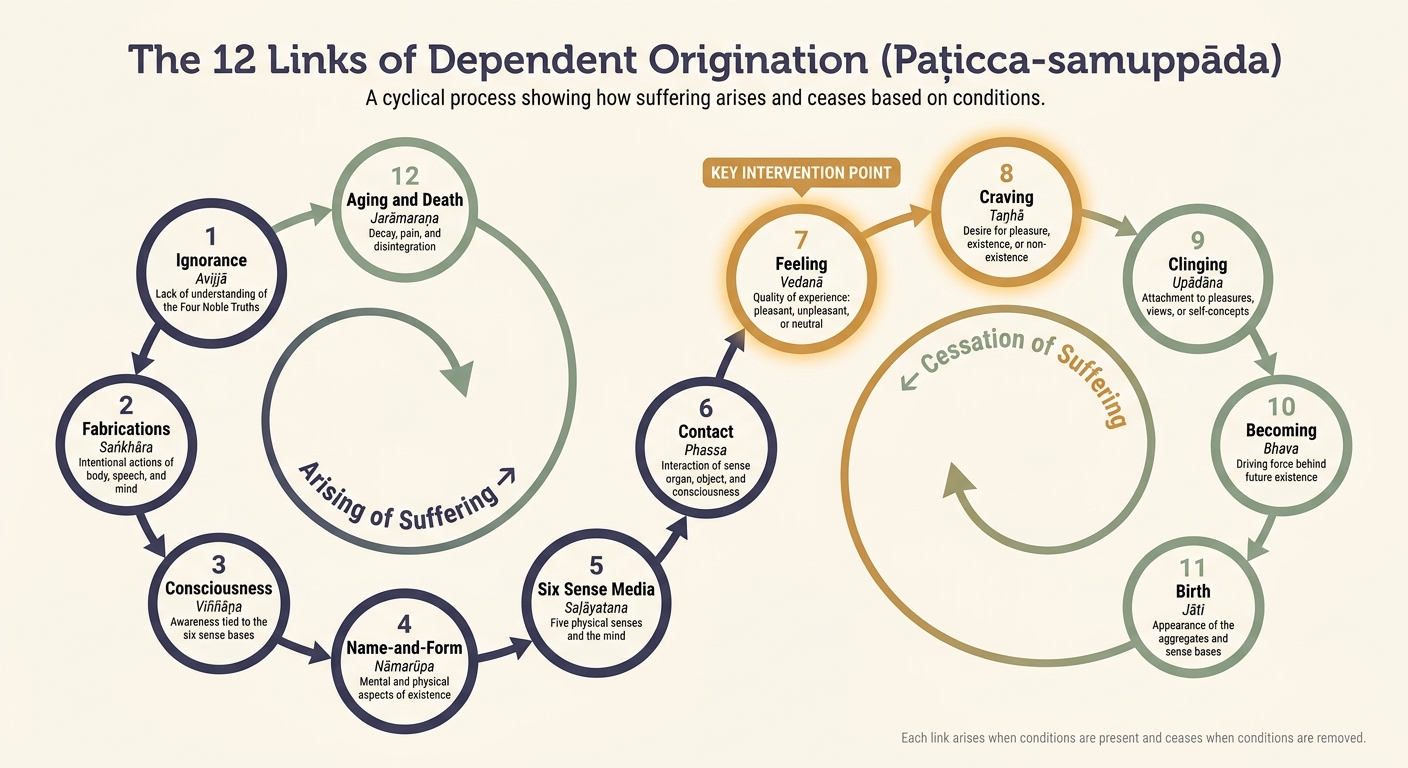
The 12 Links of Dependent Origination: How Suffering Arises and Ceases
The Twelve Links of Dependent Origination
Dependent Origination outlines a sequence of 12 interconnected links, known as nidānas, which explain how suffering comes into being and how it can be overcome. This chain operates in two directions, showing both the arising of suffering and its cessation.
| Link # | Term (Pali) | Meaning |
|---|---|---|
| 1 | Ignorance (Avijjā) | A lack of understanding of the Four Noble Truths and the nature of reality |
| 2 | Fabrications (Saṅkhāra) | Intentional actions of body, speech, and mind |
| 3 | Consciousness (Viññāṇa) | Awareness tied to the six sense bases, especially in the context of rebirth |
| 4 | Name-and-Form (Nāmarūpa) | The combination of mental and physical aspects of existence |
| 5 | Six Sense Media (Saḷāyatana) | The five physical senses and the mind (intellect) |
| 6 | Contact (Phassa) | The interaction of a sense organ, its object, and the resulting consciousness |
| 7 | Feeling (Vedanā) | The quality of experience - whether pleasant, unpleasant, or neutral |
| 8 | Craving (Taṇhā) | Desire for sensory pleasure, continued existence, or even non-existence |
| 9 | Clinging (Upādāna) | Attachment to pleasures, views, or concepts of self |
| 10 | Becoming (Bhava) | The driving force behind future existence, shaped by habitual tendencies |
| 11 | Birth (Jāti) | The appearance of the aggregates and the functioning of the sense bases |
| 12 | Aging and Death (Jarāmaraṇa) | The inevitable process of decay, pain, and the disintegration of the aggregates |
A key takeaway is that while past conditions (such as the body and senses) influence the present, current actions have the power to change the chain’s trajectory.
This interconnected process provides a framework for understanding how impermanence, the absence of a fixed self, and suffering are deeply intertwined.
Connection to Impermanence, Non-Self, and Suffering
The 12 links of Dependent Origination highlight three core Buddhist concepts: impermanence, non-self, and suffering. Each link arises only when the necessary conditions are present, and it ceases when those conditions disappear. This constant arising and fading away emphasize the impermanence of all experiences. Furthermore, the absence of a fixed or permanent "self" in this unfolding process underscores the principle of non-self. Together, these links form the foundation of suffering, showing how it originates and how it can be dismantled.
As stated in the Majjhima-nikāya:
"Who sees dependent arising sees the Dharma; who sees the Dharma sees dependent arising."
By understanding Dependent Origination, one gains a deeper appreciation of impermanence and the absence of a permanent self, paving the way for liberation from suffering.
Dependent Origination as a Practical Teaching, Not Speculation
The Buddha presented Dependent Origination as a practical tool for addressing the roots of suffering, rather than as a subject for abstract debate. It serves as a diagnostic framework, helping practitioners identify and eliminate the conditions that give rise to suffering.
As Piyadassi Thera aptly put it:
"Dependent origination is not a discourse for the unintelligent and superficial, nor is it a doctrine to be grasped by speculation and mere logic put forward by hair-splitting disputants."
This teaching is often described as the middle way between extreme views like eternalism (the idea of an unchanging self) and nihilism (the belief that nothing exists). Instead, it portrays experience as a conditioned, dynamic process - neither fixed nor completely void of meaning.
Common Misinterpretations and Their Corrections
Misinterpretation 1: Dependent Origination as Determinism
When Western readers first encounter Dependent Origination, they often view it through the lens of analytic philosophy, which tends to pit free will against strict determinism. Because Dependent Origination describes how phenomena arise from prior conditions, it can be misunderstood as rigid determinism.
But there’s an important distinction. Determinism implies that if A causes B, then B is inevitable. Dependent Origination, however, suggests that A conditions B - meaning A makes B possible or more likely, but the outcome depends on a complex, shifting interplay of factors. Instead of a predictable domino effect, think of it as a river whose course can shift with even a single moment of mindfulness. The Buddha rejected fatalistic views, seeing them as harmful because they deny the transformative potential of mindful effort.
As one explanation puts it:
"Determinism says the chain is unbreakable. Dependent origination says: that is the chain, and here are the tools for working with it." – Just-Buddha.org
Misinterpretation 2: Dependent Origination as Creationism
Some interpret Dependent Origination as implying a first cause or creator because it describes a chain of arising. However, paṭicca-samuppāda refers to a beginningless cycle, not a linear sequence with a defined starting point. Unlike creationist beliefs that attribute existence to a single omnipotent cause, Buddhist teachings emphasize that phenomena arise from multiple causes, with no single factor solely responsible for any event.
Piyadassi Thera explained it clearly:
"If one posits a 'First Cause' one is justified in asking for the cause of that 'First Cause,' for nothing can escape the law of condition and cause which is patent in the world to all but those who will not see." – Piyadassi Thera
This perspective shifts focus away from abstract debates about origins and toward the role of personal actions in shaping outcomes.
Misinterpretation 3: Dependent Origination as Merely Psychological or Solely Cosmological
Some see Dependent Origination as a description of moment-to-moment mental processes, mapping how the mind moves from sensation to craving. Others view it as a grand cosmological explanation of existence across multiple lifetimes. While both perspectives capture parts of the teaching, neither tells the whole story.
The texts show that Dependent Origination operates on multiple levels - across time, within the mind, and throughout society. It’s not a simple linear sequence but a dynamic feedback loop.
As scholar Vidyabhaskar Omkara observed:
"The Buddha's intention in establishing this chain is consistently soteriological... it identifies the conditions that give rise to an ailment and thereby reveals the conditions whose removal would allow the ailment to cease." – Vidyabhaskar Omkara
Misinterpretation 4: Dependent Origination as Abstract Theory
A frequent mistake is treating Dependent Origination as an intellectual exercise - something to analyze and debate without applying it to life. This misses the point entirely. The teaching isn’t meant for idle speculation but for practical transformation.
Viewing it as abstract theory overlooks its ethical and meditative importance. Dependent Origination highlights specific points where we can intervene in our habitual patterns. These aren’t abstract concepts - they show up in daily life, like how we react to a frustrating conversation or a disappointing situation. By introducing new conditions, such as mindfulness or ethical intention, we can change the trajectory of these patterns.
As one teaching puts it:
"The conditions you inherited are not your fault. The conditions you contribute going forward are your practice." – Just-Buddha.org
Seeing Dependent Origination as a practical guide helps us recognize its relevance in everyday situations, setting the stage for exploring its applications further.
Practical Applications for Daily Life
Noticing Conditional Patterns in Daily Life
Dependent Origination becomes tangible when you start observing your own reactions. A feeling emerges, then craving follows, which often leads to action or conflict. This cycle repeats itself, usually unnoticed, unless you consciously pay attention to it.
Bhikkhu Bodhi, translating directly from the Mahā Nidāna Sutta, explains:
"In dependence upon feeling there is craving; in dependence upon craving there is pursuit; in dependence upon pursuit there is gain; in dependence upon gain there is decision-making."
The key moment to intervene lies in the gap between feeling and craving. When you notice an emotion - whether it's frustration, longing, or discomfort - and recognize it as fleeting and conditioned, you create a pause. This pause is where meaningful practice begins.
Scholar Andrea Sangiacomo articulates this process:
"By realizing how any given experience arises out of the systematic conditional relationship among several factors, the practitioner's attention is directed to contemplate the constitutively conditional nature of phenomenal experience as a whole."
This awareness transforms theoretical understanding into practical self-reflection.
Using Sutta 423 for Daily Reflection

A simple way to nurture this awareness is by reflecting on the Buddha's teachings daily. The Sutta 423 app offers one verse from the Dhammapada each day - 423 verses in total, enough for over a year of reflection. This daily habit acts as a small but steady influence (upanisā), helping to cultivate wiser attention over time.
Each verse gently reminds you of the principle of conditionality, steering your mind away from automatic reactions and toward mindful reflection.
P. A. Payutto highlights the importance of understanding and applying these teachings:
"Our happiness within this natural system depends on having some knowledge of how it works and practicing correctly within it, through addressing problems on the personal, social, and environmental levels."
Connecting Study with Practice
The teachings emphasize identifying key moments to interrupt habitual reactions. To truly benefit, study must align with direct observation and practice. Reading about Dependent Origination provides the framework, but its value lies in applying it to real-life situations. Meditation and ethical behavior bring these insights to life.
For example, when faced with a challenging emotion, ask yourself: "What is sustaining this feeling right now?" It could be unwise attention, a lack of mindfulness, or a sensory trigger. Recognizing the "fuel" for the emotion is the first step to letting it go - just as a fire dies down when its source of fuel is removed.
Dhivan Thomas Jones encapsulates the essence of this teaching:
"Dependent arising is not a theory about the world, but a teaching about the arising and ceasing of suffering."
Conclusion: A Balanced Understanding of Dependent Origination
Dependent Origination is often misunderstood - sometimes seen as strict determinism, a cosmological framework, abstract philosophy, or merely cause and effect. These misinterpretations can obscure its true purpose: understanding how suffering arises and how it can cease.
At its heart, Dependent Origination is a dynamic interplay of conditions, where each element influences and is influenced by others. Bhikkhu Bodhi describes it as a "teaching by the middle," avoiding the extremes of eternalism (the belief in a permanent self) and annihilationism (the belief in total nonexistence). Instead, it reveals a reality where conditions arise and pass away, without a fixed self or complete void. This perspective ties directly to the practical methods discussed earlier.
The Buddha himself highlighted the complexity of this teaching:
"Deep, indeed, Ānanda, is this paṭicca-samuppāda, and deep does it appear. It is through not understanding, through not penetrating this doctrine, that these beings have become entangled like a matted ball of thread." - The Buddha, Dīgha-nikāya
Understanding alone isn’t enough to break the cycle. What’s needed is direct experience: observing the chain as it unfolds, pausing before reacting, and questioning habitual patterns with mindfulness. Small, intentional actions - like reflecting on a verse from the Sutta 423 app - can begin to shift this chain of conditions. By addressing these common misinterpretations, the teaching becomes a practical tool for transformation.
The key insight here is that every condition that arises also has the potential to cease. This is not just a theoretical notion - it’s an invitation to engage with even the most ingrained patterns and discover the possibility of change.
FAQs
Where can I break the chain in real life?
Breaking the chain of dependent origination involves observing your experiences as they happen, rather than viewing them as unchangeable. There are specific moments where you can step in and disrupt the cycle:
- The space between contact and feeling: Notice the moment when sensory contact transitions into a feeling.
- The shift from feeling to craving: Pay attention to how feelings can lead to desire or aversion.
- The fixation of identity between grasping and becoming: Recognize when attachment begins to shape your sense of self.
When reactions arise, pause. Allow feelings to come and go without holding onto them. Over time, these patterns will start to lose their grip. You might also benefit from incorporating daily reflection, such as using Sutta 423, to deepen your awareness.
How is this different from karma or fate?
Dependent origination and karma are interconnected concepts, yet they address different aspects of existence. Dependent origination describes how all phenomena come into being through specific causes and conditions. Karma, within this framework, highlights the role of intentional actions in shaping future experiences. Unlike the idea of fate, these teachings stress the importance of conditionality and personal responsibility, demonstrating that outcomes are shaped by individual choices and actions - not by an unchangeable destiny.
Do the 12 links happen in one moment or across lifetimes?
The twelve links of Dependent Origination can be approached in two ways. The traditional view spans past, present, and future lives, often referred to as the three-life model. Alternatively, they can be understood as unfolding within a single moment, emphasizing present-moment psychological dynamics. Whichever perspective you choose, these links serve as a practical tool for meditative exploration. For those seeking a straightforward way to incorporate such teachings into daily life, Sutta 423 in the Dhammapada provides a helpful starting point.