
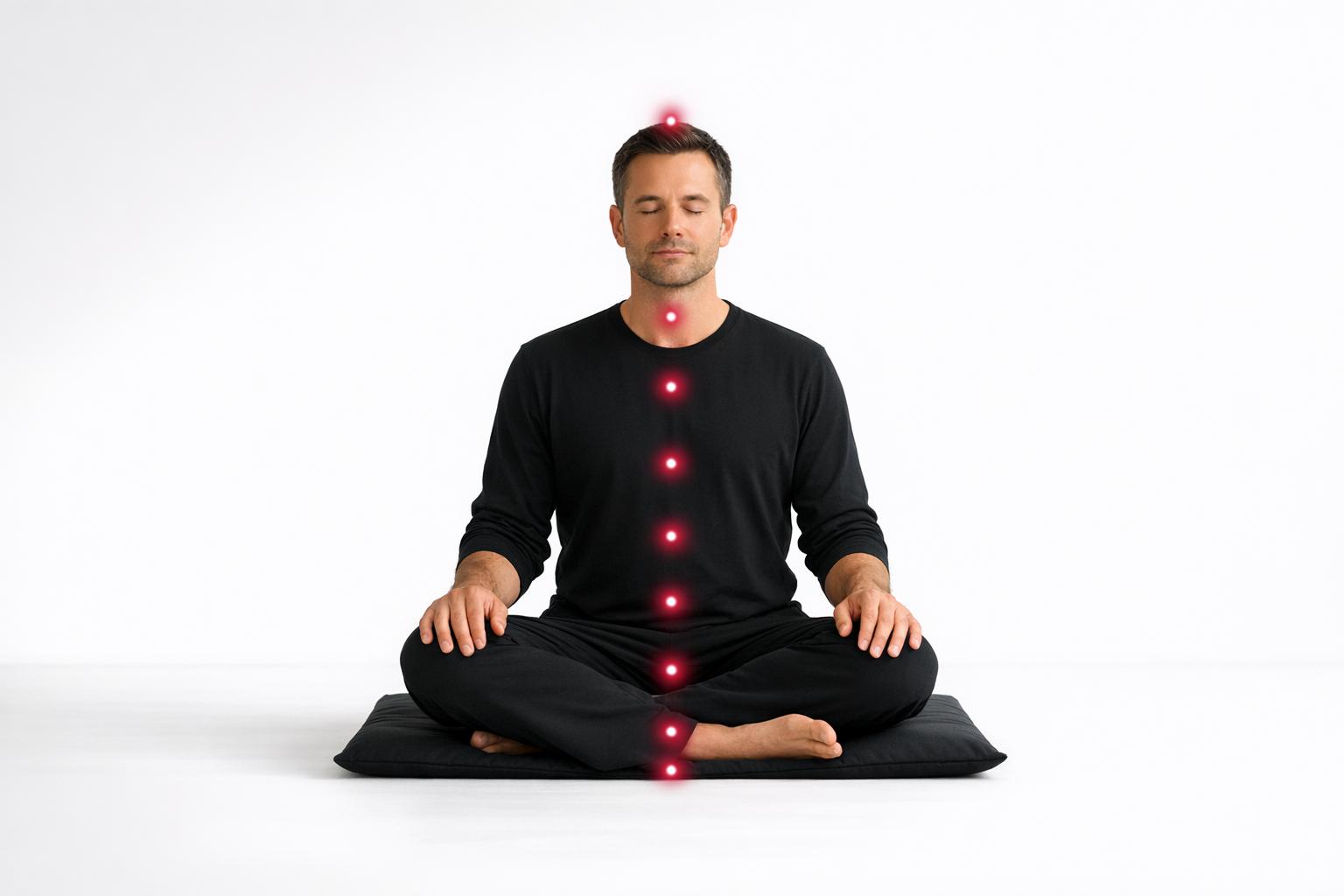
How Body Scan Meditation Aids Awareness
Train interoception with body scan meditation to reduce stress, regulate emotions, and build daily awareness.
Body scan meditation helps you reconnect with your body by focusing on physical sensations, like tension or warmth, from head to toe. It’s not about fixing anything but observing with curiosity. This practice improves awareness of your body’s internal signals (interoception), which can help you catch stress and emotional shifts early. Research shows stress-related conditions make up 60–80% of doctor visits, and body scans can help mitigate these effects by calming the mind and reducing anxiety.
Here’s what you need to know:
- What It Does: Helps you notice body sensations and understand emotions better.
- How It Works: Shifts focus from mental stress to physical awareness, calming the nervous system.
- Benefits: Reduces stress, supports emotional regulation, and reconnects you with your body.
- Challenges: Restlessness, sleepiness, or discomfort can arise but can be managed with simple adjustments.
- Daily Practice: Use guided or self-guided scans, lasting 10–45 minutes, or quick check-ins during busy days.
Pairing this practice with reflective verses from the Dhammapada can deepen mindfulness and help integrate insights into daily life. Even 10 minutes a day can improve awareness and create a calmer mental state.
Body Scan Meditation for Awareness and Calm | Meditate with MSK
The Awareness Gap in Modern Life
Many Americans go through their day on autopilot - checking phones, sitting at desks, and juggling tasks - without paying attention to the subtle signals their bodies send. While our brains create automatic habits to help us navigate daily life, this efficiency comes with a downside: over time, we lose touch with what our bodies are trying to tell us. Tristan Harris, Product Philosopher at Google, highlights this issue, noting that "Digital tech... forced our nervous systems into overdrive." The statistics back this up: the average attention span on a screen has plummeted from two and a half minutes in 2004 to just 47 seconds today. Every notification, every scroll pulls our focus outward, making it harder to tune into internal sensations. Scientists describe this struggle as a clash between "exteroception" (awareness of external stimuli) and "interoception" (awareness of internal bodily states). This growing disconnect can lead to physical discomfort and emotional instability.
What Happens When You Ignore Your Body
When you constantly ignore your body's signals, small cues can go unnoticed until they become severe. Willa Blythe Baker, PhD, Founder and Spiritual Director of Natural Dharma Fellowship, emphasizes,
"The body's involvement in our daily survival has become so minimal that our bodies suffer pervasively from a collective sedentariness that has come to impact our longevity, not to mention our physical and mental well-being."
Sedentary lifestyles limit the variety of physical sensations your body can produce, which in turn makes the signals you do receive harder to interpret. Studies reveal that this sensory shutdown in brain areas linked to bodily awareness is associated with an eightfold increase in the risk of developing a depressive episode. On an emotional level, reduced awareness of your body's signals can make it harder to understand and manage your feelings, often resulting in impulsive behavior.
How Stress and Rumination Take Hold
When bodily signals are ignored, stress can build and spiral into repetitive cycles. The brain stays stuck in problem-solving mode, replaying worries and worst-case scenarios instead of finding genuine rest. Alex Alonso, COO of Bright Futures Treatment Center, explains,
"In an increasingly industrial world... silence starts to feel unusual. In that space, the brain forgets how to slow down and recover."
As the Niroga Institute points out, "Awareness alone does not equate to regulation; it's just the first step". Simply recognizing that you're stressed isn't enough - you need to actively engage with your body to release that tension. Stress is fundamentally a physical response, preparing your body for action. But if you're sedentary, that energy has nowhere to go, leaving cortisol levels elevated and your nervous system stuck in high alert. Practices like body scan meditation can help break this cycle and restore a sense of equilibrium.
How Body Scan Meditation Builds Awareness
Body scan meditation helps train your mind to notice even the smallest physical sensations, bridging the gap between your awareness and your body's signals. The practice involves systematically focusing on different parts of your body, from your feet to your head, while observing any sensations without trying to change them. It’s not just about relaxation - it’s an active exercise in tuning into your internal world. As AJ Keller, CEO of Neurosity, explains:
"The body has been talking to you your entire life. The body scan is just the practice of finally learning to listen."
Tuning Into Your Body's Signals
When you focus your attention on specific areas of your body, you engage the somatosensory cortex - your brain's internal map of the body. Over time, this practice refines your sensory awareness by expanding the brain’s representation of these areas.
This heightened awareness goes beyond physical sensations. Studies reveal that being in tune with your internal signals, known as interoceptive accuracy, is a better predictor of emotional regulation than IQ or memory skills. For instance, recognizing a tight chest, a clenched jaw, or shallow breathing can help you respond thoughtfully rather than react impulsively. Dr. Melissa Young from the Cleveland Clinic sums it up:
"The goal of a body scan is not necessarily to change anything, just to build an ongoing awareness of how you're feeling because, again, we disconnect so much."
This ability to notice and understand your body's signals can also help break unhealthy mental patterns.
Stepping Out of Mental Loops
One of the key benefits of body scanning is its impact on the Default Mode Network (DMN) - the brain system responsible for daydreaming, replaying the past, and worrying about the future. By shifting your attention to physical sensations, you reduce DMN activity, effectively cutting off the mental loops that fuel stress and anxiety. As Keller puts it:
"Every moment spent attending to a body sensation is a moment not spent in the thought loops that sustain mental distress."
Research backs this up, showing that an eight-week body scan program can lower cortisol levels and even reduce gray matter density in the amygdala, the brain's threat-detection center. This creates a calmer mental state that carries over into daily life.
Once these mental loops are quieted, you can focus on observing your sensations with a neutral mindset.
Observing Without Judgment
The practice of noticing sensations - whether it’s tension, warmth, or numbness - without labeling them as good or bad helps your brain process signals more clearly. This strengthens the connection between the insula (the brain's center for internal awareness) and the prefrontal cortex (responsible for rational thinking), while loosening ties to the amygdala. Over time, this rewires the brain to interpret signals with less emotional intensity.
This approach is especially helpful for managing pain. In the 1980s, Dr. Jon Kabat-Zinn at the University of Massachusetts Medical Center worked with chronic pain patients who hadn’t found relief through traditional treatments. By teaching them to explore their pain with curiosity - focusing on its edges, temperature, or intensity - many patients reported feeling less discomfort, even though their physical condition remained unchanged. The pain was still there, but the suffering decreased. This level of awareness builds resilience, both emotionally and physically, for life’s challenges.
Common Challenges in Body Scan Practice and How to Handle Them
Even when you know the benefits of body scan meditation, certain challenges can crop up. These hurdles often call for practical tweaks to keep the practice effective.
Managing Restlessness or Sleepiness
Restlessness and sleepiness are two common, yet very different, challenges. Sleepiness often happens because lying down activates the parasympathetic nervous system - your body’s "rest-and-digest" mode. This, combined with increased alpha brainwave activity, can lead to drowsiness, especially if you’re tired or practicing late in the day. Restlessness, on the other hand, usually stems from a mind accustomed to constant stimulation. When you focus on a "blank spot" - an area of the body without noticeable sensations - it can heighten this feeling.
Here’s how to handle these issues. If you’re feeling sleepy, try sitting upright in a chair instead of lying down, or practice earlier in the day, like in the late afternoon. If restlessness takes over, don’t resist it. Instead, turn your attention to the sensation itself. Where does the restlessness show up in your body? Is it a buzzing in your chest or a tightness in your hands? Dr. Sarah Mitchell from Simply Psychology suggests:
"The urge to move is itself a useful object of observation. Noticing the quality of restlessness - where it lives in the body, how it changes - turns the difficulty into the practice."
These small adjustments can help you stay present and prepare you to face deeper emotional experiences during the scan.
Working Through Discomfort or Strong Emotions
Feeling discomfort or strong emotions during a body scan is normal and often shows that your awareness is growing. While it might feel unsettling, it’s a sign the practice is doing its job - helping you tune in to what’s already there. Instead of avoiding these sensations, try to explore them. For example, if you feel tension or pain, describe it in detail: Is it sharp or dull? Hot or cold? Does it have defined edges? This shift from reacting to observing can be transformative.
If a specific sensation triggers overwhelming emotions, take a moment to ground yourself. Open your eyes, look around, and feel your feet firmly on the floor. This grounding technique helps you stay connected to the present moment without abandoning the practice entirely. This idea aligns with the concept of vedana from Buddhist psychology, which teaches that every sensation carries a feeling tone - pleasant, unpleasant, or neutral. Body scanning helps you notice these tones without immediately reacting to them.
Letting Go of Self-Criticism
A wandering mind is part of the process, not a failure. The act of noticing when your mind drifts and gently bringing your focus back strengthens your awareness over time. It’s also helpful to redefine what counts as a meaningful observation. If you scan an area, like your left calf, and feel nothing, that’s not a mistake - it’s still valuable information. AJ Keller, CEO of Neurosity, explains it well:
"Noticing the blank spot is just as valuable as noticing a vivid sensation. It tells you where your interoceptive map has gaps."
Progress in body scanning isn’t about how calm or focused you feel. It’s about how honestly you observe what’s happening in the moment. This non-judgmental mindset is key to building greater self-awareness through the practice.
Body Scan Techniques You Can Use Every Day
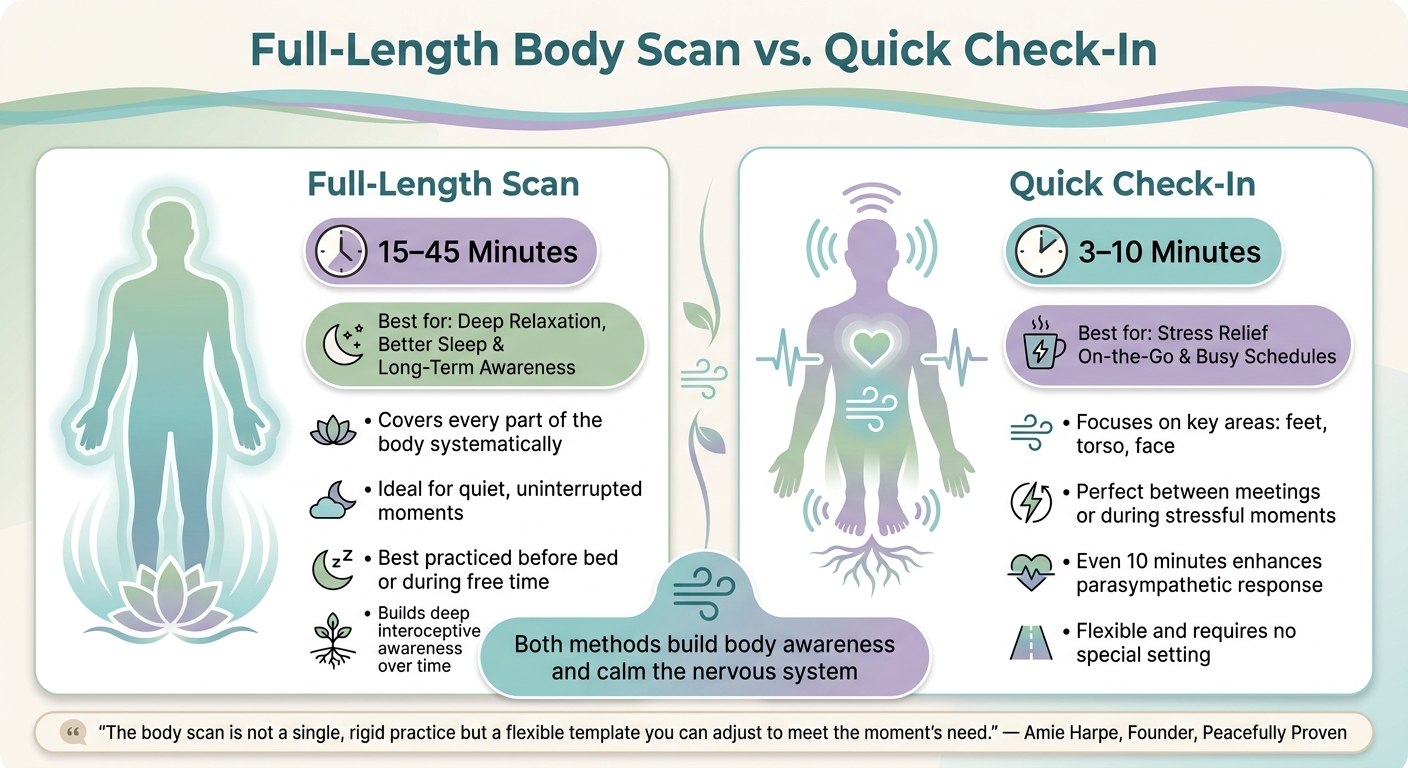
Full-Length Body Scan vs. Quick Check-In: Which Practice Is Right for You?
Once you've gotten comfortable managing restlessness, discomfort, and self-criticism, it's time to make body scanning a part of your daily life. The beauty of this practice? It’s flexible - no strict schedule or perfect setting required. These approaches can fit seamlessly into whatever your day looks like.
Full-Length Scans vs. Quick Check-Ins
A full-length scan, which takes about 15–45 minutes, involves systematically focusing on each part of the body. This type of scan is great for deep relaxation, improving sleep, and building long-term awareness of your body's internal signals. On the other hand, a quick check-in is shorter (3–10 minutes) and focuses on key areas like the feet, torso, or face instead of every single part. Research suggests that even brief sessions - 10 minutes, for example - can enhance your ability to sense internal signals and encourage a calming parasympathetic response.
Amie Harpe, Founder of Peacefully Proven, explains:
"The body scan is not a single, rigid practice but a flexible template that you can adjust to meet the moment's need."
Here’s a simple way to decide: use a full scan when you have a quiet, uninterrupted moment, like winding down before bed. A quick check-in is perfect for busier times, such as between meetings or when stress starts creeping in during the day.
Guided vs. Self-Guided Practice
Guided sessions can be especially helpful when you're just starting - they simplify things by walking you through the process, so there’s no need to worry about remembering steps or doing it “right.” As you gain confidence, self-guided practice allows you to move at your own pace and spend extra time on areas that need it. Both methods have their strengths. Many people prefer guided audio for longer sessions and switch to self-guided quick check-ins during their day.
Whichever method you choose, the key is to approach it with patience and curiosity.
Bringing Kindness and Curiosity to Your Practice
Body scanning isn’t just about how long you practice or whether it’s guided - it’s also about your mindset. The way you approach each session can make all the difference. Instead of judging yourself (“Was I focused enough?”), try observing sensations with curiosity. For example, you might simply note, “tightness in the left shoulder” or “warmth across the chest.” If your mind drifts, gently bring your attention back.
Mindfulness author Amy White describes this beautifully:
"I sometimes tell students to return as if placing a spoon gently back in a drawer. No ceremony. No scolding. Just the small sound of attention coming home."
The essence of the practice, as taught in MBSR (Mindfulness-Based Stress Reduction), is straightforward: "The practice is to notice, allow, and begin again."
Pairing Body Scan Meditation with Dhammapada Reflection
Combining body scan meditation with verses from the Dhammapada creates a deeper connection between physical mindfulness and reflective thought. This pairing not only enhances awareness of the body but also encourages a more thoughtful and intentional approach to life. By integrating these practices, you can address stress and overthinking while cultivating a grounded and present mindset.
The body scan meditation itself has roots in vipassanā and the Kāyagatā-sati Sutta (Mindfulness Immersed in the Body), which emphasize the importance of being fully present. Similarly, the Dhammapada offers timeless wisdom that complements this practice by reminding you why mindfulness matters, not just how to practice it.
Reading a Verse Before or After Your Scan
Incorporating a Dhammapada verse into your meditation practice can set the tone for a more reflective session. Reading a verse before your scan encourages patience, acceptance, and a deeper understanding of impermanence. Translator and Abbot Thanissaro Bhikkhu captures this idea perfectly:
"The role of mindfulness is to keep the mind properly grounded in the present moment in a way that will keep it on the path."
For instance, reflecting on a verse about the body’s impermanence - its aging, vulnerability to illness, and fleeting state of health - can help you approach the meditation with less attachment to how you think you should feel. This mindset helps you tune in to your body’s actual signals rather than clinging to idealized notions of youth or wellness. Alternatively, reading a verse after your scan provides a moment for quiet reflection. With your mind already calm and open, the wisdom of the verse can resonate more deeply and guide you toward integrating these insights into daily life.
Using Sutta 423 to Support Daily Practice
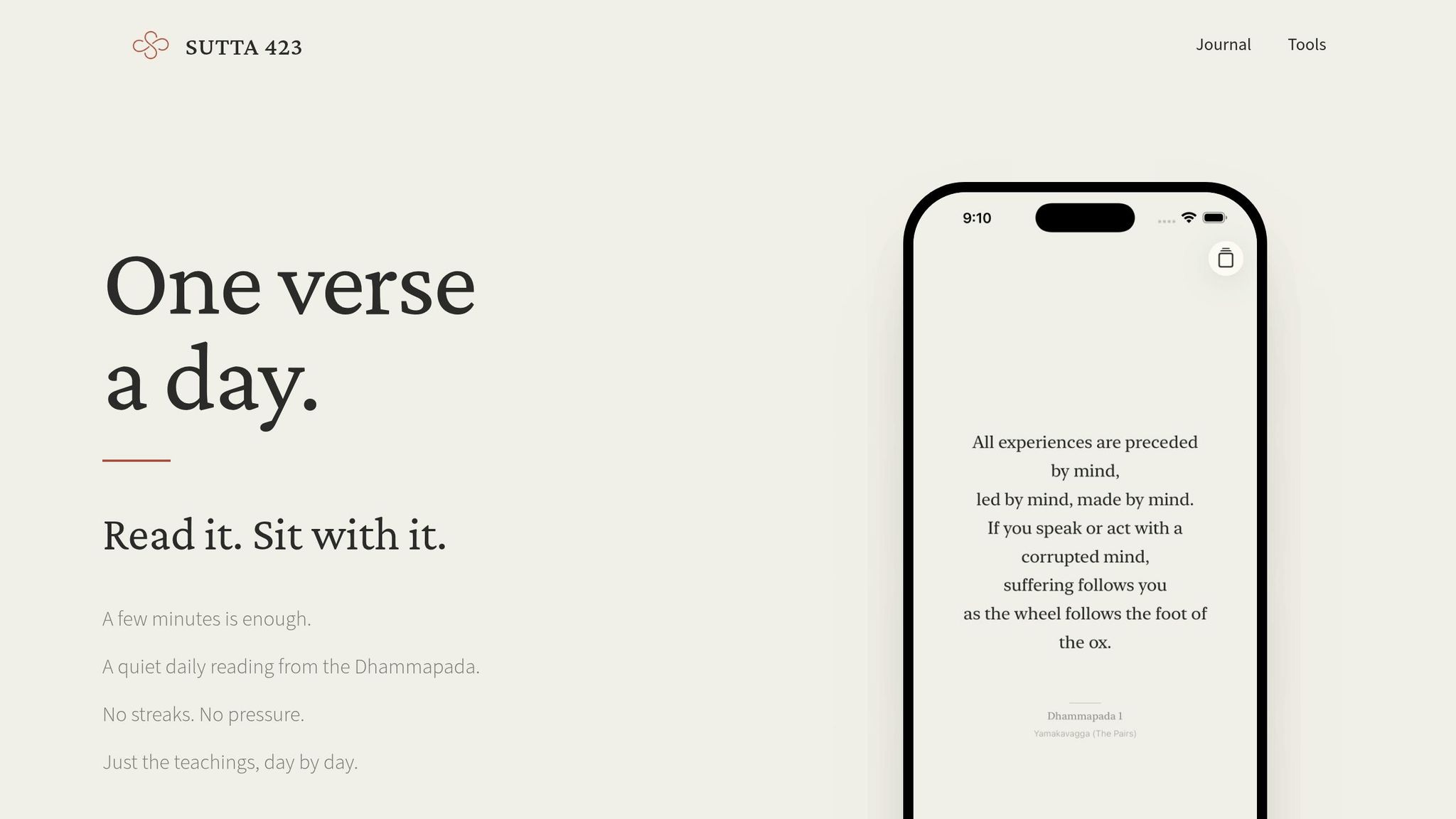
To maintain the insights gained during meditation, a consistent daily reminder can be incredibly helpful. Sutta 423 is an app designed for this purpose, offering one verse from the Dhammapada each day for quiet reflection. The app emphasizes simplicity:
"A quiet daily reading from the Dhammapada. No streaks. No pressure. Just the teachings, day by day."
Over the course of a year, the app guides you through all 423 verses, providing a steady, low-pressure way to stay connected to these teachings. This daily practice serves as a gentle complement to your body scan meditation, offering a single moment of reflection each day to deepen mindfulness and understanding.
How to Track Your Progress in Awareness
Progress in body scan meditation often reveals itself in small, quiet ways - like noticing subtle sensations or catching stress patterns before they escalate.
Signs That Your Awareness Is Growing
One of the first signs of progress is recognizing tension before it takes over. Maybe you catch yourself clenching your jaw during a meeting or notice shallow breaths creeping in before a tough conversation. Along with this comes emotional clarity - the ability to tell anxiety apart from hunger or fatigue instead of feeling a vague sense of stress. That moment of recognition? That’s your practice starting to pay off.
Science backs this up. A study found that participants who practiced 20-minute daily body scans for eight weeks were significantly better at detecting their own heartbeats compared to those in a control group. This kind of internal awareness is a skill that builds with consistent effort.
Another sign of progress is learning to separate physical sensations from emotional reactions. For instance, instead of jumping to "something is wrong", you might notice, "my chest feels tight right now." This ability to describe sensations (tight, warm, pulsing) without immediately labeling them as threats is a meaningful shift.
These subtle changes can be tracked using simple methods to help you see your growth more clearly.
Simple Ways to Monitor Your Practice
To make these shifts more visible, try a few easy tracking techniques. As your awareness deepens, these methods can help you stay connected to your progress and refine your practice.
- Keep a journal: After each session, jot down specific sensations and where you felt them. Over time, you might notice patterns - some areas may feel vivid, while others seem like "blank spots", signaling opportunities to expand your awareness.
- Track early emotional awareness: Pay attention to how quickly you notice stress signals. For example, if you used to recognize tension only after a headache hit, but now catch it at the first sign of a clenched jaw, that’s measurable progress.
- Notice your mental settling: Observe how quickly your mind quiets at the start of a session. If distractions fade faster than they used to, it’s a sign your practice is taking root.
"The body scan is simply the practice of learning to listen to that language [of sensation]. And like any language, it becomes richer and more nuanced the more attention you give it."
These small yet powerful indicators show how reconnecting with your body through sustained awareness can transform your daily experience.
Conclusion: What Body Scan Meditation Can Do for You
Body scan meditation helps bridge the gap between your mind and body. By dedicating just 10 minutes a day, you can become more attuned to stress signals, better understand your emotions, and develop a calm, grounded presence. Research suggests that practicing consistently for 8 weeks can physically change your brain - reducing gray matter density in the amygdala (your brain's "threat detector") and thickening the insular cortex, which helps you interpret your body's internal signals.
The beauty of this practice lies in its simplicity: observe your sensations and gently ask yourself, "What is here?"
"The body has been talking to you your entire life. The body scan is just the practice of finally learning to listen." - AJ Keller, CEO, Neurosity
For a deeper experience, consider pairing your body scan with a daily verse from the Sutta 423 app. After grounding yourself in physical sensations, reflecting on a single Dhammapada verse can provide a quiet and purposeful focus. As Sutta 423 says: "A small portion. Enough to hold. Enough to return to."
This enhanced awareness doesn’t stay confined to your meditation sessions - it spills into your daily life. You’ll notice steadier breathing, recognize tension earlier, and respond to challenges with greater intention.
FAQs
How do I know if I’m doing a body scan correctly?
There’s no single "correct" way to practice a body scan. The key is to approach it with curiosity and an open, nonjudgmental mindset. The purpose is to observe sensations - whether they feel pleasant, unpleasant, or neutral - without attempting to alter them. If your thoughts drift, simply and gently guide your attention back to your body. Incorporating daily reflection with Sutta 423 can further enrich this practice.
What should I do if a body scan brings up strong emotions?
If strong emotions come up during a body scan, aim for awareness rather than trying to fix or push them away. Simply acknowledge the sensations and emotions as they are, without adding judgment. You might try breathing gently into the areas where these feelings are present, noticing if anything shifts. If the emotions feel too intense, take a moment to assess whether they are manageable, and approach with care. Taking time each day to reflect on these experiences can help deepen mindfulness - perhaps even incorporating a verse from Sutta 423 for added perspective.
How can I pair a body scan with a Sutta 423 verse without overthinking it?
To combine a body scan with a verse from Sutta 423, use the verse as a moment of reflection either before or after your practice - not during. Start by reading the verse to set your intention for the session. Then, shift your attention fully to the body scan, focusing on physical sensations like tension or temperature without judgment. Separating the verse from the body scan ensures you stay mindful during the practice while allowing the verse to subtly guide your day.