

Top 7 Dhammapada Verses on Guarding the Senses
Seven Dhammapada verses show how to guard the six sense doors and pause between contact and reaction to reduce craving and reactivity.
If I don’t catch a reaction early, it usually runs the whole show. That’s the core lesson here: these 7 verses map a simple path from sense contact to self-control, then from self-control to a calmer mind.
In plain terms, this article shows me how to:
- guard the six sense doors: eye, ear, nose, tongue, body, and mind
- pause between contact and reaction
- watch body, speech, and mind
- speak with more care
- lean on moderation, recollection, and mindfulness
- let go of craving, aversion, and conceit
One key Buddhist fact shapes the whole piece: there are 6 sense faculties, not 5, because the mind counts as a sense door too. That means this practice is not just about what I see or hear. It’s also about what I think right after contact happens.
Dhammapada Verses 7 & 8 l Yamaka Vagga
Quick Comparison
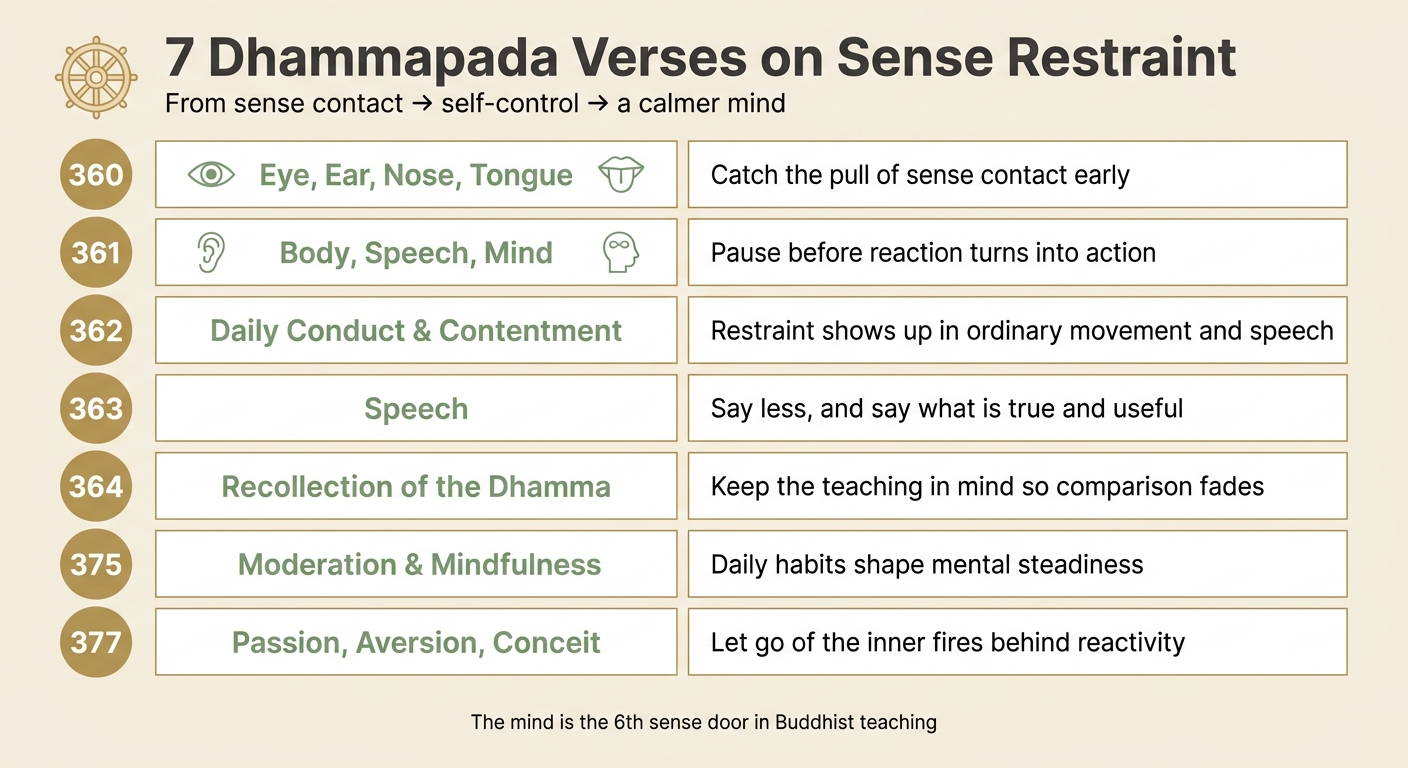
7 Dhammapada Verses on Sense Restraint: Quick Reference Guide
| Verse | Main focus | What I take from it |
|---|---|---|
| 360 | Eye, ear, nose, tongue | Catch the pull of sense contact early |
| 361 | Body, speech, mind | Pause before reaction turns into action |
| 362 | Daily conduct and contentment | Restraint shows up in ordinary movement and speech |
| 363 | Speech | Say less, and say what is true and useful |
| 364 | Recollection of the Dhamma | Keep the teaching in mind so comparison fades |
| 375 | Moderation and mindfulness | Daily habits shape mental steadiness |
| 377 | Passion, aversion, conceit | Let go of the inner fires behind reactivity |
What I like about this set of verses is how direct it is. See the trigger. Stop the slide. Choose the next step. That’s the thread running through the whole article.
Why Sense Restraint Matters in the Dhammapada
When the senses go unguarded, greed, irritation, and distress get in fast. That’s why the Dhammapada presents sense restraint as a direct way out of suffering. And that’s also why it treats restraint as something practical, not just an idea to admire from a distance.
An unguarded mind is like a leaky roof: distractions slip in, then spread unrest through the whole house.
Restraint isn’t self-punishment. It’s active steering. It means noticing an impulse before it hardens into action. You see it in ordinary moments - when you stop yourself before speaking in anger, or when you pull your attention back before distraction takes over.
The Dhammapada returns to the same pattern again and again: a guarded mind leads to clarity; an unguarded mind leads to suffering. The next verses show how restraint starts at the six sense doors, then moves into speech, action, and thought. Verse 360 begins with the senses themselves.
1. Dhammapada Verse 360: Restraint of the Eye, Ear, Nose, and Tongue
Verse 360 names four sense doors: eye, ear, nose, and tongue.
A tempting smell or sound can pull the mind before you even notice what happened. Verse 360 is not telling you to stop seeing, hearing, smelling, or tasting. It points to something more subtle: notice the instant after contact, before craving or aversion grabs hold.
That decision point - the moment before the mind runs after the stimulus - is where restraint lives. If your attention slides to your phone and you catch it, that is restraint. If a smell sparks an urge and you pause instead of following it, that is restraint in practice.
Restraint does not mean blocking the sense door. It means not going along with the reaction.
Verse 361 carries this same idea into body, speech, and mind.
2. Dhammapada Verse 361: Restraint of Body, Speech, and Mind
Verse 360 deals with sense contact. Verse 361 moves to what happens next: how you respond.
This is threefold restraint - body, speech, and mind. In plain terms, the practice is to stay aware of all three so you can pause before you react. From there, the teaching narrows to three guards: body, speech, and mind.
Each one does a different job. Bodily restraint helps prevent harmful action. Restraint in speech keeps harsh words from coming out. Mental restraint checks unskillful intent before it turns into action. This is the practical next step of sense guarding, not a separate practice.
You can think of this discipline like a well-thatched roof: rain stays out, and so do reactive impulses.
Verse 362 carries this restraint into daily conduct.
3. Dhammapada Verse 362: Hands, Feet, Speech, and Inner Contentment
Verse 362 moves from restraint to what that restraint looks like in daily life. If Verse 361 names the guards, Verse 362 shows what happens when those guards are in place.
The verse brings the idea down to earth by pointing to the body’s ordinary movements. Hands and feet stand for everyday action: what we do and where we go. Guarding the body in this sense means holding back from harmful acts and moving with care instead of drifting on impulse.
It also turns to speech. Harsh or harmful words can cause suffering and leave consequences that don’t fade fast. So the verse points to restraint in speech, along with steady attention, so the mind doesn’t slide into restlessness.
Just as important, Verse 362 points to inward contentment and treats it as a kind of wealth. When body, speech, and mind are kept in check, contentment has room to grow.
From there, the teaching turns to speech as its own test of restraint. Verse 363 narrows the focus to speech.
4. Dhammapada Verse 363: Restrained Speech and Wise Communication
After body and mind, the Dhammapada turns to speech. This is where restraint shows up in plain sight, in daily life. Verse 363 narrows sense restraint to speech itself. It points to speech that is truthful and useful, and it asks you to choose your words with care. What comes in through the senses often goes back out through the mouth.
That choice matters in everyday moments: conflict, gossip, criticism, and online communication. A quick comment can do more than we mean it to. When speech is guided by discernment, the point is no longer talking just to talk. The point is saying what is worth saying.
Guarding speech means speaking only when words are truthful and useful. Verse 364 then carries that discipline into the way a person lives without envy.
5. Dhammapada Verse 364: Living by the Teaching Without Envy
Verse 364 lays out four core practices: abiding in the Dhamma, delighting in it, meditating on it, and bearing it in mind. When these are lived, a person stays aligned with the Dhamma. Restraint stops being a one-time effort and starts to become a steady habit.
The verse stresses constant recollection. Keep the Dhamma close until it starts to shape ordinary choices, moods, and reactions. The point is simple: let wisdom stay active in the mind. In that way, sense restraint grows into steady mental discipline.
Envy often appears when the mind starts measuring itself against other people instead of staying with what is here, now. In this verse, envy is less a separate problem and more a byproduct of comparison. Verse 364 points in another direction: step away from the hunt for outside approval and return to the teaching. That turn helps calm the mind.
A simple way to practice this is to set aside a few minutes each morning or evening to reflect on one teaching, then carry it with you through the day. Little by little, it becomes part of your response pattern. And when comparison or stress shows up, the verse brings a quiet check: is the mind meeting what is actually happening, or reacting to a story about winning, losing, or not having enough? That small pause is often where mindfulness cuts through envy and brings the mind back into balance. Verse 375 then shifts from recollection to moderation and mindfulness.
6. Dhammapada Verse 375: Moderation, Mindfulness, and Guarding the Senses
After Verse 364 stresses keeping the Dhamma close at hand, Verse 375 shifts to the daily habits that make that kind of discipline possible. It points to moderation in eating, quiet instead of constant social activity, and steady practice. These aren’t dramatic acts. They’re simple, daily patterns that support sense restraint and shape how steady the mind becomes.
Heedfulness keeps the mind alert before sensory contact hardens into greed, irritation, or distress.
With steady heedfulness, restraint becomes an everyday habit instead of something you try only now and then. Verse 377 goes a step further by showing what has to be let go of in the mind itself.
7. Dhammapada Verse 377: Letting Go of Passion, Aversion, and Conceit
Verse 377 turns inward to the forces that make restraint necessary: passion, aversion, and conceit. The focus shifts from outer contact to inner response. Guarding the senses isn’t just about what you see, hear, or feel. It’s also about noticing what the mind does the moment contact happens.
In daily life, that often shows up as wanting, irritation, or self-comparison. These reactions can flare up fast. If you spot them early, you have a chance to let them pass before they harden into grasping or resistance.
This is where restraint starts to look less like control and more like release. Verse 377 completes the inward side of the practice by pointing to what must be let go, not just what must be watched. Sense restraint, then, is not only about limiting what comes in, but also about dropping the passion, aversion, and conceit that rise in response.
The next section shows how Verses 360 and 361 work together as the foundation of this restraint.
How Verses 360 and 361 Work Together
Verse 360 guards input at the sense doors. Verse 361 guards response through body, speech, and mind. Put them side by side, and you get the whole movement: from contact to reaction.
Say someone throws out a harsh comment. Verse 360 helps you spot the trigger. Verse 361 helps you decide what to do next.
A simple way to use both is a three-part check: notice tension, the urge to speak, and the first thought. It’s a fast gut-check for the moment when a reaction starts to take shape.
| Layer | Role |
|---|---|
| Body | Notice tension |
| Speech | Pause before speaking |
| Mind | Catch the first thought |
That makes the next quick-reference table easy to use.
Quick Reference Table: Sense Doors, Restraint, and Unskillful Reactions
Verses 360 and 361 are a lot easier to work with when you can see each sense door side by side. This table turns the three-part guard into a simple, quick check you can use in daily life.
| Sense Door | Restraint | Reactions to avoid |
|---|---|---|
| Eye | Not chasing sights that trigger greed or irritation | Greed, irritation |
| Ear | Listening without instant judgment | Irritation, distraction |
| Nose | Not getting pulled into smells that trigger greed or irritation | Greed, irritation |
| Tongue | Tasting with moderation and awareness | Greed, distress |
| Body | Not acting on physical impulses right away | Agitation, distress |
| Speech | Pausing before speaking and choosing words carefully | Impulsive speech |
| Mind | Catching reactive thoughts before they take over | Envy, distraction, distress |
Use the table as a fast check. Notice the door, notice the reaction, then pause.
That pause matters. The first hint often shows up in the body, speech, or mind before a reaction turns into something stronger. If you catch it early, you have a chance to stop it before it hardens.
Applying These Verses in Daily Life
Use the table as a quick check during ordinary moments.
| Situation | What to notice | Simple response |
|---|---|---|
| Scrolling social media | The pull to keep going | Pause before the next scroll and ask if you're still choosing where your attention goes |
| Overhearing criticism at work | The first spark of reaction | Give yourself a moment of space before answering or replaying it in your head |
| Craving comfort food | The urge to eat on autopilot | Slow down, eat with attention, and notice how the urge shifts |
| Sitting in traffic or replaying a stressful conversation | The mind looping into tension | Return attention to the breath or body, or bring to mind a Dhammapada verse |
Scrolling social media is where restraint of the eye and mind shows up in plain view. Notice the urge to keep scrolling. Then pause before the next swipe and ask whether you're still directing your attention, or just getting pulled along. That's sense restraint at the eye: contact without compulsion.
Overhearing criticism at work tests restraint of the ear and speech. Before you answer, or let the comment keep spinning in your mind, pause. Even a brief gap can change the whole tone of what comes next. That pause keeps reaction from turning into speech.
Craving comfort food is where restraint of the tongue and moderation meet. Slow down. Eat with attention. Watch what happens to the urge once you stop rushing and start noticing.
Sitting in traffic or replaying a stressful conversation is often where restraint of the mind matters most. Bring attention back to the breath or the body, or recall a Dhammapada verse. The breath can cut through that first wave of reaction.
For daily reflection, the Sutta 423 app offers one Dhammapada verse each day.
Conclusion
Guarding the senses doesn’t mean shutting the world out. It means changing the way you meet what shows up. You still see, hear, and think. The difference is that restraint stops those moments from turning into automatic reaction.
That change happens one pause at a time. And each pause chips away at passion, aversion, and conceit.
These verses point toward inner steadiness: less reactivity, more stability.
For daily reflection, the Sutta 423 app offers one Dhammapada verse each day.
FAQs
What are the six sense doors in Buddhism?
The material doesn’t define the six sense doors in Buddhism.
Instead, it focuses on guarding the senses so outside distractions don’t trigger greed, irritation, or distress. It talks about the practice in general terms, but it does not name or explain the six specific sense doors.
How is sense restraint different from suppression?
Sense restraint isn’t about shutting down your senses or just putting up with whatever shows up. It’s an active, deliberate practice of guarding the mind at the point of contact, so greed, irritation, or distress don’t get a foothold.
Instead of blocking out the world, you notice thoughts and emotions as they arise and create a small gap between impulse and response. That gap matters. It gives you room to steer your emotions with care, instead of letting them run wild.
Which verse is best to start with in daily practice?
There’s no single verse you have to start with. The best place to begin is the verse that fits what you need right now or the kind of trait you want to build, like patience, calm, or generosity.
You might pick a verse that feels close to your life at the moment, or simply follow the daily verse in the Sutta 423 app. In many cases, starting small with a verse that resonates works best.