

5 Benefits of Reading One Verse Per Day
Reading one Dhammapada verse daily builds mindfulness, focus, spiritual growth, and lasting inner calm.
Reading one verse daily from the Dhammapada offers simple yet powerful insights for personal growth. This practice helps you focus, reflect, and find calm in your day by engaging with timeless teachings. The benefits include:
- Mindfulness: A single verse anchors your thoughts, promoting presence and self-awareness.
- Spiritual Growth: Reflecting daily encourages inner clarity and mental transformation.
- Improved Focus: It helps cut through distractions and keeps your mind steady.
- Understanding Teachings: Complex Buddhist ideas become easier to grasp over time.
- Inner Peace: Regular reflection reduces stress and fosters calmness.
This habit requires consistency but delivers meaningful rewards. Tools like the Sutta 423 app make it even easier to integrate into your routine, offering a verse each day to guide your journey. Start small - one verse can create lasting change.
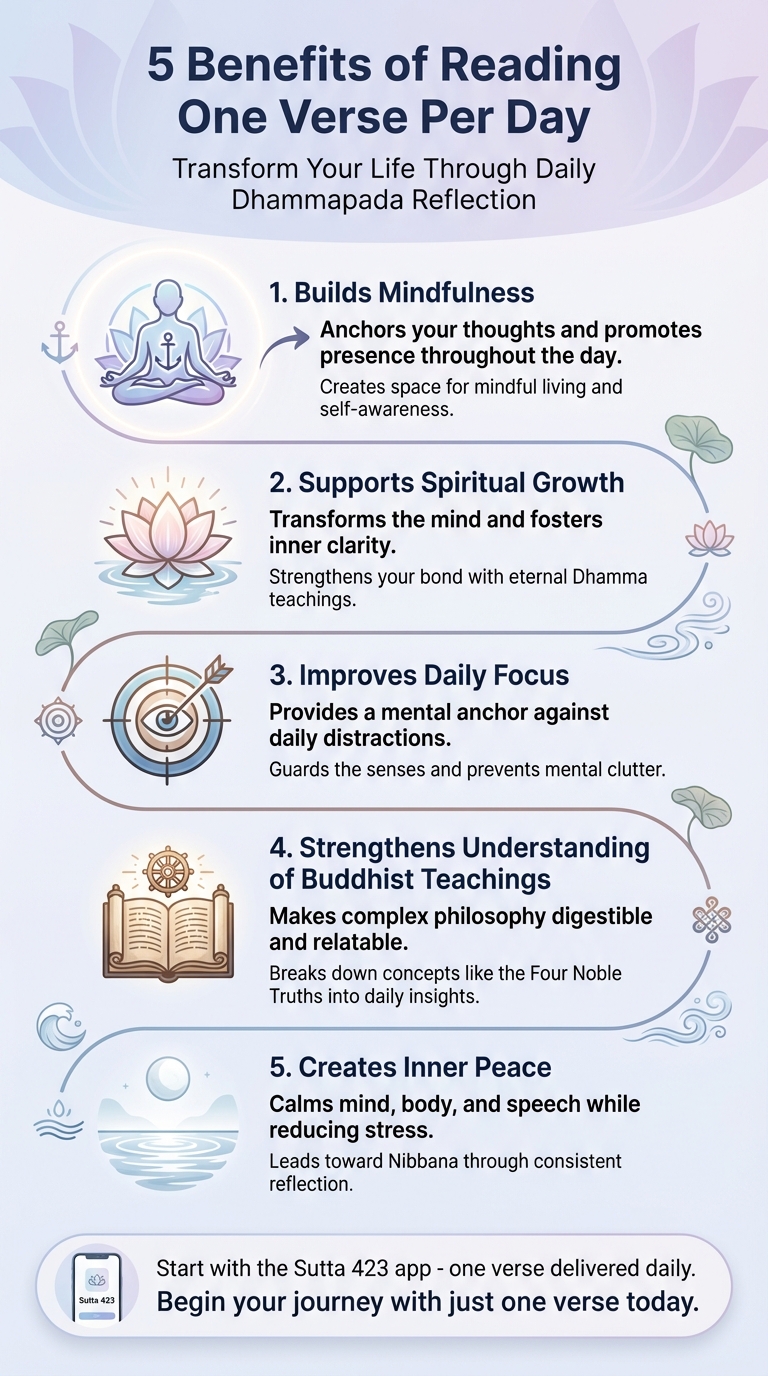
5 Benefits of Reading One Verse Per Day from the Dhammapada
Dhammapada Verse 290: Profound Happiness
1. Builds Mindfulness
Reading just one verse daily acts as an anchor for focus. Instead of skimming through lengthy texts, you concentrate on a single teaching that stays with you throughout the day. This simple ritual creates space for mindful living, training your mind to stay present rather than bouncing between distractions.
The beauty of this practice lies in its consistency and discipline. As Pavle Marinkovic explains:
"This requires a lot of discipline on a daily basis, but the rewards are much more than one could ever imagine".
This daily commitment helps your mind resist negativity and naturally shifts your attention inward, fostering a sense of awareness.
The verses also encourage self-reflection. The Buddha highlighted this with the teaching:
"In you, there is a forest (of moral defilements); you clean yourself only externally".
By reflecting on a verse each morning, you're invited to examine your inner world - your intentions, reactions, and thought patterns.
When faced with conflict, like being insulted, recalling a verse can guide you toward a calm response instead of reacting with anger. It helps you notice impulses, such as desires or frustrations, as they arise, giving you the chance to respond thoughtfully.
The Buddha also offered wisdom for this mindful approach:
"Do not follow ignoble ways, do not live in negligence, do not embrace wrong views, do not be the one to prolong samsara".
2. Supports Spiritual Growth
Buddhist spiritual growth is fundamentally about transforming the mind rather than focusing on external rituals. Reading a single verse daily encourages you to address the "forest of moral defilements" within yourself, fostering a path toward personal clarity and spiritual progress. This practice becomes a daily opportunity to refine your inner world.
Each verse serves as a moment for self-reflection. As the Buddha wisely said:
"By oneself one must censure oneself and scrutinize oneself. The self-guarded and mindful monk will always live in happiness."
Through this process, you not only examine your actions but also nurture spiritual maturity.
Daily reflection also strengthens your bond with the eternal teachings of the Dhamma. As described in the Dhammapada:
"The monk who abides in the Dhamma, delights in the Dhamma, meditates on the Dhamma, and bears the Dhamma well in mind - he does not fall away from the sublime Dhamma."
This regular practice sharpens your meditative focus and deepens your insight, laying the groundwork for inner peace and greater understanding.
3. Improves Daily Focus
Every day, your mind is bombarded with distractions - endless notifications, conversations, worries about what’s ahead, or regrets about what’s behind. Starting your morning with a single verse from the Dhammapada offers a mental anchor, a specific point of focus you can return to whenever your attention starts to wander. This simple habit ties into the mindful awareness and spiritual growth discussed earlier.
It’s like building a mental fortress. As Peter Burns, Author and Polymath, puts it:
"Rain cannot penetrate a house that is well-thatched."
In the same way, focusing on one verse creates a protective mental framework, shielding you from distractions much like a well-built roof keeps out the rain.
The secret lies in being selective. Instead of overwhelming yourself with too much information, you choose one teaching that resonates with your current situation. Thanissaro Bhikkhu captures this idea beautifully:
"Selecting the well-taught Dhamma-saying is like choosing the right flower for a particular spot in an arrangement."
This targeted approach avoids mental clutter and gives you a clear focal point for the day.
These verses also emphasize sensory restraint - guarding the "doors" of your senses so external distractions don’t stir up greed, irritation, or distress. When something arises that might normally pull you off track, you can consciously decide not to engage with it. This isn’t about suppressing your senses; it’s about choosing clarity by focusing your energy on what truly matters. This deliberate practice strengthens the mindful discipline mentioned earlier.
4. Strengthens Understanding of Buddhist Teachings
Buddhist philosophy can feel overwhelming with its depth and breadth, but reading just one verse a day from the Dhammapada makes it easier to absorb. Teachings like the Four Noble Truths, the Noble Eightfold Path, and the 37 Wings to Awakening are complex, but this daily practice breaks them into digestible reflections. By focusing on a single verse, you can gradually uncover deeper symbolic meanings and apply these insights to your daily life.
The Dhammapada brings abstract ideas to life through vivid imagery. Whether it's a cart wheel following an ox, a shadow that never leaves, or a well-thatched house keeping out rain, these metaphors illustrate how mental intentions (kamma) shape happiness or suffering. This approach makes philosophical concepts more relatable and easier to understand.
Rather than offering quick solutions for immediate challenges, the Dhammapada helps you explore how its verses interpret core Buddhist principles in profound ways. The symbolic language transforms abstract teachings into practical wisdom, making them accessible and actionable.
Each verse also serves as a guide for spiritual growth, outlining the four stages of Awakening: stream-entry, once-returning, non-returning, and arahantship. For instance, Verse 183 is often described as encapsulating the essence of the Buddha's teachings, while Verses 153–154 are believed to be the Buddha’s first words after achieving full Awakening. By engaging with these verses daily, your understanding of these stages deepens over time.
The Dhammapada also employs wordplay and double meanings to challenge conventional thought. For example, the term sama (which translates to "even" or "equal") is used metaphorically, likening spiritual harmony to being "in tune" with truth. These linguistic subtleties not only clarify abstract ideas but also enrich your understanding of what Buddhists call "right knowing", offering a fresh perspective on the teachings.
5. Creates Inner Peace
Drawing from a focused mind and a deeper grasp of Buddhist teachings, reading a daily verse nurtures a profound sense of inner peace. It calms the mind, body, and speech, while emphasizing restraint as a way to break free from suffering. By practicing restraint, you can reduce daily conflicts and ease mental unrest.
The Dhammapada uses vivid imagery to guide readers toward peace. One verse, for example, suggests "emptying the boat" - letting go of desires and anger to navigate life more lightly. Another describes serenity as being "calm in body, calm in speech, calm in thought" while shedding attachment to worldly matters. These metaphors provide powerful visuals for reflection and self-growth.
"The monk who abides in universal love and is deeply devoted to the Teaching of the Buddha attains the peace of Nibbana, the bliss of the cessation of all conditioned things." - Acharya Buddharakkhita
Daily verse reflection encourages focused self-examination, which helps quiet inner turmoil. This practice not only fosters mindfulness but also acts as a safeguard against negative impulses. Through meditation, this insight deepens, bringing you closer to a state of ultimate peace. This tranquil state naturally complements the enhanced focus discussed earlier.
Meditation takes the experience further, turning daily reading into a source of profound calm. Solitary reflection allows the mind to settle, offering a deeper understanding of the teachings. As one verse beautifully states, "The monk who has retired to a solitary abode and calmed his mind, who comprehends the Dhamma with insight, in him there arises a delight that transcends all human delights". This simple daily practice transforms reading into a wellspring of peace that permeates every aspect of life.
Conclusion
A single daily verse has the power to bring meaningful change to your life. It encourages mindfulness, supports spiritual growth, sharpens daily focus, deepens your understanding of teachings, and nurtures inner peace. Together, these benefits create a strong foundation for personal transformation, with each one complementing the others.
The beauty of this practice lies in its simplicity and accessibility. Whether you're just beginning to explore Buddhist philosophy or looking to deepen your existing practice, dedicating time to reflect on one verse a day can provide powerful guidance without demanding too much of your time.
Of course, building this habit takes commitment and consistency. It means showing up every day, even when life feels busy or the teachings challenge you. As Pavle Marinkovic wisely notes:
"This requires a lot of discipline on a daily basis, but the rewards are much more than one could ever imagine".
To make this journey even more manageable, the Sutta 423 app offers a practical solution. It delivers all 423 verses from the Dhammapada, one each day, straight to your device. With its simple and distraction-free design, the app creates the perfect space for quiet reflection, allowing you to fully absorb the wisdom of each verse.
Start this practice today. Highlight the verses that speak to you, revisit them often, and let your daily dedication guide you toward mindfulness, spiritual growth, and inner peace. The journey begins with just one verse.
FAQs
How do I choose the right verse for today?
To pick the perfect verse, think about what aligns with your current mindset or personal growth journey. Seek out verses that promote mindfulness, encourage inner peace, or spark spiritual reflection. You might also choose one that speaks to a challenge you're navigating or emphasizes traits like patience or compassion. Taking time to reflect on the themes within various verses can guide you toward the one that feels most meaningful for the day.
What should I do if a verse feels confusing or challenging?
If a verse seems unclear, take your time and approach it with curiosity and an open heart. Read it over a few times, and consider looking into the broader context to gain a clearer perspective. Practices like meditation can often bring a sense of clarity, while talking it through with a knowledgeable teacher or a fellow practitioner might offer new perspectives. Challenges like these are part of the journey and can often lead to a richer understanding.
How long should I reflect on one verse each day?
Spending just 5 to 10 minutes a day reflecting on a verse can make a significant difference. This short yet intentional practice gives you the space to meditate thoughtfully and connect on a deeper level with the teachings. It’s also a great way to cultivate mindfulness in your daily routine.