

How to Apply the Four Noble Truths Daily
Practical steps to notice daily dukkha, identify cravings, practice letting go, and integrate the Noble Eightfold Path into your routine.
The Four Noble Truths are a practical framework for managing stress and dissatisfaction in daily life. They guide you to:
- Recognize dissatisfaction (Dukkha).
- Identify its cause - craving and attachment (Samudaya).
- Understand it can end (Nirodha).
- Follow actionable steps through the Noble Eightfold Path.
Here’s how this works in real life:
- Notice stress in small moments like traffic or work tension.
- Pause and reflect on the craving or resistance causing discomfort.
- Let go of resistance to find small moments of relief.
- Practice mindfulness, ethical actions, and reflection to align with these truths.
Daily habits like short reflections, observing emotions, and mindful transitions can make these teachings part of your routine. Over time, this approach can help you respond to challenges with clarity and ease.
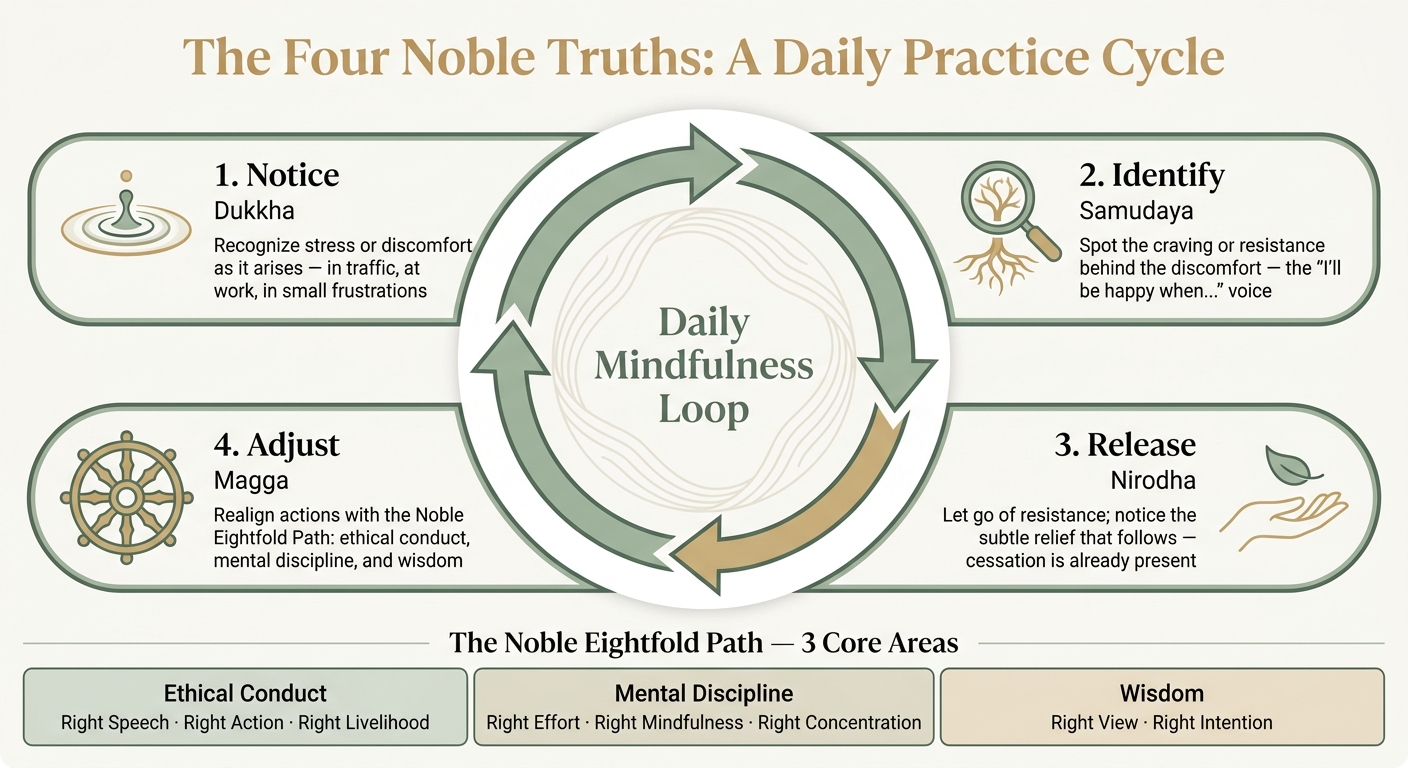
The Four Noble Truths: A Daily Practice Cycle
Recognizing Dukkha in Daily Life
What Dukkha Looks Like Day to Day
When people hear "dukkha", they often think of major struggles - grief, illness, or loss. But in reality, dukkha often shows up in much smaller, everyday ways. The original Pali term refers to a broken axle on an oxcart, painting a picture of life as a rough, uneven journey rather than a smooth ride. This subtle discomfort can appear in moments like the tension you feel opening a full inbox, the frustration of being stuck in traffic, or the quiet unease that comes with unmet personal expectations.
Even during enjoyable moments, dukkha can linger as a faint background stress. As The Mindful Spark explains:
"Understanding this truth in our daily lives isn't about wallowing in negativity. It's about acknowledging that stress and dissatisfaction are normal experiences rather than signs that something is wrong with us." - The Mindful Spark
By recognizing these small, persistent signs, you can start to notice them as they happen.
How to Spot Dukkha as It Happens
The trick is to catch your feelings before you react automatically. Buddhist teacher Thanissaro Bhikkhu uses a vivid metaphor to explain this:
"Pain is like a watering hole where all the animals in the forest - all the mind's subconscious tendencies - will eventually come to drink." - Thanissaro Bhikkhu
Take a moment to pause when you feel discomfort. Identify the emotion - whether it's irritation, worry, or something else - without rushing to judge it. Then, notice where it shows up physically: maybe in a tight chest, a clenched jaw, or shallow breaths. This simple act of pausing, naming, and observing can help you avoid what Buddhist teachings call the "second arrow", the additional mental distress we create by overthinking or resisting our initial feelings.
This practice of noticing and naming feelings lays the foundation for cultivating deeper awareness throughout your day.
Simple Practices to Build Awareness
You don't need to sit in meditation to start recognizing dukkha. Everyday moments can become opportunities to check in with yourself. Use transitions - like sitting down for a meal, stepping outside, or finishing a task - as chances to ask, "What am I feeling right now?" Over time, this habit sharpens your ability to catch subtle stress before it grows.
Try this for a day: observe every time you feel stress, no matter how minor. You might be surprised at how frequently low-level dissatisfaction pops up. Recognizing these moments is the first step toward easing that underlying tension.
Working with Craving and Attachment
Spotting Craving in Everyday Habits
Once you start noticing dukkha (suffering or dissatisfaction) as it arises, the next step is figuring out why it keeps showing up. According to the second noble truth, the root cause is craving - this constant pull to want things to be different than they are right now.
Craving shows up in two ways: either as a desire for more of what you enjoy or as a longing for something you feel is missing. This inner tug often drives everyday habits like endlessly scrolling social media, working overtime, or impulsively buying things you don’t need. As The Mindful Spark puts it:
"The root cause is our relationship with what's happening... our habit of either wanting things to be different than they are or trying to hold onto things that are naturally changing."
Pay attention to that little voice in your head saying things like, "This will make me feel better", or "I’ll finally be happy when I get that promotion." This voice isn’t offering reliable truths - it’s part of a pattern worth observing. Recognizing it is the first step toward breaking the cycle with mindful, intentional action.
Ways to Reduce Craving Day to Day
The point isn’t to get rid of all desires but to create a small pause between the craving and your reaction to it.
Before you act on a craving, take a moment to reflect on what you’re really looking for - connection, distraction, or maybe just relief. You can also try "urge surfing", a practice where you observe the physical sensations of craving as they rise and fall. Buddhist teacher Larry Yang describes this process beautifully:
"The experience of being aware of craving and all of its sensations, pleasant and unpleasant, is the experience of not being lost in the experience of craving."
This kind of awareness gives you the space to notice craving without getting swept up in it. By practicing these mindful techniques, you can begin to address craving in a way that feels manageable, building on the awareness you’ve already cultivated by recognizing dukkha. Over time, this approach helps you create a more balanced daily routine.
In addition to pausing and observing, aligning your actions with your values can further weaken craving’s hold.
How Ethical Living Reduces Craving
Your actions play a big role in how much craving you experience. Craving often leads to a cycle of chasing, clinging, and protecting what you’ve gained - which can stir up conflict and stress. Bhante Gunaratana explains this dynamic:
"Because of safeguarding, various evil, unwholesome phenomena originate. These unwholesome acts involve warfare, fighting, quarrels, slander, insulting speech, and lies."
Living ethically - whether it’s pausing before sending a heated email or resisting the urge to gossip - can help break this cycle. As The Mindful Spark suggests:
"When you're about to send that angry email, can you pause and consider your true intention? When you're tempted to gossip about a coworker, can you choose a different action that aligns more with your values?"
Bhante Gunaratana also ties mindfulness directly to ethical practice:
"If your mindfulness leads to reducing your greed, hatred, and delusion, it is right mindfulness, and every minute of this practice is beneficial."
Ethical living isn’t something separate from mindfulness - it’s a practical way to loosen the grip of craving in your everyday life. By making choices that reflect your values, you naturally reduce the stress and dissatisfaction that craving often brings.
Noticing Moments of Cessation
What Cessation Feels Like in Ordinary Moments
The third noble truth teaches that freedom from suffering often shows up in small, unforced moments - ones we might miss if we're not paying attention.
Picture this: you're stuck in traffic, feeling tense and frustrated. Then, out of nowhere, you stop resisting the situation. Maybe you turn on the radio, take a deep breath, and accept the delay. That subtle shift, that drop in tension, is what cessation feels like. It’s the relief that comes when we stop fighting reality.
These moments aren’t rare - they happen all the time. It’s the satisfaction of completing a task, the calm after a long walk, or the silence that follows a tough conversation. Cessation doesn’t require effort to create; it’s already there. The key is learning to recognize it.
By noticing these moments, we complete the cycle of understanding dukkha (suffering) and addressing craving in our daily lives. This awareness lays the foundation for cultivating deeper contentment through intentional practice.
Practices That Deepen Contentment
Acknowledging these moments can help reinforce a sense of contentment. One way to do this is through a simple evening reflection: at the end of your day, recall one or two moments where you felt a sense of ease or "enough." These don’t need to be grand or life-changing - just instances where the mental chatter quieted.
As The Mindful Spark explains:
"These small moments of letting go give us a taste of what's possible on a larger scale."
You can also use everyday transitions - starting your car, entering a room, or sitting down for a meal - as opportunities to check in with yourself. Are you holding onto tension? Is there resistance you could release? These quick pauses teach you to notice ease as it happens, not just in hindsight.
As your awareness grows, trust that each act of letting go strengthens your ability to welcome cessation into your life.
Learning to Trust the Process of Letting Go
A common hurdle to experiencing cessation is the belief that letting go equals giving up. But letting go isn’t about abandoning effort - it’s about changing how you relate to a situation without necessarily changing the situation itself.
The Mindful Spark offers a helpful analogy:
"If holding a heavy weight with a tense arm, you're going to get tired pretty quickly. But if you learn to hold it differently, or maybe set it down sometimes, the same weight becomes manageable."
Start small. Practice with minor annoyances like a slow internet connection, a drawn-out meeting, or an unexpected schedule change. Each time you notice the relief that comes from releasing resistance, you build confidence in the process. Over time, this confidence makes it easier to apply the same mindset to bigger challenges.
Bringing the Noble Eightfold Path into Daily Routines
Fitting the Eightfold Path into Daily Life
Integrating the Noble Eightfold Path into your everyday life is less about following a strict sequence and more about weaving its principles into your daily rhythm. As Tricycle Magazine explains:
"It should not be thought that the eight categories or divisions of the path should be followed and practiced one after the other... they are to be developed more or less simultaneously."
The path can be viewed as three interconnected areas: Ethical Conduct (Right Speech, Action, and Livelihood), Mental Discipline (Right Effort, Mindfulness, and Concentration), and Wisdom (Right View and Right Intention). These areas work together, influencing one another. For instance, speaking truthfully can calm the mind, which in turn helps you perceive situations with greater clarity.
Ethical Conduct serves as the foundation for everything else. As Tricycle notes, "Moral conduct is considered as the indispensable foundation for all higher spiritual attainments. No spiritual development is possible without this moral basis." From this base, mental focus and wisdom naturally grow.
Sample Daily Routines Built Around the Path
Here’s how you could incorporate the Eightfold Path into your daily routine:
| Time of Day | Path Factor | Practice |
|---|---|---|
| Morning | Right View / Right Intention | Read a Dhammapada verse via Sutta 423 and set a quiet intention for the day. |
| Work hours | Right Speech | Before sending an email or speaking in a meeting, ask yourself: Is it true? Is it useful? Is it timely? |
| Transitions | Right Mindfulness | Use natural pauses - like starting your car or entering a new space - as moments to reconnect with the present. |
| Evening | Right Concentration | End the day with 10–15 minutes of seated meditation to calm and center your mind. |
A simple habit like reading one verse from the Dhammapada each morning can have a profound impact. The Sutta 423 app delivers one verse per day, allowing you to engage with the teachings gradually over the course of a year.
Revisiting these practices regularly ensures they adapt to your personal growth and changing needs.
Reviewing and Adjusting Your Practice Over Time
Progress on the Eightfold Path isn’t always immediately visible. A weekly reflection can help you stay aligned. Take a few moments to consider where your actions felt in harmony with the path and where they didn’t - without judgment, just honest observation.
Right Effort provides a helpful framework for this reflection. Its fourfold approach involves: preventing unwholesome states, letting go of existing unwholesome states, cultivating wholesome states, and strengthening existing wholesome states. Put simply, notice what distracts you and gently guide yourself back on track.
"The path claims primacy because it is precisely this that brings the teaching to life. The path translates the Dhamma from a collection of abstract formulas into a continually unfolding disclosure of truth." - Bhikkhu Bodhi, Author and Monk
Focus on one or two aspects of the path that resonate most with your current challenges. For example, you might prioritize Right Speech if communication is a struggle, or Right Mindfulness if you find yourself easily distracted. This reflective practice connects the Four Noble Truths with your daily experiences, fostering deeper personal understanding.
Conclusion: Applying the Four Noble Truths Every Day
How the Four Noble Truths Work as a Cycle
The Four Noble Truths aren't a one-and-done concept. They're a continuous cycle - a framework you revisit over and over in daily life. As Thanissaro Bhikkhu explains:
"The four noble truths are best understood, not as beliefs, but as categories of experience."
Each moment of dissatisfaction becomes a chance to engage with this cycle. When discomfort or stress arises, you observe it, recognize the craving behind it, let go, and adjust your reaction. Then, with the next challenge or moment of unease, the process begins again. It's not about getting it "right" once - this repetition is how growth happens.
Imagine it as a diagnostic tool you carry everywhere. Whether it's a tense meeting, a traffic jam, or a restless night, you can approach it with the same steps: notice, identify, release, and adjust. With practice, this process becomes second nature, helping you navigate life's ups and downs with greater ease.
This ongoing cycle transforms ordinary moments into opportunities for mindful living.
Using Resources Like Sutta 423 to Support Daily Practice

To keep this cycle alive in your daily routine, consistent reflection is essential. The Sutta 423 app can help by delivering a verse from the Dhammapada each day. It’s a simple way to anchor your practice and set a mindful tone before your day gets busy.
"Each moment of awareness, each small choice to respond differently, is practice." - The Mindful Spark
Pair these daily verses with mindful habits - like noticing subtle tension, questioning thoughts like "I'll be happy when...", or using everyday transitions as reminders to pause. These small, steady actions add up over time. This is how the Four Noble Truths shift from being abstract ideas to a way of living that feels natural and grounded.
How the Four Noble Truths Can Reduce Suffering and Cultivate Happiness Today - Ask Mingyur Rinpoche
FAQs
How do I tell the difference between dukkha and normal stress?
Dukkha describes a deeper, more persistent sense of dissatisfaction or discontent. It often stems from attachment, cravings, or unmet expectations. Unlike normal stress, which is usually a fleeting reaction to specific events or challenges, dukkha lingers and reflects a more profound feeling of unease.
To identify dukkha, watch for recurring emotions like craving, anger, or a consistent sense of discontent. These feelings typically point to a deeper underlying dissatisfaction rather than just a momentary reaction.
What’s a simple way to pause before acting on a craving?
To manage a craving, start by taking a moment for mindful reflection. Acknowledge the craving as it arises, but instead of acting on it immediately, pause and observe it without judgment. This brief pause allows you to understand the craving for what it is and respond with intention rather than impulse. Over time, this practice can help replace automatic reactions with deliberate, mindful decisions, aligning with the principles of the Four Noble Truths.
How can I use Sutta 423 to keep this practice consistent?
Make Sutta 423’s daily verse feature part of your routine. Set aside a specific time each day - whether it’s in the morning to start your day with intention or in the evening to reflect. Read the verse mindfully, giving it your full attention. Then, take a moment to consider how it resonates with your daily experiences and ties into the Four Noble Truths. This simple habit encourages mindfulness and helps you weave these teachings into your everyday life.